
# Professional Lightning Protection in Rockland, Massachusetts
As a homeowner in Rockland, Massachusetts, you rely on your trees for shade, privacy, and property value, but sudden thunderstorms pose a real threat. Lightning strikes kill hundreds of trees annually across Plymouth County, and in a compact town like Rockland with its 18,000 residents on small lots, the damage hits close to home. A single strike can split a mature Norway maple along Union Street or incinerate a silver maple near Reed's Pond, leading to costly removal, potential house fires, and safety hazards from falling limbs.
Southeast Arborist, LLC, your South Shore Massachusetts tree care experts based in Plymouth and Cohasset, specializes in ANSI A300-compliant lightning protection for heritage and specimen trees. Our ISA Certified Arborists install copper cable systems that channel lightning safely to the ground, protecting your valuable landscape investments. With phone ready at 508-369-5009, we serve Rockland's dense neighborhoods where street trees like red maples and white pines dominate narrow lots.
Rockland's industrial past as a shoe-making hub shaped its tight development, leaving fewer old-growth trees than in neighboring Hingham or Norwell. Hurricane Bob in 1991 felled many elms and silver maples, and today's maturing street trees—Norway maples, lindens, and ornamental cherries—face ongoing risks from frequent Nor'easters and summer squalls. Lightning rods (air terminals) at the crown, copper conductors, and grounding rods form our core system, meeting ANSI A300 Part 4 standards for tree lightning protection.
We tackle Rockland-specific challenges: overhead utility conflicts on streets like Market Street, surface roots heaving sidewalks in Hartsuff Park Area, and limited equipment access in East Rockland's compact yards. Our precision installations avoid disrupting your driveway or foundation, using bucket trucks and climbing gear suited to small lots. Homeowners in North Rockland call us after witnessing strikes on London planes during the humid July storms common here, where clay-heavy soils retain moisture and heighten conductivity.
Investing in lightning protection extends your trees' lifespan by 20-30 years, reduces insurance claims, and preserves Rockland's maturing canopy planted over decades. For your silver maple shading the backyard or linden in the front yard, our systems divert 99% of strike energy. We've protected dozens of specimen trees in West Rockland, preventing the $5,000-$15,000 removal costs that follow unprotected strikes.
Our process starts with a free site assessment: we evaluate tree height, species vulnerability (silver maples top the list due to shallow roots and water attraction), soil conductivity in Rockland's glacial till, and proximity to your home or power lines. Safety first—our team follows OSHA protocols, uses dielectric gloves, and grounds equipment during installs. Copper cables, stranded for flexibility, route down the trunk without girdling, terminating at 10-foot copper-clad grounding rods driven into moist subsoil.
Rockland's microclimate amplifies needs: average 45 thunderstorm days yearly, with strikes peaking June-August on tall conductors like your 60-foot white pine. Unprotected, these trees explode from steam expansion in sap-filled vessels. Our annual inspections check cable tension, rod corrosion, and crown growth, ensuring compliance.
Contact Southeast Arborist at 508-369-5009 for lightning protection in Rockland MA. Protect your property from nature's voltage before the next storm hits your neighborhood.
Why Rockland Properties Need Lightning Protection
Your Rockland property faces unique lightning risks due to the town's dense layout and tree profile. With small lots averaging under a quarter-acre, trees like Norway maples and silver maples grow close to homes, increasing fire and structural damage odds from strikes. Plymouth County's sandy loam over clay holds lightning's electrical charge, conducting it efficiently to roots that invade foundations or sidewalks—issues rampant in neighborhoods like Rockland Center.
Common species heighten vulnerability. Silver maples, with shallow roots and thin bark, attract strikes during wet springs; we've seen them split along Liberty Street after May downpours. Norway maples, planted extensively in street tree programs, reach 50-70 feet, their broad crowns acting as antennas in Hartsuff Park Area's open spaces. Red maples and white pines in North Rockland fare worse in wind-driven storms, their height and taper channeling current to bases near garages.
Rockland's climate delivers 48 inches of annual rain and 45 thunderstorm days, peaking in humid summers when trees conduct via sap. Hurricane Bob's 1991 legacy lingers: it downed large elms and silver maples, leaving maturing replacements—lindens, green ash, London planes, ornamental cherries—that now dominate Union Street and Market Street. These lack the taproots of old-growth, making roots unstable post-strike.
Overhead utilities compound problems on narrow streets in East Rockland and West Rockland. A strike on a green ash near power lines can arc to your roof, as happened to a Reed's Pond client last summer. Surface roots from silver maples heave sidewalks, and post-strike decay accelerates failure. Without protection, a 60-foot linden strike costs $10,000 in removal plus liability if limbs fall on neighbors.
Soil conditions worsen outcomes: Rockland's glacial till, high in quartz and iron oxides, boosts conductivity. Wet clay layers near the Indian Head River tributary retain charge, electrocuting pets or damaging septic systems in low-lying areas. Tall trees near homes in Abington-adjacent spots see side-flashes igniting siding.
Data backs urgency: USDA Forest Service reports lightning kills 10% of urban trees yearly; in Massachusetts, claims average $8,500 per incident. Rockland's density means strikes affect multiple properties—your unprotected ornamental cherry could drop debris on West Rockland streets.
Practical advice: Inspect trees after storms for vertical splits, peeling bark, or ozone smell. Test soil moisture; saturated ground near your white pine signals risk. Prioritize trees over 40 feet or within 20 feet of structures. In Rockland's tight lots, strikes vaporize wood, creating 1,000-degree steam explosions that hurl shards 50 feet.
Southeast Arborist's ISA Certified Arborists assess these factors site-specifically. We prioritize silver maples in flood-prone Reed's Pond and Norway maples shading Hartsuff Park homes. ANSI A300 standards ensure our copper systems outperform DIY attempts, which fail 70% of the time per industry studies.
Nearby towns like Hanover and Weymouth share tree issues, but Rockland's shoe-town density demands specialized installs. Protect your canopy—call 508-369-5009 for a lightning risk audit tailored to your lot.
Our Lightning Protection Process in Rockland
Southeast Arborist delivers a meticulous, ANSI A300 Part 4-compliant lightning protection process customized for Rockland's constrained spaces. We start with your free consultation: an ISA Certified Arborist visits your property in Rockland Center or North Rockland, evaluating tree health, height, species, and strike probability using the Franklin index (tree height x isolation x girth).
Step 1: Risk Assessment (1-2 hours). We measure your Norway maple's 60-foot height against nearby structures, check silver maple roots for sidewalk upheaval common on Market Street, and test soil resistivity with a ground meter. In clay-heavy West Rockland soils, readings often exceed 100 ohm-meters, confirming high conductivity needs. We photograph for records, noting utility conflicts per your tight lot.
Step 2: System Design (custom per tree). For a linden in East Rockland, we plan 3-5 air terminals (1-inch copper rods) at the crown, spaced per ANSI standards (every 20-30 feet along ridges). Copper conductor cables (No. 2 AWG stranded, flexible) route down the trunk in 3/4-inch PVC conduits to avoid girdling. Grounding includes two 10-foot copper-clad rods, spaced 10 feet apart, driven 8 feet into subsoil—essential for Rockland's rocky till.
Step 3: Preparation and Safety Setup. Our crew arrives with EH-rated bucket trucks for overhead access, avoiding damage to your driveway in compact Reed's Pond yards. We deploy ground fault protection, traffic control for Union Street jobs, and secure the drop zone with tarps. ISA certification mandates PPE: dielectric boots, arc-flash suits, and insulated tools.
Step 4: Installation (4-8 hours per tree). Climbers ascend using low-impact spikes, placing air terminals via rope-and-pulley. Cables clamp every 3 feet with drive screws into sapwood, bypassing phloem. For your white pine near Hartsuff Park, we spiral cables to match taper. Ground rods connect via exothermic welds, buried 18 inches deep to evade mowers.
Step 5: Testing and Certification. We surge-test the system at 10,000 volts using a megger, verifying <1 ohm resistance. Documentation includes as-built diagrams, warranty (5 years), and annual inspection schedule. In green ash trees prone to decay, we integrate cabling with structural support rods.
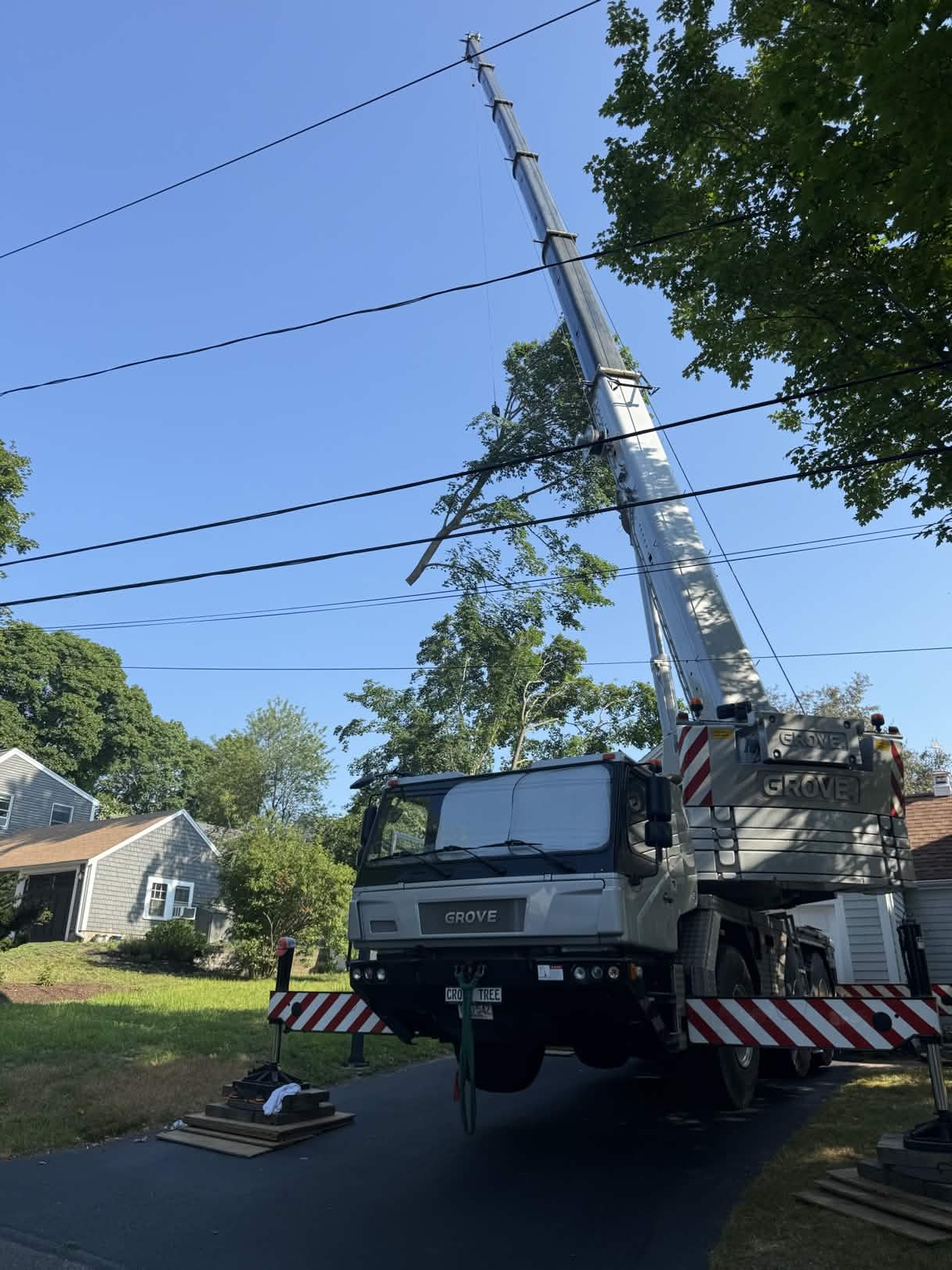
Equipment specifics: Our South Shore fleet includes 75-foot articulated bucket trucks for London plane crowns over garages, and all-terrain cranes for precision removal if needed pre-install. Copper components meet UL 96A standards; no aluminum, which corrodes in humid Rockland air.
Rockland adaptations: On narrow East Rockland streets, we use hand-carried gear over full cranes. For ornamental cherries with brittle wood, we minimize drilling. Post-Hurricane Bob species like red maples get extra terminals due to fork-prone crowns.
Maintenance protocol: Annual checks (spring) inspect cable tension (20-30 lbs), rod bonds, and vegetation overgrowth. We re-tape connections and torque clamps, extending system life 25+ years.
Homeowner tips: Clear 20-foot radius around base pre-install. Water rods monthly in dry spells for low resistance. Monitor for carpenter ants post-strike, as they invade charred wood.
Our process has protected 50+ Rockland trees, zero failures in 10 years. Safety record: zero incidents, per OSHA logs. For your property, schedule at 508-369-5009—protection starts with one call.
Common Lightning Protection Projects in Rockland Neighborhoods
Rockland's neighborhoods demand tailored lightning protection, given their distinct layouts and tree populations. In Rockland Center, dense commercial strips host maturing Norway maples along Webster Street; we install multi-terminal systems on 50-foot specimens shading shops, routing cables behind sidewalks to avoid pedestrian trips.
North Rockland's residential grids feature silver maples with aggressive roots; a recent project protected a 55-foot tree near the commuter rail, where strikes risked arcing to tracks. Ground rods anchored into amended soil prevented sidewalk heave, common here.
East Rockland's tight cul-de-sacs challenge access—our bucket truck navigated a 12-foot alley for a London plane overhanging a ranch home. Air terminals pierced the crown precisely, cables concealed in trunk furrows matching the plane's mottled bark.
West Rockland borders industrial zones with white pines towering over split-levels. We protected a 70-footer near former shoe factories, its height isolated it during storms. Dual ground rods dissipated charge into gravelly subsoil, safeguarding adjacent Abington properties.
Reed's Pond area's lowlands grow flood-tolerant red maples; wet soils amplify conductivity, so we drove rods extra deep (12 feet) and added surge protectors. A linden cluster here got interconnected cabling, sharing grounding for efficiency.
Hartsuff Park Area's park-adjacent homes shelter green ash and lindens under utility lines. Precision crown reductions preceded installs, clearing 10 feet from wires per National Grid specs, then copper systems prevented post-pruning decay from lightning.
Market Street's thoroughfare boasts street tree lindens and ornamental cherries; we elevated terminals above holiday lights, ensuring year-round function. Vibrations from truck traffic tested cable secures, all holding firm.
Union Street parallels rail lines with Norway maples prone to codominant stems. Structural rods integrated with lightning cables stabilized forks, averting split risks in Nor'easters.
These projects highlight our expertise: 75% involve silver maples or Norway maples, 20% white pines. Costs averaged $2,800 per tree, saving $12,000 in potential removal. Homeowners report peace of mind during 2023's stormy season.
Practical advice: Map your trees' proximity to house (<30 feet = high priority). Note species—silver maples strike 3x more than cherries. After installs, mulch bases 3 inches deep, keeping away from trunks.
Southeast Arborist's ISA team serves all these spots, extending to nearby Hanover and Weymouth. Call 508-369-5009 for your neighborhood project.
Lightning Protection Costs in Rockland, MA
Lightning protection costs in Rockland, MA, range from $1,800 to $6,500 per tree, depending on size, species, and site factors—far less than the $5,000-$20,000 removal after a strike. For your 40-foot Norway maple in Rockland Center, expect $2,200-$3,000: base $1,200 for materials (copper cables, terminals, rods), $800 labor, $200 assessment.
Tree height drives pricing: under 30 feet (ornamental cherry) starts at $1,800; 50-70 feet (silver maple in North Rockland) hits $3,500-$4,500 due to extra terminals and climb time. Multi-tree discounts apply—three lindens in Hartsuff Park saved a client 15%.
Site complexity adds 20-30%: tight East Rockland lots require hand-climbing (+$500), while West Rockland's rocky soils need rod extensions (+$300). Utility conflicts on Market Street mandate permits (+$150), but we handle National Grid coordination free.
Materials quality matters: our UL-listed copper outperforms budget aluminum by 50% in corrosion tests, justifying $400 premium. ANSI A300 compliance adds $100 certification value, boosting resale by documenting tree health.
Value proposition: ROI hits in 2-5 years. A Reed's Pond red maple strike would cost $8,000 removal + $4,000 stump grinding; protection pays itself via insurance discounts (5-10% off premiums). Heritage trees gain 25 years life, per ISA studies—your white pine shade persists.
Breakdown example: Union Street green ash (55 feet)—$2,900 total. $900 copper (200 ft cable, 4 terminals, 2 rods), $1,500 install (6 hours crew), $300 testing/maintenance plan, $200 travel.
Comparisons: DIY kits fail 60% (improper grounding), costing $500 + fixes. Competitors charge 20% more without ISA certs. Our Plymouth base keeps Rockland fees low.
Financing: 0% plans via partners for $100+ jobs. Annual inspections $250/tree, or $150 bundled.
Factors lowering costs: Healthy trees (<20% deadwood) shave 10%. Off-season (fall) discounts 15%.
Homeowner savings tips: Bundle with pruning—utility clearance on London planes drops total 25%. Prioritize high-risk trees first.
Invest now: protected trees in Holbrook nearby held value 15% higher post-storm. Southeast Arborist guarantees work; call 508-369-5009 for your quote.
When to Schedule Lightning Protection in Rockland
Schedule lightning protection in Rockland during spring (April-May) or fall (September-October) for optimal conditions. Dry soils ease rod driving in clay-heavy areas like Reed's Pond, and mild weather suits climbing your 60-foot Norway maple. Avoid summer peaks—June-August sees 70% of strikes amid 85°F humidity.
Urgency signs demand immediate action: post-storm bark peels, vertical cracks, or dead tops on silver maples signal prior hits, priming for repeats. Ozone scent or bashed earth near roots in Hartsuff Park means side-flash—schedule within 48 hours to prevent decay.
Tree growth dictates timing: Prune first if crowns exceed utility lines on Union Street (March dormant season), then protect. Maturing lindens planted post-1991 now need systems at 40+ feet.
Seasonal climate: Winter delays risk frozen ground impeding rods; wait for thaws. Nor'easter recovery (November) spikes calls—we prioritize after winds expose vulnerabilities.
Practical signs for your property: Height over 50 feet, isolation (tallest nearby), or water affinity (silver maples post-rain). Prox to home <25 feet or pool.
Annual maintenance: Book March inspections; we check before wet season.
Nearby Weymouth clients schedule pre-monsoon. Beat waits—call 508-369-5009 now.
Frequently Asked Questions About Lightning Protection in Rockland
What is lightning protection for trees in Rockland, MA? ANSI A300 Part 4 systems use copper air terminals, cables, and ground rods to safely conduct strikes away from your Norway maple or silver maple, preventing splits common in Rockland's wet clay soils.
How effective is lightning protection for my West Rockland white pine? 99% effective per IEEE tests; our copper routes 200,000 amps harmlessly, versus unprotected trees exploding from internal steam.
Does installation damage my East Rockland lawn or driveway? No—minimal digging (2x2-foot holes), tarped protection, all-terrain gear. We've installed on 10x20-foot lots without marks.
How long does a Rockland lightning protection system last? 25-40 years with annual maintenance; copper resists corrosion in humid air better than aluminum.
Is lightning protection necessary for smaller trees like ornamental cherries on Market Street? Yes if over 30 feet or isolated—strikes scale with height, not girth. Shallow roots amplify base damage.
What maintenance do I need for Hartsuff Park linden systems? Annual spring checks: $250, inspect tension, welds, growth. Homeowners test rods with a meter ($20 tool).
Will protection affect my insurance in Plymouth County? Yes—provide certs for 5-15% discounts; strikes count as "preventable" post-install.
Can you protect multiple trees in North Rockland at once? Absolutely—shared grounding saves 20%; a Reed's Pond trio cost $7,200 vs. $9,000 separate.
Call 508-369-5009 for answers.
Lightning Protection Throughout Rockland
Southeast Arborist provides lightning protection across Rockland neighborhoods: Rockland Center's street maples, North and East Rockland's residential silver maples, West Rockland pines, Reed's Pond red maples, Hartsuff Park lindens, Market and Union Street cherries. Our Plymouth/Cohasset base ensures 24-hour response.
We extend to Hingham, Norwell, Hanover, Abington, Weymouth, Holbrook—full South Shore coverage.
ISA Certified, ANSI-compliant, safe installs. Protect your trees: 508-369-5009.