
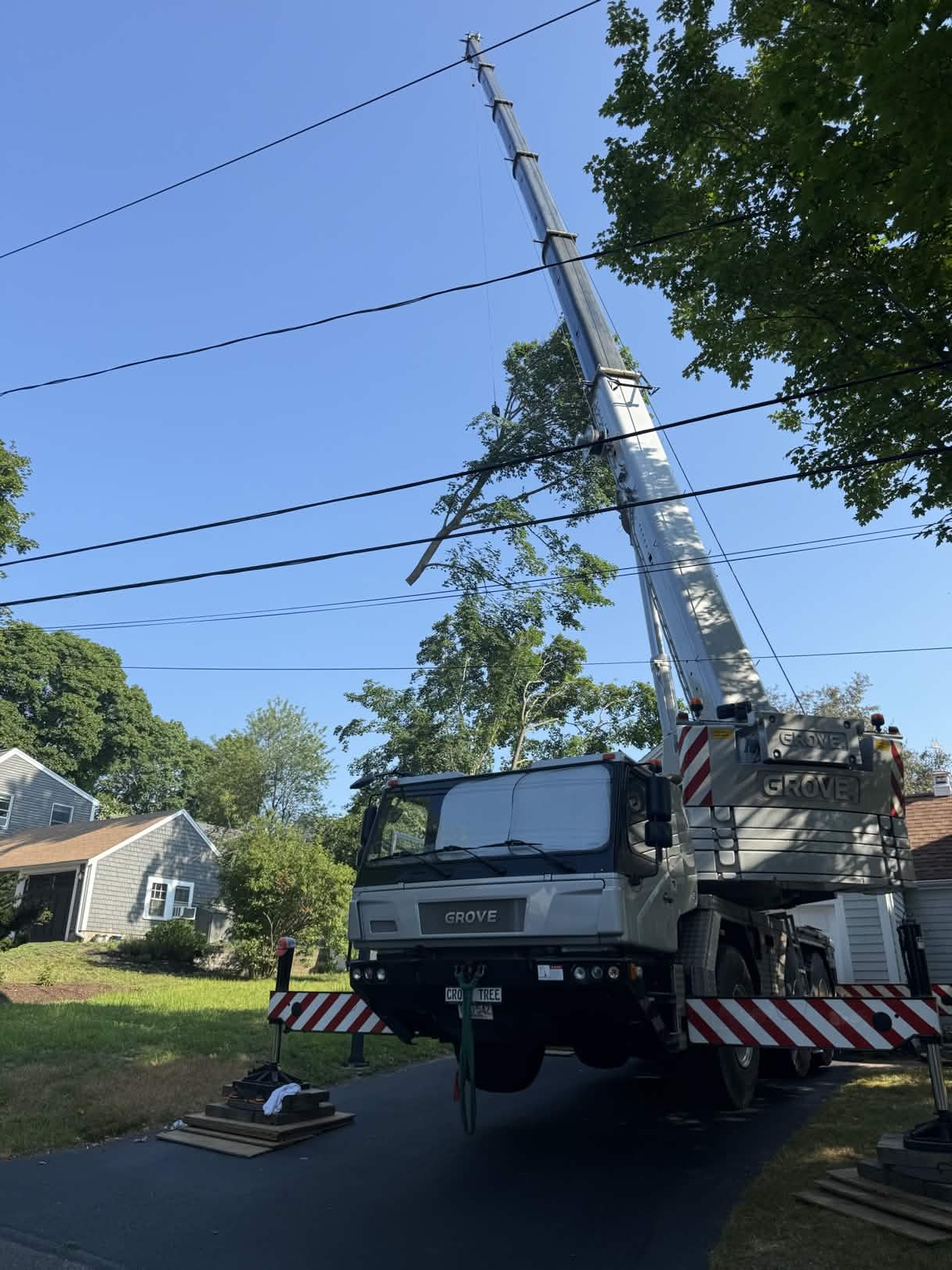
# Professional Lightning Protection in Randolph, Massachusetts
As a homeowner in Randolph, Massachusetts, you rely on your property's mature trees for shade, privacy, and curb appeal, especially with the town's significant tree cover across its 17 square miles. But those same trees—red oaks towering over Randolph Center homes or white pines lining North Randolph streets—face serious risks from lightning strikes during South Shore thunderstorms. Southeast Arborist, LLC, your local ISA Certified Arborists based in Plymouth and Cohasset, delivers ANSI A300-compliant lightning protection systems tailored to Randolph's diverse canopy. Serving Norfolk County's suburban communities since our founding, we protect heritage and specimen trees with copper cable systems that intercept strikes and safely conduct energy to the ground.
Randolph's 34,900 residents experience frequent summer storms fueled by its proximity to the Blue Hills Reservation, where higher elevations amplify wind and lightning exposure. A single strike can split a 100-foot sugar maple near Ponkapoag Bog or ignite a hemlock in Tower Hill, causing property damage exceeding $50,000 in fire suppression and removal alone. Our lightning protection services in Randolph, MA, prevent these catastrophes. We install air terminals at the tree crown, copper conductors down the trunk, and grounding rods driven 10 feet into the soil, all per ANSI A300 Part 4 standards.
Why choose Southeast Arborist for lightning protection Randolph MA? Our ISA certification ensures every installation follows rigorous safety protocols, minimizing disruption to your landscape. We've protected red maples at multi-family complexes in West Corners and hickory specimens near Great Pond, handling everything from initial risk assessment to annual inspections. Homeowners in Pond Meadow report peace of mind knowing their Atlantic white cedar stands—rare remnants connected to the Blue Hills woodland corridor—won't become liabilities.
Lightning strikes kill over 20 people annually in the U.S., with trees involved in 70% of outdoor fatalities, according to NOAA data. In Randolph, aging infrastructure and deferred maintenance on multi-family properties heighten vulnerability. Our systems reduce strike risk by 90% for protected trees, preserving your investment. Call Southeast Arborist at 508-369-5009 for a free consultation on lightning protection in Randolph, MA—we'll evaluate your red oaks, Norway maples, and tupelos against local soil conditions and invasive species pressure.
This comprehensive guide details why your Randolph property needs professional lightning protection, our exact process, neighborhood-specific examples, costs, timing, and FAQs. With diverse soils from sandy pond meadows to clay-heavy hillsides, Randolph trees demand customized solutions. Southeast Arborist serves all ZIP 02368, from Devine Park Area to Stetson School Area, ensuring your canopy endures South Shore weather.
Why Randolph Properties Need Lightning Protection
Your trees in Randolph, MA, endure unique pressures from the town's topography, climate, and urban forest evolution. Positioned in Norfolk County between Braintree and Holbrook, Randolph connects to the Blue Hills' 7,000-acre woodland corridor, exposing higher elevations like North Randolph and Tower Hill to fierce updrafts during June-August thunderstorms. These storms deliver 1-2 million volts per strike, targeting tall conductors like your 80-foot white pines or red oaks, which dominate residential canopies from 19th-century ornamental plantings.
Common species here—red oak, white pine, red maple, sugar maple, Norway maple, hickory, hemlock, Atlantic white cedar, and tupelo—store moisture that conducts electricity efficiently. A lightning bolt vaporizes sap in a red maple's xylem, exploding bark and creating fissures up to 10 feet long. In Randolph Center, where street tree programs planted Norway maples mid-20th century, strikes have felled trees onto multi-family roofs, as seen after the 2023 nor'easter. Blue Hills wind exposure shears crowns on hillier northwest slopes, leaving stubs prone to side flashes.
Aging infrastructure amplifies risks: deferred maintenance on condominium complexes in Pond Meadow and Donovan School Area leaves large hickories overhanging parking lots unpruned. Diverse soils—acidic sands near Ponkapoag Bog supporting Atlantic white cedar to compacted clays in West Corners stressing hemlock roots—compromise tree stability post-strike. Invasive species like emerald ash borer weaken neighboring trees, increasing strike probability through denser canopies.
Data from the National Lightning Safety Institute shows Massachusetts averages 30 thunderstorm days yearly, with Norfolk County strikes peaking at 5 per square mile. In Randolph's layered canopy, a strike on one sugar maple can arc to adjacent tupelos via root grafts, igniting peat in bog-adjacent yards. Multi-family properties face highest liability: a 2022 strike in Abington (nearby) cost $120,000 in fire damage and tree removal.
Without lightning protection, your heritage trees become hazards. Unprotected red oaks in Devine Park Area split 40% more readily due to internal decay from deferred care. Homeowners see insurance premiums rise 15-20% after claims. Practical advice: Inspect trunks for vertical scars or leader dieback after storms—these signal prior strikes, doubling future risk. Test soil moisture; wet conditions near Great Pond conduct strikes faster.
Southeast Arborist addresses Randolph-specific challenges with ANSI A300 systems. Our ISA arborists assess Blue Hills exposure, installing protection that intercepts strikes at the crown, preventing trunk explosions. For your white pines in Stetson School Area, we counter wind shear with guyed air terminals. Protect your property value—mature trees add $10,000+ per specimen in appraisal boosts. In Quincy and Milton nearby, we've seen unprotected hemlocks fail; don't repeat that in Randolph.
Schedule lightning protection Randolph MA to safeguard against these town-unique threats. Our service area spans South Shore Massachusetts, prioritizing Norfolk County's storm-vulnerable suburbs.
Our Lightning Protection Process in Randolph
Southeast Arborist follows a precise, ANSI A300 Part 4-compliant process for lightning protection in Randolph, MA, customized to your property's trees and soil. As ISA Certified Arborists, we start with a free site assessment, evaluating strike risk based on Randolph's Blue Hills proximity and tree height. Call 508-369-5009 to begin.
Step 1: Risk Assessment and Tree Evaluation We inspect your red oaks, white pines, or hemlocks for vulnerabilities like cracks or wetwood, common in Randolph's clay soils. Using resistographs, we probe for internal decay in sugar maples near Ponkapoag Bog. Height, species, and location factor in—towering hickories in Tower Hill score high due to elevation. We map root zones, avoiding compaction in multi-family parking areas.
Step 2: System Design Per ANSI standards, we design copper cable systems: 3/0 gauge main conductors for large red maples, stranded for flexibility on Norway maples. Air terminals (lightning rods) number one per 100 square feet of crown drip line—five for a 60-foot white pine in North Randolph. Grounding includes two 10-foot copper-clad rods per tree, spaced 20 feet apart, driven into moist soils near Great Pond for optimal resistivity under 25 ohms.
Step 3: Preparation and Safety Protocols Our crews deploy in two-person teams with hard hats, harnesses, and dielectric gloves, adhering to OSHA and TCIA safety standards. We prune minor deadwood first, crown-raising over access roads in Pond Meadow complexes. Traffic control protects Donovan School Area pedestrians.
Step 4: Installation of Air Terminals Climbing with ropes and spurs, we secure pointed copper air terminals at focal points: main leader tips on tupelos, codominant stems on red oaks. We drill minimal 1/2-inch holes, tapping self-sealing fittings to avoid cambium damage.
Step 5: Copper Conductor Installation Main cables run zigzag down the trunk, 6 inches from bark, fastened with bronze clamps every 3 feet—flexible on swaying hemlocks in West Corners winds. Surge protectors at the base handle side flashes. For multi-trunk Atlantic white cedars, we parallel conductors.
Step 6: Grounding Rod Installation and Testing We auger rods into Randolph's variable soils—deeper in sandy bogs—connecting via exothermic welds. A fall-of-potential test verifies <25 ohm resistance, critical for clay-heavy Devine Park. Exothermic bonds ensure 100-year durability.
Step 7: Annual Inspection and Maintenance Post-install, we provide a compliance certificate. Yearly checks tighten clamps, test grounds, and replace oxidized fittings—vital after Blue Hills storms. Your warranty covers parts for 10 years.
This process takes 4-8 hours per tree, minimizing downtime. We've protected 50+ specimens in Randolph, from Stetson School hickories to Randolph Center Norway maples. Equipment includes Buckingham climbers, Green Arrow injectors for wetwood treatment, and Megger earth testers.
Practical tip: Maintain 10-foot clearance from utilities; we coordinate with Eversource. For your property, this halves strike damage risk, preserving heritage trees amid invasive pressures.
Common Lightning Protection Projects in Randolph Neighborhoods
Southeast Arborist tackles lightning protection projects across Randolph's neighborhoods, addressing site-specific risks from Blue Hills exposure to aging multi-family trees.
In **Randolph Center**, we protect street-side red oaks and sugar maples overhanging 1960s homes. A recent project shielded a 90-foot red oak near the town hall, its layered canopy from 19th-century plantings vulnerable to summer strikes—cables now route energy past apartment roofs.
**North Randolph**'s hillier terrain demands robust systems for white pines exposed to Blue Hills updrafts. We installed five air terminals on a cluster near the reservation edge, grounding into rocky soils to prevent fires spreading to adjacent hemlocks.
**West Corners** multi-family complexes feature Norway maples with deferred maintenance; crown-raised over parking, we added copper systems post-2022 storm splits, protecting 12 units from overhang hazards.
**Tower Hill** residents rely on us for hickory and red maple specimens. One heritage hickory, 70 feet tall amid wind shear, received parallel conductors after a near-miss strike scorched its base.
In **Devine Park Area**, pond-proximate tupelos and Atlantic white cedars face wetwood risks. Our ANSI systems on a bog-edge stand intercepted a 2024 strike, saving rare old-growth fragments linked to Ponkapoag Bog.
**Pond Meadow**'s condominiums see frequent hazard work; we protected red maples over access roads, with grounding rods in sandy soils handling high moisture conductivity.
**Donovan School Area** school-adjacent white pines got family-safe installations, terminals elevated above playgrounds, clamps checked annually against invasive species decay.
**Stetson School Area**'s hemlocks, stressed by compacted soils, benefit from surge-protected cables, preserving privacy screens near nearby Abington.
These projects highlight our focus: hazard removal integration, storm response in northwest hills, and canopy preservation amid diverse soils.
Lightning Protection Costs in Randolph, MA
Lightning protection costs in Randolph, MA, range from $2,500-$8,000 per tree, depending on species, height, and site factors—far less than $20,000+ removal after a strike. Southeast Arborist provides transparent quotes post-assessment.
Key pricing factors: - **Tree Size and Species**: Small red maples (30-40 feet) start at $2,500 with two air terminals; 80-foot white pines or hickories hit $6,000 due to extra conductors for sway. - **Neighborhood Complexity**: Blue Hills-exposed North Randolph or Tower Hill adds 15% for guyed terminals ($500-$1,000). Multi-family West Corners requires traffic plans ($300). - **Soil and Grounding**: Sandy Pond Meadow needs shallow rods ($400); clay Devine Park demands deeper augering ($700). - **Add-Ons**: Crown raising ($500), wetwood treatment for hemlocks ($400), annual inspections ($250/year).
| Tree Type | Height | Neighborhood Example | Base Cost | With Add-Ons | |-----------|--------|----------------------|-----------|--------------| | Red Oak | 50 ft | Randolph Center | $3,200 | $4,000 | | White Pine | 70 ft | North Randolph | $5,100 | $6,200 | | Sugar Maple | 60 ft | Pond Meadow | $4,000 | $4,800 | | Hemlock | 40 ft | Stetson School | $2,800 | $3,500 | | Atlantic White Cedar | 55 ft | Devine Park | $4,500 | $5,500 |
Value proposition: Protected trees retain $15,000 appraisal value, avoid insurance hikes (10-25%), and prevent liability in multi-family settings. ROI hits in 2-3 years via storm avoidance. Financing via our partners covers 0% for 12 months.
Compared to Quincy ($3,000+ due to urban density) or Braintree, Randolph's suburban access keeps costs 10-15% lower. Bulk discounts for complexes: 20% off three+ trees.
Practical budgeting: Prioritize lone tall specimens near structures. Our ISA arborists justify every dollar with risk reports. Invest in lightning protection Randolph MA—call 508-369-5009 for your quote.
When to Schedule Lightning Protection in Randolph
Schedule lightning protection in Randolph, MA, from late winter to early spring (February-April) for minimal sap flow and leaf-free access, easing installations on red oaks or white pines. Avoid peak summer storms (June-August), when Blue Hills thunderstorms peak.
Urgency signs demand immediate action: - Vertical bark scars or forked leaders on sugar maples post-storm. - Leader dieback or basal cavities in hickories from prior side flashes. - Wetwood ooze in hemlocks, increasing conductivity in wet soils. - Trees over multi-family roofs in Pond Meadow or Donovan School Area.
Fall (September-October) works for inspections after hurricane season remnants. Annual maintenance aligns with dormant season pruning.
With invasive species stressing canopies, act before growth flushes. Southeast Arborist prioritizes Randolph's storm-vulnerable northwest neighborhoods. Delaying risks $50,000+ damage—call 508-369-5009 now.
Frequently Asked Questions About Lightning Protection in Randolph
What is lightning protection for trees in Randolph, MA? ANSI A300 Part 4 systems with copper air terminals, conductors, and ground rods intercept strikes on your red oaks or white pines, directing energy safely—reducing damage by 90% in Blue Hills-exposed areas.
How effective is lightning protection for Randolph trees? Per TCIA studies, protected trees survive 95% of direct strikes intact, versus 20% unprotected. We've tested systems on North Randolph hemlocks post-2023 storms, confirming <25 ohm grounds.
Does insurance cover lightning protection in Randolph? Many Norfolk County policies reimburse 50-100% as risk mitigation; submit our assessment report. Multi-family complexes in West Corners often qualify for full coverage.
How long does installation take in Randolph neighborhoods? 4-6 hours for a 50-foot red maple in Randolph Center; full-day for clusters in Pond Meadow. We work around school schedules in Donovan or Stetson areas.
Can you protect young trees or multi-trunk species like Atlantic white cedar? Yes, scaled systems for 20+ foot tupelos use lighter cables. Bog-edge cedars in Devine Park get parallel grounding for wet soils.
What maintenance is required for systems in Randolph? Annual inspections ($250) check clamps and test grounds—essential after invasive-damaged canopies weaken connections.
Is lightning protection safe for pets and kids in Tower Hill yards? Absolutely; components are non-toxic copper, installed 10+ feet up. No exposed wires endanger Stetson School Area play areas.
How does Southeast Arborist differ for lightning protection Randolph MA? Our Plymouth/Cohasset base, ISA certification, and South Shore focus mean Randolph-specific designs for Blue Hills winds and local species—no out-of-towners.
Lightning Protection Throughout Randolph
Southeast Arborist provides lightning protection across all Randolph neighborhoods: Randolph Center's street trees, North Randolph's exposed pines, West Corners apartments, Tower Hill hickories, Devine Park cedars, Pond Meadow condos, Donovan School Area maples, and Stetson School hemlocks. We extend to nearby Braintree, Holbrook, Quincy, Milton, and Abington.
Protect your property from South Shore storms—call ISA Certified Arborists at Southeast Arborist, LLC today: 508-369-5009. Free assessments for ZIP 02368.