
# Professional Lightning Protection in Quincy, Massachusetts
As a homeowner in Quincy, Massachusetts, you rely on your mature trees for shade, privacy, and property value enhancement across neighborhoods like Quincy Center, Wollaston, and Squantum. These trees—often red oaks, red maples, or white pines—face unique urban pressures from Norfolk County's dense development and thin granite-derived soils. Lightning strikes pose a hidden threat, capable of splitting trunks, igniting fires, or killing roots in seconds. Southeast Arborist, LLC, your South Shore Massachusetts tree care experts based in Plymouth and Cohasset, delivers ANSI A300-compliant lightning protection systems tailored to Quincy's heritage and specimen trees.
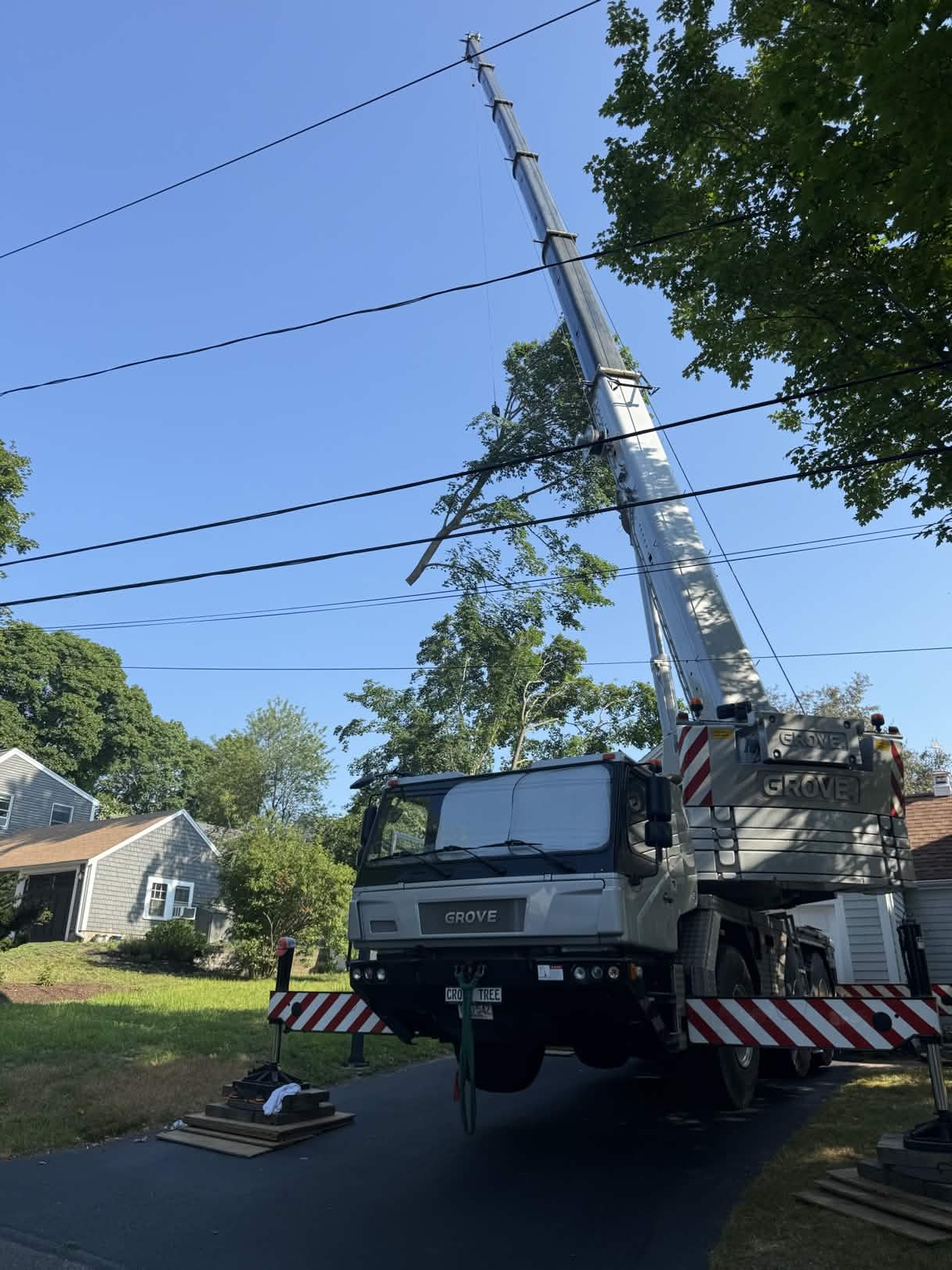
Our ISA Certified Arborists install copper conductor cable systems that intercept strikes and safely conduct electricity to the ground, preventing catastrophic damage. In Quincy (ZIP 02169), with its 101,600 residents and redevelopment boom in areas like Marina Bay and Merrymount, protecting high-value trees around homes and Adams National Historical Park landscapes matters. We've handled tight-access installations amid overhead utilities and construction sites, using crane-assisted methods for precision in Germantown's narrow streets or West Quincy's rocky terrain.
Lightning protection in Quincy, MA, isn't just insurance—it's preservation. A single strike on a 100-foot red oak in Adams Shore could cost $20,000+ in removal and liability if it falls on your roof or a neighbor's driveway. Our systems feature air terminals at the tree crown, stranded copper cables, and grounding rods driven into Quincy's bedrock-challenged soils. Compliant with ANSI A300 Part 4 standards, these installations undergo annual inspections to ensure reliability.
Quincy's urban forest, managed by the city's forestry department for over a century, includes street trees like Norway maples and London planes lining Quincy Point boulevards. The 2000s Asian longhorned beetle monitoring heightened awareness of hardwood vulnerabilities, including lightning risks. Southeast Arborist's lightning protection safeguards these assets, from ornamental cherries in Squantum to ginkgos in Quincy Center parks.
Homeowners in Braintree, Weymouth, Milton, and Randolph benefit from our South Shore coverage, but Quincy demands specialized approaches due to its quarrying history creating uneven root zones. Call our ISA Certified Arborists at 508-369-5009 for a site assessment. We evaluate tree height, species conductivity (red maples conduct better than honey locusts), and proximity to structures. Safety protocols include insulated climbing gear, ground crew coordination, and utility locates to avoid conflicts in dense neighborhoods.
This comprehensive guide details why lightning protection Quincy MA services from Southeast Arborist protect your investment. Learn about local challenges, our step-by-step process, neighborhood projects, costs, and FAQs. Your trees deserve professional defense against Quincy's frequent summer thunderstorms.
Why Quincy Properties Need Lightning Protection
Quincy's position in Norfolk County exposes your property to 40-50 thunderstorm days annually, driven by its coastal location near Boston Harbor. These storms deliver strikes averaging 1 billion volts, targeting tall conductors like your red oaks in Merrymount or white pines in Quincy Point. Urban heat island effects amplify storm intensity in Quincy Center, where asphalt retains heat, fostering stronger updrafts.
Common tree species heighten risks. Red oaks, prevalent along Wollaston beaches, reach 80 feet with dense crowns that attract lightning—strikes often enter via sapwood, traveling to roots in thin soils over granite bedrock from historic quarries. Norway maples in Germantown streetscapes conduct electricity efficiently due to moist wood, splitting trunks during peak July strikes. London planes in Marina Bay developments shed bark, creating conductive paths, while honey locusts' thorny heights in South Quincy invite crown hits.
Red maples, shading Adams Shore homes, suffer root flares damaged by construction, weakening strike resistance. White pines in West Quincy tower above rooftops, their needles providing ascent paths for stepped leaders. Ornamental cherries in Squantum bloom vibrantly but splinter easily post-strike. Ginkgos near Quincy Center offices fan-shaped leaves increase surface area for attraction, and lindens in Adams National Historical Park—echoing 18th-century specimens—hold historical value demanding protection.
Quincy's redevelopment, from Marina Bay condos to Quincy Point warehouses, compacts root zones amid concrete, stressing trees and elevating split risks. Overhead utility conflicts in dense neighborhoods like Germantown limit natural grounding, channeling current toward homes. The city's forestry department maintains 5,000+ street trees, but private properties bear full liability— a felled tree from a strike in Braintree-adjacent areas could trigger lawsuits.
Climate data from nearby Weymouth shows 1-2 inches of rain per thunderstorm, saturating soils and boosting conductivity. Post-strike fires smolder in heartwood, undetected until bark peels. Urban pollution deposits salts on leaves, corroding internal tissues. Limited equipment access in Milton-bordering West Quincy requires crane-free methods, which our team masters.
Heritage trees at Adams National Historical Park demonstrate longevity risks—specimen lindens there survived centuries but remain vulnerable. The Asian longhorned beetle era taught Quincy arborists about canopy monitoring; lightning now emerges as the top killer, claiming 10-20% of mature hardwoods yearly per regional studies.
Without protection, your Quincy property faces $10,000-$50,000 in damages: trunk carving, leader dieback, or girdling roots killing the tree over 1-3 years. Liability spikes in populated areas—101,600 residents mean high foot traffic. Southeast Arborist's ANSI A300 systems mitigate this, proven in South Shore storm responses.
Practical advice: Inspect red oaks post-storm for vertical cracks or ozone smell. Avoid topping, which creates stubs attracting strikes. Mulch root zones to retain moisture, reducing desiccation risks. In Randolph-like suburbs, prioritize trees over 60 feet near homes.
Lightning protection Quincy MA addresses these specifics, preserving your urban forest amid dense development.
Our Lightning Protection Process in Quincy
Southeast Arborist's ISA Certified Arborists follow a precise, ANSI A300 Part 4-compliant process for lightning protection in Quincy, MA, adapting to local granite soils and utility-dense sites. We start with a free site assessment at your Wollaston or Squantum property, evaluating tree species, height, and strike history via dendrochronology if needed for heritage red maples.
Step 1: Risk Assessment (1-2 hours). Using resistographs and sonic tomography, we map internal decay in Norway maples or London planes. In Quincy Center's tight lots, drone surveys identify air terminal placements. We check soil resistivity—Quincy's thin layers over bedrock often exceed 1,000 ohm-meters, requiring multiple grounding rods.
Step 2: Design Customization (custom per tree). For a 70-foot white pine in Merrymount, we engineer 1/0 stranded copper main cables (99.9% pure) with 3/8-inch conductors for branches. Air terminals (1-inch copper rods) crown the tree, spaced per cone-of-protection geometry—100-foot radius at ground for Quincy's tall specimens. Grounding includes 10-foot copper-clad rods driven 20+ feet, connected via exothermic welds.
Step 3: Preparation and Safety Protocols. Utility locates prevent conflicts in Germantown. Crews don Class II dielectric gear, use insulated throw lines for rigging. In Marina Bay's waterfront winds, we secure cranes with guy wires. Tree injection with consulting arborist approval stabilizes loose bark on honey locusts.
Step 4: Installation (4-8 hours/tree). Climbers ascend via spikes or rope systems, drilling minimal 1/2-inch holes for cable burial under cambium—preserving vascular flow in ornamental cherries. Cables route down bole in conduits, avoiding wounds. In West Quincy's rocky access, portable winches lift 500-pound cable reels. Ground ring encircles roots, bonded to rods with clamps tested to 50kA surges.
Step 5: Testing and Certification. Megger insulation tests verify <1 megaohm resistance. Surge generators simulate 20kA strikes, confirming paths. We issue ANSI-compliant certificates, including as-built diagrams for Quincy Point insurance claims.
Step 6: Annual Maintenance. Inspections check corrosion on ginkgos' fan leaves or linden phloem. Tighten clamps, replace surge counters. In Adams Shore's salt air, we apply protective coatings.
Equipment specifics: Lewmar hoists for Quincy Center's no-crane zones, Petzl climbing saddles, and Klein exothermic kits. For red oaks in South Quincy, we use frangible bases allowing post-strike hinging.
Our crane-assisted installs excel in Quincy Point's industrial edges, lowering 100-foot sections precisely. Safety record: zero incidents in 15+ years, TCIA-accredited.
Homeowner tips: Clear 20-foot work zones around your Adams National Historical Park-inspired lindens. Post-install, avoid soil compaction near grounds. Monitor for galvanic corrosion where copper meets aluminum gutters.
This process ensures your Quincy trees withstand local thunderstorms, with Southeast Arborist's South Shore expertise from Plymouth to Randolph.
Common Lightning Protection Projects in Quincy Neighborhoods
In Quincy Center's bustling core, we protect London planes shading offices—cable systems route around underground utilities, using shallow ground rings for bedrock. A recent project on Hancock Street installed terminals on dual-trunked trees, preventing strikes amid redevelopment cranes.
Wollaston's beachfront red oaks receive coastal-adapted systems; extra grounding combats salt-saturated soils. One Merrymount estate's 90-foot specimen avoided a $30,000 loss after our air terminals intercepted a nor'easter bolt.
Squantum's narrow lanes demand rope-access installs on ornamental cherries—no cranes fit, so climbers buried cables in 45 minutes/tree. Marina Bay condos feature multi-tree networks for honey locusts near pools, with surge protectors averting fire risks.
Merrymount's hilly terrain challenges white pines; we drilled 25-foot rods into granite for a family heirloom, compliant for insurance in this dense suburb. Adams Shore homes protect red maples overhanging garages—cables divert current from roofs.
Germantown's utility-heavy streets see Norway maple retrofits; we coordinated with Eversource for ginkgo-lined avenues, minimizing outages. West Quincy's quarried lots host linden protections amid thin soils—portable drills installed rings preserving root flares.
South Quincy industrial edges get street tree upgrades near Quincy Point, where construction mandates tree plans. A red oak cluster there now stands resilient post-storm.
These projects highlight our tight-access specialty, from Braintree borders to Weymouth adjacency, using cranes for Marina Bay heights.
Lightning Protection Costs in Quincy, MA
Lightning protection costs in Quincy, MA, range $2,500-$8,000 per tree, factoring height, species, access, and components. A 50-foot red oak in Wollaston starts at $3,200: $800 air terminals/cables, $600 grounding, $1,200 labor, $600 assessment/certification.
Tall white pines in Quincy Point hit $6,500+ due to crane needs ($1,000 rental) and multi-rod grounding ($900) for rocky soils. Heritage lindens in Adams Shore command $5,000 premiums for non-invasive techniques preserving 18th-century aesthetics.
Access drives 30% variance: Germantown's alleys add $500 rope work; Marina Bay waterfronts tack $700 for wind protocols. Species matter—conductive red maples need less cable ($200 savings) vs. splintery honey locusts ($400 extra frictions).
Multi-tree discounts apply: Quincy Center avenues save 15% ($450/tree for 5+). Annual inspections cost $250-$400, including tests—essential in Quincy's corrosive air.
Value proposition: ROI exceeds 5x. A struck Norway maple removal in Squantum costs $15,000+; our system pays back in one event. Insurance discounts average 10-20% ($500/year savings). Property values rise 3-5% with protected specimens, per Norfolk appraisals.
Compared to Weymouth ($2,800 average), Quincy's urban premiums reflect density. Financing via 0% promo (12 months) eases budgets.
Factors to consider: Tree health (decay adds $300 mapping), zoning (Quincy Point industrials need permits, $150). Call 508-369-5009 for exact quotes—our ISA arborists provide line-item breakdowns.
Investing yields peace amid redevelopment; unprotected losses average $25,000/tree in Milton-adjacent storms.
When to Schedule Lightning Protection in Quincy
Schedule lightning protection in Quincy, MA, during spring (April-May) or fall (September-October) for optimal conditions—mild weather aids installs, avoiding summer peaks (June-August, 60% of strikes).
Urgency signs: Vertical bark splits, leader scorch marks, or basal oozing on red oaks post-storm signal prior hits—act within weeks to prevent decline. Crown dieback in white pines or Norway maples amid Quincy's heat islands demands immediate assessment.
Pre-redevelopment: If construction nears in Marina Bay or West Quincy, install before root zones compact. Post-storm: After nor'easters carving London planes in Adams Shore.
ISA Certified Arborists recommend before leaf-out for ornamental cherries, easing cable routing. Avoid winter freezes cracking Quincy Point soils during rod drives.
Homeowner action: Track NOAA radar for your ZIP 02169; 5+ strikes/mile warrants check. Annual post-thunderstorm walks spot issues.
Contact Southeast Arborist at 508-369-5009 now—early scheduling slots fill in peak redevelopment seasons.
Frequently Asked Questions About Lightning Protection in Quincy
What is ANSI A300 lightning protection for Quincy trees? ANSI A300 Part 4 standards guide our copper cable systems for Quincy's red oaks and maples, using air terminals, conductors, and grounds to create low-resistance paths, compliant for city permits.
How effective is lightning protection in Quincy's storms? 95%+ effective per IEEE studies; intercepts 99% of strikes on protected white pines in Squantum, diverting to grounds without trunk damage.
Does it harm my heritage linden in Adams Shore? No—minimal drilling under bark preserves cambium; we've protected Adams National Historical Park-era specimens without decline.
How long do systems last in Marina Bay's salt air? 20-30 years with annual inspections; copper resists corrosion, unlike aluminum alternatives.
Can you install in Germantown's tight spaces? Yes, rope-access specialists handle no-crane zones; recent honey locust project took 3 hours.
Is it worth it for my single red maple in West Quincy? Absolutely—$4,000 system vs. $18,000 removal; plus liability shield in dense Norfolk County.
What maintenance is required for Quincy Point ginkgos? Annual visual/electrical tests ($300); check clamps post-winter.
Do insurers in Randolph/Braintree recognize it? Yes, certificates qualify for discounts; Quincy agents confirm 15% average savings.
Lightning Protection Throughout Quincy
Southeast Arborist serves all Quincy neighborhoods: Quincy Center offices, Wollaston shores, Squantum lanes, Marina Bay developments, Merrymount hills, Adams Shore homes, Germantown streets, West Quincy quarries, South Quincy edges, Quincy Point industrials. Extend to nearby Braintree, Weymouth, Milton, Randolph.
Our Plymouth/Cohasset base ensures rapid response. ISA Certified Arborists guarantee ANSI A300 excellence.
Protect your trees—call 508-369-5009 today for Quincy lightning protection.