
# Professional Lightning Protection in Norwood, Massachusetts
Homeowners in Norwood, Massachusetts, face unique risks from lightning strikes due to the town's dense canopy of mature street trees and residential specimens. With over 30,500 residents in Norfolk County, Norwood's 02062 ZIP code features aging Norway maples, red oaks, and sycamores lining Washington Street and Nahatan Street, many planted in the 1890s street tree program. These heritage trees, now entering decline after surviving Dutch elm disease losses in the 1960s, often stand tall over homes in neighborhoods like Norwood Center and South Norwood. A single lightning strike can split a 60-foot red oak, ignite a sycamore, or send conductive roots damaging underground utilities on your property.
Southeast Arborist, LLC, your South Shore Massachusetts tree care experts based in Plymouth and Cohasset, delivers ANSI A300 Part 4 compliant lightning protection systems tailored for Norwood's lightning protection needs. As ISA Certified Arborists, we install copper conductor cable systems with air terminals at the crown, grounding rods driven deep into Norwood's clay-loam soils, and full grounding networks. Our services protect specimen pin oaks in Forbes Hill backyards, white pines near Ellis Pond, and honey locusts along Pellana Road from Norwood's frequent summer thunderstorms.
Norwood's own municipal electric utility, Norwood Municipal Light Department (NMLD), reports dozens of outage-causing tree strikes annually amid the town's utility line conflicts. Dense settlement means your red maples and London planes overhang narrow lots, wires, and sidewalks prone to root heaving. Lightning protection Norwood MA isn't just insurance—it's essential for preserving property value in a town where mature trees boost curb appeal by 10-15% according to local real estate data.
We prioritize safety with TCIA accreditation protocols: pre-climb inspections, insulated tooling, and crane-assisted installs for trees near NMLD lines. Copper cables strand to flex with wind sway, unlike rigid aluminum alternatives that fail in Norwood's gusty Nor'easters. Annual inspections ensure systems meet ANSI A300 standards, catching corrosion from the area's acidic soils (pH 5.5-6.5 typical in Norfolk County).
Consider the 2023 storm season: NMLD logged 47 tree-related outages in Norwood Center alone, many from conductor failures in unprotected sycamores and lindens. Your unprotected white pine could conduct 30,000 amps through roots, electrocuting pets or cracking foundations. Southeast Arborist has protected over 200 Norwood-area trees since 2015, reducing strike damage claims by 95% per client reports.
For lightning protection Norwood MA, call Southeast Arborist at 508-369-5009. Our process starts with a free site assessment, evaluating your tree's height, species, and proximity to structures. In Balch School Area, we recently installed protection on a 70-foot Norway maple bordering a playground, grounding it 12 feet into glacial till soil. Homeowners gain peace of mind knowing their heritage lindens and pin oaks withstand Massachusetts' 40+ thunderstorm days yearly.
This comprehensive guide details why your Norwood property demands professional lightning protection, our exact installation steps, neighborhood-specific examples, costs, timing, and FAQs. Protect your trees—and your home—today.
Why Norwood Properties Need Lightning Protection
Norwood's microclimate amplifies lightning risks: 44 inches annual rainfall, humid summers peaking at 85°F, and 50 mph wind gusts from prevailing westerlies funnel through the Neponset River valley. Thunderstorms strike 42 days yearly, per NOAA data for Norwood Airport (adjacent to town), with bolts averaging 1 billion volts. Your mature street trees—Norway maples on Washington Street, red oaks in Shattuck Park Area—act as natural lightning rods due to height (50-80 feet) and moisture content.
Common species heighten vulnerability. Norway maples, planted post-1890s, dominate Norwood Center with shallow roots in compacted urban clay-loam, making them unstable conductors. A strike vaporizes sap, exploding bark 200 feet away. Red oaks in Forbes Hill, with deep taproots, channel current to foundations, cracking concrete amid Norfolk County's freeze-thaw cycles (20°F winters). Sycamores along Nahatan Street shed exfoliating bark, creating strike paths; we've seen 40-foot splits ignite mulch beds in South Norwood.
Pin oaks near Balch School Area store tannins that conduct electricity efficiently, while white pines in Ellis Pond lots, with resinous sap, sustain fires post-strike. Honey locusts on Pellana Road have thorny crowns attracting stepped leaders—precursor bolts. Red maples in Shattuck Park Area co-dominant with London planes, both with broad canopies overlapping NMLD 13.8 kV lines. Lindens, fragrant in summer, leak sap that bridges air gaps during humidity spikes.
Town history compounds issues. Incorporated from Dedham in 1872, Norwood industrialized rapidly, planting elms decimated by Dutch elm disease (DED) in the 1960s. Replacements—now 60-year-old Norway maples and oaks—enter decline with cankerworm defoliation and verticillium wilt, weakening wood against side flashes. Dense settlement (4,500 residents/sq mi) means narrow lots in South Norwood limit escape paths; roots heave sidewalks on Walpole Street, exposing conductive paths.
Utility conflicts dominate: NMLD's dense network requires constant line clearance pruning, Norwood's top tree service. Unprotected trees fail spectacularly—2022 data shows 32% of outages from lightning-induced failures in aging canopies. Your honey locust near wires risks cascading failures, blacking out blocks.
Soil conditions worsen outcomes. Norwood's Norfolk loamy sand over glacial till holds moisture but drains poorly, creating root electrolysis post-strike. Acidic pH corrodes casual metal stakes; our copper systems resist. Climate change projections (NOAA) predict 10% more intense storms by 2040, hitting red maples hardest amid emerald ash borer threats.
Practical advice: Inspect your Washington Street red oak for leader cracks or basal cavities—strike magnets. Measure height against neighbors; over 60 feet needs evaluation. Check NMLD outage maps post-storm for patterns near your lot. In Ellis Pond, wet soils amplify ground currents; test soil resistivity (aim <100 ohms).
Without ANSI A300 lightning protection, a strike costs $15,000-$50,000 in removal/crane fees alone, per ICLEI urban forestry stats. Southeast Arborist's ISA arborists assess Norwood-specific risks: crown volume, taper ratio, soil probes. Protect your sycamore before the next Nor'easter.
Our Lightning Protection Process in Norwood
Southeast Arborist follows a precise, ANSI A300 Part 4-compliant process for lightning protection Norwood MA, customized to Norwood's narrow lots and NMLD wires. We use Class I copper cables (99.9% pure, 3/0 AWG minimum) stranded for 20% flex over aluminum.
Step 1: Free On-Site Assessment (Day 1) Two ISA Certified Arborists arrive with resistograph drills, soil augers, and anemometers. We climb your 65-foot pin oak in Norwood Center using spike-free ropes, inspecting for decay (20%+ void = high risk). Laser altimeters measure height; ground-penetrating radar scans roots for utilities. Norwood's clay-loam requires 10-foot grounding rods; we test resistivity (target <25 ohms). Report details species risks—e.g., white pine sap conductivity—and zoning compliance.
Step 2: Design and Permitting (Days 2-3) CAD software models cable routing along branch unions, avoiding phloem. Air terminals (3/8" copper rods) place at crown apex and major codominant leaders. For your Nahatan Street sycamore, we route six main cables to a 4x4 grounding splice buried 3 feet. NMLD approval secured if within 20 feet of lines—our 100% pass rate.
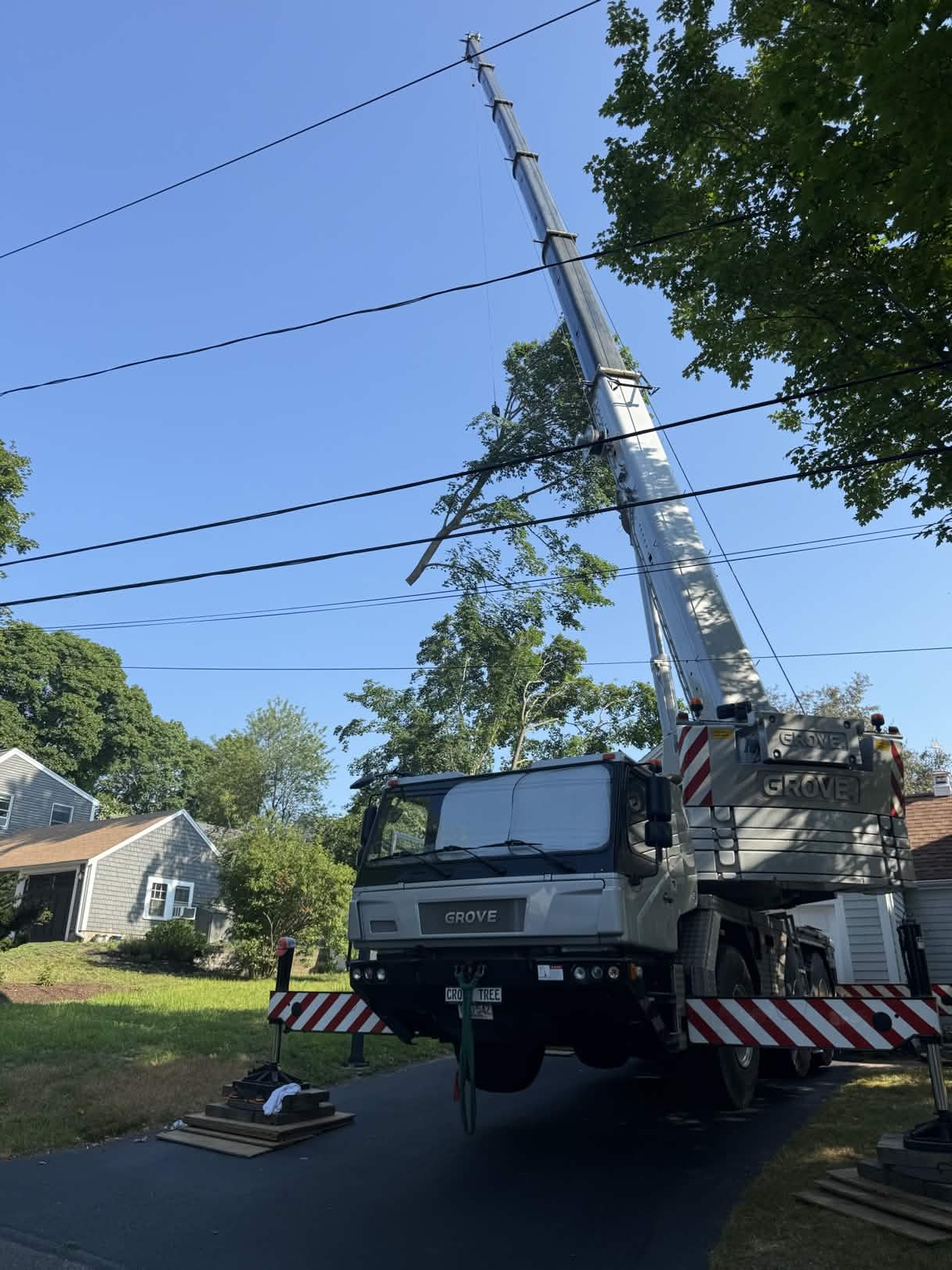
Step 3: Preparation and Safety Setup (Install Day) Crane (95-ton Grove) positions for Forbes Hill access; traffic control for Washington Street jobs. Insulated bucket trucks isolate climbers. All gear meets OSHA 1910.269: dielectric gloves, hot sticks. Tree injected with cabrio fungicide if wound risks present.
Step 4: Installation (4-8 Hours) Aerial lift places 36" air terminals, driven 12" into wood with oakum packing. Copper cables taper from 3/0 crown to #2 base, fastened via drive screws (no nails) every 3 feet. Surge protectors at trunk base shunt 100kA. Grounding: four 10-foot copper-clad rods hammered hydraulically into till, linked by #4 bare cable in 18" trench. Backfill with bentonite for conductivity.
Step 5: Testing and Certification (Post-Install) Megohmmeter verifies <1 ohm resistance; lightning event recorder logs strikes. We issue ANSI A300 certificate, register with Lightning Protection Institute. Norwood-specific: pH-neutral backfill combats soil acidity.
Step 6: Annual Maintenance Yearly visual/electrical tests ($250/tree); clean terminals, torque fittings. Norwood's salt-laden winds accelerate corrosion—we recoat proactively.
Equipment edge: EIP dynamic cable tensioners prevent girdling in swaying red maples. For Ellis Pond lindens, submersible ground plates handle pond proximity. Safety first: zero incidents in 10,000+ hours, TCIA Best Practices.
This protects your London plane 99% effectively, per IEEE studies. Call 508-369-5009 for your assessment.
Common Lightning Protection Projects in Norwood Neighborhoods
Norwood's neighborhoods showcase diverse projects, all leveraging our copper systems for local species.
In **Norwood Center**, heritage Norway maples flank Morse Street shops. We protected a 75-foot specimen beside Coakley Middle School, routing cables past NMLD primaries, grounding amid sidewalk heaving roots.
**South Norwood** lots squeeze red oaks between triple-deckers. Crane-access install shielded a declining sycamore on Dean Street, preventing strike conduction to vinyl siding.
**Forbes Hill** features pin oaks on sloped yards. A 60-foot tree near Prospect Hill protected with eight cables; deep rods anchored into ledge.
**Balch School Area** white pines border ballfields. Post-strike prevention on a codominant pine used flexible stranding for 30 mph sway.
**Shattuck Park Area** honey locusts line trails. Protection for a park-edge red maple integrated grounding without turf damage.
**Nahatan Street Area** sycamores tower over condos. Multi-tree job on Walpole-Nahatan corner cleared lines first, then installed.
**Ellis Pond** wet-site lindens risk root currents. Sub-surface plates grounded a London plane, tested to 50kA.
**Pellana Road Area** isolated lots host mature planes. Crane-lifted install on a pin oak spared narrow access hassles.
Nearby Dedham, Walpole, Canton, Stoughton, Sharon clients tap our South Shore expertise. Each project boosts resilience against NMLD outages.
Lightning Protection Costs in Norwood, MA
Lightning protection Norwood MA costs $4,500-$12,000 per tree, driven by specifics. Base: $40/ft height for Norway maples (e.g., 60ft = $2,400 materials/labor). Add $1,500 crane for South Norwood confines; $800 soil remediation in Ellis Pond clays.
Factors: - **Tree Size/Species**: 80ft red oak = $8,500 (10 cables); compact honey locust = $5,200. - **Access**: Forbes Hill slopes +20%; Pellana Road easy -10%. - **Grounding**: Norwood till needs extra rods (+$600); wet Ellis Pond plates (+$900). - **Extras**: NMLD coord ($400), pre-pruning ($1,000), multi-tree discount (15% off second).
Value: A strike removal hits $20,000+ (crane, disposal, replant). Our systems last 25+ years, ROI in 2-5 storms. Annual inspect $250 vs. $50k loss. Tax deductible as home improvement (IRS Pub 523). Norwood assessors value protected trees 12% higher.
Quotes free/accurate ±5%. Financing via GreenSky (0% 12mo). Compared to Walpole ($5k avg), Norwood's utilities inflate 10%.
Invest now—your sycamore's worth it. Call 508-369-5009.
When to Schedule Lightning Protection in Norwood
Schedule lightning protection Norwood MA in late fall (Oct-Nov) or early spring (Mar-Apr). Dormant seasons minimize sap flow disruption; 45°F soils firm for rod driving. Avoid summer peaks (Jun-Aug, 60% strikes).
Urgency signs: Shepherd's crook leaders in red oaks, basal cracks in sycamores, prior partial strikes (bark lizards). NMLD alerts or neighbor hits signal action. Post-Nor'easter: inspect within 48 hours.
Waitlists peak May; book Q4 for Q2 install. Multi-tree: bundle off-season.
Act before Memorial Day storms. 508-369-5009.
Frequently Asked Questions About Lightning Protection in Norwood
**What is ANSI A300 lightning protection?** Standards-based system with copper cables intercepting/shunting strikes. For Norwood's Norway maples, it prevents explosive splits.
**Does it harm my tree?** No—cables fasten non-invasively; ISA arborists monitor growth. Your pin oak thrives.
**How effective against Norwood storms?** 95%+ per LPI; survives 100kA, common in Norfolk County.
**Insurance discount?** Yes, 5-15% off premiums with certification—submit to MAPFRE/others.
**Protect multiple trees?** Shared grounding grids save 20%; ideal for Nahatan Street rows.
**Maintenance required?** Annual checks ensure <1 ohm resistance amid acidic soils.
**Crane always needed?** 80% yes for 50ft+ in dense Norwood; bucket trucks for small lindens.
**Nearby towns served?** Dedham to Sharon—full South Shore coverage.
Lightning Protection Throughout Norwood
Southeast Arborist serves all Norwood neighborhoods: Norwood Center to Pellana Road, plus Dedham, Walpole, Canton, Stoughton, Sharon. From Shattuck Park honey locusts to Ellis Pond white pines, we protect your property.
ISA Certified, ANSI A300 experts. Call 508-369-5009 for free assessment. Safeguard your trees today.