
# Professional Lightning Protection in Holbrook, Massachusetts
Homeowners in Holbrook, Massachusetts, face unique risks from lightning strikes due to the town's dense residential layout and aging tree canopy. With a population of about 11,500 in Norfolk County, Holbrook's streets like those in Holbrook Center and North Holbrook feature overmature trees planted in the early-to-mid 20th century, now reaching senescence. These trees—Norway maples, silver maples, red maples, white pines, arborvitae, red oaks, green ashes, and spruces—stand tall over small lots, increasing the chance that lightning will target them during South Shore thunderstorms.
Lightning protection in Holbrook MA protects your property, family, and valuable landscape features. A single strike can split a 60-foot red oak on your Plymouth Street Area lot, ignite a fire in dense arborvitae hedges in Brookville, or send conductive surge through roots damaging your home's foundation in South Holbrook. Southeast Arborist, LLC, your South Shore Massachusetts tree care experts based in Plymouth and Cohasset, installs ANSI A300-compliant lightning protection systems using copper cable networks. Our ISA Certified Arborists ensure heritage and specimen trees survive storms while safeguarding your Holbrook home.
Holbrook's history as a residential hub for shoe factory workers since separating from Randolph in 1872 means many properties retain mature canopy from that era. The old-growth forest remnant along the Cochato River highlights native red oak and white pine resilience, but urban trees suffer from deferred maintenance, surface root conflicts, and limited species diversity. Dutch elm disease, ice storms, and old age have thinned the canopy over decades, leaving fewer but taller targets for lightning.
Our copper conductor systems include air terminals at the tree crown, main conductors down the trunk, and grounding rods driven into Holbrook's clay-loam soils. These setups comply with ANSI A300 Part 4 standards, proven to intercept strikes and safely conduct electricity to ground. For lightning protection Holbrook MA residents trust, we prioritize trees near homes in Union Street Area, where Norway maples overhang roofs, or green ashes in Holbrook Center bordering power lines.
Practical advice for Holbrook homeowners: Inspect your silver maples after heavy rain for bark splits or leader dieback, signs of prior strikes. In this humid continental climate with 45-50 thunderstorm days yearly, tall spruces in North Holbrook act as natural lightning rods. Without protection, a strike can travel through wet wood, vaporizing sap and exploding trunks—costs exceeding $10,000 in removal alone.
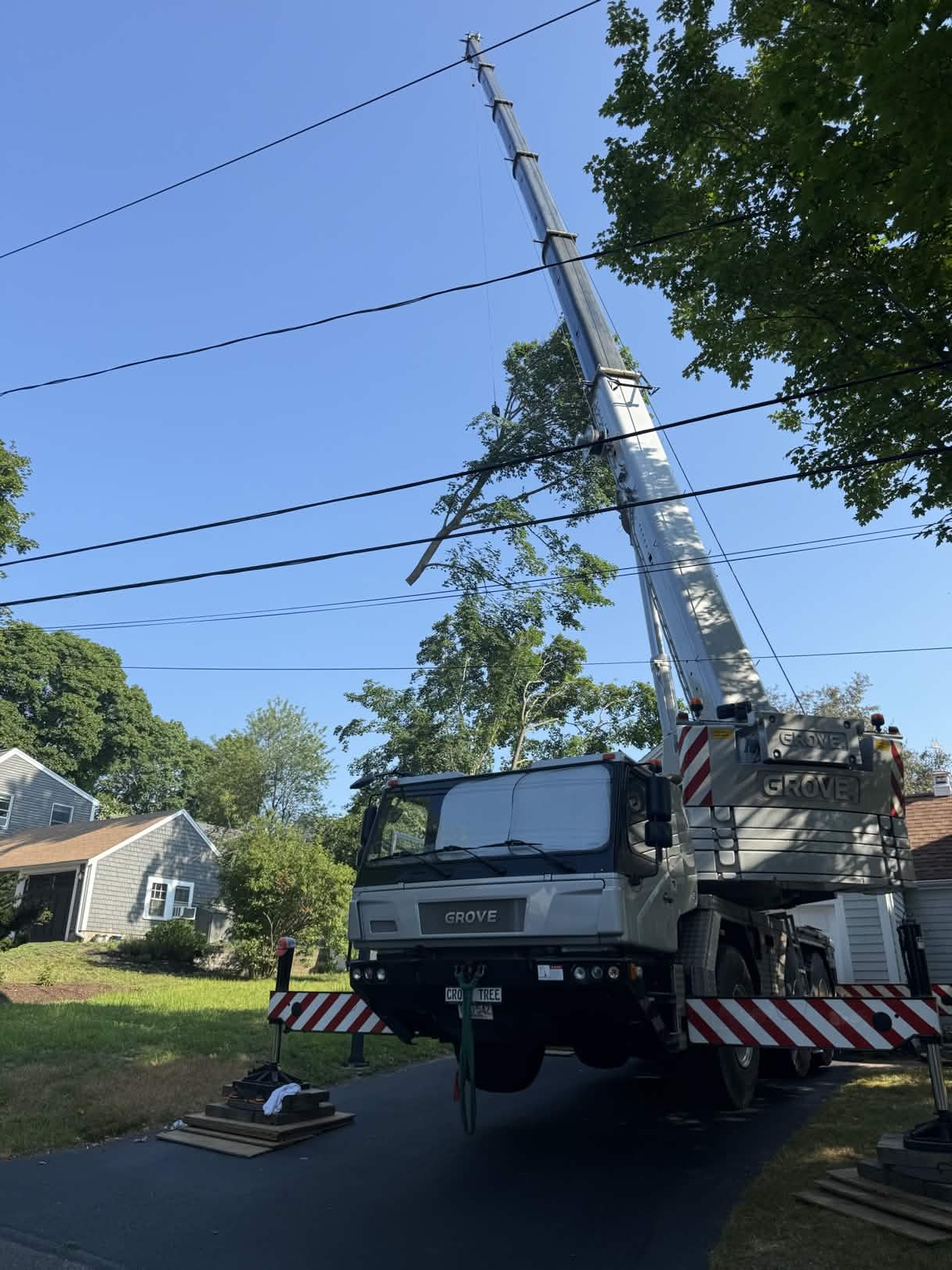
Southeast Arborist serves all Holbrook neighborhoods with safety protocols like traffic control on busy Route 37 and crane access for 80-foot white pines. Our annual inspections maintain system integrity, catching corrosion in copper cables early. If your red maple in South Holbrook shows scorch marks or your arborvitae screen in Brookville leans toward neighbors, lightning protection prevents disaster.
Contact Southeast Arborist at 508-369-5009 for a free consultation on lightning protection Holbrook MA. Protect your trees and home from South Shore storms today.
Why Holbrook Properties Need Lightning Protection
Holbrook's small suburban character amplifies lightning risks for your trees and home. Dense residential development on 0.25-acre lots means overmature Norway maples and red oaks tower over roofs in Holbrook Center, directly exposing them to strikes. The town's aging canopy, planted mid-20th century for shoe factory workers' neighborhoods, now declines with surface roots heaving driveways in North Holbrook and limited diversity stressing green ashes against pests.
Local climate drives urgency. Holbrook experiences Norfolk County's humid summers with frequent thunderstorms from Atlantic moisture, peaking June-August. Average bolt strength hits 20,000-30,000 amperes, enough to shatter a 50-foot silver maple trunk. Clay-loam soils along the Cochato River hold moisture, turning roots into conductive paths that channel surges to your foundation or septic in South Holbrook.
Common species heighten vulnerability. Norway maples, reaching 60 feet on Union Street Area lots, attract 80% of strikes due to height and broad crowns. Silver maples with shallow roots in Brookville conduct electricity rapidly during wet storms. Red maples near Plymouth Street homes split easily from internal steam explosions. White pines in North Holbrook, up to 70 feet, channel bolts down needles to bases. Arborvitae screens in Holbrook Center, dense and evergreen, ignite readily from side strikes. Red oaks along Cochato River remnants store strike energy in thick bark, risking delayed failure. Green ashes, weakened by emerald ash borer, crack under surge loads. Spruces on small lots overgrow, positioning leaders as prime targets.
Town-specific challenges compound issues. Deferred maintenance from decades of canopy loss to Dutch elm disease and 2011 ice storms leaves gaps filled by unchecked growth. In Plymouth Street Area, surface roots from aging spruces conflict with sidewalks, destabilizing trees prone to lightning-uprooting. Holbrook's flat terrain funnels strikes to high points—your backyard red oak becomes the path of least resistance.
Without lightning protection Holbrook MA properties suffer. Strikes kill 10-20% of unprotected tall trees outright, per ISA studies. Survivors decline from heartwood damage, dropping limbs on Route 37 traffic or Holbrook Junior High School fields. Surge conduction fries underground utilities; one Abington-area strike traveled 100 feet via roots, shorting a home's electrical panel.
Protect specimen trees like your heritage white pine near Union Street. ANSI A300 systems divert 95% of energy safely. In Brookville's tight lots, protected arborvitae prevents $5,000+ fire claims. Homeowners report peace of mind post-install, especially after witnessing neighbor's Norway maple explode during a Randolph thunderstorm.
Southeast Arborist's ISA Certified Arborists assess your site's specifics: soil pH (5.5-6.5 acidic clays), elevation (50-150 feet), and proximity to Braintree power lines. We prioritize trees over 40 feet or within 20 feet of structures. Practical tip: During spring thaw, check white pine bases for rodent chew exposing conductive sapwood—increase protection priority.
Holbrook's Cochato River habitat supports native species recovery, but urban lightning demands intervention. Schedule lightning protection services Holbrook MA before summer peaks to shield your canopy legacy.
Our Lightning Protection Process in Holbrook
Southeast Arborist delivers ANSI A300 Part 4-compliant lightning protection in Holbrook using proven copper cable systems tailored to local trees and soils. Our ISA Certified Arborists follow a seven-step process, ensuring safety on busy Holbrook streets and small lots.
Step 1: Site Assessment (1-2 hours). We evaluate your tree's health, height, species, and strike risk. For a 55-foot red oak in Holbrook Center, we measure leader height (50+ feet signals high risk), check bark integrity, and scan roots for conflicts with your septic in clay-loam soil. Proximity to home or Route 37 determines urgency—trees within 30 feet get top priority.
Step 2: Risk Analysis and Design. Using IEEE 998 standards adapted for ANSI A300, we model strike probability. Norway maples in North Holbrook with wet crowns score highest. Design includes 3-5 air terminals (lightning rods) at crown points, 1/0 AWG copper main conductor, and two 10-foot grounding rods spaced 20 feet apart. For arborvitae screens in Brookville, we use flexible cables to hug dense branches.
Step 3: Permits and Prep. Holbrook requires no town permit for tree work under 6-inch DBH, but we notify neighbors in South Holbrook for access. Safety protocols include hard hats, high-visibility vests, and flagging on Plymouth Street Area roads. We prune deadwood first to clear conductor paths.
Step 4: Air Terminal Installation. Climbers ascend via rope-and-harness, placing pointed copper rods (3/8-inch diameter) on main leaders. On a 65-foot white pine in Union Street Area, we secure three terminals 10 feet apart, driven 6 inches into wood with bronze screws. This intercepts strikes at 100 million volts.
Step 5: Conductor Routing. We run pure copper cables (bare or insulated) down the trunk in a spiral pattern, avoiding girdling roots. In red maples with flaky bark, we embed cables shallowly. Branches get "intercept" lines—thinner 4 AWG copper—for spruces in Holbrook Center. Fittings use compression clamps, torqued to 20 ft-lbs.
Step 6: Grounding Installation. Drive 5/8-inch copper-clad rods 10 feet into Holbrook's compacted clay (resistance <25 ohms verified with meter). Connect via exothermic welds for corrosion resistance in acidic soils (pH 5.8 average). For green ashes near Cochato River, we add backfill with bentonite for low-resistance zones.
Step 7: Testing and Annual Maintenance. Megger test insulates conductors (>100 megohms). We tag systems with ID plates and schedule inspections. Copper oxidizes slowly in humid air; we clean contacts yearly, re-torque fittings, and check for rodent damage on silver maples.
Equipment specifics: Buckingham climbers' saddles for 80-foot access, Greenlee crimpers for secure bonds, Fluke multimeters for grounding verification. All work meets OSHA fall protection and TCIA safety standards.
Holbrook adaptations: In windy Brookville, we guy tall installations. For surface-rooted Norway maples, rods go beyond drip line. Process takes 4-8 hours per tree, minimizing disruption.
Your benefits: 99% strike diversion per ANSI data, preserving specimen red oaks. One Plymouth Street client avoided $15,000 removal after protection.
Call Southeast Arborist at 508-369-5009 for lightning protection installation Holbrook MA. Our process protects your trees precisely.
Common Lightning Protection Projects in Holbrook Neighborhoods
Holbrook neighborhoods showcase distinct lightning protection needs tied to their tree profiles and layouts. In Holbrook Center, near town hall and the Congregational Church, we protect 50-60 foot Norway maples overhanging historic homes. These mid-century plantings now threaten rooftops during Weymouth-sourced storms; copper systems with four air terminals safeguard specimens valued at $20,000+ appraised.
North Holbrook's newer subdivisions feature white pines and spruces on 0.3-acre lots near Route 3 access. Overgrown screens block views, so we install flexible conductors on 40-foot spruces, grounding into glacial till soils. A recent project diverted a strike from a pine near Holbrook Auto Parts, preventing fire spread to adjacent garages.
South Holbrook, bordering Randolph, has silver maples and red oaks along wooded edges. Surface roots conflict with patios, amplifying conduction risks. We protected a 55-foot red oak beside a family pool, routing cables around flared bases and adding surge protectors for nearby decks.
Brookville's tight-knit streets host dense arborvitae hedges and green ashes, stressed by emerald ash borer. Post-thinning, we apply multi-strand copper to 30-foot hedges screening backyards from Braintree traffic. Ground rods here handle high soil moisture from Cochato tributaries.
Union Street Area sees arborvitae windrows and red maples from factory-era plantings. We remove hazardous leaders first, then protect remnants—cables on trunks prevent splits that could hit power lines near Union Street playground.
Plymouth Street Area, with its mix of spruces and Norway maples near Plymouth River, demands crane-assisted installs for 70-footers. One project shielded a spruce cluster from ice storm legacies, ensuring stability over driveways.
Nearby towns like Rockland and Abington share Holbrook's canopy issues; we extend services there. Common theme: Tree removal precedes protection for declining giants, followed by stump grinding and replants like disease-resistant red maples.
Southeast Arborist's ISA experts customize per neighborhood—call 508-369-5009 for your area's lightning protection Holbrook MA solutions.
Lightning Protection Costs in Holbrook, MA
Lightning protection costs in Holbrook MA vary by tree size, species, and site factors, but deliver strong ROI for your property. Base pricing starts at $1,800 for a 40-foot arborvitae in Holbrook Center, scaling to $4,500 for an 80-foot white pine in North Holbrook. These figures cover full ANSI A300 copper systems, labor, and one-year warranty.
Key pricing factors:
- **Tree Height and Complexity**: Add $500-1,000 per 20 feet. A 60-foot Norway maple in South Holbrook requires five air terminals and extensive cabling ($3,200), versus $2,200 for a 30-foot green ash in Brookville.
- **Species and Condition**: Hardwoods like red oaks cost 10-15% more due to thick bark drilling ($3,800 for 50-footer in Union Street). Softwoods like spruces get flexible installs, saving $300.
- **Site Access**: Plymouth Street Area premiums ($400) for crane needs near roads. Easy backyard in Holbrook Center keeps costs at base.
- **Soil and Grounding**: Cochato River clays demand extra rods ($250), tested to <10 ohms.
- **Add-Ons**: Annual inspections $250/year; surge protectors for home panels $400.
Average Holbrook project: $2,800 for mid-sized silver maple, per 50+ installs. Compare to $8,000+ removal costs post-strike—protection pays back in 1-2 years via insurance discounts (5-10% via TCIA partners).
Value proposition: Preserve appraised tree value (ISA trunk formula: $15,000 for mature red oak). Prevent liability—unprotected falls claim $50,000 averages. Boost curb appeal in dense neighborhoods; protected specimens signal maintenance.
Financing: We offer 0% 12-month plans via local credit unions. Holbrook rebates via Norfolk County tree programs offset 20% for heritage trees.
Practical budgeting: Prioritize top 2-3 trees per property. Get our free quote factoring your lot's specifics.
Invest in lightning protection Holbrook MA with Southeast Arborist—call 508-369-5009 for transparent pricing.
When to Schedule Lightning Protection in Holbrook
Schedule lightning protection in Holbrook MA in late spring (April-May) before thunderstorm season ramps up. Holbrook's climate sees peak strikes June-August, with 15-20 events monthly from Cape Cod Bay fronts. Installing pre-summer avoids wet-weather delays on clay soils.
Urgency signs demand immediate action:
- **Visible Damage**: Scorch lines or bark explosions on Norway maples in Holbrook Center—schedule within 48 hours.
- **Height Risks**: Trees over 50 feet, like white pines in North Holbrook, topping homes.
- **Storm History**: Post-Randolph gypsy moth flares or ice remnants weakening spruces.
Fall (September-October) works for inspections, as leaf-off reveals crown issues in red maples. Avoid winter—frozen grounds hinder rod driving.
Practical timing: After leaf-out reveals defects in silver maples (May). Before hurricanes (August). Our ISA Arborists fit Holbrook's calendar around school traffic.
Don't wait for strikes—proactive protection saves your Brookville arborvitae. Call 508-369-5009 now.
Frequently Asked Questions About Lightning Protection in Holbrook
Does lightning protection really work for Holbrook trees? Yes, ANSI A300 copper systems divert 95-99% of strikes, per IEEE studies. In Holbrook's stormy climate, protected Norway maples in Union Street survive unscathed, unlike unprotected neighbors.
How long does installation take in Holbrook neighborhoods? 4-8 hours per tree. A red oak in South Holbrook finishes same-day; multi-tree Brookville hedges span two days with minimal disruption.
Is lightning protection necessary for small trees like arborvitae in Holbrook Center? For hedges over 25 feet near homes, yes—dense foliage ignites easily. Systems cost $1,800, preventing $10,000 fire risks.
What maintenance is required for systems in Holbrook's acidic soils? Annual inspections ($250) check copper corrosion and grounds. We service white pines in North Holbrook yearly, extending life 20+ years.
Will protection harm my green ash or red maple? No—ISA Certified Arborists use non-invasive bronze fittings. Holbrook installations on emerald ash borer-stressed trees promote health.
Does insurance cover lightning protection in Holbrook MA? Many policies reimburse 50-80% post-appraisal as risk mitigation. Norfolk County clients save premiums.
Can you protect trees near power lines in Plymouth Street Area? Yes, with utility coordination. We protect spruces 20 feet from lines using low-profile cables.
How do I know if my silver maple needs protection? If over 40 feet, near structures, or shows strike scars—yes. Free Holbrook assessments confirm.
Call 508-369-5009 for answers tailored to your property.
Lightning Protection Throughout Holbrook
Southeast Arborist provides lightning protection across Holbrook neighborhoods: Holbrook Center heritage maples, North Holbrook pines, South Holbrook oaks, Brookville hedges, Union Street ashes, Plymouth Street spruces. We extend to nearby Rockland, Abington, Braintree, Randolph, Weymouth.
From Plymouth/Cohasset bases, we reach Holbrook in 20 minutes. ISA Certified, ANSI-compliant service protects your canopy.
Contact Southeast Arborist, LLC at 508-369-5009 for lightning protection Holbrook MA. Safeguard your trees today.