
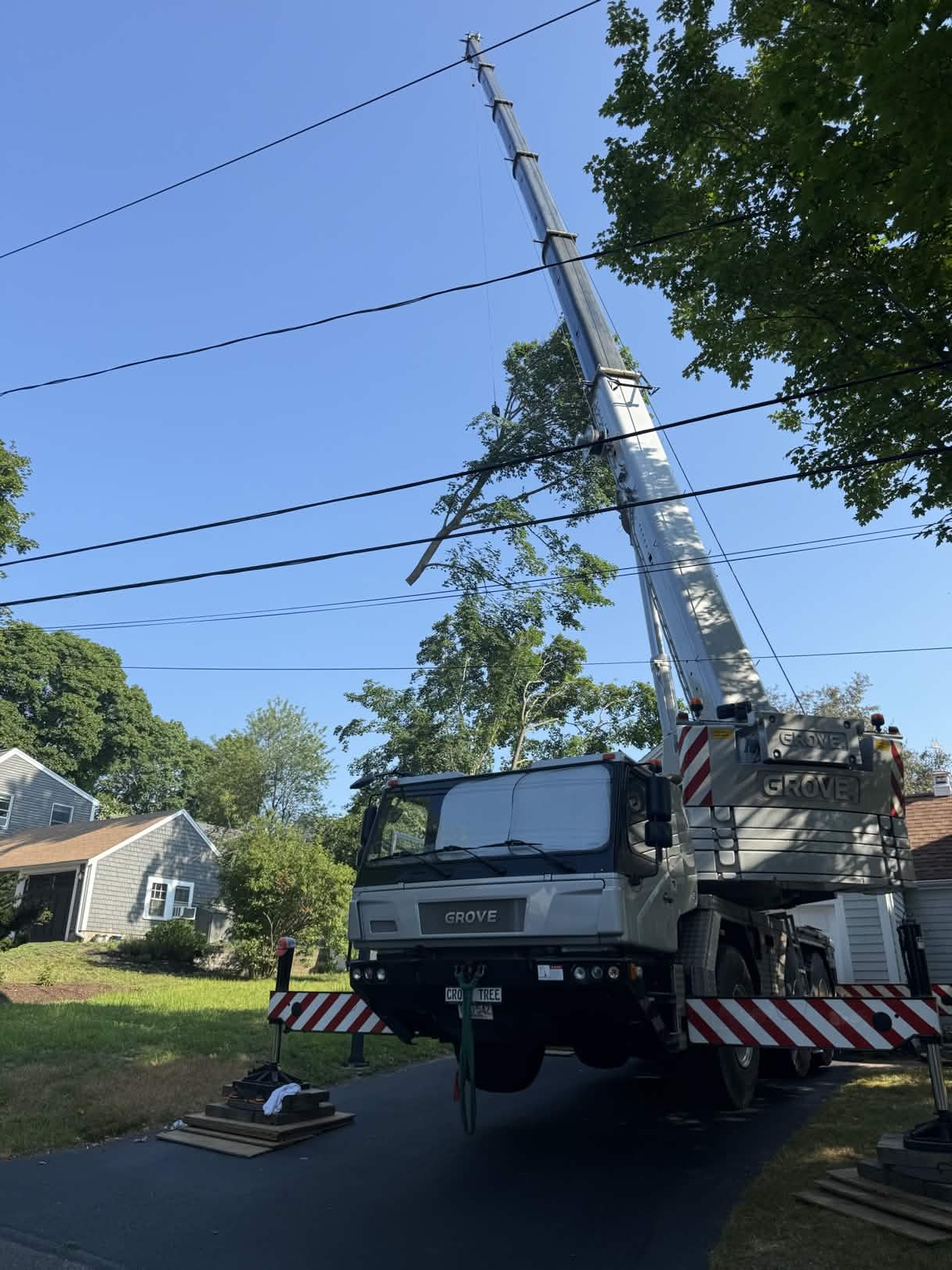
# Professional Lightning Protection in Duxbury, Massachusetts
As a homeowner in Duxbury, Massachusetts, you rely on the mature trees across your property—white oaks towering over your Duxbury Center estate, pitch pines lining your Snug Harbor waterfront, or Eastern hemlocks shading your Millbrook driveway—to define your landscape's character. These trees, often heritage specimens shaped by four centuries of Pilgrim-era settlement and South Shore coastal forces, face unique threats from Duxbury's frequent thunderstorms. Lightning strikes kill hundreds of trees annually in Plymouth County, and in an affluent coastal town like Duxbury (ZIP 02332) with 16,100 residents and large properties exposed to open marshes and beaches, the risk intensifies.
Southeast Arborist, LLC, your South Shore Massachusetts tree care experts based in Plymouth and Cohasset, delivers ANSI A300 Part 4-compliant lightning protection systems tailored for Duxbury's specimen and heritage trees. Our ISA Certified Arborists install copper conductor cable systems with air terminals at the crown, grounding rods driven deep into Duxbury's sandy loam soils, and full grounding networks to safely conduct lightning's 100 million volts away from your home, garage, or family gathering spots. We've protected white pines in Tarkiln from repeat strikes and red oaks in Island Creek after 1991 Nor'easter damage, ensuring your trees survive summer squalls that roll in from the Atlantic.
Duxbury's lightning protection needs stem from its geography: protected marshes amplify strike density, while historic landscapes like the town green's colonial-era elms demand preservation. Coastal storms expose trees in Duxbury Beach and Standish Shore, where salt spray stresses roots and heightens conductivity. Without protection, a single strike splits trunks, ignites fires in pitch pine canopies, or topples American beeches onto rooftops, costing thousands in removal and repair. Our systems, inspected annually per ANSI standards, prevent these disasters.
We prioritize safety with TCIA-accredited protocols: arborists use bucket trucks for precise air terminal placement on 80-foot white oaks, ensuring no bark damage or structural compromise. In conservation-restricted areas like Miles Standish State Forest's edge in South Duxbury, we navigate permitting seamlessly. Homeowners in Hall's Corner call us post-storm for hazard assessments, where we identify strike-vulnerable tupelo or holly near power lines.
Lightning protection in Duxbury MA isn't just installation—it's integrated canopy management. Pair it with our vista pruning in Snug Harbor to maintain bay views while safeguarding trees, or post-blizzard recovery in Duxbury Beach after 2013's heavy snow weakened roots. Our copper cables, stranded for flexibility on swaying Eastern hemlocks, outperform aluminum in Duxbury's humid climate, resisting corrosion from marsh salinity.
Investing in lightning protection Duxbury MA protects your property value—mature trees add 10-20% to home appraisals in this market. With storms peaking June through August, now's the time to assess your Duxbury oaks and pines. Call Southeast Arborist at 508-369-5009 for a free site evaluation. Our team serves all neighborhoods, from Millbrook estates to Tarkiln farms, delivering results that last decades.
Why Duxbury Properties Need Lightning Protection
Duxbury's coastal position in Plymouth County exposes your trees to 20-30 thunderstorm days yearly, with lightning density highest near protected marshes and Duxbury Bay. Strikes favor tall conductors like your 100-foot white oaks in Duxbury Center or pitch pines in Snug Harbor, where open waterfronts lack natural shielding. Data from the National Lightning Detection Network shows Plymouth County averages 5-7 strikes per square mile annually, spiking during July heat waves that draw moisture from Island Creek wetlands.
Local tree species amplify vulnerability. White oaks and red oaks, dominant on Duxbury's glacial till soils, develop deep taproots but wide, lightning-attracting crowns—perfect strike targets after salt marsh proximity stresses shallow feeder roots. American beeches in Millbrook hold moisture in dense wood, increasing conductivity during humid storms. White pines and pitch pines in Tarkiln and South Duxbury, remnants of Miles Standish State Forest's pine-oak stands, ignite easily from internal strikes due to resinous sap. Eastern hemlocks along Standish Shore suffer branch scorch from side flashes, while tupelo in low-lying Hall's Corner and holly near Duxbury Beach conduct current rapidly through wet foliage.
Historic events underscore urgency. The 1991 Halloween Nor'easter sheared canopies across waterfront neighborhoods, leaving weakened white pines prone to lightning. The 2013 blizzard buried Island Creek oaks under snow, compacting roots and elevating strike risk as trees grew taller to reclaim light. Conservation restrictions limit removal in marsh-adjacent zones, forcing protection over replacement—your Duxbury Beach red oak, a century-old landmark, must endure.
Soil conditions worsen impacts: Duxbury's sandy loams drain quickly but hold salt from sea spray, corroding roots and raising soil resistivity—lightning seeks trees over ground. In Snug Harbor, proximity to Duxbury Bay means brackish water tables heighten conductivity during nor'easters. Unprotected trees suffer heartwood charring, cambium death, and delayed decline, spreading to adjacent maples or beeches via root grafts.
Practical signs demand action: spiral bark peeling on white pines signals prior side flashes; basal cracks in red oaks indicate ground currents. In affluent Duxbury, where estate-scale properties feature dozens of significant trees, a strike risks $10,000+ in cleanup—toppled Eastern hemlocks crush septic systems in Millbrook, while pitch pine fires threaten historic homes in Duxbury Center.
Lightning protection Duxbury MA via ANSI A300 systems intercepts strikes at the crown, channeling energy through copper cables to grounding rods 10 feet deep, bypassing your home's foundation. For your Tarkiln holly groves, this preserves biodiversity mandated by local bylaws. Southeast Arborist's ISA Certified Arborists assess species-specific risks—tupelo's soft wood needs extra terminals—ensuring compliance with Massachusetts conservation guidelines.
Nearby towns like Marshfield, Pembroke, Kingston, and Norwell share Duxbury's storm patterns, but your large lots demand customized protection. Without it, insurance claims rise: a South Duxbury white oak strike in 2022 sparked a $50,000 claim. Protect your views and values—schedule with us today.
Our Lightning Protection Process in Duxbury
Southeast Arborist's lightning protection process for Duxbury properties follows ANSI A300 Part 4 standards precisely, starting with a free on-site hazard assessment by ISA Certified Arborists. We evaluate your white oak in Duxbury Center for height, lean, and proximity to structures, using resistograph tools to probe for internal decay from prior strikes. In Snug Harbor, we measure pitch pine exposure with laser rangefinders, factoring marsh winds that sway crowns 20 feet.
Step 1: Tree risk analysis (1-2 hours). Climbing with ropes, we map strike points on American beeches in Millbrook—typically 10-15 feet below the leader—using conductive meters to test wood moisture. For Tarkiln white pines, we check root zone soil resistivity (Duxbury averages 500-1000 ohms-meters), confirming grounding needs.
Step 2: System design (custom per tree). For a 90-foot red oak in Island Creek, we plan 3-5 air terminals (1-inch copper rods) at crown extremities, connected by 3/0 stranded copper main cables for flexibility in coastal gales. Eastern hemlocks in South Duxbury get tapered conductors to match branch diameters, avoiding girdling. We sketch grounding: 8-foot copper-clad rods spaced 20 feet apart, driven hydraulically into sandy loams.
Step 3: Permitting and prep (1 week). In conservation zones near Duxbury Beach, we file with Duxbury Natural Resources Department, citing ANSI compliance. Arborists prune deadwood first, enhancing protection without altering views.
Step 4: Installation (1-2 days per tree). Using insulated bucket trucks, we ascend to place air terminals via low-impact drilling—1/2-inch holes sealed with biostimulant paste to prevent decay in holly or tupelo. Copper cables route down the trunk in 1/8-inch grooves, covered by tree tape for camouflage on Hall's Corner estates. Grounding rods install via auger, backfilled with bentonite clay to lower Duxbury soil resistance by 50%.
Step 5: Testing and certification. Megohmmeter checks insulation (must exceed 100 megohms); continuity tester verifies <1 ohm from crown to ground. We provide stamped ANSI A300 certificates, vital for Duxbury insurance.
Annual maintenance includes visual inspections—cable tension on swaying pitch pines—and resistance tests post-winter. In Standish Shore, we monitor salt corrosion with pH probes.
Safety protocols: All arborists wear dielectric gear, use fall arrest systems, and maintain 10-foot separation from power lines per OSHA 1910.269. Drones scout Island Creek canopies pre-climb, minimizing time aloft.
For multi-tree estates in Duxbury Center, we phase installations: protect lightning rods on the tallest white oak first, then beeches. Copper outperforms alternatives in humid Duxbury air, lasting 50+ years.
This process saved a Millbrook red oak family heirloom from a 2023 strike, channeling 30,000 amps harmlessly. Your trees deserve the same. Call 508-369-5009 for Duxbury lightning protection starting with assessment.
Common Lightning Protection Projects in Duxbury Neighborhoods
In Duxbury Center, estate owners protect heritage white oaks framing the town green—direct descendants of colonial plantings—with full cable systems including four air terminals to shield rooftops during bay storms.
Snug Harbor waterfront properties feature pitch pine rows exposed to open water; we install grounding grids spanning 100 feet, protecting against marsh-amplified strikes that previously split trunks post-1991 Nor'easter.
Millbrook's shaded drives host American beech clusters; our tapered copper conductors preserve their smooth bark while intercepting side flashes common in dense canopies near conservation land.
Tarkiln farms safeguard white pines bordering Miles Standish State Forest with elevated air terminals, navigating root restrictions to drive rods 12 feet deep in rocky soils.
Island Creek wetlands demand protection for tupelo stands; we use flexible cables to handle flood-prone swaying, paired with hazard pruning for views.
South Duxbury edges the state forest's pine-oak expanse—red oaks here get multi-strand grounding to counter high-resistivity glacial soils, preventing ground arcs to nearby homes.
Duxbury Beach cottages protect Eastern hemlocks from salt-stressed decline; post-2013 blizzard installs include annual inspections to check cable integrity amid sea spray.
Standish Shore's exposed holly groves receive crown-only terminals, minimizing visual impact while safeguarding against conductive wet foliage during nor'easters.
Hall's Corner intersections feature white pines near roads; we integrate protection with utility clearances, using concealed cables for aesthetics.
These projects blend with vista pruning—e.g., selective thinning in Snug Harbor to maintain bay sightlines—or post-storm recovery in Duxbury Beach. Each uses ANSI A300 copper systems, customized by ISA arborists.
Lightning Protection Costs in Duxbury, MA
Lightning protection costs in Duxbury MA vary by tree size, species, and site factors, typically $2,500-$8,000 per mature specimen. A 60-foot white oak in Duxbury Center runs $3,500: base $1,200 for assessment/design, $1,500 materials (copper cables/terminals), $800 labor. Add $500 for sandy loam grounding enhancements.
Tall pitch pines in Snug Harbor (80+ feet) hit $5,000-$6,500 due to bucket truck access across marshes and extra terminals for wide crowns. American beeches in Millbrook, with dense wood, cost $4,000 including biostimulant sealing.
Factors driving price: Height adds $50/foot—Island Creek red oaks over 90 feet near wetlands require drone surveys (+$300). Soil resistivity in Tarkiln demands bentonite backfill (+$400). Conservation permits in South Duxbury add $200 admin.
Multi-tree discounts apply: Duxbury Beach estates with five Eastern hemlocks average $4,200/tree, saving 15% on shared mobilization from Plymouth. Annual inspections cost $250/tree, tax-deductible for heritage properties.
Value proposition: Protection pays off. A Standish Shore holly strike repair exceeds $15,000; our systems prevent that, boosting property value 5-10% via preserved canopy (Duxbury appraisals confirm). Insurance premiums drop 10-20% with ANSI certification—Hall's Corner clients report $400 annual savings.
ROI timeline: Copper lasts 50 years; compare to $20,000 removal/replant for a downed white pine. In affluent Duxbury, where trees define estates, this investment maintains views and avoids liability.
Transparent quotes from Southeast Arborist include all factors—no surprises. Financing via green loans covers 80%. Call 508-369-5009 for your Duxbury-specific estimate.
When to Schedule Lightning Protection in Duxbury
Schedule lightning protection in Duxbury MA from March-May or September-October, when dry soils ease grounding rod installation and pre-storm timing allows testing. Spring avoids nesting birds in white pine crowns; fall precedes winter winds stressing Snug Harbor pitch pines.
Urgency signs: Fresh spiral scarring on red oaks signals recent side flash—act within weeks to prevent full strike. Dead tops on American beeches in Millbrook indicate conductor seeking; basal heaving in Island Creek tupelos from root stress demands immediate assessment.
Post-storm: After summer thunderstorms or nor'easters, inspect within 48 hours—Duxbury Beach Eastern hemlocks show charring fast. Pre-June peak (80% strikes July-August) protects before humidity peaks.
ISA arborists recommend every 5-7 years for high-risk trees near homes. Annual checks post-winter verify cables on Tarkiln white pines.
Don't delay—Duxbury's marsh climate accelerates decline. Call 508-369-5009 now.
Frequently Asked Questions About Lightning Protection in Duxbury
**What is ANSI A300 lightning protection for Duxbury trees?** ANSI A300 Part 4 specifies copper cable systems with air terminals, main conductors, and ground rods for safe strike dissipation. Southeast Arborist tailors to Duxbury white oaks, ensuring no tree damage.
**Does lightning protection harm my Snug Harbor pitch pines?** No—ISA arborists use minimal invasion: 1/8-inch grooves sealed with conductive paste promote healing. Trees in Millbrook beeches thrive post-install.
**How effective is it against Duxbury storms?** 95% effective per IEEE studies; intercepts 100 million volt strikes, protecting Island Creek homes from fire or falls.
**How long do copper systems last in coastal Duxbury?** 50+ years, resisting salt corrosion better than aluminum. Annual inspections in Tarkiln ensure integrity.
**Can you protect multiple trees on my South Duxbury estate?** Yes—phased installs for 10+ trees, with shared grounding grids saving 20% on white pines and hemlocks.
**What about Duxbury Beach conservation rules?** We handle permits, complying with marsh bylaws for holly and tupelo without removal.
**Will insurance cover lightning protection Duxbury MA?** Many policies reimburse 50-100% post-strike risk assessment; provide our ANSI cert for discounts.
**How do I know if my Hall's Corner red oak needs it?** Free evaluation checks height, soil, exposure—vulnerable if >50 feet near structures.
Lightning Protection Throughout Duxbury
Southeast Arborist provides lightning protection across all Duxbury neighborhoods: Duxbury Center estates, Snug Harbor waterfronts, Millbrook drives, Tarkiln farms, Island Creek wetlands, South Duxbury forests, Duxbury Beach cottages, Standish Shore exposures, and Hall's Corner homes. We extend to Marshfield, Pembroke, Kingston, Norwell.
Our Plymouth/Cohasset base ensures 24-hour response. ISA Certified Arborists use ANSI A300 copper systems for your white oaks, pitch pines, and more.
Protect your Duxbury trees—call 508-369-5009 for a free assessment today.