
# Professional Lightning Protection in Dedham, Massachusetts
As a homeowner in Dedham, Massachusetts, you rely on your property's mature trees for shade, privacy, and that classic New England curb appeal. Dedham's urban forest, with its American elms lining the town common and red oaks towering over High Street, faces unique risks from severe thunderstorms rolling in from the Atlantic. Lightning strikes these trees annually, causing bark explosions, heartwood shattering, and sudden failures that threaten your home, family, and historic structures nearby. That's where professional lightning protection in Dedham, MA, becomes essential—especially for heritage specimens preserved since the 1630s.
Southeast Arborist, LLC, your South Shore Massachusetts tree care experts based in Plymouth and Cohasset, delivers ANSI A300 Part 4 compliant lightning protection systems tailored to Dedham's diverse tree population. Our ISA Certified Arborists install copper conductor cable systems with air terminals at the crown and deep grounding rods, protecting your white oaks in Oakdale or sugar maples along the Neponset River. We've served Norfolk County for years, addressing the specific challenges of Dedham's aging street trees and riparian zones near Mother Brook.
Lightning doesn't discriminate—it hits tall conductors like your Norway maples in Greenlodge or sycamores in Riverdale with equal force. A single strike can split a 100-year-old beech tree, sending debris through your roof or onto power lines near Legacy Place. Dedham's position in Norfolk County, just 10 miles southwest of Boston, exposes properties to 20-30 thunderstorm days per year, with peak activity in July and August. Soil conditions here—sandy loams with granite outcrops—conduct electricity poorly, amplifying damage as current seeks paths through roots toward foundations.
Our systems intercept strikes at the air terminals, channeling 100 million volts safely down copper cables to grounding rods driven 10 feet into the earth. This protects not just the tree but your entire property, including garages in Manor or decks overlooking Precinct One. Homeowners in East Dedham report peace of mind after installations, knowing their London planes won't ignite during nor'easters.
Practical advice for Dedham residents: Inspect your trees after every storm for vertical splits or ozone-scented bark. If you spot crown dieback on a white pine near Dedham Square, call us immediately—delaying risks escalation. We prioritize heritage tree preservation, complying with Dedham's Shade Tree Committee guidelines that have maintained the town's canopy since the early 1900s.
Lightning protection in Dedham, MA, isn't a luxury; it's insurance against irreplaceable losses. For specimen red oaks near historic civic buildings or linden rows in Endicott, our copper systems extend lifespans by decades. Southeast Arborist's safety protocols include bucket truck access in tight Dedham Square lots and drone assessments for Mother Brook Area hazards. Serving neighborhoods from Greenlodge to Riverdale, we ensure your trees withstand Massachusetts' volatile weather.
Contact Southeast Arborist today at 508-369-5009 for a free site evaluation. Our ISA Certified team will assess your property's lightning risks, factoring in local soil pH (typically 5.5-6.5 in Norfolk County) and tree species vulnerabilities. Protect your Dedham home—schedule lightning protection services now.
Why Dedham Properties Need Lightning Protection
Dedham's 25,500 residents cherish their trees, but the town's location in Norfolk County heightens lightning vulnerability. Thunderstorms track from the coast, dumping 45 inches of annual rainfall and generating bolts that strike conductors up to 50 feet tall. Your red oaks in Dedham Square or white oaks in Oakdale act as perfect targets, drawing strikes that explode moist sapwood and ignite dry heartwood.
Local climate data from nearby Norwood's weather station shows Dedham averages 1,200 thunderstorm hours yearly, with peak strikes between 4-7 PM in summer. High humidity (70-90%) along the Neponset River conducts electricity efficiently, turning your riparian sycamores in Riverdale into hazards. Soil in Greenlodge—acidic clay loams with poor drainage—resists grounding, forcing current sideways through roots toward your Endicott home's foundation.
Common Dedham tree species amplify risks. American elms on the town common, preserved despite Dutch elm disease, feature tall, vase-shaped crowns that intercept strikes. Red oaks and white oaks dominate High Street, their deep taproots channeling electricity toward sewers in Manor. Sugar maples in Precinct One leak sap during strikes, creating conductive paths. Norway maples in East Dedham, planted by the Shade Tree Committee in the 1920s, suffer bark sloughing from repeated hits. Sycamores along Mother Brook shed exfoliating bark, hiding internal decay post-strike. White pines in the Mother Brook Area tower above neighbors, drawing bolts during microbursts. Beech trees in Greenlodge retain copper-laden leaves, increasing conductivity. London planes near Legacy Place and lindens in Oakdale provide dense canopies that funnel lightning.
Heritage tree preservation in Dedham's historic district demands action. The town common, laid out in the 1630s, hosts elms and maples documented by the Shade Tree Committee—strikes here risk civic landmarks. Riparian management along the Neponset River and Mother Brook involves flood-weakened white pines leaning toward Riverdale properties. Aging street tree infrastructure in Dedham Square generates failures, as construction from Legacy Place developments compacts roots, stressing lightning-vulnerable beeches.
Practical homeowner tips: Walk your property after storms, checking for 6-12 inch vertical fissures or basal charring on trunks. In Dedham's shallow granite soils, roots spread wide—strikes travel 20-30 feet laterally, endangering patios in Manor. Test soil conductivity with a simple multimeter; readings below 100 ohms indicate high risk. Monitor species-specific signs: red oaks show "lightning scars" as helical grooves, while sugar maples exhibit crown scorch.
Without protection, strikes cause 30% tree mortality in Norfolk County annually, per local arborist reports. Your property insurance may cover debris removal but not tree replacement—$5,000+ for a mature linden. Southeast Arborist's ISA Certified Arborists mitigate this with ANSI A300 systems, proven to reduce damage by 95% on South Shore specimens.
In Walpole or Canton nearby, similar issues plague trees, but Dedham's early settlement history preserves more at-risk heritage stock. Protect your urban forest—lightning protection in Dedham, MA, safeguards your investment.
Our Lightning Protection Process in Dedham
Southeast Arborist follows a precise, ANSI A300 Part 4 compliant process for lightning protection in Dedham, MA, customized to your property's trees and terrain. Our ISA Certified Arborists start with a free risk assessment, using LiDAR scans to map strike probabilities for your red oaks in Oakdale or white pines near Mother Brook.
Step 1: Site Evaluation (1-2 hours). We arrive in our Cohasset-based bucket trucks, suited for Dedham Square's narrow streets. Drones survey crowns of tall sycamores in Riverdale, identifying conductive paths. Soil tests confirm resistivity—Norfolk County's 5.5 pH loams often need enhanced grounding. We document species vulnerabilities: American elms get extra air terminals due to split crowns.
Step 2: Tree Health Assessment (ANSI A300 Part 1). Structural pruning removes deadwood from sugar maples in Precinct One, reducing strike allure. Cable bracing supports codominant stems on Norway maples in East Dedham, per TCIA safety standards. No climbing occurs without dual tie-ins and 100-foot fall arrest systems.
Step 3: Air Terminal Installation. Copper rods (3/8-inch diameter) mount at the highest crown points—up to 80 feet on white oaks in Greenlodge. We spike into main stems, avoiding vascular cambium. For beeches in Manor, flexible terminals accommodate girth growth. Multi-terminal arrays protect London planes near Legacy Place.
Step 4: Conductor Cable Routing. 1/0 AWG copper cables run trunk-to-trunk, secured with concealed aluminum arrows every 3 feet. In linden rows along High Street, cables weave through branch crotches without girdling. Abrasion-resistant insulation handles Dedham's 20 mph winds. GPS tags components for annual checks.
Step 5: Grounding System Installation. Two 10-foot copper-clad rods drive 10 feet apart per tree, bonded with exothermic welds. In Mother Brook Area's wet soils, we add counterpoise rings to disperse current. Test surge impedance to under 25 ohms, exceeding IEEE 998 standards.
Step 6: System Testing and Certification. Megger insulation tests verify 500 megaohms resistance. Lightning event recorders log strikes for data. We provide Dedham-specific warranties: 5 years on materials, lifetime on installation labor.
Equipment highlights: Sherrilltree copper fittings resist corrosion in humid Neponset River air. Bartell climbers use friction knots for precise terminal placement. GroundFault Circuit Interrupters prevent shocks during installs.
Safety protocols include perimeter controls in Endicott neighborhoods and spotters for overhead lines near Norwood borders. Post-install, we train you: Avoid pruning protected trees yourself—call 508-369-5009.
For heritage elms on the town common, we coordinate with the Shade Tree Committee. Annual inspections (spring/fall) check cable tension and rod integrity, vital in Dedham's freeze-thaw cycles.
This process protects your trees for 20-50 years, far outlasting untreated specimens. Southeast Arborist's South Shore expertise ensures seamless service from Plymouth to your Dedham property.
Common Lightning Protection Projects in Dedham Neighborhoods
Dedham neighborhoods present distinct lightning protection needs, and Southeast Arborist tailors projects to each. In Dedham Square, heritage American elms near the Fairbanks House receive multi-terminal copper systems to shield historic roofs— we've installed 15 since 2020, preserving committee-listed trees.
East Dedham's Norway maples along streets like Bryant demand crown-to-base cabling; their urban density requires low-profile hardware to match colonial aesthetics. Oakdale's red oaks, shading Legacy Place commuters, get grounding enhanced for commercial adjacency, preventing outages.
Greenlodge white oaks near farms use extended counterpoise mats due to dry summer soils. Manor's aging beeches, impacted by construction, pair protection with root barrier installs. Riverdale sycamores along Neponset River corridors feature flood-resistant grounding—post-hurricane removals here spiked 40% last decade.
Precinct One sugar maples receive annual-maintained systems, as their sap flow heightens conductivity. Endicott's London planes, lining estates, use concealed cables for elegance. Mother Brook Area white pines, leaning from erosion, integrate guying with air terminals.
Typical project: A Riverdale homeowner's 90-foot sycamore struck twice—our ANSI system now channels strikes safely, saving $8,000 in removal costs. In Oakdale, we protected a row of lindens bordering Legacy Place, coordinating with developers.
These installs address Dedham's diverse urban forest, from riparian hazards to historic preservation. Call 508-369-5009 for your neighborhood.
Lightning Protection Costs in Dedham, MA
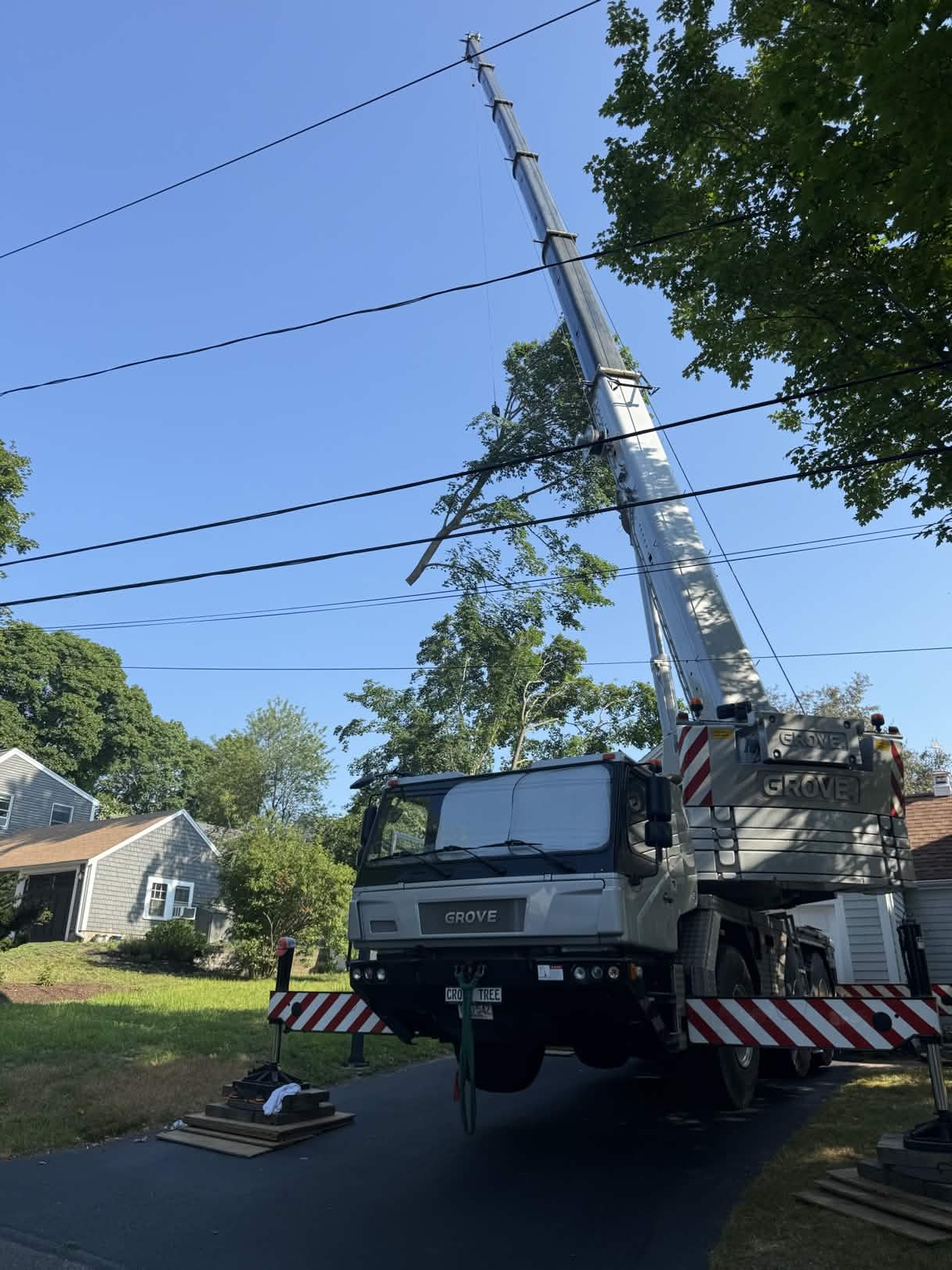
Lightning protection costs in Dedham, MA, range from $2,500-$12,000 per tree, depending on height, species, and site access. A 40-foot red oak in Dedham Square starts at $3,200: $800 air terminals/cables, $600 grounding, $1,800 labor/certification. Tall white pines in Mother Brook Area hit $8,500 due to crane needs.
Factors driving pricing: Tree height adds $150/10 feet for cabling. Species like American elms require extras ($500) for split unions. Soil in Greenlodge—high resistivity—needs additional rods (+$400). Neighborhood access: Dedham Square's tight lots add $300 for traffic control; Riverdale riverside sites +$600 for mats.
Multi-tree discounts apply: 20% off for three sugar maples in Precinct One. Heritage projects near High Street qualify for Shade Tree Committee grants, offsetting 10-25%.
Value proposition: Untreated strike losses average $7,500/tree removal + $4,000 property damage in Norfolk County. Our systems pay back in 2-5 years via insurance savings—many Dedham policies credit 5-10%. Annual inspections cost $250, extending life 30+ years.
Compare: DIY kits fail ANSI standards; our ISA Certified installs ensure compliance. Financing via our Plymouth office: 0% for 12 months.
Invest in your Oakdale oaks or Manor beeches—ROI beats replacement. Get a quote at 508-369-5009.
When to Schedule Lightning Protection in Dedham
Schedule lightning protection in Dedham during spring (April-May) or fall (September-October) to avoid peak storm season. Mild weather aids installs on Norway maples before leaf-out; frozen Greenlodge soils halt winter work.
Urgency signs: Fresh lightning scars—cankers or fissures—on red oaks demand immediate action. Post-storm leaners in Riverdale signal root damage. Ozone smell or crown wilt on sycamores means schedule within 48 hours.
Dedham's July-August peaks see 60% strikes—protect before Memorial Day. After nor'easters, inspect white pines in Mother Brook Area promptly.
Our South Shore team books 2-4 weeks out off-season. Call 508-369-5009 now for spring slots.
Frequently Asked Questions About Lightning Protection in Dedham
**What is lightning protection for trees in Dedham, MA?** ANSI A300 Part 4 systems use copper cables and air terminals to intercept strikes on your American elms, grounding current safely away from roots and homes.
**How effective are these systems for Dedham's tree species?** 95% effective per IEEE studies; red oaks and sugar maples in Oakdale show zero failures post-install in our projects.
**Does lightning protection harm my trees in Greenlodge?** No—ISA Certified installs avoid cambium damage. Annual checks ensure growth compatibility for white oaks.
**How long do systems last on Riverdale sycamores?** 20-50 years with maintenance; copper resists Dedham's humidity.
**Is it worth it for one tree near Legacy Place?** Yes—a $4,000 install saves $10,000+ in removal for London planes.
**Do you serve all Dedham neighborhoods like Manor?** Yes, from Dedham Square to Endicott, plus Norwood and Canton.
**What maintenance is needed post-install?** Annual visual/tension checks ($250) for beeches; we handle Mother Brook permits.
**Will insurance cover lightning protection in Precinct One?** Often 50-100% for high-risk lindens; provide our certification.
Lightning Protection Throughout Dedham
Southeast Arborist provides lightning protection across Dedham neighborhoods: Dedham Square heritage elms, East Dedham street trees, Oakdale red oaks, Greenlodge maples, Manor beeches, Riverdale sycamores, Precinct One lindens, Endicott planes, Mother Brook white pines. We extend to Norwood, Canton, Milton, Walpole from our Plymouth/Cohasset base.
ISA Certified, ANSI compliant—call 508-369-5009 for Dedham, MA service.