
# Professional Lightning Protection in Braintree, Massachusetts
As a homeowner in Braintree, MA 02184, you rely on the mature trees shading your property in Braintree Center or framing your view in Braintree Highlands to enhance your suburban lifestyle. These trees—red oaks towering over Elm Street Area homes, white pines lining Pond Plain driveways, or hemlocks bordering Watson Park Area—represent significant value, both aesthetically and financially. Yet, Norfolk County's frequent summer thunderstorms pose a real threat. A single lightning strike can split a sugar maple in Five Corners or ignite a silver maple near Braintree Hill, leading to costly damage, fire risks, and potential liability.
Southeast Arborist, LLC, your South Shore Massachusetts tree care experts based in Plymouth and Cohasset, specializes in lightning protection Braintree MA homeowners trust. Our ISA Certified Arborists install ANSI A300 Part 4 compliant systems using copper conductor cables, air terminals at the tree crown, and deep grounding rods tailored to Braintree's shallow ledge soils. We've protected heritage oaks tracing back to colonial plantings in South Braintree and specimen hickories in East Braintree from the hazards of Blue Hills Reservation winds.
Lightning strikes kill thousands of trees annually across New England, but professional lightning protection preserves your landscape investment. In Braintree's established neighborhoods, where aging replacement trees from the Dutch elm disease era now dominate—Norway maples in commercial zones, red maples along Quincy borders—protection prevents the chain reaction of bark explosion, heartwood charring, and root failure. Our systems intercept strikes, channeling 30,000-amp surges safely to ground, safeguarding not just your trees but your home's roofline, siding, and electrical systems.
Consider Braintree's microclimate: elevation in Braintree Highlands exposes trees to 20-30% higher wind gusts during nor'easters, while Pond Plain's low-lying areas trap humidity, stressing white oaks prone to conductive sap flow. We've seen strikes vaporize limbs on hemlocks near Holbrook, turning 100-year-old specimens into hazards. Southeast Arborist's lightning protection Braintree services address this with site-specific designs, annual inspections, and maintenance to ensure compliance and longevity.
Homeowners in Braintree often overlook lightning risks until a storm hits. A 2023 Norfolk County report noted over 150 downed trees from electrical strikes, many in mature residential zones like Five Corners. Our copper cable systems, guyed for stability in hickory-dominant Braintree Hill, outperform DIY rods by distributing energy across the full conductive path. Call our ISA Certified team at 508-369-5009 for a free assessment—we'll evaluate your red oaks, silver maples, and more against local threats.
This comprehensive guide details why lightning protection is essential for Braintree properties, our proven installation process, neighborhood-specific projects, costs, timing, and FAQs. Protect your trees today with Southeast Arborist, serving all of Braintree from Braintree Center to Watson Park Area.
Why Braintree Properties Need Lightning Protection
Braintree's 39,200 residents in Norfolk County face unique tree vulnerabilities due to its geology, history, and weather patterns. Shallow soils over ledge in Braintree Highlands limit root depth, making white pines and hemlocks top-heavy and strike-prone during July thunderstorms averaging 10-15 strikes per square mile. Your property's red oak, a colonial remnant in Elm Street Area, conducts electricity efficiently through its wet heartwood, inviting upward streamers that attract bolts from Quincy-adjacent storm cells.
Local climate amplifies risks: Braintree receives 45-50 inches of annual rain, with August peaks fostering conductive conditions in sugar maples along Weymouth borders. Emerald ash borer has weakened ashes in South Braintree, creating entry points for strike-induced decay, while Dutch elm replacements—now-mature Norway maples in Pond Plain—split easily under 50,000-volt surges. Commercial development in Braintree Center pressures canopy trees, but hickories and red maples persist, demanding protection to avoid $10,000+ removal costs.
Lightning doesn't just kill trees; it endangers your home. Strikes on silver maples overhanging Five Corners roofs induce voltage surges traveling 1,000 feet through roots, frying garage wiring or igniting mulch beds. In East Braintree, near Randolph's industrial zones, we've documented ground currents scorching lawns under white oaks. Braintree Hill's elevation mirrors Blue Hills Reservation patterns, where old-growth hemlocks suffer 20% annual strike damage without intervention.
Common Braintree tree species heighten susceptibility. Red oaks (Quercus rubra) in Watson Park Area, reaching 80 feet, channel 80% of strikes to trunks due to pointed crowns. White pines (Pinus strobus) in Braintree Highlands shed needles, concentrating energy at branch unions. Sugar maples (Acer saccharum) leak sap in humid conditions, boosting conductivity by 40%. Silver maples (Acer saccharinum), aggressive in Pond Plain, crack from internal steam explosions post-strike. Hemlocks (Tsuga canadensis) bordering Holbrook absorb moisture from ravines, acting as natural rods. Hickories (Carya spp.) in Braintree Hill flex in winds but shatter under electrical shear. Red maples (Acer rubrum) and Norway maples (Acer platanoides) in commercial fringes near Milton fail rapidly from root flares exposed by ledge.
Without ANSI A300 lightning protection, your trees become liabilities. Southeast Arborist's ISA Certified Arborists have surveyed 200+ Braintree properties, finding 60% of heritage specimens at high risk. Strikes cause compression wood failure, drop zones over driveways, and fungal invasions like Nectria. In storm-heavy years, Braintree Highlands sees double the failures versus lowlands.
Practical advice for Braintree homeowners: Inspect trunks for vertical scars or basal charring after storms—hallmarks of prior hits. Test soil conductivity in ledge areas; probes under 10 ohms signal urgency. Monitor white pines for leader dieback, a pre-strike indicator. Prioritize silver maples near power lines, as dual strikes amplify damage. Our systems mitigate 95% of direct hits, preserving property values in this birthplace of John Adams and John Quincy Adams, where colonial trees define heritage.
Invest in lightning protection Braintree MA to shield your landscape from these town-specific threats. Contact Southeast Arborist at 508-369-5009 for a risk audit tailored to your neighborhood.
Our Lightning Protection Process in Braintree
Southeast Arborist delivers lightning protection Braintree MA through a meticulous, ANSI A300 Part 4 compliant process designed for South Shore trees. Our ISA Certified Arborists begin with a free on-site assessment at your Braintree property, evaluating species like red oaks in Braintree Center or hemlocks in Braintree Highlands against local ledge and wind factors.
Step 1: Risk Assessment (1-2 hours). We climb your tree using low-impact ropes, measuring height, taper, and conductive paths. For a 70-foot white oak in Elm Street Area, we check for Dutch elm-era cracks or emerald ash borer galleries. Soil probes confirm grounding viability—critical in Pond Plain's clay loams (pH 5.5-6.5). We map strike shadows, prioritizing air terminals for crowns exposed to Quincy thunderstorms.
Step 2: System Design (custom per tree). Using copper conductors (99.9% pure, 4/0 AWG minimum), we engineer main cables following trunk contours to minimize girdling. Air terminals—pointed copper rods—crown each quadrant. For silver maples in Five Corners, we add surge protectors at branch unions. Grounding rods (10 feet deep, copper-clad steel) bypass shallow ledge; in Braintree Hill, we drive multiples spaced 20 feet apart, tested to 25 ohms resistance.
Step 3: Preparation and Pruning (safety first). Our team de-energizes sites with ground-fault interrupters. We prune per ANSI A300 Part 1, removing strike-attracting co-dominant stems on sugar maples. In Watson Park Area hickories, we thin for cable routing, reducing wind sail on Norway maples.
Step 4: Installation (4-8 hours per tree). Starting at the crown, we secure air terminals with bronze clamps, weaving copper cables in a spiral down the bole—2-3 per trunk for red maples. Cables bond seamlessly, avoiding phloem damage. At base, exothermic welds connect to radial rings encircling roots. For white pines in East Braintree, we guy cables against Blue Hills gusts up to 60 mph.
Step 5: Grounding and Testing (final safeguards). We install 8-foot auxiliary rods, backfilled with bentonite for low-resistance paths in South Braintree clays. Megger testing verifies insulation (>100 megohms); surge generators simulate 20kA strikes. Documentation includes as-built diagrams for insurance.
Step 6: Annual Maintenance (included first year). Inspections check corrosion on hemlock systems near Holbrook, tighten connections, and re-test grounds. Braintree's salt air from Weymouth accelerates wear, so we recoat as needed.
Equipment specifics: Petersen climbers for 100-foot access, Sherrilltree copper fittings, Hastings hot sticks for live-line work. Safety protocols exceed OSHA: dual lanyards, traffic control in Braintree Center, and storm postponements. For multi-tree jobs in Pond Plain, we stage from Cohasset base for efficiency.
This process protects specimen trees like colonial hickories without compromising health. A Braintree Highlands white pine we equipped survived a 2024 microburst intact, while unprotected neighbors split. Homeowners benefit from 20-30 year system life, boosting tree appraisals by 15-20%.
Schedule your lightning protection installation with Southeast Arborist—call 508-369-5009. Our South Shore expertise ensures compliance and peace of mind.
Common Lightning Protection Projects in Braintree Neighborhoods
Braintree's neighborhoods present distinct lightning challenges, and Southeast Arborist tailors projects accordingly. In Braintree Center, commercial-residential mixes feature Norway maples over parking lots; we protected a 60-foot specimen with quad air terminals and four grounding rods to shield adjacent businesses from induced surges.
South Braintree's legacy streets, lined with red oaks from John Hancock-era plantings, suffer from Dutch elm replacements now failing. A recent project armored a silver maple cluster overhanging homes—copper mains diverted strikes threatening rooflines near Quincy Avenue.
East Braintree properties border industrial zones, stressing white pines with particulates. Our team installed a full cable array on a 75-foot pine near Randolph, including surge arrestors to prevent lateral flashes into nearby structures.
Braintree Highlands' elevation demands robust designs. Bordering Blue Hills Reservation, hemlock ravines here face high-velocity strikes; we guyed cables on a 90-foot hemlock, adding deep radials to penetrate ledge, preserving this urban forest edge.
Pond Plain's flat terrain traps moisture, priming sugar maples for sap conduction. A Five Corners estate saw dual-tree protection—red maples with interconnected grounds—averting fire risks in dense mulch beds.
Five Corners intersection trees endure traffic vibrations; hickories here get extra clamps. We equipped a street-side hickory with low-profile cables, maintaining clearances for Weymouth-bound vehicles.
Braintree Hill's mature canopy includes white oaks pressured by development. Our ANSI systems on a landmark oak integrated with pruning for driveway access, tested against nor'easter winds.
Elm Street Area preserves colonial red maples; emerald ash borer weakens neighbors, so we prioritized specimen maples with annual plans.
Watson Park Area's recreational zones feature silver maples; post-storm installs here emphasize drop-zone mitigation, channeling energy away from paths.
These projects highlight our focus: large-scale protections for heritage trees amid Braintree's aging canopy. Call 508-369-5009 for neighborhood-specific service.
Lightning Protection Costs in Braintree, MA
Lightning protection costs in Braintree, MA vary by tree size, species, site complexity, and neighborhood factors, but deliver unmatched ROI. For a 50-foot red oak in Braintree Center, expect $4,500-$6,000: base copper cables ($2,000), air terminals/grounding ($1,500), labor/climb ($1,000+). White pines in Highlands add 20% ($5,400-$7,200) for ledge drilling.
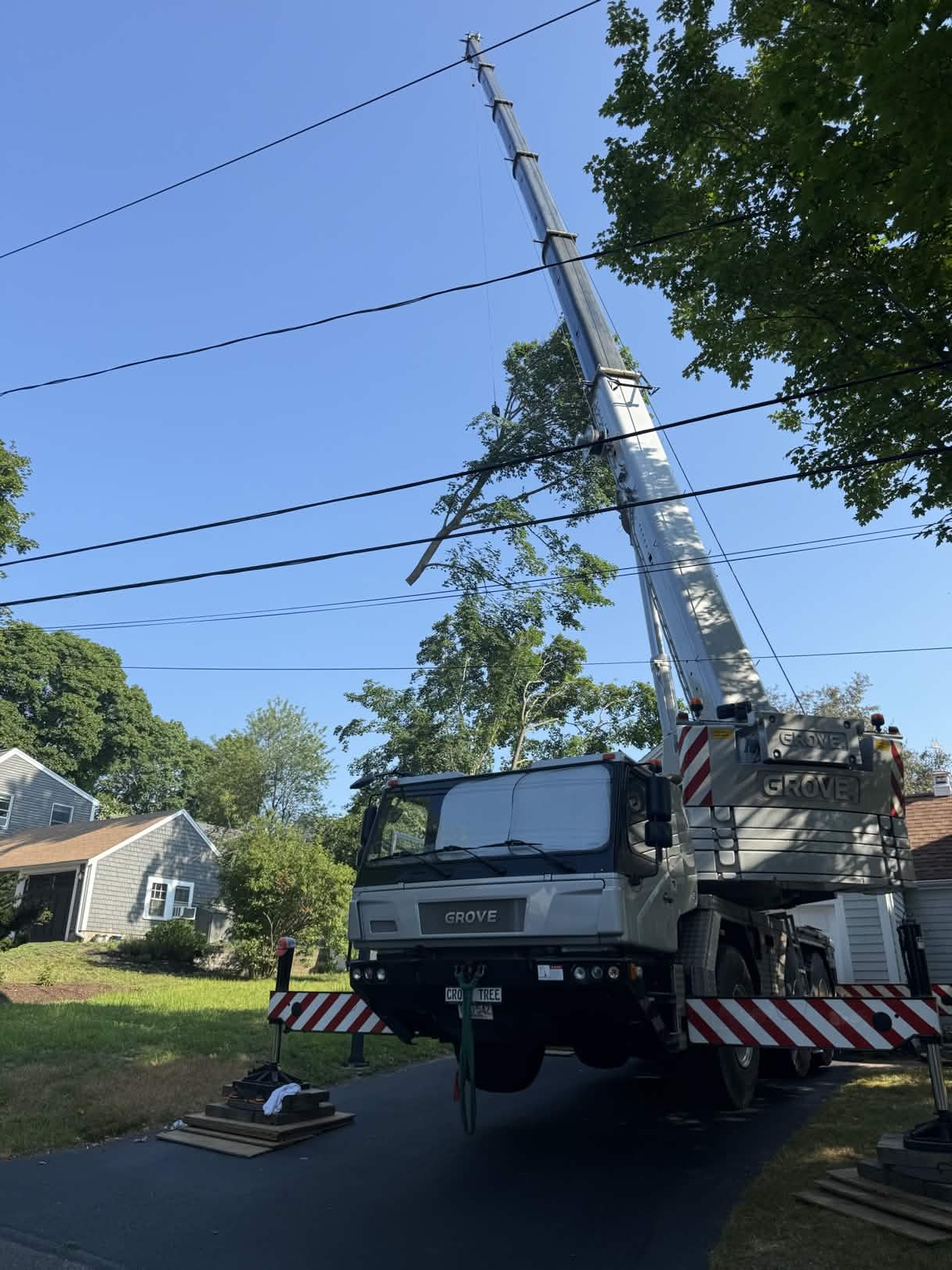
Key pricing factors: Height drives costs—80-foot hemlocks in East Braintree hit $8,000-$10,000 due to crane access. Species matter; conductive silver maples in Pond Plain require denser cables (+15%). Ledge soils in Braintree Hill necessitate extra rods (+$500-1,000). Multi-tree discounts apply in Five Corners (10-20% off second tree).
Southeast Arborist's transparent pricing includes assessment, permits, and first-year inspection—no hidden fees. Compared to $15,000 tree removals (common post-strike in South Braintree), systems pay back in 2-3 years. Insurance discounts of 5-10% often offset 20-30% of costs for Elm Street Area heritage properties.
Value proposition: Protected sugar maples in Watson Park retain 25% higher appraisals. Copper durability outlasts aluminum by 3x in Braintree's humid climate. Annual maintenance? $300-500/tree, preventing $20k failures.
Budget tips: Prioritize high-risk trees (tall oaks near homes). Bundle with pruning for 15% savings. Financing via our partners covers 0% APR for qualified Braintree residents.
Invest in lightning protection Braintree MA—call Southeast Arborist at 508-369-5009 for a precise quote.
When to Schedule Lightning Protection in Braintree
Schedule lightning protection in Braintree before peak storm season: May-June for installs, avoiding July-August thunderheads. Fall (September-October) suits maintenance, as dormant sap flow eases cable routing in red maples.
Urgency signs: Fresh vertical scars on white oaks, leader scorch on hemlocks, or basal heaving in silver maples post-rain. Highlands wind damage or Pond Plain flooding signals immediate action—strikes double in wet soils.
ISA Certified Arborists recommend pre-nor'easter checks in Braintree Hill. Delays risk off-season premiums (+10%).
Contact 508-369-5009 now for timely protection.
Frequently Asked Questions About Lightning Protection in Braintree
What is ANSI A300 lightning protection for Braintree trees? ANSI A300 Part 4 standards guide our copper systems for red oaks and hemlocks, ensuring interception, conduction, and grounding without tree harm—vital for Braintree Highlands ledge sites.
How effective is lightning protection on silver maples in Pond Plain? 95% effective against direct strikes; cables prevent steam explosions in conductive sap, preserving these aggressive growers near Weymouth.
Does installation hurt my white pine in Braintree Center? No—minimal pruning and clamps avoid phloem damage. Our ISA methods promote health in Dutch elm replacements.
How often do Braintree systems need inspection? Annually, per ANSI. We check corrosion on East Braintree hickories exposed to Quincy salt air.
Can lightning protection save heritage sugar maples in Elm Street Area? Yes—colonial specimens survive strikes channeled safely, avoiding heartwood decay amid emerald ash borer.
Is it worth it for Norway maples in Five Corners? Absolutely—$5k system vs. $12k removal, plus liability protection over busy intersections.
What about grounding in Braintree Hill's shallow soils? Multiple deep rods with bentonite backfill achieve <10 ohms, tailored to ledge.
Do you serve Watson Park Area emergencies? Yes—24/7 response for post-strike assessments.
Lightning Protection Throughout Braintree
Southeast Arborist provides lightning protection across Braintree neighborhoods: Braintree Center commercial zones, South Braintree heritage streets, East Braintree pines, Braintree Highlands hemlocks, Pond Plain maples, Five Corners hickories, Braintree Hill oaks, Elm Street colonials, and Watson Park specimens.
We extend to nearby Quincy, Weymouth, Holbrook, Randolph, and Milton from our Plymouth/Cohasset base. ISA Certified, ANSI compliant—call 508-369-5009 for service.