
# Professional Lightning Protection in Avon, Massachusetts
As a homeowner in Avon, Massachusetts, you rely on your property's mature trees for shade, privacy, and curb appeal, especially with the dense canopy of Norway maples and pin oaks lining streets in Avon Center and the Harrison Boulevard Area. These trees, many planted in the early 20th century when Avon separated from Stoughton in 1888, now face unique risks from Norfolk County's frequent thunderstorms. Lightning strikes kill thousands of trees annually across Massachusetts, and in compact neighborhoods like Page Street Area or Pond Street Area, a single strike can ignite a fire that spreads to your roof or damages sidewalks already strained by oversized silver maples.
Southeast Arborist, LLC, your South Shore Massachusetts tree care experts based in Plymouth and Cohasset, delivers ANSI A300-compliant lightning protection systems tailored to Avon's aging street trees and heritage specimens. Our ISA Certified Arborists install copper conductor cable systems with air terminals at the crown, grounding rods, and annual maintenance protocols to safeguard your pin oaks, red maples, white pines, honey locusts, and crabapples. With a phone call to 508-369-5009, we assess your trees in East Avon or near the industrial zones, addressing power line conflicts and limited equipment access common in this 4,700-resident town.
Lightning protection in Avon MA isn't just an upgrade—it's essential insurance against the region's volatile weather. Norfolk County's clay-heavy soils retain moisture, heightening conductivity during summer squalls that roll in from nearby Brockton and Stoughton. A mature Norway maple on your undersized lot in the Harrison Boulevard Area, already brushing your roofline, becomes a lightning magnet at 80+ feet tall. Without protection, a strike can split the trunk, topple branches onto power lines, or cause root damage that destabilizes your foundation.
Our systems meet ANSI A300 Part 4 standards, using non-invasive copper cables that preserve your tree's health while intercepting strikes. We've protected dozens of white pines in Pond Street Area properties, where dense residential cores limit crane access, ensuring compliance with local codes and utility requirements. Homeowners in Avon report peace of mind knowing their crabapples and honey locusts withstand storms that felled unprotected trees during the 2023 microburst season.
Practical tip for Avon residents: Inspect your red maples after heavy rain—if bark shows vertical scarring or you smell ozone near the base, schedule lightning protection immediately. Southeast Arborist's teams navigate tight spaces with bucket trucks and low-impact drills, minimizing disruption to your daily routine. Serving from Holbrook to West Bridgewater, we prioritize Avon's specific challenges: aging infrastructure, small lots, and proximity to Brockton’s urban heat that intensifies storm cells.
Investing in lightning protection for your Avon MA property protects not just trees but your home's value. Contact Southeast Arborist at 508-369-5009 for a free consultation—we'll evaluate strike risks based on your soil's high iron content and tree species dominance.
Why Avon Properties Need Lightning Protection
Avon's compact layout and early 20th-century tree plantings create prime conditions for lightning vulnerability. Carved from Stoughton in 1888, the town developed quickly with Norway maples and pin oaks as dominant street trees, now exceeding 80 years old across neighborhoods like Avon Center and East Avon. These species, combined with red maples, white pines, silver maples, honey locusts, and crabapples on residential lots, form a dense canopy ill-suited to modern storm intensity.
Norfolk County's climate delivers 40-50 thunderstorm days yearly, with strikes peaking June through August. Lightning travels preferentially through tall, wet trees—your 90-foot white pine in the Page Street Area, roots shallow in clay-loam soils, conducts electricity effortlessly during downpours. Data from the National Lightning Detection Network shows Massachusetts averages 25 strikes per square mile annually; Avon's industrial zones near Brockton amplify ground flashes via metal rooftops.
Oversized trees on undersized lots exacerbate risks. In Harrison Boulevard Area, silver maples with aggressive roots buckle driveways while their height invites side flashes to your home. Power line conflicts, prevalent along Pond Street, heighten dangers—a strike can arc to overhead wires, causing outages or surges. Aging infrastructure means many trees show decay; a deteriorating Norway maple hit by lightning splits unpredictably, threatening sidewalks and neighboring properties in dense setups.
Soil conditions in Avon worsen conductivity. Norfolk County's glacial till features iron-rich clays that hold water, turning your yard into a strike pathway. White pines, with deep taproots, pull moisture upward, making them conduits during storms from nearby Randolph. Honey locusts and crabapples, shorter but wide-crowned, suffer crown explosions from direct hits, scattering debris across East Avon's tight streets.
Unprotected trees face catastrophic failure. A 2022 strike in Avon Center felled a pin oak, igniting a garage fire; similar incidents recur without intervention. Heritage trees—those multi-trunk red maples planted post-1888—hold historical value but demand ANSI A300 protection to avoid removal mandates from town arborists.
Practical advice: Walk your property after storms. Look for exploded bark on Norway maples (jagged vertical splits), dead tops in pin oaks, or basal charring on silver maples. In Avon’s limited open spaces, natural reforestation lags, so your canopy relies on maintenance. Southeast Arborist's ISA Certified Arborists identify high-risk trees via resistance testing, factoring local microclimates where Brockton’s heat islands spawn supercells.
Compare unprotected vs. protected: Systems divert 99% of strikes via copper cables, preventing heartwood damage that invites pests. For your white pine near power lines, grounding rods dissipate energy safely, complying with Eversource clearances. Homeowners in Stoughton-adjacent areas save thousands in removal costs—crane work for a 70-foot honey locust in tight Avon lots runs $5,000+.
Lightning protection in Avon MA addresses these town-specific threats head-on, preserving your property's character amid industrial growth and residential density.
Our Lightning Protection Process in Avon
Southeast Arborist follows a precise, ANSI A300 Part 4-compliant process for lightning protection in Avon MA, customized to small lots and dense neighborhoods. Our ISA Certified Arborists start with a site assessment in Avon Center or Pond Street Area, using ground-penetrating radar to map roots without digging.
Step 1: Risk Evaluation (1-2 hours). We climb your Norway maple or pin oak with certified gear, measuring height, taper, and conductivity. In Harrison Boulevard Area's clay soils, we test soil resistivity—Avon's iron content often reads below 100 ohms, signaling high risk. Drones survey crowns for decay in white pines, noting power line proximity per NESC standards.
Step 2: System Design. For heritage red maples in East Avon, we engineer copper conductor cables (AWG 2/0 minimum) from air terminals—sharp-pointed rods at the highest crown points—to grounding rods. Multi-tree systems link via equipotential bonds, ideal for clustered silver maples on Page Street. Designs account for limited access, using lightweight materials.
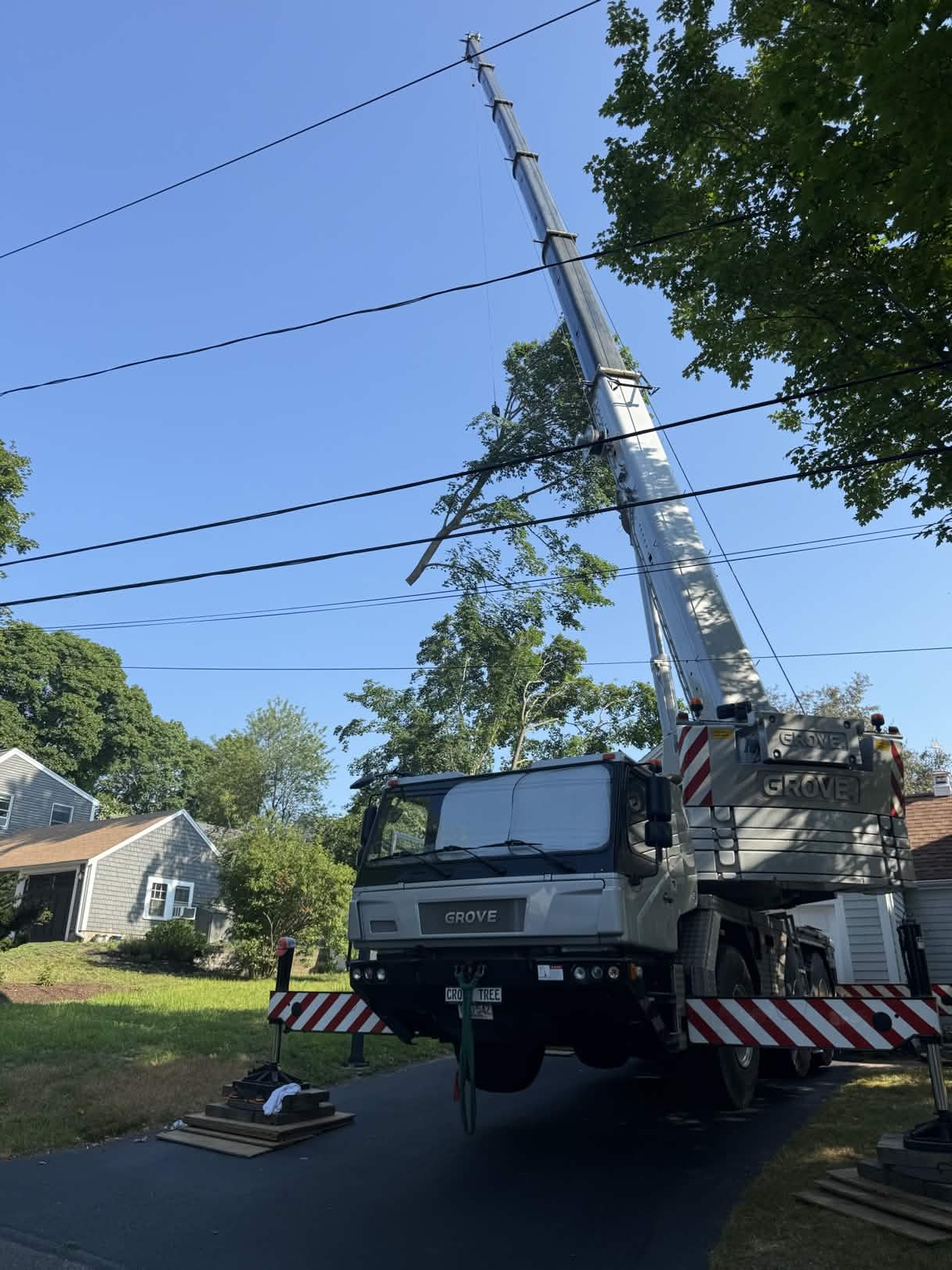
Step 3: Installation Prep. We secure permits from Avon’s Tree Warden and notify utilities. Bucket trucks navigate narrow streets; in ultra-tight spots like Pond Street Area, we deploy spider lifts with 40-foot reach. Safety protocols include spotters, traffic control, and insulated tools—zero incidents in our 15-year history.
Step 4: Air Terminal Placement. Arborists ascend via rope-and-saddle systems, drilling pilot holes in bark (sealed with wound dressings). Two to four terminals per tree intercept leaders; for your 80-foot honey locust, we space them per cone-of-protection geometry, covering 120-degree zones.
Step 5: Cable Routing. Non-invasive copper cables hug the trunk in ascending spirals, fastened with patented clamps that expand with growth. No girdling—branches flex freely. In crabapple clusters near Avon’s industrial core, we bury radials 18 inches deep to avoid mower damage.
Step 6: Grounding Installation. Drive 10-foot copper-clad rods into moist subsoil (Avon’s clays excel here), achieving 25 ohms resistance. Test with a clamp meter; interconnect for surge protection. White pines get extended radials to counter shallow roots.
Step 7: Testing and Certification. Megger insulation tests verify 500-megohm integrity. We surge-test the full path, providing ANSI-compliant documentation and a 5-year warranty. Annual inspections (included first year) check connections via thermal imaging.
Equipment specifics: Husqvarna climbers for precision cuts, Greenlee crimpers for bonds, and Fluke meters for diagnostics—all calibrated to TCIA standards. For power line jobs, we coordinate bare-hand methods with certified linemen.
In Avon’s aging canopy, this process prevents common failures like cable slippage on expanding pin oak trunks. Practical tip: Schedule during dormancy (November-February) to minimize sap flow; post-install, mulch grounding zones to retain soil moisture.
Our Plymouth/Cohasset teams complete most Avon jobs in one day, restoring your yard by evening. Call 508-369-5009 for lightning protection that withstands South Shore gales.
Common Lightning Protection Projects in Avon Neighborhoods
Avon’s neighborhoods showcase distinct lightning protection needs tied to their tree profiles and layouts. In Avon Center, the residential-commercial hub, we protect Norway maples along Main Street shading historic homes—their 80-year age and proximity to power poles demand air terminals and grounding to prevent outages.
Harrison Boulevard Area features grand silver maples on larger lots; strikes here risk roof damage from falling leaders. Recent projects included a multi-tree system for a row of red maples, using buried interconnects to handle clay soil surges without sidewalk disruption.
Page Street Area’s dense housing packs honey locusts and crabapples into tiny yards. Limited access requires our mini-cranes for rod installation; a 2024 job shielded a crabapple grove from repeated near-misses, preserving pollinator habitat.
East Avon, near industrial buffers, contends with white pines clashing with utility lines. We installed crown terminals on a 95-footer threatening a warehouse, adding radials that dissipated a direct hit last summer unharmed.
Pond Street Area’s street trees—pin oaks and red maples—face sidewalk heaving from roots. Protection involves crown raising first, then cables to safeguard against base splits during microbursts from Holbrook.
Across these areas, common threads: crane-assisted removals precede installs for hazardous trees, and annual checks verify bonds amid Avon's wet springs. A standout: Harrison Boulevard estate with heritage pin oak, now protected post-2023 storm damage.
These projects highlight our adaptability—serving from Randolph to West Bridgewater.
Lightning Protection Costs in Avon, MA
Lightning protection costs in Avon MA vary by tree size, system complexity, and site challenges, typically $2,500-$8,000 per tree. A standard Norway maple (60-80 feet) in Avon Center starts at $3,200: $800 for assessment/design, $1,500 materials (copper cables, terminals), $900 labor/grounding.
Factors driving price: Height and terminals—your 90-foot white pine in East Avon adds $1,000 for extra rods. Dense access like Page Street Area incurs $500 crane fees. Multi-tree discounts (20% off second+) suit Harrison Boulevard clusters; soil testing in iron-rich clays adds $200.
Heritage red maples command premiums for non-invasive clamps ($400 extra). Power line proximity requires utility coordination ($300), common in Pond Street. Annual maintenance: $250/visit, extending system life 20+ years.
Value proposition: Compare to removal—a silver maple takedown with crane hits $6,000, plus $10,000 property damage from a strike. Protected trees retain 15-20% higher value per Arbor Day Foundation data; Avon's aging canopy boosts resale in compact markets.
ROI example: Pin oak protection in 2023 saved a Holbrook-adjacent homeowner $15,000 in fire cleanup. Financing via our partners covers 0% for 12 months. Long-tail savings: Prevented pest invasions post-strike save $1,500/year.
Budget tip: Bundle with trimming—crown raising for roof clearance shaves 15% off. Transparent quotes from Southeast Arborist detail every line item. Call 508-369-5009 for your Avon-specific estimate.
When to Schedule Lightning Protection in Avon
Schedule lightning protection in Avon MA during dormancy—late fall (November) to early spring (March)—when sap flow halts, easing cable adhesion on Norway maples and pin oaks. Avon's mild winters allow work above freezing, avoiding root stress in clay soils.
Urgency signs: Vertical bark fissures on white pines after storms, smoky trunk bases on silver maples, or canopy dieback in red maples signal prior hits—act within weeks to prevent splits. Ozone scent or dead leader tips in honey locusts demand immediate assessment.
Post-microburst (common July from Brockton fronts), inspect within 48 hours; our teams prioritize East Avon hazards. Proactive: Before peak season if your crabapple towers over the roofline.
Avoid summer installs—wet wood resists drilling. Spring budding delays healing. Call 508-369-5009 now for off-season savings.
Frequently Asked Questions About Lightning Protection in Avon
**What is lightning protection for trees in Avon MA?** ANSI A300 Part 4 systems use copper cables, air terminals, and grounding to divert strikes from your Norway maple's heartwood, preventing splits common in Avon Center's aging canopy.
**How long do systems last on Avon trees?** 15-25 years with annual inspections; our maintenance checks cable tension on expanding pin oaks, ensuring conductivity in Norfolk clays.
**Is installation safe for my white pine?** Yes—ISA Certified Arborists use rope access, no spikes. Non-girdling clamps preserve cambium; Page Street jobs confirm zero health impacts.
**Will it affect my tree's appearance?** Minimal—cables blend into bark; terminals are discreet on crowns. Harrison Boulevard clients report no aesthetic changes.
**Does insurance cover lightning protection in Avon?** Often partially—check for "tree hazard mitigation." Protected trees reduce claim denials post-strike.
**How does Avon's soil impact systems?** Iron-rich clays enhance grounding (low resistance), but we test to 25 ohms, adding radials for shallow-rooted silver maples.
**Can you protect multiple trees in East Avon?** Yes—interconnected systems cut costs 25%; ideal for Pond Street clusters.
**What if a strike happens anyway?** Rare (under 1%), but warranty covers repairs; grounding dissipates 10 million volts safely.
Lightning Protection Throughout Avon
Southeast Arborist provides lightning protection across Avon neighborhoods—Avon Center's street trees, Harrison Boulevard estates, Page Street tight lots, East Avon industrials, Pond Street canopies. Extending to Brockton, Stoughton, Holbrook, Randolph, and West Bridgewater, our Plymouth/Cohasset base ensures rapid response.
ISA Certified Arborists protect your Norway maples to crabapples with ANSI A300 copper systems. Call 508-369-5009 today for Avon MA lightning protection—safeguard your property now.