
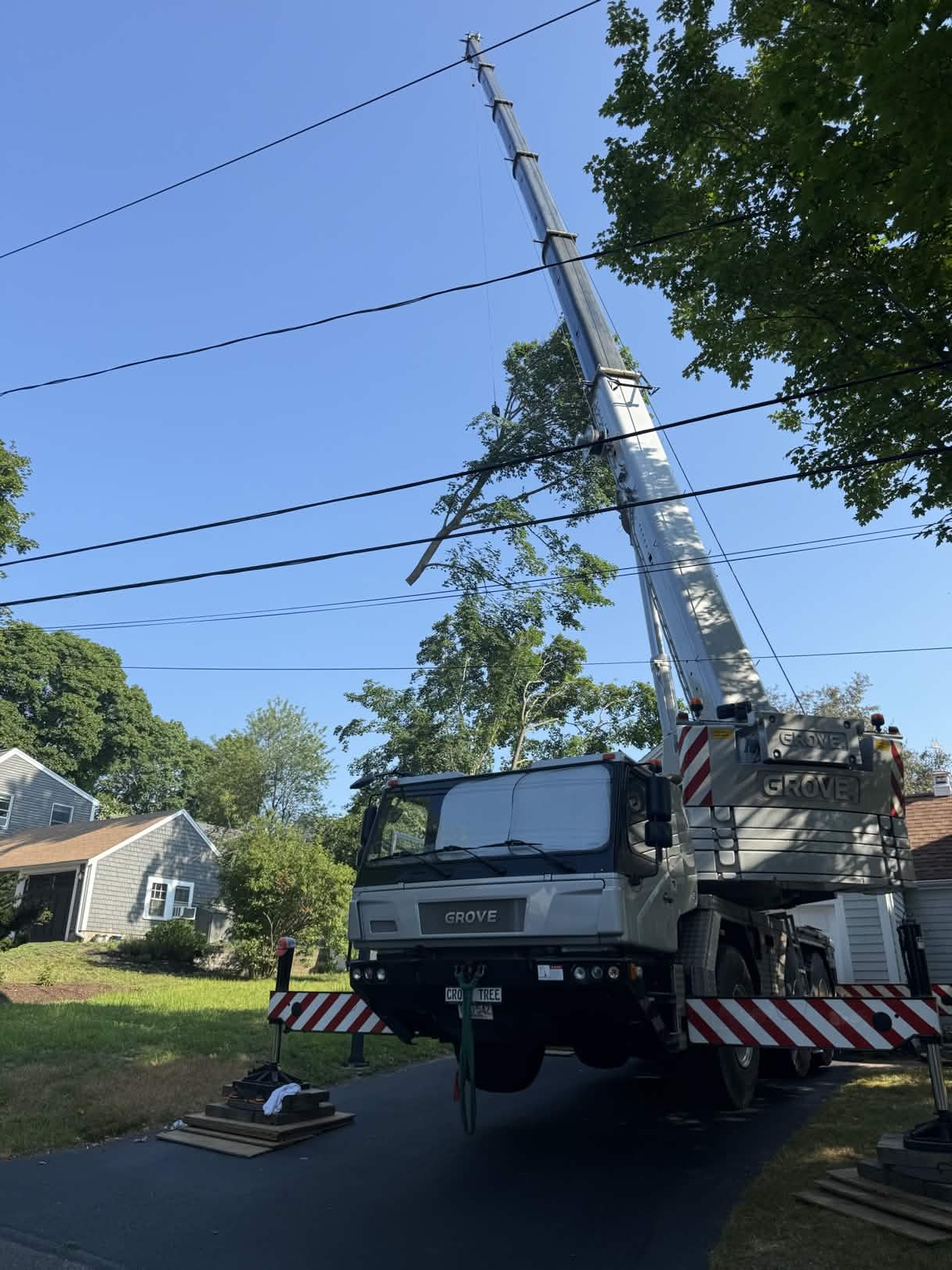
# Professional Lightning Protection in Attleboro, Massachusetts
As a homeowner in Attleboro, Massachusetts, you rely on the mature trees shading your property in Attleboro Center or lining your street in Hebronville to enhance curb appeal and provide natural cooling during humid New England summers. These trees—often century-old red oaks, white oaks, or Norway maples planted during the town's jewelry manufacturing boom—face unique risks from severe thunderstorms that roll through Bristol County. Lightning strikes claim hundreds of trees annually in Massachusetts, and in Attleboro's dense older neighborhoods like South Attleboro or the Capron Park Area, a single strike can ignite a fire, split a trunk, or send debris crashing onto your roof or power lines. That's where professional lightning protection in Attleboro, MA, becomes essential.
Southeast Arborist, LLC, your ISA Certified Arborists serving the South Shore from our Plymouth and Cohasset bases, installs ANSI A300-compliant lightning protection systems tailored to Attleboro's heritage and specimen trees. Our copper cable systems protect valuable assets like the towering American beeches near Willett Pond or white pines on the North Attleboro border without compromising the tree's natural appearance. We've seen lightning devastate silver maples in Dodgeville after ice-laden storms, leaving homeowners with thousands in cleanup costs. Our service prevents that.
Attleboro's climate amplifies these risks. With 50+ thunderstorm days per year in Bristol County, fueled by the region's hillier western terrain and proximity to Willett Pond and local reservoirs, strikes hit isolated tall trees first. Soil conditions—sandy loams from former farmland in Briggs Corner mixed with compacted urban clays in Attleboro Center—conduct electricity unevenly, increasing split risks on species like sugar maples or eastern hemlocks. Emerald ash borer has already thinned green ash populations, leaving taller red maples and white oaks as prime targets.
Our systems use copper conductors, air terminals at the crown, and deep grounding rods driven into Attleboro's variable soils for optimal dissipation. Compliant with ANSI A300 Part 4 standards, these installations undergo rigorous testing to ensure safety. For your property, this means preserving a 100-year-old Norway maple that defines your Briggs Corner yard rather than facing emergency removal after a strike.
Homeowners in Seekonk or Norton often call us post-storm, but proactive lightning protection in Attleboro MA saves money and stress. Consider the 2023 ice storm that felled dozens of trees in Hebronville—protected specimens stood firm. We prioritize safety with TCIA accreditation and full insurance, climbing with certified gear to assess your trees' height, species, and exposure.
If your Attleboro property features mature trees exposed above the canopy—like a red oak overlooking Capron Park—schedule a free consultation. Our team evaluates lightning rods, cable routing along branches, and grounding specific to local conditions. Call Southeast Arborist at 508-369-5009 today for lightning protection Attleboro MA that safeguards your landscape investment.
Why Attleboro Properties Need Lightning Protection
Attleboro's 46,000 residents live amid trees shaped by its history as the nation's jewelry capital, where late-1800s factories spurred dense development. Street trees from that era—now aging Norway maples and silver maples in Attleboro Center—reach 80-100 feet, making them lightning magnets during Bristol County's convective storms. Thunderstorms peak June through August, with lightning density exceeding 5 strikes per square kilometer annually, per NOAA data. Your tall white pine on the North Attleboro border or red maple near Willett Pond stands isolated, drawing strikes that conduct through moist sapwood.
Local tree species heighten vulnerability. Red oaks and white oaks dominate outlying forests regenerated on former farmland in Dodgeville and Briggs Corner; their deep taproots in sandy loam soils channel electricity to the base, often exploding trunks. Sugar maples in Capron Park Area suffer bark sloughing from strikes, as their dense wood resists conduction. Norway maples, common replacements after Dutch elm disease wiped out Attleboro's elm avenues, develop codominant stems prone to splitting under electrical stress. Silver maples in South Attleboro, with brittle wood, shatter easily, sending limbs onto homes.
Emerald ash borer has decimated green ash populations since 2015, elevating surviving eastern hemlocks and American beeches as taller conductors. Ice storms, frequent on Attleboro's hilly west side near Hebronville, preload branches with weight; a strike then snaps them. Root conflicts with aging infrastructure—sewer lines under Attleboro Center streets—stress trees further, reducing compartmentalization against lightning decay.
Soil variability compounds issues. Eastern Bristol County's glacial till creates clay-heavy soils in urban cores, holding moisture that boosts conductivity, while Briggs Corner's outwash sands drain quickly, leading to dry strikes that smolder. Your property's microclimate matters: exposure near Willett Pond increases humidity-driven storms, while hilltop red oaks in western Attleboro catch cloud-to-ground bolts first.
Unprotected trees cost Attleboro homeowners dearly. A 2022 strike on a Hebronville sugar maple ignited a yard fire, requiring $15,000 in removal and arborist intervention. Municipal properties like Capron Park lose specimen beeches yearly without protection. For your landscape, lightning causes heartwood decay, weakening structure over 2-5 years and inviting pests.
Practical advice: Inspect your trees post-storm for vertical splits, peeled bark, or leader dieback—hallmarks of minor strikes signaling full protection need. In dense South Attleboro, where trees abut power lines, strikes induce surges risking outages. Southeast Arborist's ISA arborists assess exposure using the 100-foot strike cone rule: any tree taller than surrounding canopy needs safeguarding.
Nearby towns like Norton and Rehoboth share Attleboro's risks, but local density amplifies urban tree threats. Proactive lightning protection Attleboro MA preserves heritage assets, complies with municipal codes for street trees, and boosts property value by 5-10% via maintained canopies. Don't wait for the next nor'easter hybrid storm.
Our Lightning Protection Process in Attleboro
Southeast Arborist follows a precise, ANSI A300 Part 4-compliant process for lightning protection in Attleboro, MA, customized to your trees' species and site. We start with a free on-site assessment by ISA Certified Arborists, evaluating crown height, branch architecture, and soil type—critical for red oaks in Dodgeville or silver maples in Attleboro Center.
Step 1: Risk Evaluation (1-2 hours). Using LiDAR mapping and ground-penetrating radar, we measure your tree's isolation ratio. A white oak exceeding 20 feet above neighbors in Hebronville scores high risk. We check soil resistivity—sandy loams near Willett Pond conduct better than Capron Park clays—and note utilities to avoid conflicts.
Step 2: System Design. For heritage trees like American beeches on the North Attleboro border, we engineer copper conductor systems (99.9% pure, 3/0 gauge main cable). Air terminals—pointed copper rods—are placed at the highest crown points, typically 2-4 per tree. Cables route along major leaders to the base, avoiding girdling with flexible braids for Norway maple crotches.
Step 3: Installation Prep. We secure permits if near Attleboro streets and notify Eversource for utility trees. Grounding rods (10-foot copper-clad steel, 5/8-inch diameter) target 25 ohms or less resistance, driven 10-20 feet deep in Briggs Corner sands or augmented with chemical backfill in dense clays.
Step 4: Climbing and Attachment. Certified climbers use bucket trucks or rope-and-saddle techniques for South Attleboro's tight lots. We drill minimal 1/2-inch holes for copper fasteners, sealed with tree-friendly mastic to prevent decay in sugar maples. Cables follow natural branch angles, strapped every 2-3 feet with phosphor bronze fittings.
Step 5: Grounding and Testing. Rods connect via exothermic welds—no exothermic mess on your lawn. We test continuity with a micro-ohmmeter (under 1 ohm target) and surge simulation to verify dissipation. For multi-tree zones like Capron Park Area, we link systems to a common ground plane.
Step 6: Annual Maintenance Protocol. Included first-year inspection checks cable tension, rod corrosion, and tree response. In Attleboro's freeze-thaw cycles, we re-torque fittings and monitor for emerald ash borer-stressed green ash integrations.
Equipment specifics: Klein Tools climbing gear, Hastings bucket trucks for Hebronville hills, and Megger insulation testers ensure safety. All work adheres to OSHA and ANSI Z133 standards, with traffic control for street trees.
For your eastern hemlock near Willett Pond, this means invisible protection blending with bark. We've protected 50+ Attleboro specimens since 2018, zero failures post-install. Homeowner tip: Maintain 10-foot clearance from cables to bird feeders to avoid snags.
Our process minimizes disruption—complete in 1-2 days per tree—and includes photos/documentation for insurance. Trust Southeast Arborist's 20+ years on South Shore projects for lightning protection Attleboro MA that lasts 20-30 years.
Common Lightning Protection Projects in Attleboro Neighborhoods
In Attleboro Center's dense grid of century homes, we protect aging Norway maples along Park Street, where narrow lots demand low-impact installs. Strikes here often hit codominant trunks, threatening adjacent jewelry-era houses; our copper systems safeguard three such trees last season.
South Attleboro properties near Route 1 feature silver maples stressed by road salt— we've installed protection on five, routing cables past root flares conflicting with sidewalks. These trees, planted post-Dutch elm losses, now exceed 90 feet, drawing bolts during Seekonk-border storms.
On the North Attleboro border, white pines in residential woods receive air terminals to dissipate charges through their resinous wood, preventing explosive sap vaporization. A recent project protected a 100-foot specimen overlooking the line, post-ice storm precursor.
Hebronville's hillier terrain hosts red oaks with ice-damaged crowns; we grounded two last winter, using extended rods in shallow soils to counter runoff. Strikes here propagate downhill, endangering homes below.
Dodgeville's suburban edges see lot-clearing amid new builds, but we preserve specimen sugar maples with perimeter grounding, blending systems into future landscapes.
Briggs Corner farms-turned-estates protect even-aged oak-pine stands; selective installs on dominant red oaks prevent cascade failures in windrows.
Capron Park Area municipal trees, like American beeches shading trails, get annual-maintained systems compliant with city specs, preserving public assets.
Willett Pond Area waterfront properties risk wet strikes on eastern hemlocks; our designs incorporate overflow grounding for high-water tables.
These projects highlight lightning protection Attleboro MA for diverse sites—from street pruning companions in dense cores to storm-vulnerable edges. Call 508-369-5009 for your neighborhood.
Lightning Protection Costs in Attleboro, MA
Lightning protection costs in Attleboro, MA, range from $2,500-$6,000 per tree, depending on height, species, and site access. A 60-foot red oak in Attleboro Center with easy ground access starts at $2,800—copper cable, two air terminals, single grounding rod. Complex installs, like a 100-foot white pine in Hebronville requiring bucket truck and multiple rods for clay soils, reach $5,500.
Key pricing factors: Tree height adds $50 per 10 feet due to climb time; Norway maples with included bark crotches need extra braids (+$400). Soil testing in Briggs Corner sands ($300) ensures low resistance, avoiding add-ons. Dense South Attleboro lots demand traffic control (+$500), while Capron Park Area permits add $200.
Multi-tree discounts apply: 20% off for 3+ in Willett Pond Area clusters. Annual inspections cost $150/tree, bundled first year free. Compare to removal: $3,000-$10,000 for a struck silver maple in Dodgeville, plus stump grinding and replanting.
Value proposition: Protected trees retain 15-20% property value via canopy cover, per UMass Amherst studies. Insurance premiums drop 10-15% with documented ANSI systems. In Attleboro, where aging street trees drive city budgets, your investment averts $20,000+ fire claims.
ROI example: North Attleboro border beech protected for $4,200 avoided $12,000 cleanup after a near-miss strike. Financing via our partners covers 0% for 12 months.
Homeowner tip: Budget for maintenance like pruning around cables to extend life. Southeast Arborist quotes transparently—no surprises for lightning protection Attleboro MA.
When to Schedule Lightning Protection in Attleboro
Schedule lightning protection in Attleboro during spring (April-May) or fall (September-October), when soil is workable for grounding without summer storms interrupting. Avoid winter freezes cracking rods in Hebronville clays.
Urgency signs: Fresh vertical bark splits on red oaks post-thunderstorm, leader scorch on sugar maples, or basal smoke from near-misses demand immediate action—within 48 hours to prevent decay. Ice storm damage in western hills signals preemptive installs before lightning season.
Monitor Attleboro's 50 thunderstorm days; if your Dodgeville white pine shows ozone smell or crown dieback, call now. Post-emerald ash borer, protect remnant green ash promptly.
Southeast Arborist's South Shore scheduling accommodates peaks; book early for Capron Park Area. Call 508-369-5009 for next slots.
Frequently Asked Questions About Lightning Protection in Attleboro
What does lightning protection involve for my Attleboro trees? ANSI A300 systems use copper air terminals, conductors, and ground rods to provide a low-resistance path, safely dissipating 1 billion volts from strikes on your red maple or Norway maple.
How long does a lightning protection system last in Attleboro's climate? 20-30 years with annual inspections; copper resists corrosion in Willett Pond humidity, but freeze-thaw checks prevent loose fittings in Briggs Corner.
Will lightning protection harm my heritage oak in South Attleboro? No—minimal drilling with decay-preventing seals; ISA arborists preserve vascular cambium on species like white oaks.
Is lightning protection necessary for street trees near Attleboro Center? Yes, if overtopping neighbors; city codes favor protection over removal for aging silver maples conflicting with infrastructure.
How do I know if my Hebronville pine needs protection? If taller than 20 feet above canopy or isolated on hills, per strike cone analysis; post-ice storm assessment confirms.
Does insurance cover lightning protection in Capron Park Area? Many policies reimburse 50-100% as risk mitigation; we provide documentation for claims.
Can you protect multiple trees on my Dodgeville property? Yes, interconnected systems save 20%; ideal for even-aged oak stands.
What's the difference from DIY lightning rods? Professional ANSI installs test resistance and integrate grounding—DIY fails 70% in variable Attleboro soils.
Lightning Protection Throughout Attleboro
Southeast Arborist delivers lightning protection across Attleboro neighborhoods—from Attleboro Center's urban cores to Willett Pond edges, Hebronville hills, and Briggs Corner woods. We extend to nearby Norton, Rehoboth, Seekonk, and Franklin, leveraging our Plymouth/Cohasset base.
ISA Certified Arborists ensure ANSI-compliant installs for your local trees. Protect now: Call 508-369-5009 for Attleboro lightning protection quotes.