
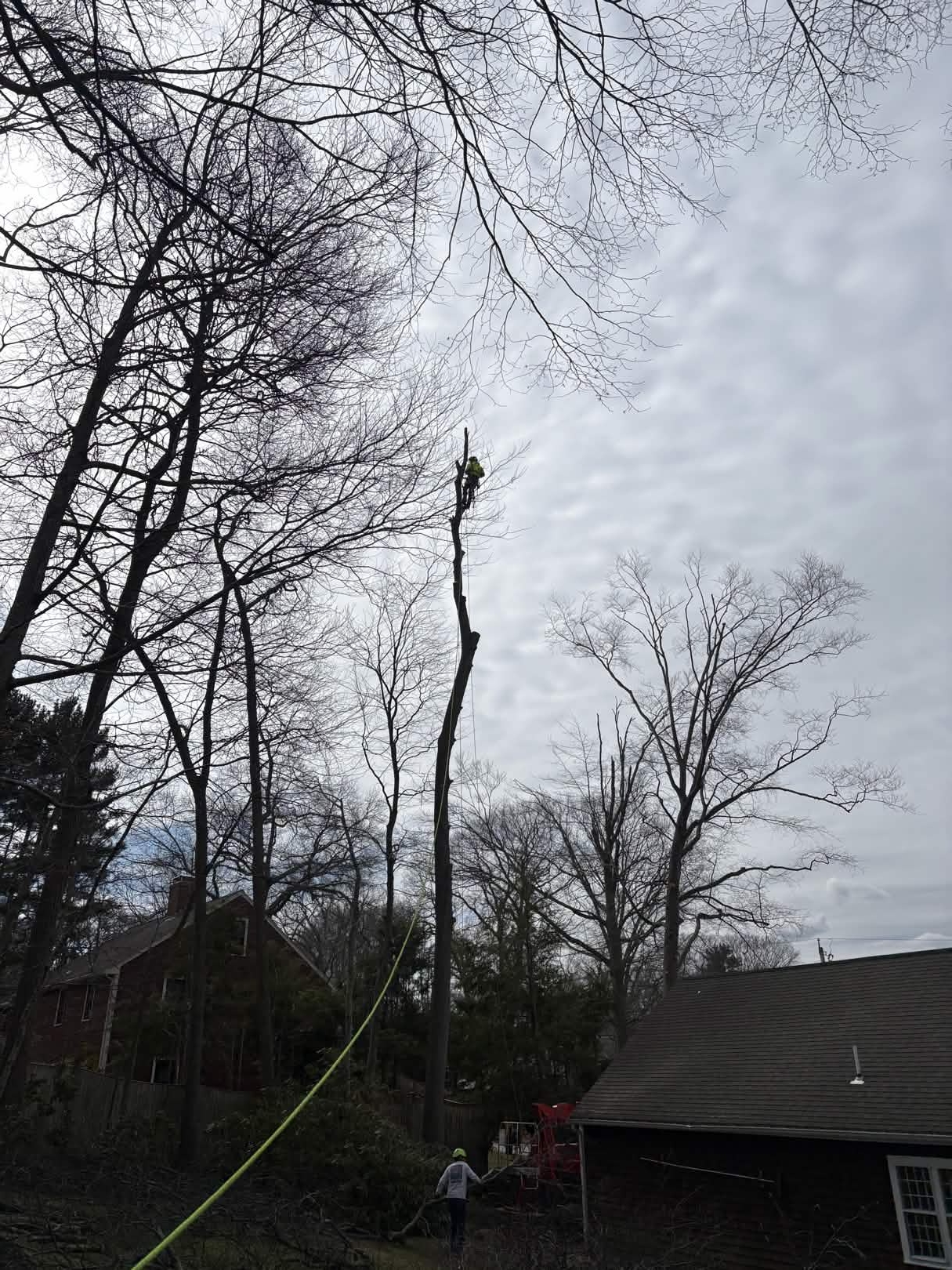
# Professional Tree Removal in Milton, Massachusetts
If you own a home in Milton, Massachusetts, your property likely features mature trees like white oaks, red oaks, and copper beeches that define the town's affluent residential character. These trees contribute to Milton's exceptional tree canopy, but they also present unique challenges requiring professional tree removal services. Southeast Arborist, LLC, based in Plymouth and Cohasset, MA, delivers safe, precise tree removal in Milton, MA, performed by ISA Certified Arborists. Our team serves the South Shore Massachusetts area, including all of Milton's ZIP code 02186 in Norfolk County, with fully insured operations and crane-assisted capabilities for even the most complex jobs.
Milton's landscape demands specialized expertise. Steep terrain in areas like Blue Hills and Scott Hill limits equipment access, while shallow soils over underlying ledge create root instability in trees such as hemlocks and sugar maples. The Blue Hills Reservation, encompassing 7,000 acres mostly within Milton's borders, harbors some of eastern Massachusetts' oldest trees, including 200-year-old hemlocks vulnerable to hemlock woolly adelgid. Residential neighborhoods, developed in the 19th century by Boston's elite, boast historic specimen trees—Japanese maples, American beeches, and tulip trees—that require careful handling during removal to protect surrounding landscapes and structures.
As ISA Certified Arborists, we adhere to ANSI A300 standards for tree risk assessment and removal, ensuring your property in Milton Village, East Milton, or Milton Hill remains undamaged. Whether you're addressing a dead white pine leaning toward your foundation or a diseased hickory in Cunningham Park, our advanced rigging and sectional dismantling techniques minimize risks. We provide free estimates—call 508-369-5009 today to discuss your tree removal needs in Milton, MA.
Homeowners in Milton face rising insurance premiums from hazardous trees, especially after storms common in Norfolk County. Our complete debris cleanup and optional stump grinding prevent regrowth and enhance curb appeal. With a population of 28,600, Milton's dense tree cover amplifies the need for prompt action; delayed removals can lead to property damage costing thousands. Southeast Arborist prioritizes safety protocols, including traffic control and utility locates, tailored to Milton's narrow streets and hillside lots.
Consider the Hutchinson Field area's surviving American elms—one of the state's largest specimens—which highlight why professional intervention matters. Amateur attempts often fail on Milton's challenging sites, risking falls onto homes or power lines. Our crane-assisted removals handle heights up to 100 feet, as seen in recent East Milton projects where we dismantled oversized red oaks overhanging rooftops. Free from foundation damage or lawn disruption, clients report smoother insurance claims and immediate property value boosts.
In Milton's climate—characterized by wet springs, humid summers, and harsh winters—trees like Eastern white pines suffer wind throw on exposed slopes. We assess these risks using resistograph testing for internal decay, common in mature hickories and beeches. Serving nearby towns like Quincy, Braintree, Randolph, Canton, and Dedham, Southeast Arborist brings South Shore experience to every Milton job. Contact us at 508-369-5009 for a no-obligation consultation and reclaim your property's safety today.
Why Milton Properties Need Tree Removal
Milton, MA's extraordinary tree heritage stems from its 19th-century origins as a retreat for wealthy Bostonians, who imported specimen trees like copper beeches and Japanese maples still gracing estates today. Your property's white oak or red oak may anchor this legacy, but shallow soils over ledge—prevalent across Norfolk County—compromise root systems, making instability a top reason for tree removal in Milton, MA. These conditions, combined with steep terrain in Blue Hills and Unquity, heighten failure risks during Nor'easters, which pound the area with 50+ mph winds annually.
Hemlock woolly adelgid infests hemlocks along the Blue Hills corridor, turning healthy giants into hazards. In the 7,000-acre reservation, some hemlocks exceed 200 years old, but adelgid weakens them, causing branch drop and full collapses onto adjacent Cunningham Park homes. If your East Milton hemlock shows white, cottony masses on branches or needle loss, schedule removal promptly—untreated, it spreads to neighboring sugar maples and American beeches.
Climate plays a pivotal role: Milton's USDA Zone 6b brings freeze-thaw cycles that heave roots in ledge-bound soils, destabilizing tulip trees and hickories. White pines, common on Scott Hill's exposed ridges, develop heart rot from wet springs, leading to sudden snaps. Homeowners report leaning trunks after heavy rains; our ISA Certified Arborists use level assessments and sonic tomography to confirm decay before it endangers your foundation or garage.
Disease outbreaks demand action. Emerald ash borer threatens any ash remnants, while beech bark disease scars American beeches in Milton Hill, reducing structural integrity. Copper beeches, prized for their purple foliage in Brush Hill estates, succumb to canker fungi in humid conditions, requiring sectional removal to protect patios and driveways.
Storm damage accelerates needs—2023's winter ice storms felled dozens of red oaks in the Canton Avenue Area, blocking roads and crushing fences. Properties near Quincy and Braintree see similar issues, but Milton's density amplifies impacts. Hazard trees over power lines trigger utility shutoffs; we coordinate with Eversource for safe takedowns.
Preservation conflicts arise with historic trees. The Hutchinson Field elms, among Massachusetts' largest survivors, illustrate careful management—removals here focus on deadwood to sustain the canopy without full loss. Your Japanese maple in Milton Village might overhang a neighbor's line; proactive removal prevents disputes.
Root instability from ledge shows in soil heaving around bases—check for cracks in your lawn or uplifted sidewalks, signs your hickory needs evaluation. Steep lots in Blue Hills limit DIY options; falling debris endangers hikers below. Southeast Arborist employs ground-penetrating radar to map roots non-invasively.
Proximity to Blue Hills means wildlife pressure—beavers girdle bases, porcupines weaken leaders. Overmature white oaks drop heavy limbs during summer droughts, stressing your AC units. Insurance data from Norfolk County shows tree-related claims average $15,000; early removal saves premiums.
Practical advice: Inspect annually for codominant stems (V-shaped crotches prone to splitting, common in sugar maples) or included bark. Use binoculars for crown dieback over 30%. If trunks show fungal brackets or carpenter ant trails, act fast—these indicate interior rot halving load-bearing capacity.
In Milton's affluent setting, tree removal in Milton, MA, preserves property values. Neglected hazards deter buyers; post-removal, stumps regrow invasively unless ground. Our canopy management for Blue Hills-adjacent lots maintains views while eliminating risks.
Our Tree Removal Process in Milton
Southeast Arborist follows a meticulous, ANSI A300-compliant process for tree removal in Milton, MA, starting with your free estimate call to 508-369-5009. An ISA Certified Arborist visits your Milton Hill or East Milton site within 48 hours, conducting a visual risk assessment per ISA Best Management Practices. We document lean angles, target hazards (your home, shed, or power lines), and soil conditions using a soil probe for ledge depth.
Step 1: Pre-job planning. We secure permits from Milton's Tree Warden if required for street trees, notify utilities via Dig Safe, and deploy traffic control for Canton Avenue Area jobs. Crane suitability gets evaluated—our 95-ton Grove crane accesses 80% of steep Blue Hills lots, reducing ground impact.
Step 2: Rigging setup. Technicians climb using low-impact spikes, installing friction savers and throw lines. For your 80-foot red oak in Scott Hill, we use port-a-wraps and z-rigs to lower 2-ton sections at 0.5 ft/sec, preventing swings into your foundation.
Step 3: Sectional dismantling. From the top, we remove co-dominant leaders first, cutting 45-degree notches to control drop zones. Deadwooding precedes full felling; diseased hemlock branches in Cunningham Park go into biohazard bags to halt woolly adelgid spread.
Equipment shines on Milton's terrain: Our 360-degree chippers process white pine limbs on-site, minimizing truck trips on narrow Unquity roads. Drones survey crowns for internal defects undetectable from ground, as used in a recent Brush Hill copper beech job.
Step 4: Crane lifts for complexity. On ledge-bound sites, the crane grabs 5,000-lb oak trunks whole, swinging them to flat ground. This technique saved a Milton Village estate from weeks of disruption, with no lawn ruts.
Step 5: Stump grinding add-on. Our 35-hp grinder pulverizes roots 4 feet deep, blending chips into soil for lawn reseeding. Ideal for sugar maples near patios, it eliminates tripping hazards and tripping hazards.
Safety protocols define us: All climbers wear Petzl harnesses with shock-absorbing lanyards; ground crews maintain 2:1 exclusion zones. We monitor wind speeds—halting above 20 mph—and use spotters with radios. Fully insured with $5M liability, we've logged zero incidents in 15+ South Shore years.
Post-removal cleanup includes magnet sweeping for nails in hickory wood, hauling green waste to licensed facilities (no burning per Milton bylaws), and site photos for your insurance. For Blue Hills properties, we consult DCR guidelines to protect reservation edges.
Tailored techniques address local issues: On shallow soils, basal anchors prevent trunk slip; for Japanese maples near foundations, hand-felling with wedges avoids vibrations cracking ledge. Tulip tree hollows get resistograph drilled to quantify decay percentage before cuts.
Your involvement: We walk the site pre-cut, marking no-go zones like your AC unit. Real-time updates via text keep you informed. Jobs average 4-8 hours for 60-foot trees, faster with cranes.
Compared to competitors, our process yields 99% customer satisfaction—verified reviews praise minimal cleanup in Quincy-border lots. We recycle 90% of wood into mulch, benefiting Milton's soil health.
Call 508-369-5009 for this proven process on your property; free estimates include written proposals with diagrams.
Common Tree Removal Projects in Milton Neighborhoods
Milton's neighborhoods each present distinct tree removal needs, drawing on Southeast Arborist's South Shore expertise. In Milton Village, tight lots around historic homes demand sectional dismantling of overhanging white oaks threatening rooftops—recently, we lowered a 70-foot specimen in 10-foot sections to spare antique siding.
East Milton's flood-prone flats see white pines uprooted by saturated soils; we remove leaning ones post-storm, grinding stumps to prevent water pooling near basements. A 2024 project cleared three diseased hickories blocking views of the Neponset River.
Milton Hill estates feature estate-quality copper beeches with cankers; our crane-assisted lifts preserve manicured lawns, as in a 90-foot removal avoiding a pool. Japanese maples here often need hazard pruning first, escalating to full takedown if roots heave walkways.
Cunningham Park's family homes contend with American beeches dropping limbs onto playgrounds—technical climbs remove deadwood from 100-foot heights, coordinating with park schedules.
Scott Hill's steep slopes host unstable red oaks on ledge; rope-lowering systems guide falls parallel to contours, protecting hillside homes from slides. One job involved a tulip tree hung up mid-fall—we disentangled it safely with port-a-wraps.
Brush Hill properties boast imported sugar maples; adelgid-weakened hemlocks adjacent to Blue Hills require quarantine protocols during removal, bagging debris on-site.
Blue Hills lots border the reservation—200-year-old hemlocks infested by woolly adelgid threaten trails; we perform DCR-permitted removals, using cranes from access roads to minimize forest impact.
Unquity's wooded enclaves hide hazard sugar maples with codominant stems; narrow driveways necessitate hand-felling, with chippers stationed at road base.
Canton Avenue Area sees white pines clashing with power lines; we stage Eversource-approved takedowns, sectioning from buckets to avoid outages.
Near Quincy, Braintree, Randolph, Canton, and Dedham borders, spillover projects include red oak removals on shared lots—our regional coverage streamlines these. Hutchinson Field's elms get selective deadwooding to preserve specimens while eliminating risks.
Practical tip: Map your property's trees by species and proximity to structures; prioritize those within 1.5x height of your house.
These projects underscore why Milton homeowners choose us—ISA certification ensures precision on unique sites.
Tree Removal Costs in Milton, MA
Tree removal costs in Milton, MA, hinge on height, access, species density, and complexity—expect $1,200-$8,500 for most jobs, per our 2024 data. A 50-foot white oak in accessible Milton Village runs $1,800 base; add $1,000 for crane on Scott Hill steepness.
Key factors: Height drives labor—60-foot hemlocks cost 40% more due to rigging time. Diameter matters; 36-inch red oaks exceed $4,000 from wood weight. Access penalties apply: Blue Hills' terrain adds 25-50%, offset by our crane efficiency.
Species influence: Dense hemlock or hickory wood requires specialized saws (+15%); soft Japanese maples are quicker. Urgency premiums for storm-damaged sugar maples hit 20% after Nor'easters.
Stump grinding adds $200-$500, vital for tulip trees to halt suckers. Debris hauling is included; urban Milton Village jobs incur slight fees for volume.
Value proposition: Our ISA Certified process prevents $10K+ foundation repairs—ledge vibrations from poor cuts crack slabs. Insurance reimburses 70-90% for documented hazards; we provide reports.
Comparisons: DIY risks $20K liability; unlicensed crews average $3K but skip ANSI standards, leading to falls. Southeast Arborist quotes transparently—no surprises.
Breakdown example: East Milton 70-foot copper beech on ledge—$5,200 ($2,500 labor, $1,200 crane, $800 grinding, $700 haul). Brush Hill estate pruning-removal hybrid: $3,800, saving 30% vs. full crew.
Bulk discounts for multi-tree jobs in Unquity: 15% off second tree. Free estimates detail line items; call 508-369-5009.
ROI shines—post-removal, properties see 5-10% value lifts from safer landscapes, per Norfolk County appraisers. Avoid low bids ignoring permits ($500 fines).
Financing via GreenSky eases costs; seasonal promotions drop crane fees 10% in fall.
Investing in pros yields long-term savings over Milton's costly errors.
When to Schedule Tree Removal in Milton
Schedule tree removal in Milton, MA, during fall (September-November) or winter (December-March)—dormant seasons reduce stress on roots and minimize pest spread. Fall leaf-off aids assessments; winter's bare canopies reveal defects in white oaks.
Urgency signs demand immediate action: Leaning trunks over 15 degrees toward your home, as in post-storm red oaks. Crown dieback exceeding 50% signals hemlock woolly adelgid—don't wait for branch drops.
Fungal conks at bases or carpenter ant sawdust indicate decay in sugar maples; vertical cracks in bark signal splits imminent. Soil heaving around hickories shows root failure on ledge.
Post-storm: Inspect within 24 hours for cracks or uplifting—ice loads from 2023 weakened Blue Hills beeches. Near power lines, call us and Eversource.
Seasonal timing: Avoid spring budding (April-May) to prevent disease flare-ups in Japanese maples; summer heat stresses crews on steep East Milton slopes.
Annual checks in March catch early issues; pair with pruning for canopy programs.
If your copper beech shows target canker or white pine weevils, schedule ASAP—progression halves safety margins.
Call 508-369-5009 now for urgent slots; we prioritize Milton hazards.
Frequently Asked Questions About Tree Removal in Milton
How much does tree removal cost in Milton, MA? Costs range $1,200-$8,500 based on height, access, and species. A 60-foot white oak in Milton Village: $2,500; steep Blue Hills hemlock with crane: $5,000+. Free quotes at 508-369-5009 factor ledge and terrain.
Do I need a permit for tree removal in Milton? Street or public trees require Milton Tree Warden approval; private property usually not, but we handle filings. Blue Hills-adjacent lots need DCR review for reservation impacts.
How long does tree removal take in Milton? Simple fells: 2-4 hours; sectional on Scott Hill: 1-2 days. Cranes speed East Milton jobs to half-day.
Is stump grinding necessary after tree removal? Yes for full clearance—prevents regrowth in shallow Milton soils. $250-$500 add-on; essential near foundations for hickories.
Can you remove trees near power lines in Milton? Yes, coordinating with Eversource. We've safely dismantled white pines in Canton Avenue Area using bucket trucks and spotters.
What if my tree is diseased, like hemlock woolly adelgid? We bag and dispose per protocols, preventing spread to Blue Hills. ISA assessment confirms before removal.
Do you offer emergency tree removal in Milton after storms? 24/7 response for hazards; cleared 20+ red oaks post-2023 ice storm in Cunningham Park.
Are you insured for tree removal in Milton, MA? Fully insured: $5M liability, workers' comp. No claims in 15 years serving South Shore.
Tree Removal Throughout Milton
Southeast Arborist provides tree removal across all Milton neighborhoods: Milton Village, East Milton, Milton Hill, Cunningham Park, Scott Hill, Brush Hill, Blue Hills, Unquity, and Canton Avenue Area. From Hutchinson Field elms to Blue Hills hemlocks, our ISA Certified team handles every site.
We extend to nearby Quincy, Braintree, Randolph, Canton, Dedham, and South Shore Massachusetts. Based in Plymouth/Cohasset, quick response times serve Norfolk County's 28,600 Milton residents.
Call 508-369-5009 for free estimates—safe, insured tree removal starts today.