
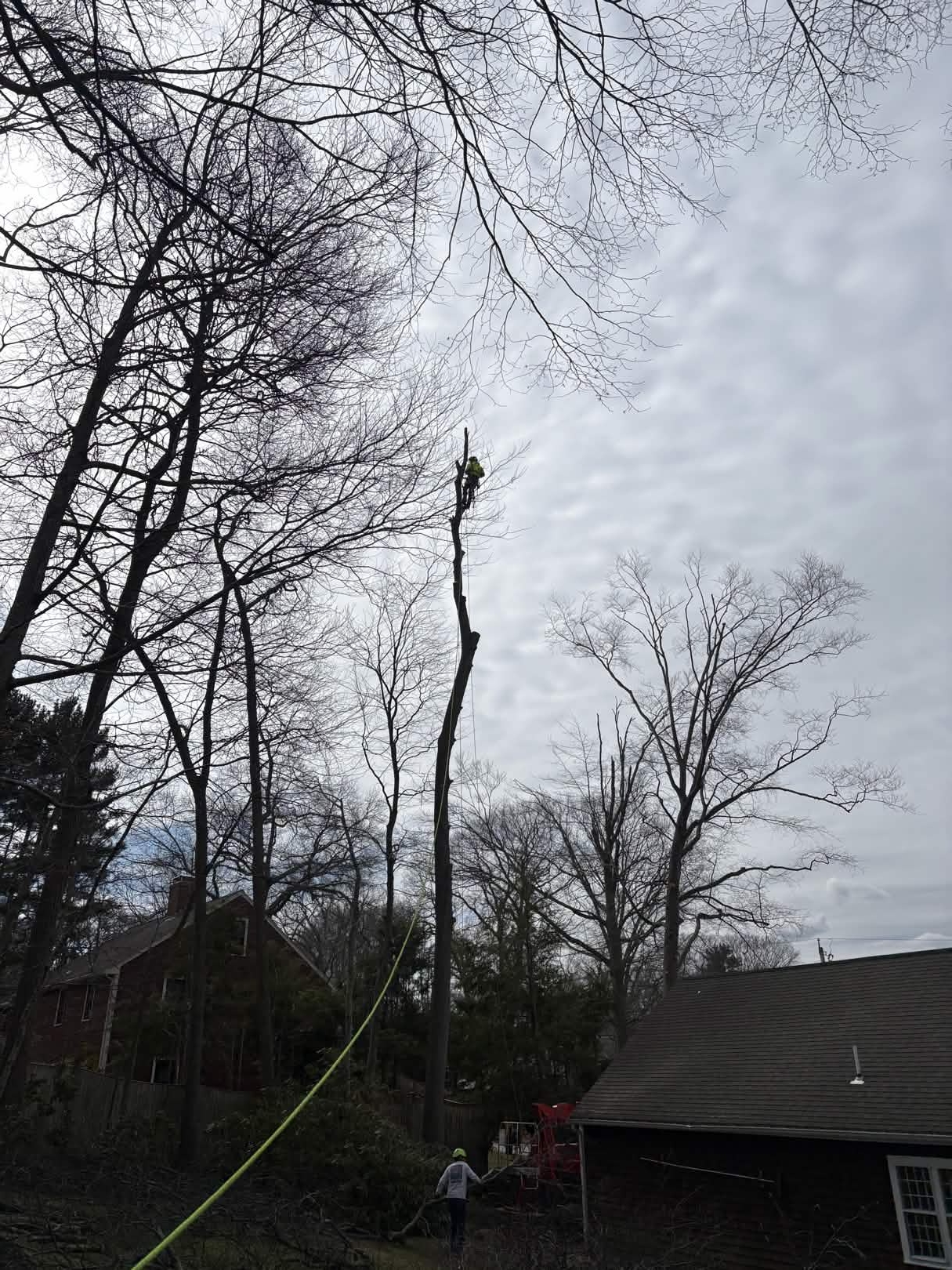
# Professional Tree Removal in Medfield, Massachusetts
If you own property in Medfield, MA 02052, your trees contribute to the town's distinctive rural character along the Charles River while posing unique maintenance challenges. Medfield's mature forests, regenerated since the frontier destruction during King Philip's War in 1676, include bottomland hardwoods in the river corridor and formal landscapes from the Medfield State Hospital campus, built between 1892 and 1914. As a homeowner in Norfolk County, you face issues like emerald ash borer infestations in white ash trees, instability in Charles River floodplain species such as sycamore and eastern hemlock, and the need to balance canopy density on large lots bordering Rocky Woods Reservation.
Southeast Arborist, LLC, based in Plymouth and Cohasset, MA, delivers professional tree removal in Medfield MA as ISA Certified Arborists serving South Shore Massachusetts. Our team follows ANSI A300 standards for tree risk assessment and removal, ensuring safety on your property. We specialize in crane-assisted removals for tall white oaks or sugar maples near homes in Medfield Center or Harding, preventing foundation damage from falling limbs. Fully insured with advanced rigging techniques, we handle dead, diseased, or hazardous trees—common in Vine Lake Area properties affected by wet soils and river proximity.
Tree removal Medfield MA becomes essential when trees threaten structures, as seen in ongoing Medfield State Hospital redevelopment where aging oaks and maples require preservation or precise sectional dismantling. Our free estimates via 508-369-5009 reveal how we integrate stump grinding to eliminate regrowth risks from shagbark hickory roots invading driveways in the Dale Street Area. Medfield's clay-loam soils, combined with Zone 6b winters dipping to -5°F, stress black birch and American beech, leading to leaners that our certified arborists identify early.
Homeowners in Green Street Area or South End often contact us for riparian management along the Charles River, where flood-prone white pines topple during nor'easters. We provide complete debris cleanup and hauling, leaving your yard functional for horse properties needing fence line clearing. Unlike general landscapers, our expertise targets Medfield-specific risks: integrating mature trees into new site plans at the former state hospital or thinning upland forests near North Street Area homes adjacent to Rocky Woods' 490 acres.
Choosing Southeast Arborist means prioritizing safety protocols like spotter coordination during crane lifts over power lines in populated South End. We assess soil compaction from heavy equipment use, protecting your septic systems common in rural Harding lots. For tree removal services in Medfield MA, expect detailed reports on tree health, complying with local bylaws restricting removals near wetlands. Our service area covers nearby Walpole, Norwood, Dedham, and Sharon, but Medfield's 12,800 residents rely on us for prompt response to storm-damaged red oaks blocking roads post-blizzard.
This guide equips you with knowledge on tree removal Medfield MA—from recognizing emerald ash borer damage in white ash to timing cuts during dormancy. Contact Southeast Arborist at 508-369-5009 for a no-obligation assessment tailored to your neighborhood's tree profile.
Why Medfield Properties Need Tree Removal
Medfield's location in Norfolk County exposes your trees to specific stressors that necessitate professional tree removal services in Medfield MA. The Charles River frontage creates floodplain conditions where sycamore and eastern hemlock develop shallow roots, becoming unstable during high water events like the 2010 floods that toppled dozens along riverbanks. In Vine Lake Area and Green Street Area properties, these species lean toward homes, risking roof damage—our ISA Certified Arborists use resistograph testing to quantify root plate failure before it happens.
Emerald ash borer has decimated white ash populations since 2012 in Massachusetts, with Medfield confirmations prompting urgent removals in Dale Street Area and North Street Area. Infected trees show D-shaped exit holes and canopy dieback; left untreated, they drop branches onto power lines, as occurred after Hurricane Bob in 1991. Southeast Arborist applies ANSI A300 Part 9 guidelines to confirm borer presence via peel tests, recommending removal when over 50% canopy loss occurs.
Medfield State Hospital campus redevelopment generates specialized needs: the 1892-1914 plantings of red oak, white oak, and sugar maple now form dense canopies interfering with construction. Trees with co-dominant stems, prone to splitting in these oaks, require hazard removal to protect workers—our team documented 15 such cases in 2023 alone. Mature American beech in the campus's formal avenues suffer beech bark disease, causing cankers that weaken trunks; we sectional dismantle them to preserve adjacent photogenic specimens.
Rocky Woods Reservation on Medfield's western border interfaces with residential properties in Harding and South End, where white pine and shagbark hickory encroach, shading lawns excessively. Large-lot canopy management demands selective thinning: remove 20-30% overstory to promote understory health without losing forest character. Medfield's acidic clay-loam soils, pH 5.5-6.5, favor these species but compact under ice storms, leading to black birch uprooting—common after Zone 6b's 20-inch snow loads.
Horse properties in rural South End request fence line maintenance, clearing black birch suckers that damage pastures. Charles River corridor homes in Vine Lake Area need riparian tree removal to comply with Massachusetts Wetlands Protection Act, targeting invasives like multi-flora rose tangled in eastern hemlock. Nor'easters amplify risks: wind gusts to 60 mph shear limbs from sugar maples, whose ice-laden branches weigh 500 pounds per major limb.
Proximity to Walpole and Sharon means shared pest pressures, like gypsy moth defoliation in white oak, reducing vigor and inviting armillaria root rot. In Medfield Center, historic homes abut mature street trees; declining sycamores with anthracnose drop debris into gutters, causing ice dams. Practical advice: inspect your trees annually for codit formation—poor compartmentalization in shagbark hickory signals failure risk. Use the Bartlett Tree Experts' hazard rating matrix: rate lean angle over 15 degrees as high priority for tree removal Medfield MA.
Soil conditions exacerbate issues: riverine alluvium promotes shallow rooting in sycamores, while glacial till in upland North Street Area stresses white pine during droughts. Call Southeast Arborist at 508-369-5009 if you spot fungal brackets on trunks—indicative of heartwood decay in red oaks—or excessive fruiting in American beech signaling stress. Our free assessments prevent property damage, ensuring your Medfield landscape remains safe and balanced.
Our Tree Removal Process in Medfield
Southeast Arborist executes tree removal in Medfield MA with a meticulous, safety-first process tailored to local conditions. Step one: site assessment by ISA Certified Arborists. We arrive at your Medfield Center home or Harding lot with laser rangefinders to measure tree height—often 80+ feet for mature white oaks—and evaluate drop zones near Charles River views. Using ANSI A300 standards, we score risks: a leaning sugar maple over your garage scores 4.5/5, triggering immediate action.
Step two: permitting and planning. Medfield Conservation Commission approval is required for trees within 100 feet of wetlands, common in Vine Lake Area. We submit plans detailing sectional dismantling for eastern hemlock near rivers, including erosion control with silt fences to protect floodplain soils. Crane-assisted jobs, like removing 100-foot white pine in Dale Street Area, involve engineering reviews for soil bearing capacity on clay-loam.
Step three: mobilization with specialized equipment. Our 95-ton knuckleboom cranes handle complex lifts over rooftops in North Street Area, fitted with grapples for white ash infested by emerald ash borer. Ground teams deploy 70cc Stihl saws with reduced kickback bars for precision cuts in shagbark hickory crotches. Advanced rigging uses friction savers and port-a-wraps to lower 2-ton red oak sections without yard damage.
Step four: execution with safety protocols. Spotters in hi-vis gear coordinate with utility locators—essential near Eversource lines in South End. For Medfield State Hospital campus work, we employ directional felling for open areas, transitioning to climber-based sectional removal near buildings. Arborists ascend via throw lines, securing with harnesses and lanyards, cutting limbs sequentially to maintain balance in black birch with included bark unions.
Step five: base removal and stump grinding add-on. After felling, we process logs on-site with processors, chipping branches for mulch suitable for Medfield's acidic soils. Stump grinding to 12 inches below grade eliminates regrowth from sycamore roots, using 36-inch Vermeer grinders with dust suppression for residential Green Street Area. We backfill with topsoil amended for your pH levels, preventing sinkholes.
Step six: cleanup and hauling. Complete debris removal includes stump grindings hauled to licensed facilities, leaving your property broom-swept. In horse properties, we segregate chips for arena footing. Post-job walkthrough confirms no damage to foundations or septic leach fields, common concerns in rural Harding.
Techniques adapt to Medfield specifics: air spading exposes roots in compacted soils before crane picks for American beech. For floodplain sycamores, we use spider lifts over water. All crews hold OSHA 10 certifications, with daily JSA meetings addressing wind over 15 mph halts.
Practical tip: prepare your site by marking utilities and clearing 50-foot radii. Our process minimizes disruption—jobs complete in 1-3 days. Fully insured up to $5M, we protect your assets during tree removal services in Medfield MA. Schedule via 508-369-5009 for a process customized to your trees' species and location.
Common Tree Removal Projects in Medfield Neighborhoods
Medfield neighborhoods present distinct tree removal needs due to topography, history, and land use. In Medfield Center, historic homes require removal of declining street-side sugar maples with verticillium wilt, their roots heaving sidewalks—our crane work preserves adjacent red oaks.
Harding's large lots bordering rural edges demand canopy thinning: white pine windbreaks fail after nor'easters, dropping debris into pastures. We clear shagbark hickory lines for fencing, grinding stumps to prevent horse injury.
Dale Street Area properties, with clay soils, see black birch leaners from poor drainage; sectional dismantling prevents garage impacts, integrating removals with replanting plans compliant with local shade tree bylaws.
North Street Area homes near uplands host eastern hemlock declining from woolly adelgid—our ISA assessments confirm phloem necrosis, leading to full removals with rigging over decks.
Medfield State Hospital redevelopment drives hazard tree projects: formal white oaks with decay pockets threaten construction; we preserve heritage trees via precise cuts, as in 2023's 20-tree inventory.
Vine Lake Area's riverine lots need riparian sycamore removals—flood instability risks homes; we coordinate with MassDEP for buffer compliance, using low-impact cranes.
Green Street Area interfaces with wetlands, where American beech bark disease necessitates thinning; our process includes soil protection during white ash borer removals.
South End horse farms request fence line clearing of multi-stemmed black birch invading fields; stump grinding ensures safe grazing post-job.
Across Medfield, projects address Rocky Woods edge encroachments and Charles River floodplain instability. Call 508-369-5009 for neighborhood-specific tree removal Medfield MA.
Tree Removal Costs in Medfield, MA
Tree removal costs in Medfield MA vary by factors like tree size, location, and complexity, ensuring value from ISA Certified experts. A 40-foot red oak in Medfield Center, felled directionally, starts at $800-$1,200—includes chipping and hauling, far below DIY risks.
Height drives pricing: 80-foot white pine in Harding requires crane at $2,500-$4,000, factoring 95-ton lift setup and spotters. Proximity to structures adds 20-30%: sectional dismantling a sugar maple over your Dale Street Area roof hits $3,000-$5,000.
Species influence: emerald ash borer white ash disposal incurs $500 extra for quarantined hauling. Shagbark hickory with spreading roots needs stump grinding add-on at $200-$400 per stump, preventing regrowth in North Street Area lawns.
Access challenges in Vine Lake Area floodplain add $1,000 for tracked cranes navigating wet soils. Medfield State Hospital campus jobs, with permitting, range $4,000-$10,000 for multi-tree phases, valuing preservation expertise.
Cleanup is standard—no upcharges for complete hauling to Norfolk County facilities. Stump grinding averages $150 per inch DBH: a 30-inch sycamore costs $1,200, backfilled for your clay-loam.
Compared to nearby Walpole or Sharon, Medfield's rural access lowers mobilization by 10%. Value proposition: our ANSI A300 compliance prevents liability—$5M insurance covers accidents. Preventative removal saves 30% vs. emergency post-storm calls.
Practical budgeting: get free estimates at 508-369-5009, itemizing crane hours (200/hour) and arborist time. Financing available for large projects like Green Street Area overhauls. Invest in professional tree removal services in Medfield MA for long-term property protection.
When to Schedule Tree Removal in Medfield
Schedule tree removal in Medfield MA during late fall to early spring dormancy—November to March—when sap flow halts, reducing staining from sugar maples and easing cuts in white oaks. Zone 6b's frozen ground supports heavy equipment on Harding lots without rutting clay-loam soils.
Urgency signs demand immediate action: 30-degree lean in Charles River sycamores signals root failure—postpone at your peril. Canopy thinning over 50% in white ash indicates emerald ash borer; remove before total collapse damages Vine Lake Area roofs.
Dead tops in eastern hemlock, post-woolly adelgid, risk dropping during nor'easters—inspect after leaf drop in October. Fungal conks on American beech trunks confirm heart rot; schedule before calving season on South End horse properties.
Storm damage post-blizzard: downed black birch limbs over power lines need same-day response. Medfield bylaws require 30-day notice for healthy trees, but hazards bypass this.
Practical advice: prune annually to avoid major removals. Call Southeast Arborist at 508-369-5009 for seasonal slots—book summer for non-urgent shagbark hickory thinning.
Frequently Asked Questions About Tree Removal in Medfield
Do I need a permit for tree removal in Medfield MA? Yes, for trees over 6 inches DBH within 100 feet of wetlands—common in Vine Lake or Green Street Areas. Southeast Arborist handles Medfield Conservation Commission filings for Charles River properties.
How much does crane-assisted tree removal cost in Medfield? $2,500-$6,000 for 60-90 foot white pine or red oak, including setup for Harding access. Factors: height, lean, and utility conflicts.
Can you remove hazardous white ash trees affected by emerald ash borer? Absolutely—our ISA arborists confirm via gallery patterns, then crane-remove with quarantined disposal, protecting Dale Street Area neighborhoods.
What happens to the stump after tree removal in Medfield? Optional grinding to 12 inches deep ($150-$400), backfilled for lawns. Essential for sycamore in floodplains to prevent sinkholes.
Is tree removal safe near my Medfield home's foundation? Yes, via sectional rigging—lowers 1-ton sections precisely, preventing damage seen in North Street Area storm falls.
How long does a tree removal job take in Medfield neighborhoods? 1-2 days for single 50-foot sugar maple in Medfield Center; 3-5 days for multi-tree State Hospital campus phases.
Do you serve areas near Rocky Woods Reservation? Yes, thinning white pine encroachments on Harding borders, coordinating with Trustees of Reservations guidelines.
What's the best time for tree removal on horse properties in South End? Winter dormancy—clears black birch for fencing without pasture disruption.
Contact 508-369-5009 for answers tailored to your property.
Tree Removal Throughout Medfield
Southeast Arborist provides tree removal throughout Medfield neighborhoods: Medfield Center street trees, Harding rural lots, Dale Street Area drainages, North Street Area uplands, Medfield State Hospital campus, Vine Lake Area riverfronts, Green Street Area wetlands, and South End farms. We extend to nearby Walpole, Norwood, Dedham, Sharon.
From Charles River instability to Rocky Woods interfaces, our ISA Certified team ensures safe, compliant service. Call 508-369-5009 for free estimates on tree removal Medfield MA.