
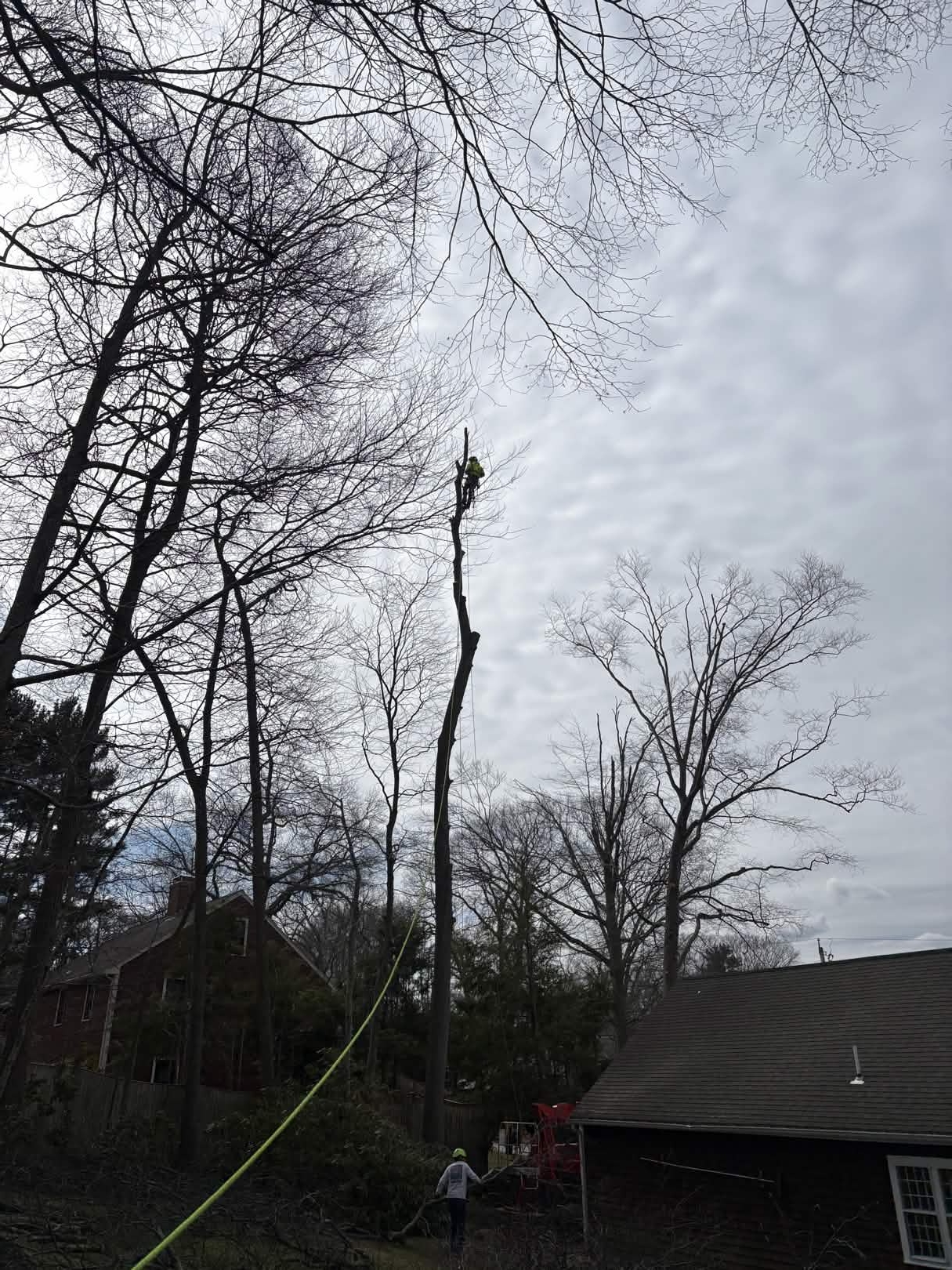
# Professional Tree Removal in Easton, Massachusetts
Homeowners in Easton, Massachusetts, face unique challenges with tree removal due to the town's rich arboricultural heritage and environmental pressures. Easton, in Bristol County with a population of about 25,000, preserves historic landscapes from the Ames family's 1870s investments and Frederick Law Olmsted's designs in North Easton. These legacy trees—European beeches, lindens, red oaks, and white oaks—define the character of neighborhoods like North Easton, South Easton, Eastondale, Furnace Village, Five Corners, Unionville, the Stonehill College Area, and Easton Center. However, when dead, diseased, or hazardous trees threaten your property, professional tree removal becomes essential.
Southeast Arborist, LLC, based in Plymouth and Cohasset, delivers safe tree removal in Easton MA as ISA Certified Arborists serving the South Shore Massachusetts region. Our team follows ANSI A300 standards for tree care, ensuring every job prioritizes safety, precision, and property protection. Whether you're dealing with a leaning white pine near your Furnace Village home or hemlock woolly adelgid-infested eastern hemlocks in shaded Eastondale ravines, we provide crane-assisted removals, advanced rigging, sectional dismantling, complete debris cleanup, stump grinding add-ons, and full insurance coverage.
Easton's trees contend with Hockomock Swamp encroachment, where aggressive red maples and Atlantic white cedars invade residential edges from the largest freshwater wetland in Massachusetts, an Area of Critical Environmental Concern. Deer browse stunts regeneration of sugar maples and American beeches, while the local climate—wet springs, humid summers, and freeze-thaw cycles on clay-loam soils—accelerates decay in mature specimens. These factors make DIY tree removal risky; a single mistake near H.H. Richardson architecture or Stonehill College pathways could cause foundation damage or injury.
Our free estimates via 508-369-5009 assess your Easton property's specifics, from soil compaction around Unionville oaks to wind exposure in Five Corners. We prevent issues like root upheaval from red oaks during storms, common after Nor'easters that batter the South Shore. Homeowners choose us for our expertise in heritage tree management, unlike generic services. For tree removal Easton MA, we dismantle trees piece by piece to protect your roof, driveway, and historic mill village surroundings.
Practical advice for Easton residents: Inspect your trees annually for cracks in white oak trunks or adelgid wool on hemlocks, especially post-winter. If a sugar maple overhangs your Eastondale garage, schedule removal before leaf-out in spring to minimize sap mess. Our process minimizes disruption, hauling away all debris to keep your yard pristine. With Easton Green's Olmsted-era beeches at risk from age and pests, timely tree removal preserves your property value amid rising South Shore real estate demands.
In this guide, discover why Easton's trees demand specialized removal, our step-by-step methods, neighborhood-specific projects, costs, timing, and FAQs. Protect your Easton home—contact Southeast Arborist at 508-369-5009 for tree removal Easton MA today.
Why Easton Properties Need Tree Removal
Easton's arboricultural heritage sets it apart in southeastern Massachusetts, with Olmsted-designed landscapes in North Easton featuring mature European beeches, lindens, red oaks, and white oaks planted in the 1870s. These specimen trees enhance property values but require vigilant management as they age on Easton's clay-loam soils, which retain moisture and promote fungal issues like Armillaria root rot in sugar maples. Your trees in South Easton or Eastondale may show decline from the town's humid continental climate: average annual rainfall of 48 inches fuels Hockomock Swamp expansion, pushing red maples and Atlantic white cedars onto suburban parcels in Furnace Village and Unionville.
Hockomock Swamp, bordering Easton to the west, exerts pressure on residential edges. Its ancient red maple stands and Atlantic white cedar bogs encroach aggressively, with roots invading foundations in low-lying Five Corners homes. Deer browse, rampant in Bristol County, prevents regeneration of American beeches and lindens, leaving gaps filled by hazardous invasives. In shaded ravines near Stonehill College, eastern hemlocks suffer from hemlock woolly adelgid, an invasive pest that turns needles gray and kills trees within 4-10 years, creating falling branch risks near pathways.
Storm damage from Nor'easters, common on the South Shore, splits white pines and red oaks, whose shallow roots on compacted soils fail in saturated ground. Easton's freeze-thaw cycles crack bark on European beeches, inviting beech bark disease. Near Easton Center's H.H. Richardson structures, like the Oakes Ames Free Library, leaning sugar maples threaten historic integrity. Institutional needs at Stonehill College demand hazard assessments for campus oaks and hemlocks, where student safety hinges on proactive removal.
Homeowners in North Easton preserve Olmsted specimens through preservation pruning, but deadwood removal prevents failure. In Eastondale, linden decline from verticillium wilt necessitates full tree removal to protect adjacent properties. Red maples along Hockomock edges grow 2-3 feet yearly, crowding Unionville driveways and dropping debris that clogs gutters during wet springs. White pines in open Easton Green exposures shed heavy branches in ice storms, damaging roofs.
Practical steps for your Easton property: Check for codominant stems in red oaks, a weak structure prone to splitting in 40-50 mph winds. Test soil pH—Easton's averages 5.5-6.5, acidic for beeches but stressing lindens. Monitor for cankers on Atlantic white cedars near swamps, signaling phytophthora root rot. If deer rubs scar young sugar maples, removal averts future hazards.
Nearby towns like Stoughton, Sharon, Norton, Bridgewater, and Brockton share similar issues, but Easton's unique blend—historic trees plus swamp interface—demands ISA expertise. Southeast Arborist identifies risks like girdling roots on white oaks in Furnace Village, preventing sidewalk upheaval. Without professional tree removal Easton MA, you risk liability; Massachusetts law holds owners responsible for tree failures onto neighboring properties.
Our ANSI-compliant assessments evaluate lean angles over 20 degrees or 25% canopy loss as removal triggers. Save your Easton landscape—call 508-369-5009 for a free evaluation tailored to Bristol County's conditions.
Our Tree Removal Process in Easton
Southeast Arborist's tree removal process in Easton MA follows a meticulous, safety-first protocol as ISA Certified Arborists adhering to ANSI A300 standards. We begin with a free on-site assessment at your North Easton or South Easton property, using resistograph tools to probe decay in red oaks and visual tree risk assessments (VTA) for hemlock adelgid damage.
Step 1: Hazard Evaluation (1-2 hours). Our team maps your tree's proximity to structures—crucial near Stonehill College buildings or Furnace Village mills. We measure lean with clinometers, check for root plate lift from Hockomock saturation, and scan for splits in white pines using binoculars. For European beeches in Eastondale, we assess bark disease via core samples.
Step 2: Customized Plan Development. Based on Easton's clay-loam soils and wind patterns, we select techniques: sectional dismantling for urban Easton Center lots or crane-assisted for tall sugar maples overhanging Unionville roofs. Permits from Easton's Tree Warden are secured if your tree exceeds 12-inch caliper near roads.
Step 3: Site Preparation and Safety Setup. We deploy traffic control in Five Corners, tarps under Eastondale drop zones to protect lawns, and erect barriers around H.H. Richardson sites. All crew wear PPE per OSHA 1910.269, with spotters monitoring for power lines common in North Easton.
Step 4: Rigging and Dismantling. Advanced rigging with port-a-wraps and friction savers lowers sections precisely. For a 80-foot Atlantic white cedar near Hockomock Swamp edges, we use GRCS (ground rigging control system) to control descent, preventing property damage. Crane-assisted jobs deploy 65-ton Grove cranes for red maples over 60 feet, felling in 50-100 ton lifts.
Step 5: Cutting and Removal. ISA arborists climb with spike-free techniques on heritage lindens, starting at the top to reduce weight. Chainsaws meet ANSI B7.1 sharpness standards; we buck logs into 18-inch rounds for hauling. Dead eastern hemlocks in shaded ravines are dismantled limb-by-limb to avoid ravine slip.
Step 6: Stump Grinding Add-On. Our 35HP Vermeer grinders pulverize stumps to 12 inches below grade, backfilling with native soil mix suited to Easton's pH. This prevents regrowth of red maples and tripping hazards in Stonehill College Area pathways.
Step 7: Cleanup and Hauling. We chip branches on-site for mulch (returned if requested) or haul via 20-yard dumps to licensed facilities. Rakes and blowers restore your yard, removing 100% debris—vital for Easton Green's pristine aesthetics.
Equipment specifics: 100-foot man lifts for high access, 28-ton knucklebooms for tight Eastondale yards, and drone surveys for swamp-adjacent properties. Fully insured with $5M liability, we prevent foundation cracks from root removal vibrations.
Practical tip: For your property, clear 20-foot radius around the base beforehand. In Easton's wet springs, we schedule post-rain to firm soils. This process minimizes disruption, often completing residential jobs in one day.
From assessment to pristine yard, our Easton tree removal ensures safety amid local challenges like deer paths and historic preservation. Dial 508-369-5009 for your free estimate.
Common Tree Removal Projects in Easton Neighborhoods
In North Easton, Olmsted-era European beeches and lindens near Ames Mansion often require removal due to age-related decline, with codominant leaders failing in storms. Homeowners here call us for sectional dismantling to protect H.H. Richardson landmarks like the Ames Free Library.
South Easton properties face red maple encroachment from Hockomock Swamp, where fast-growing trees lean toward homes. We perform crane-assisted removals, grinding stumps to halt suckering on clay-loam soils.
Eastondale's shaded ravines host eastern hemlocks infested with woolly adelgid; we dismantle these hazards limb-by-limb, preventing branch drop on nearby roads.
Furnace Village mill-era white oaks develop hollows from historic soil compaction; our resistograph probes confirm internal decay, leading to safe felling with tarps shielding foundations.
Five Corners sees white pines toppled by Nor'easter winds due to shallow roots—crane work clears intersections without traffic delays.
Unionville residential edges battle Atlantic white cedar bog expansion; we rig and remove to reclaim yards, adding stump grinding for clean property lines.
Stonehill College Area demands institutional-scale projects: hazard assessments along pathways remove leaning sugar maples and American beeches, with cranes accessing campus interiors safely.
Easton Center's mature red oaks threaten green spaces; preservation pruning sometimes fails, necessitating full removal with ANSI standards to maintain historic character.
Across neighborhoods, projects address deer browse-stunted regeneration and swamp interface growth. Practical advice: Document tree issues with photos for insurance in these high-value areas. Southeast Arborist's ISA certification ensures compliance with Easton's bylaws.
We serve nearby Stoughton, Sharon, Norton, Bridgewater, and Brockton too. For tree removal Easton MA in your neighborhood, call 508-369-5009.
Tree Removal Costs in Easton, MA
Tree removal costs in Easton MA vary by factors like tree size, location, and complexity, reflecting the town's historic trees and swamp influences. A 40-foot red oak in North Easton averages $1,200-$2,500; crane assistance adds $500-$1,500 for heights over 50 feet near H.H. Richardson sites.
Diameter drives pricing: under 24-inch caliper (common for Eastondale lindens) costs $800-$1,800; 36+ inches for mature white oaks in Furnace Village reaches $3,000-$6,000 due to rigging time.
Accessibility matters—Unionville swamp-edge Atlantic white cedars require GRCS rigging, adding 20-30% ($400-$900). Stonehill College Area institutional jobs factor volume discounts for multiple hazards.
Add-ons: Stump grinding $200-$500 per stump, suiting Easton's clay-loam to prevent regrowth. Debris hauling $300-$600 for full-yard cleanup, essential post-Nor'easter.
Soil and climate inflate costs: Saturated Hockomock parcels need mats ($200/day) to protect lawns. Hemlock adelgid cases demand biohazard protocols (+10%).
Value proposition: Our ISA certification and ANSI A300 compliance prevent $10,000+ foundation repairs from improper removal. Free estimates detail breakdowns—no surprises. Compared to uninsured crews, our $5M coverage saves liability headaches.
Practical budgeting: Get 3 quotes, but prioritize certifications. Off-season (winter) saves 15-20%. Financing via Service Finance available.
Easton homeowners invest wisely—timely removal preserves property values rising 5-7% yearly in Bristol County. Contact Southeast Arborist at 508-369-5009 for precise tree removal Easton MA pricing.
When to Schedule Tree Removal in Easton
Schedule tree removal in Easton MA during dormancy—late fall (November-December) or winter (January-March)—when leafless trees ease access and reduce sap in sugar maples. Easton's mild winters (average low 20°F) allow year-round work, but avoid wet springs when Hockomock saturation softens clay-loam soils.
Urgency signs: Leaning over 15 degrees toward your South Easton home, target canker on European beeches, or 30% deadwood in white pines signals immediate action. Hemlock woolly adelgid (white wool on bark) in Eastondale ravines demands removal within 6 months of detection.
Post-storm: Nor'easters topple red oaks; inspect within 48 hours for cracks. Deer browse exposing roots on American beeches warrants pre-summer scheduling.
Practical advice: Use the TRAQ system—score your tree's risk (low/ moderate/ high). High-risk? Call same-week. For Unionville swamp maples, schedule before leaf-out to minimize debris.
Our team books quickly for Five Corners hazards. Protect your Easton property—dial 508-369-5009 now.
Frequently Asked Questions About Tree Removal in Easton
How much does tree removal cost in Easton MA? Costs range $800-$6,000 based on 12-48 inch diameters, with crane adds for North Easton beeches. Free quotes from Southeast Arborist factor local soil and swamp access.
Do I need a permit for tree removal in Easton? Yes, for public right-of-way trees or over 12-inch caliper near roads. We handle Easton's Tree Warden process seamlessly.
Is crane-assisted tree removal necessary in Easton? Essential for 50+ foot white pines in Furnace Village or swamp-edge cedars in Unionville to prevent damage.
How long does tree removal take in Easton neighborhoods? Residential jobs: 4-8 hours. Stonehill multi-tree projects: 1-3 days with cranes.
What about stump removal after tree removal Easton MA? Add our grinding service ($200-$500) to eliminate red maple regrowth on Easton's acidic soils.
Are you insured for tree removal in Easton? Fully insured with $5M liability; ISA Certified Arborists follow ANSI A300 for zero incidents.
Can you remove hazardous hemlocks near Hockomock Swamp? Yes, specialized dismantling for adelgid-infested trees protects Eastondale ravines and properties.
When is the best time for tree removal in Easton? Winter dormancy for minimal impact on lindens and oaks; urgent anytime for leaning hazards.
Call 508-369-5009 for answers tailored to your Easton trees.
Tree Removal Throughout Easton
Southeast Arborist provides expert tree removal across Easton neighborhoods: North Easton Olmsted sites, South Easton swamp edges, Eastondale ravines, Furnace Village mills, Five Corners intersections, Unionville yards, Stonehill College Area, and Easton Center greens. From Stoughton to Brockton, our South Shore Massachusetts coverage ensures rapid response.
Preserve your property's heritage safely. Free estimates: 508-369-5009. Visit from Plymouth/Cohasset today.