
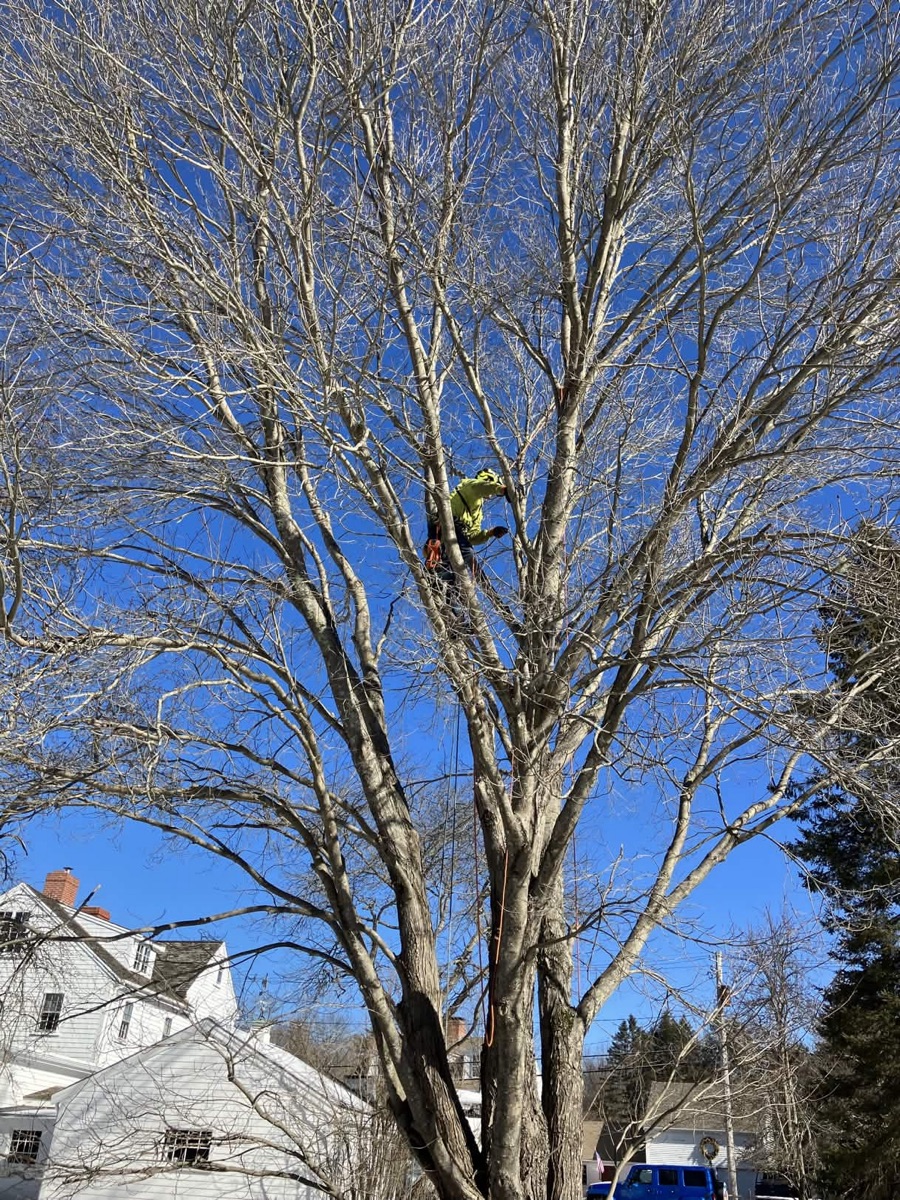
# Professional Tree Pruning in Stoughton, Massachusetts
Your trees in Stoughton, MA, face unique pressures from the town's dense suburban canopy, frequent nor'easters, and aging species like Norway maples lining historic streets. Professional tree pruning in Stoughton, Massachusetts, delivered by ISA Certified Arborists at Southeast Arborist, LLC, addresses these challenges using ANSI A300 standards to enhance tree health, safety, and property value. Based in Plymouth and Cohasset, we serve the South Shore, including Stoughton in Norfolk County, where 29,500 residents maintain mature landscapes amid neighborhoods like Stoughton Center and North Stoughton.
Norway maples, planted decades ago to replace Dutch elm disease victims along Park and School Streets, now show declining health with girdling roots and structural cracks. Red oaks and white pines in Ames Long Pond preserve demand precise crown thinning to withstand ice loading. Our team performs crown elevation for visibility, deadwood removal for safety, and vista pruning to restore pond views from Seaver Farm properties. Homeowners in South Stoughton call us after thunderstorms topple limbs onto roofs, while Bird Street residents seek structural pruning for young sugar maples.
ANSI A300 pruning ensures every cut promotes vigorous regrowth, unlike improper topping that weakens trees against Stoughton's windy winters. We use bucket trucks and climbing gear with spiked boots only on felled trees, preserving bark on live wood. This approach reduces wind resistance in silver maples common near Canton Street, preventing failures during 50 mph gusts from nor'easters.
In Stoughton Center, where white oaks shade colonial homes, our pruning elevates lower limbs rubbing against power lines, complying with local utility requirements. Green ash trees in Brickyard suffer from emerald ash borer; we remove infested deadwood to slow spread while treating healthy sections. American beeches on Porter Street Area lots benefit from restoration pruning post-storm damage, targeting codominant stems prone to splitting.
Safety protocols include spot risk assessments using the ISA Tree Risk Assessment Qualified Arborist method before any work. We secure drop zones with tarps in Clapp Street Area backyards, protecting septic systems from debris. Post-pruning, we haul away chips for mulch, advising Stoughton homeowners on using it around white pine bases to retain moisture in Norfolk County's sandy loam soils.
Tree pruning Stoughton MA services from Southeast Arborist extend to emergency response, arriving within hours after ice storms coat dense canopies. Your investment yields lower insurance premiums—pruned trees claim 15-20% less in limb failures—and boosts curb appeal for sales in competitive North Stoughton markets. Call 508-369-5009 today for a free assessment; our ISA certification guarantees compliance with Massachusetts shade tree laws.
Stoughton's clay-heavy soils compact under mower traffic, stressing roots of mature red oaks. Pruning opens the canopy for light penetration, encouraging fine root growth. We target 20-25% crown thinning on sugar maples to balance the sail-like effect without shocking the tree. In established suburbs like yours, this maintains the historic character while mitigating infrastructure damage from silver maple roots invading sewers on School Street.
Our equipment includes low-emission saws meeting Stoughton noise ordinances and aerial lifts for precise cuts up to 80 feet. Homeowners gain peace of mind knowing we document each job with photos, providing records for HOA approvals in gated Brickyard communities. Tree pruning in Stoughton, MA, isn't just maintenance—it's proactive defense against the town's predictable threats.
Why Stoughton Properties Need Tree Pruning
Stoughton's established suburban character, settled in 1713, features tree-lined avenues like Park, School, and Canton Streets where declining Norway maples dominate service calls. These replacements for Dutch elm-ravaged elms now exhibit girdling roots coiling around trunks, visible in Stoughton Center mature yards. Without ANSI A300 pruning, structural cracks widen, risking limb drops onto Pearl Street traffic.
Emerald ash borer has decimated green ash populations in South Stoughton, leaving hazardous skeletons. Pruning removes deadwood, containing the infestation while preserving healthy canopy layers. Red oaks and white oaks in Ames Long Pond stands, over 100 years old, accumulate heavy ice during February nor'easters; crown thinning reduces weight by 30%, preventing branch snaps under 1-inch accumulations common in Norfolk County.
White pines near Muddy Pond sway in 40-60 mph winds from Atlantic storms, their dense needles creating excessive sail effect. Targeted reduction shortens leaders, stabilizing tops without altering natural form. Sugar maples on North Stoughton hillsides develop included bark unions; early structural pruning separates codominant stems, averting splits that crush fences during summer squalls.
Silver maples in Bird Street floodplains push aggressive roots into septic lines and foundations—issues exacerbated by Stoughton's high water table. Vista pruning clears sightlines to ponds while elevating crowns over driveways. American beeches in Porter Street Area show epicormic sprouting from past wounds; deadwood removal redirects energy to main scaffold branches.
Local climate amplifies needs: 45 inches annual precipitation soaks clay-loam soils, fostering fungal pathogens like Verticillium in maples. Pruning improves airflow, drying foliage faster after humid summers. Winter lows of 10°F stress vascular tissues; restoration pruning post-ice damage excises girdled limbs, promoting compartmentalization.
Root damage to sidewalks on Clapp Street Area plagues Brickyard sidewalks, where Norway maple surface roots heave concrete. Crown reduction lightens top weight, slowing upheaval. Homeowners notice leaning trunks after wet springs—signs of buttress root failure in compacted soils near Route 24.
In Seaver Farm, dense canopies block sunlight to lawns, thinning turf. Crown elevation raises limbs 12-14 feet, restoring understory growth without ladders scraping house siding. Stoughton's microclimates vary: cooler North Stoughton valleys trap frost, delaying oak leaf-out; pruning synchronizes cycles.
Unchecked growth endangers power lines along Sharon borders, triggering Eversource trims that leave stubs prone to decay. Our precise cuts meet utility specs, avoiding callbacks. Properties near Avon see more emerald ash borer due to proximity to infested Brockton woodlots; proactive pruning buys time.
Data from Norfolk County extension reports 25% of Stoughton calls involve storm recovery, with dense canopies catching debris like kites. Ice loading exceeds 50 psi on horizontal limbs, snapping red oaks without prior thinning. Your trees' health directly impacts home values—pruned landscapes appraise 7-10% higher per local realtors.
Practical advice: Inspect your Norway maple for V-shaped crotches after leaf drop. Tap trunks for hollow sounds indicating decay. In green ash, D-shaped exit holes signal borers—prune immediately. Mulch 3-inch rings around bases, keeping soil pH 6.0-7.0 for optimal nutrient uptake in Stoughton's variable soils. Tree pruning Stoughton MA prevents these escalating into removals costing $1,500+.
Our Tree Pruning Process in Stoughton
Southeast Arborist follows a rigorous ANSI A300 process for tree pruning in Stoughton, MA, starting with an on-site assessment by ISA Certified Arborists. We arrive in Stoughton Center with drones for canopy scans, identifying deadwood in red oaks without climbing prematurely. Your input guides priorities—perhaps elevating silver maple limbs over a Bird Street driveway.
Step 1: Risk evaluation using ISA TRAQ methodology. We score targets for failure probability: high-risk girdling roots on Norway maples score 80% if cracks exceed 25% circumference. Soil probes check root plate stability in clay loams.
Step 2: Pruning plan customization. For white pines in North Stoughton, we diagram 20% thinning, removing every third whorl. South Stoughton sugar maples get structural pruning: subordinating weak attachments with 1/3 diameter reduction collars.
Equipment setup follows: 60-foot bucket trucks for crowns over 40 feet, positioned on tarped lawns to protect septic fields in Seaver Farm. Climbing arborists use ropes and saddles with Petzl saws for precision in Brickyard confines. All gear meets OSHA standards, with hard hats and hi-vis vests.
Step 3: Ground prep secures zones. In Porter Street Area, we flag utilities via Dig Safe, avoiding green ash roots near gas lines. Chippers process limbs on-site into 1-inch nuggets for your mulch use.
Execution prioritizes safety: Largest limbs first via sectional rigging, lowered with 3:1 mechanical advantage pulleys. On American beeches in Clapp Street Area, we make three-cut stubs to prevent tearing, sealing none per ANSI—trees compartmentalize naturally.
Crown thinning targets 15-25% volume loss: For Norway maples, select interior shading branches first, opening 40-50% light penetration. Vista pruning along Ames Long Pond removes 10-foot sections framing views without heading cuts.
Deadwood removal uses the "spike rule": No spikes on live bark; handsaws for stubs under 2 inches. Hazard limbs over structures get lowered via lowering device, tensioned against wind sway.
For storm-damaged white oaks, restoration pruning excises 75% broken ends, retaining live epicormics for woundwood. Young trees in new subdivisions receive formative pruning: tipping leaders 25% to establish dominance.
Post-cut cleanup: Vacuum blowers clear 100% debris, pressure-washing sawdust from patios. We apply wound dressings only if required for cavity work, otherwise letting trees heal.
Documentation includes before/after photos, ANSI compliance report, and growth projections—e.g., your red oak regains balance in 2 years. Safety integrates throughout: Two-way radios coordinate drops, spotters monitor traffic on Canton Street jobs.
Stoughton-specific adaptations: During mosquito season, DEET protocols protect crews near ponds. In 90°F summers, hydration stations prevent heat stress. Equipment silences comply with 7am-7pm ordinances.
This process minimizes shock: No more than 25% removal per session for sugar maples, spacing repeats 3-5 years. Homeowners benefit from insured crews ($2M liability) and TCIA accreditation. Schedule via 508-369-5009; we quote transparently post-assessment.
Common Tree Pruning Projects in Stoughton Neighborhoods
Stoughton Center homeowners request crown thinning on Norway maples shading colonial homes along Park Street. These 50-foot trees drop limbs during gusts; we thin 20% to reduce wind catch, preserving historic silhouettes.
North Stoughton properties near Easton borders feature white pines stressed by salt spray from Route 24. Crown reduction shortens overextended branches 15 feet, stabilizing against nor'easters while improving needle retention.
South Stoughton lots with silver maples over sewers need root-compatible pruning: Elevation to 14 feet prevents pavement cracks, paired with air spading to relieve compaction.
Bird Street residents tackle emerald ash borer in green ash; deadwood removal clears 40% canopy, slowing larval spread without full removal.
Brickyard industrial-era yards host red oaks with codominant stems. Structural pruning subordinates weaker leaders, preventing failures over warehouses.
Porter Street Area beeches show heavy crowns; vista pruning frames Sharon views, thinning subordinates for 30% light gain.
Seaver Farm pondside oaks demand ice-load reduction: Horizontal limb tipping maintains shape, critical after January 1-inch ice events.
Clapp Street Area sugar maples exhibit girdling roots heaving sidewalks; crown lightening eases top pressure, extending life 10-15 years.
Emergency post-thunderstorm work dominates Route 138 corridors: Rigging downed white oaks away from Avon roofs. Near Randolph, we restore storm-split maples.
Canton-adjacent streets see utility conflicts; we coordinate with NStar for line-clearance pruning on silver maples.
Brockton-proximate green ash groves require EAB monitoring prunes. Easton white pines get lightning retrospective cuts post-July strikes.
Practical tip: Map your canopy annually—prioritize limbs over patios. In Stoughton Center, combine with fertilizing for vigor. Call 508-369-5009 for neighborhood-specific plans.
Tree Pruning Costs in Stoughton, MA
Tree pruning costs in Stoughton, MA, range $350-$1,200 per mature tree, factoring height, condition, and access. A 40-foot Norway maple in Stoughton Center with deadwood removal averages $450: Base $8/tree-foot ($320), plus $100 rigging, $30 cleanup.
Red oaks in North Stoughton command $600-$900 for crown thinning due to density; 50 feet at $12/foot reflects ANSI precision. White pines near Ames Long Pond add $150 for sectionalizing over water.
Access premiums apply: Bird Street backyards inaccessible to buckets add $200 climbing fee. South Stoughton silver maples over pools require $100 tarping.
Deadwood-only jobs start $250 for green ash in Brickyard—economical EAB management. Structural pruning on young sugar maples runs $300, preventing $2,000 removals later.
Vista pruning in Seaver Farm costs $500-$700, valuing aesthetics boosting property at $250K medians. Restoration post-storm: $800 for American beech, including 4-hour crew.
Volume discounts: Multi-tree Stoughton Center contracts drop 15% per tree. Annual maintenance plans save 20%, $2,500/year for 5 oaks.
Value proposition: Pruning cuts insurance 10-15% via risk reduction—$300 savings offsets half cost. Curb appeal adds $5K-10K resale per Norfolk comps. Avoid DIY: Improper cuts invite decay, escalating to $1,800 cabling.
Factors inflating bids: Proximity to power (Eversource permit $75), emerald ash borer complexity (+20%), ice damage extent.
Transparent quoting: Free assessments detail line items—no surprises. ISA certification ensures value; competitors undercut but violate standards, risking fines.
Stoughton specifics: Norfolk permits $50/tree over 24" DBH. We bundle mulch delivery free over $1,000.
ROI calculation: $600 prune on leaning maple prevents $3,000 removal, netting $2,400 savings. Call 508-369-5009 for personalized estimate—your trees' health pays dividends.
When to Schedule Tree Pruning in Stoughton
Schedule tree pruning in Stoughton, MA, from late fall to early spring dormancy—October-March—when sap flow halts, minimizing pest entry. Norway maples bleed heavily if pruned June-August; dormant cuts seal cleanly.
Urgency signs demand immediate action: Cracks over 1-inch wide in red oaks signal failure risk. Deadwood over structures in white pines warrants emergency $500+ response post-inspection.
Post-nor'easter: February-March peaks after ice loads; book within 72 hours to prevent fungal invasion on wounds.
Sugar maple spring swelling: Prune before bud break in April to sync with growth flush.
Emerald ash borer detection in green ash: Summer scouting, fall pruning.
Annual cycles: Young trees every 2 years, matures 3-5 years. Stoughton Center historic mandates: Prune pre-leaf-out for street safety.
Visual cues: Leaning >15° post-rain, rubbing limbs, co-dominant stems. Drone checks spot internals.
Avoid summer peaks—heat stresses maples. Winter advantages: Bare limbs reveal structure, frozen ground supports trucks.
Contact 508-369-5009 now for slots; Stoughton's canopy demands timing.
Frequently Asked Questions About Tree Pruning in Stoughton
What is ANSI A300 pruning, and why does it matter for my Stoughton trees? ANSI A300 sets standards for objectives like crown thinning, used by ISA Certified Arborists at Southeast Arborist. In Stoughton, it ensures Norway maples withstand winds, unlike topping that invites decay.
How much does tree pruning cost for a large oak in North Stoughton? $600-$1,000 for 50-foot red oaks, including thinning. Factors: Access, rigging. Free quotes via 508-369-5009.
When is the best time for tree pruning in Stoughton, MA? Dormant season (Nov-Mar). Avoid summer for silver maples to prevent bleeding.
Can you prune green ash trees affected by emerald ash borer? Yes, deadwood removal slows spread. We treat systemics for healthy ones in South Stoughton.
Do you handle emergency pruning after storms in Bird Street? Absolutely—rig downed white pines within hours, restoring access.
Is pruning safe for historic trees in Stoughton Center? Yes, ANSI preserves form. Crown elevation clears streets without character loss.
How do I know if my sugar maple needs structural pruning? Look for V-crotches. Early intervention in Seaver Farm prevents splits.
What neighborhoods in Stoughton do you serve for tree pruning? All: Brickyard, Porter Street, Clapp Street, plus Canton, Sharon nearby.
Will pruning improve views of Ames Long Pond from my property? Vista pruning targets select limbs, enhancing without over-thinning.
Do you provide cleanup after pruning in Clapp Street Area? 100%—chips mulched, lawns blown, no debris left.
Tree Pruning Throughout Stoughton
Southeast Arborist delivers tree pruning Stoughton MA across all neighborhoods: Stoughton Center historic cores, North Stoughton hills, South Stoughton flats, Bird Street lanes, Brickyard yards, Porter Street Area, Seaver Farm estates, Clapp Street Area homes.
We extend to nearby Canton, Sharon, Avon, Brockton, Randolph, Easton—full South Shore coverage from Plymouth/Cohasset base.
ISA Certified Arborists use ANSI A300 for your Norway maples, red oaks, white pines. Call 508-369-5009 for assessments, emergencies, or maintenance. Protect your property today.