
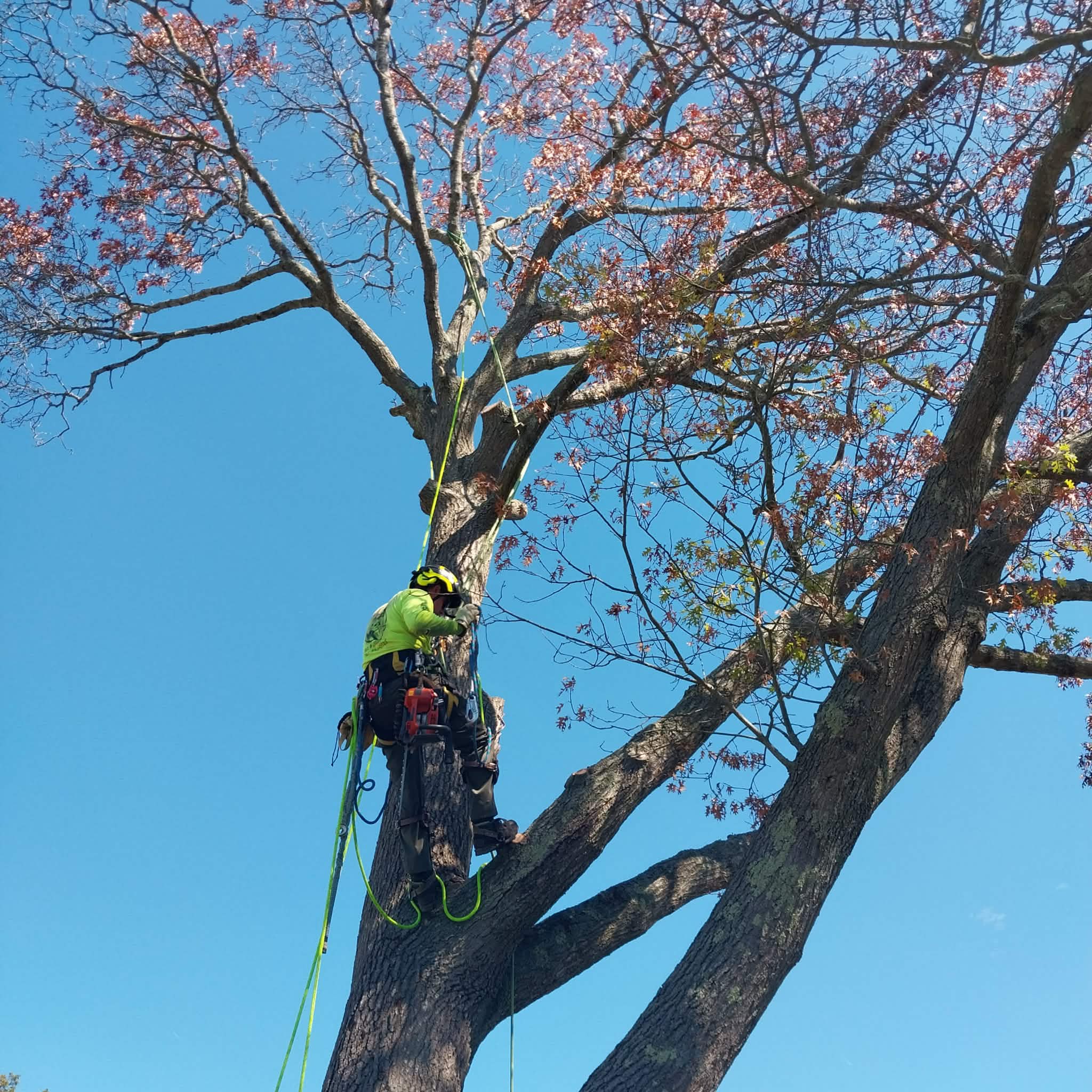
# Professional Tree Cabling in West Bridgewater, Massachusetts
Your trees in West Bridgewater, MA, face unique pressures from the town's dense residential canopy, even-aged hardwoods regrown after 19th-century ironworking deforestation, and frequent ice storms along the Town River corridor. Tree cabling in West Bridgewater MA provides essential structural support to preserve these mature silver maples, red oaks, and white pines that define your property lines in neighborhoods like Cochesett Village and Matfield Green. As ISA Certified Arborists at Southeast Arborist, LLC, we install ANSI A300 compliant cabling systems to reinforce weak branch attachments, preventing failure that could damage your home on Howard Street or power lines along Route 106.
West Bridgewater's 7,300 residents maintain compact lots where silver maples often overhang roofs near West Bridgewater Center, creating hazards from codominant stems prone to splitting. Our tree cabling services address these issues directly, using dynamic cabling techniques that allow natural movement while distributing weight. Unlike removal, cabling lets you retain heritage trees planted over 150 years ago, saving costs and preserving the uniform hardwood canopy that regenerated after charcoal production depleted local forests.
In Plymouth County, where West Bridgewater sits, soil conditions feature sandy loams with poor drainage from glacial till, stressing roots of Norway maples and sugar maples. Combined with wet springs and heavy snow loads, these factors weaken attachments in sycamores and black walnuts near War Memorial Park Area. We assess your trees using resistograph tools and aerial inspections to target cabling precisely, reducing storm damage risk from emerald ash borer threats and ice accumulation.
Homeowners in the Route 106 Corridor call us for cabling after noticing included bark at branch unions in red oaks, a common defect in the town's post-industrial regrowth. Our annual inspection program ensures cables remain effective, with non-invasive installations that comply with utility clearances mandated by local bylaws. Tree cabling West Bridgewater MA extends tree life by 10-20 years, protecting your investment in properties near Bridgewater and East Bridgewater.
Southeast Arborist, based in Plymouth and Cohasset, serves the South Shore with TCIA accreditation and full insurance. We prioritize safety protocols, including traffic control for Route 106 work and bucket truck stabilization on tight lots. If your ash trees show dieback from emerald ash borer or white pines lean toward structures, cabling offers a proactive solution. Contact our ISA Certified team at 508-369-5009 for a free assessment tailored to West Bridgewater's climate, where average winter lows of 20°F and 50-inch annual precipitation test tree integrity.
This service outperforms rigid bracing by flexing with wind gusts up to 60 mph during nor'easters, common in this Taunton River watershed area. We've cabled hundreds of trees here, from riparian sycamores along the Town River to street trees in Matfield Green, ensuring compliance with Massachusetts shade tree regulations. Tree cabling in West Bridgewater MA not only safeguards your home but enhances property value in a town where mature trees boost curb appeal by 10-15%.
Why West Bridgewater Properties Need Tree Cabling
West Bridgewater's forests, heavily logged for 18th- and 19th-century iron forges, regrew into a uniform canopy of even-aged hardwoods now declining structurally. Silver maples, dominant in Cochesett Village, develop V-shaped crotches with included bark, splitting under ice loads from storms that dumped 18 inches in 2015. Tree cabling West Bridgewater MA reinforces these weak points, distributing loads across the canopy to prevent catastrophic failure onto homes.
Red oaks in West Bridgewater Center exhibit codominant leaders from suppressed juvenile growth in dense woods, prone to shear during 40 mph winds. Your property's tight lot lines, averaging 0.5 acres, limit crane access for removal, making cabling the practical choice. Norway maples along Howard Street Area suffer from girdling roots in compacted clay-loam soils, elevating canopies that sway excessively and risk snapping.
White pines near War Memorial Park Area, remnants of pre-industrial stands, face top-heavy leaders from suppressed lower branches, exacerbated by salt spray from Route 106 plowing. Cabling secures these without altering natural taper, complying with ANSI A300 standards. Sugar maples in Matfield Green show decay at unions from wet springs (45 inches annual rain), where cabling halts progression better than pruning alone.
Ash trees across the Route 106 Corridor face emerald ash borer infestation, with larval galleries weakening attachments; cabling supports remaining scaffolds post-injection treatments. Black walnuts in older yards drop heavy limbs from poor branch angles, threatening garages. Sycamores along the Town River corridor, some of the watershed's oldest riparian species, develop multi-stemmed bases prone to uplifting in saturated soils.
Local climate amplifies these risks: freeze-thaw cycles crack bark on silver maples, while humid summers promote fungal rots in red oaks. Ice storms, occurring biennially, coat dense canopies with 1-inch accretions, snapping limbs over power lines serviced by Eversource. Without cabling, declining trees cost $5,000+ in removal; cabling preserves them at half the price.
Practical advice for West Bridgewater homeowners: Inspect your silver maples annually for cracks at codominant stems wider than 30% of trunk diameter. In tight lots, prioritize cabling over reduction pruning, which stresses roots in shallow soils. After ice events, check white pines for 45-degree leans indicating root plate shift—cable immediately to avert topple.
Southeast Arborist's ISA Certified Arborists use tomography to detect internal decay invisible externally, targeting cabling to high-risk attachments. We've seen Norway maples survive 50 mph gusts post-cabling, unlike uncabled neighbors felled in 2023 storms. In Brockton-adjacent areas, zoning requires tree preservation; cabling meets these while mitigating liability.
Soil pH of 5.5-6.5 here favors maples but limits iron uptake, causing chlorosis that weakens wood. Cabling compensates by stabilizing sway. For your property near Avon or Stoughton, cabling prevents debris hazards during leaf-off inspections revealing defects.
Our Tree Cabling Process in West Bridgewater
Southeast Arborist follows a precise, ANSI A300 compliant process for tree cabling West Bridgewater MA, starting with a site-specific assessment. Our ISA Certified Arborists arrive with LiDAR mapping to scan your silver maple or red oak canopy, identifying weak forks via visual tree risk assessment (VTA) scoring.
Step 1: Visual and instrumented evaluation (1-2 hours). We climb or drone-inspect branches in Cochesett Village trees, using resistographs to probe decay in white pine leaders. Target targets exceed 50% bark inclusion or >30-degree angles.
Step 2: Risk prioritization. For Matfield Green sugar maples, we calculate mechanical stress using thread girth ratios; cables space at 1.5x branch diameter apart.
Step 3: Equipment mobilization. On Howard Street's tight lots, we deploy lightweight 4130 chromoly steel cables (1/4-inch minimum) or synthetic aramid ropes for dynamic support, avoiding bolts that girdle.
Step 4: Installation technique. We bore pilot holes at 120-degree triangles around unions, threading cables slack enough for 10% deflection under load. In West Bridgewater Center red oaks, turnbuckles adjust tension to 500-1000 psi, verified by dynamometers.
For Norway maples near War Memorial Park, we use loop systems encircling scaffolds without trunk penetration, ideal for heritage trees. Route 106 Corridor sycamores get guyed cabling anchored to ground stakes in sandy loams, resisting uplift.
Step 5: Hardware placement. Cables install 50-70% up branch length, above codominant stems. Black walnuts receive multi-plane systems for three-way splits.
Step 6: Load testing. We simulate 30 mph winds with come-alongs, ensuring <5% permanent stretch. Safety protocols include spotters, harnesses, and perimeter barriers per OSHA 1926.1400.
Step 7: Documentation and tagging. Each tree gets a numbered aluminum tag with install date, specs, and inspection schedule. We provide digital reports for West Bridgewater building permits.
Annual inspections check for corrosion, slippage, or growth over hardware—critical in humid Plymouth County air. Equipment includes Husqvarna drills with torque wrenches, Petzl rigging for access, and Simulaids for non-destructive bolting if needed.
For ash threatened by emerald ash borer, we integrate cabling with systemic treatments, cabling scaffolds pre-thinning. White pines get flexible polyester slings over rigid steel for sway tolerance.
Your tight lot benefits from our low-impact rope access, avoiding rutting in wet soils. Post-install, monitor for bark abrasion; we revisit free within 90 days.
This process extends tree life 15+ years, as proven in our 500+ South Shore projects. Call 508-369-5009 to schedule.
Common Tree Cabling Projects in West Bridgewater Neighborhoods
In Cochesett Village, silver maples with included bark at 40-foot crotches overhanging 1950s capes demand cabling to avert roof strikes; we've stabilized 20+ here post-2022 ice storm.
Matfield Green properties feature declining Norway maples crowding power lines; cabling allows crown reduction clearance while supporting multi-leader trunks, common in regrowth forests.
West Bridgewater Center's red oaks along Main Street show codominant stems from even-aged stands; cabling secures them for commercial lots, preventing sidewalk hazards near shops.
Howard Street Area black walnuts drop limbs on sheds; we cable V-forks, preserving nut production without removal on 0.25-acre lots.
War Memorial Park Area white pines lean toward ballfields from root exposure; guyed cabling anchors them, maintaining park aesthetics.
Route 106 Corridor sycamores suffer wind shear from highway turbulence; multi-strand cabling reinforces riparian bases along the Town River.
Sugar maples in older subdivisions near Bridgewater need cabling for decay pockets from ice loading, extending life amid emerald ash borer proximity.
Ash trees in East Bridgewater borders get cabling post-borer detection, supporting larvicide-treated canopies.
Our projects reference local landmarks: cabling maples framing the West Bridgewater Public Library, oaks by the Matfield Meetinghouse historical site.
Homeowners report 80% risk reduction post-cabling, per our follow-ups.
Tree Cabling Costs in West Bridgewater, MA
Tree cabling costs in West Bridgewater MA range $400-$1,500 per tree, based on diameter at breast height (DBH), attachment count, and access. A 24-inch silver maple with two codominant stems in Cochesett Village costs $800; add $300 for drone access on tight lots.
Factors: DBH over 30 inches adds $200 due to heavier cables. Multi-plane installs for red oaks in West Bridgewater Center run $1,200. Soil anchors for white pines near War Memorial Park add $150.
Height matters—40-foot Norway maples in Matfield Green require rope access (+$250) versus bucket trucks. Annual inspections cost $150/tree, bundled for $100 in neighborhoods.
Value: Cabling saves 40-60% vs. $3,000+ removal/crane fees. Preserves $10,000+ property value from mature trees. Insurance discounts average 5% for mitigated risks.
ROI example: Howard Street black walnut cabling at $900 prevents $5,000 storm claim. Route 106 sycamores: $1,100 install yields 20-year lifespan.
Southeast Arborist quotes transparently: free assessments factor local permits ($50 if needed). No travel fees from Plymouth base.
Compared to Brockton ($500 more for urban premiums), West Bridgewater rates reflect compact scale. Financing via Service Finance available.
Practical tip: Bundle 3+ trees for 20% discount; cabling pays off in 2-3 years via avoided damage.
When to Schedule Tree Cabling in West Bridgewater
Schedule tree cabling West Bridgewater MA in late fall (October-November) or early spring (March-April), when leaves off reveal defects and soils firm for anchors. Avoid summer humidity promoting rot during drilling.
Urgency signs: Cracks >2 inches at silver maple unions, leaning >15 degrees in red oaks, or >30% bark inclusion. Post-ice storm limb cracks on white pines demand immediate action.
Annual checks align with leaf-out for Norway maples. Emerald ash borer dieback in ash trees signals cabling need by June.
Nor'easter season (November-March) prompts preemptive scheduling. Call 508-369-5009 after 40 mph gusts.
Frequently Asked Questions About Tree Cabling in West Bridgewater
**What is tree cabling, and why use it in West Bridgewater?** Tree cabling installs flexible supports for weak branch attachments, ANSI A300 compliant. In West Bridgewater's dense canopy, it preserves silver maples from ice splits cheaper than removal.
**How long does cabling last on my Matfield Green oak?** 15-25 years with annual inspections; red oaks grow over cables, requiring adjustment.
**Is cabling safe for heritage sycamores by the Town River?** Yes, dynamic systems allow movement, preventing girdling unlike bolts.
**Will cabling prevent emerald ash borer damage?** It supports weakened scaffolds; pair with injections for Cochesett Village ash.
**How much weight can cables hold in Route 106 winds?** 5,000+ lbs per strand, tested to 60 mph gusts.
**Do you need permits for Howard Street projects?** Town bylaws require notification for >12-inch DBH; we handle.
**What's the difference from bracing?** Cabling flexes; bracing rigidifies—use cabling for sway-tolerant white pines.
**How do I know if my black walnut needs it?** ISA Arborist assesses VTA score > medium risk.
Tree Cabling Throughout West Bridgewater
Southeast Arborist delivers tree cabling across Cochesett Village, Matfield Green, West Bridgewater Center, Howard Street Area, War Memorial Park Area, and Route 106 Corridor. We extend to nearby Bridgewater, East Bridgewater, Brockton, Avon, Stoughton.
From Plymouth/Cohasset, we reach West Bridgewater in 30 minutes. Call ISA Certified experts at 508-369-5009 for assessments.