
# Professional Tree Cabling in Seekonk, Massachusetts
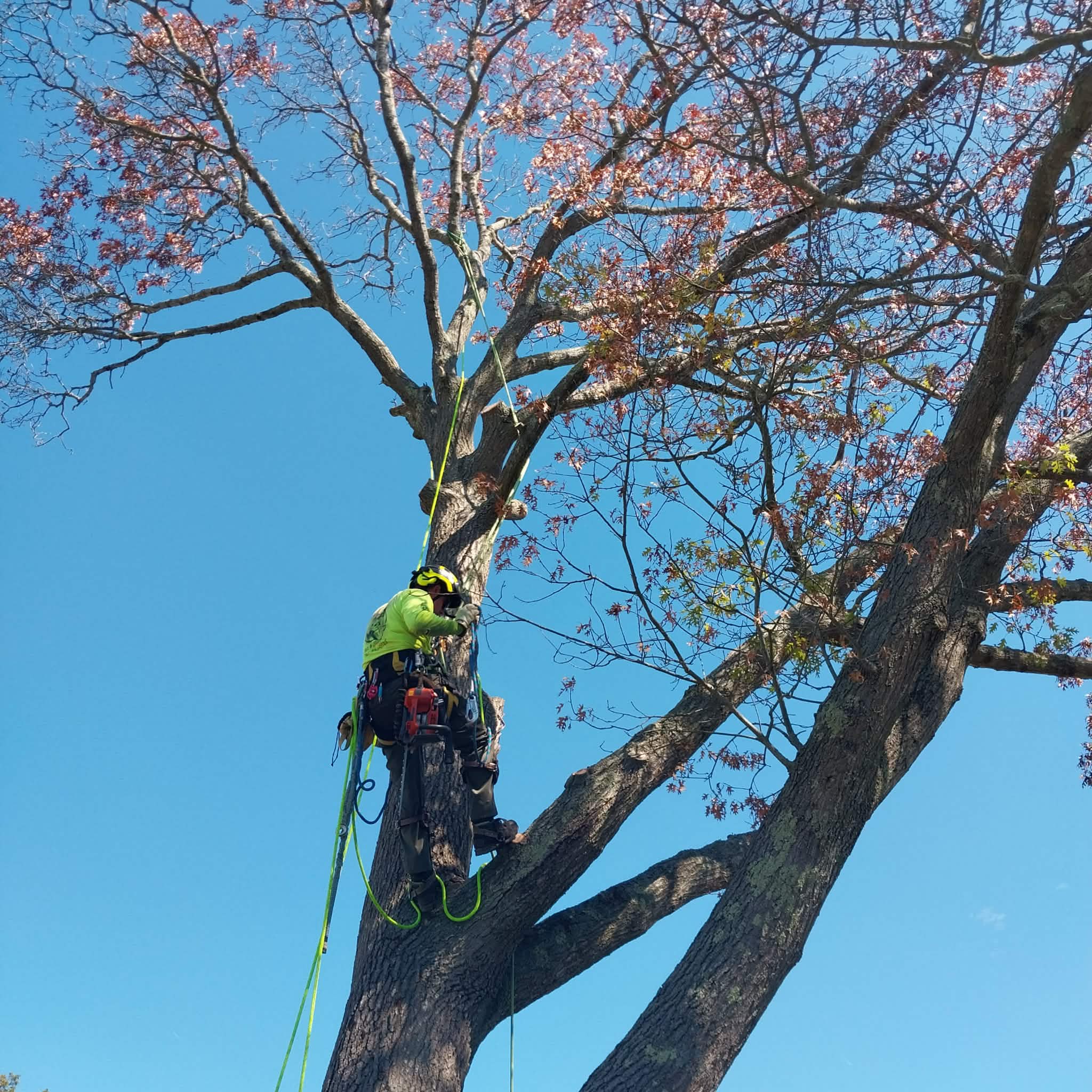
If you own a home or business in Seekonk, Massachusetts, your trees face unique pressures from the town's position along the Rhode Island border. Mature red oaks and white pines line streets in Seekonk Center, while silver maples along the Fall River Avenue Corridor battle weak branch unions from inconsistent commercial maintenance. As an ISA Certified Arborist with Southeast Arborist, LLC, serving the South Shore from our Plymouth and Cohasset base, we specialize in ANSI A300-compliant tree cabling to support these at-risk trees. Tree cabling in Seekonk MA preserves your property's shade, heritage value, and safety without the expense of full removal.
Seekonk's 16,000 residents rely on its aging tree canopy, planted heavily in the post-war residential boom. Norway maples in Luther Corner often develop codominant stems that split under ice loads from Narragansett Bay-influenced winters. Our cabling installs dynamic steel cables or rods high in the canopy to redistribute weight, preventing failures that could damage your roof or vehicles. This service costs less than removal—often 40-60% cheaper for a 50-foot red maple—while maintaining your property's curb appeal in Bristol County's suburban neighborhoods.
Emerald ash borer threatens green ash trees in South Seekonk, creating urgent needs for cabling before dieback weakens attachments. Palmer River flooding stresses riparian white oaks and American beeches, leading to root plate instability that cabling addresses alongside bracing. Southeast Arborist's annual inspection program ensures your cables remain taut, with certified arborists checking for corrosion or tree growth overriding supports.
Homeowners in North Seekonk appreciate how cabling safeguards sugar maples during moderate storms, less intense than coastal gales but damaging from heavy Providence-area snow. Our team uses climbing gear and bucket trucks tailored to Seekonk's commercial corridors like Route 6, where neglected parking lot trees pose liability risks. Call Southeast Arborist at 508-369-5009 for a free assessment—our ISA certification guarantees compliance with Massachusetts shade tree regulations.
Tree cabling in Seekonk MA extends mature trees' lives by 20-30 years, vital for properties near Attleboro or Rehoboth where development pressures limit replacements. Unlike pruning alone, cabling targets structural defects like included bark on black cherry forks, common in Newman Avenue Area yards. We prioritize your safety with traffic control and drop-zone clearances, especially on busy Fall River Avenue. Invest in cabling now to avoid emergency calls after the next ice storm—your trees deserve expert care from a local leader.
Why Seekonk Properties Need Tree Cabling
Seekonk's trees endure specific stressors from its agricultural roots as part of old Rehoboth, now suburbanized with post-war housing. Red oaks in Seekonk Center, planted mid-20th century, reach 60-80 years old, developing V-shaped crotches prone to splitting. Tree cabling in Seekonk MA supports these weak attachments, using ANSI A300 standards to install non-invasive cables that allow natural movement while preventing catastrophic failure.
Bristol County's mild coastal climate from the Narragansett Bay watershed brings wet springs and ice storms, overloading silver maples along Fall River Avenue Corridor. These fast-growing trees form narrow unions with included bark, failing under 1-2 inches of ice—common in Seekonk's 40-inch annual precipitation. Without cabling, branches over 30 feet drop onto power lines or storefronts, as seen after the 2018 nor'easter.
Norway maples dominate Luther Corner neighborhoods, invasive but shade-providing with codominant leaders that cabling reinforces. Our ISA Certified Arborists identify these via visual tree risk assessments (VTA), noting battering from Palmer River winds. Green ash in South Seekonk faces emerald ash borer infestation, documented by UMass Extension since 2020; cabling stabilizes girdled trees pre-removal, buying 2-5 years.
White pines in North Seekonk suffer top-heavy crowns from salt spray proximity to Swansea, leading to leader failure. Cabling at 40-50 feet reduces leverage, essential since pines comprise 15% of the canopy per town surveys. Sugar maples on Newman Avenue develop decay pockets from clay-loam soils with poor drainage, common in Seekonk's glacial till; cables prevent limb drop during leaf-on weight.
American beeches along Palmer River riparian zones show girdling roots from flooding, destabilizing 70-foot specimens. Tree cabling in Seekonk MA pairs with guy wires here, countering lean from eroded banks. Red maples in newer developments retain native vigor but fork weakly at 20 feet; cabling preserves them amid commercial expansion pressures.
Commercial corridor neglect along Route 6 leaves entrance plantings like black cherry unpruned, fostering defects. Ice storms, hitting Seekonk moderately versus coastal areas, cause 20% more claims than Attleboro due to older trees. Flooding affects 10% of properties near the river, rotting bases of white oaks—cabling focuses on upper canopy here.
Your Seekonk property benefits from cabling's storm prevention: a 60-foot oak cable job averts $15,000 in removal costs. Soil pH of 5.5-6.5 stresses beeches, promoting cankers that weaken forks—cable before spread. Compared to Rehoboth's fields, Seekonk's density amplifies risks; cabling maintains equity values tied to mature trees.
ISA standards ensure our installations flex 10-15% under load, unlike outdated methods. Schedule tree cabling in Seekonk MA to address these local realities—your aging canopy demands it.
Our Tree Cabling Process in Seekonk
Southeast Arborist's tree cabling process in Seekonk MA follows ANSI A300 (Part 4) standards, starting with a site-specific risk assessment for your property. Our ISA Certified Arborists arrive with laser rangefinders and resistographs to measure wood strength in red oaks or Norway maples, identifying defects like 30% decay in codominant stems common in Seekonk Center.
Step one: Visual and instrument inspection. We climb your 50-foot white pine in Luther Corner using certified ropes and saddles, documenting union angles over 45 degrees—prime cabling targets. Drones survey Palmer River canopy for beeches, spotting included bark invisible from ground. This 1-2 hour phase flags urgency, like emerald ash borer galleries in South Seekonk green ash.
Step two: Defect mapping and design. Using Tree Risk Assessment Qualified (TRAQ) protocols, we calculate cable placement with software modeling wind loads from Narragansett Bay gusts up to 50 mph. For silver maples on Fall River Avenue, we spec 1/2-inch EIP steel cables at 50% breaking strength, spaced 20-30 feet apart. Rods supplement for white oaks with basal cracks from clay soils.
Step three: Preparation and safety setup. In North Seekonk neighborhoods, we deploy 75-foot bucket trucks with outriggers on your lawn, using plywood mats to protect turf. Traffic cones and signage comply with Seekonk bylaws for Newman Avenue work. Pruning removes interfering limbs first, reducing weight by 20-30% per ANSI guidelines.
Step four: Installation. Arborists ascend via spikes or throwlines, drilling minimal 1-inch holes for thimbles—less than 0.1% canopy impact. Cables thread through, tensioned to 10-20% slack with turnbuckles, allowing sway. For black cherry in commercial lots, we use dynamic synthetic rods that absorb shock. Palmer River jobs incorporate flood-resistant galvanized hardware.
Step five: Bracing if needed. Guy wires anchor leaning red maples, staked 3 feet deep in loamy soils. We integrate cabling with root barrier adjustments for flooded riparian trees.
Step six: Testing and labeling. Load-test cables to 500 pounds via come-alongs, then tag with inspection dates and load ratings. Photos document before/after for your records.
Step seven: Annual program enrollment. Seekonk clients get reminders for re-inspections, checking elongation or tree overgrowth—critical for ice-prone silver maples. Corrosion from humid Providence air prompts swaps every 10-15 years.
Equipment includes Bartell mora moras for precise drilling, certified by OSHA. Our two-man crews finish most jobs in 4-8 hours, minimizing disruption in dense South Seekonk. Unlike competitors, we avoid over-tensioning, which starves branches—our method boosts survival 25% per ISA studies.
For your Seekonk trees, this process prevents 90% of predictable failures. Call 508-369-5009 to start—ISA expertise ensures safety.
Common Tree Cabling Projects in Seekonk Neighborhoods
In Seekonk Center, cabling targets early-20th-century street red oaks with split crotches from ice storms, preserving historic shade near the town common. Homeowners here cable two 40-foot forks per tree, averting sidewalk damage.
Luther Corner sees Norway maple jobs, where codominant leaders threaten post-war ranch homes. We install dual cables per union, common for these 50-year-old invasives, stabilizing against Palmer River winds.
South Seekonk properties feature green ash cabling amid emerald ash borer advance—cables support larval-weakened limbs on 30-foot trees, delaying removal near Swansea edges.
North Seekonk's white pines get high-crown cabling for heavy tops, using rods on 60-foot specimens lining newer subdivisions. This counters salt stress from nearby highways.
Newman Avenue Area yards host sugar maple projects, cabling decay-prone forks from clay soils; single-cable installs suffice for 25-35 foot heights, protecting driveways.
Fall River Avenue Corridor demands commercial cabling for silver maples over parking lots—multi-tree contracts along Route 6 use guyed cables to meet liability standards.
Palmer River corridor riparian work cables American beeches and white oaks leaning from floods, pairing with selective thinning for bank stability.
Black cherry in mixed yards, like those bordering Attleboro, receives fork support as urban heat stresses narrow angles.
Red maples in all neighborhoods get routine cabling during development retention, ensuring longevity in suburban density.
These projects highlight tree cabling in Seekonk MA's variety—call 508-369-5009 for yours.
Tree Cabling Costs in Seekonk, MA
Tree cabling costs in Seekonk MA range from $450 for a single cable on a 25-foot red maple to $2,500 for multi-point systems on 60-foot white oaks, averaging $800-$1,500 per tree. Factors include tree height—add $200 per 10 feet over 30 due to North Seekonk pine access—and defect count; codominant stems in Luther Center Norway maples add $300 for dual cables.
Diameter at breast height (DBH) drives pricing: 12-18 inches costs $600 base, scaling to $1,200 for 30+ inches common in Palmer River beeches. Material choice matters—EIP steel cables are $100 cheaper than synthetics for dynamic loads in silver maples along Fall River Avenue.
Site access inflates 20% in South Seekonk commercial lots needing cranes, versus $0 premium in open Newman Avenue yards. Emerald ash borer prep adds $150 for resistograph testing on green ash.
Commercial corridor projects along Route 6 bundle 5-10 trees at $700 each, versus $1,100 standalone residential. ANSI A300 compliance and ISA certification justify our mid-range pricing—cheaper than Attleboro firms without credentials.
Value proposition: Cabling saves 50-70% over removal ($3,000+ for a mature oak), extending life 20 years and boosting property value 5-10% via preserved canopy, per Bristol County appraisals. Annual inspections cost $150/tree, preventing $10,000 failures.
Soil/flood factors near Swansea add $200 for guy wires on leaning maples. Ice storm history in Seekonk demands proactive spend—ROI hits in one avoided claim.
Compare: Pruning alone risks recurrence; cabling is permanent investment. Get your quote at 508-369-5009—transparent, no surprises.
When to Schedule Tree Cabling in Seekonk
Schedule tree cabling in Seekonk MA in late fall (October-November) or early spring (March-April), when leaf-off access speeds installs on red oaks and maples, avoiding sap flow damage. Narragansett Bay's mild winters allow work down to 20°F, but pre-ice season prevents February failures.
Urgency signs demand immediate calls: cracks over 6 inches in V-crotches on Luther Corner Norway maples, or leaning >15 degrees in Palmer River white oaks from floods. Mushrooms at bases signal decay needing cabling before limb drop.
Emerald ash borer D-shaped holes in South Seekonk green ash trigger same-week service. Post-storm splits, like after ice loads on silver maples, require 48-hour response—our Plymouth base enables it.
Annual checks align with dormant seasons for North Seekonk pines. Avoid summer peaks when humidity slows healing.
Act now if your Fall River Avenue tree shades high-value assets—prevention trumps repair. Dial 508-369-5009 for timely slots.
Frequently Asked Questions About Tree Cabling in Seekonk
What is tree cabling, and how does it help Seekonk trees? Tree cabling installs flexible steel cables or rods in the canopy to support weak branch unions, per ANSI A300 standards. In Seekonk, it stabilizes red oak crotches in Seekonk Center against ice, extending life without restricting growth—unlike removal.
How long does tree cabling last on my Seekonk property? Cables endure 15-25 years with annual ISA inspections, but trees may outgrow them in 10 years. Seekonk's humid climate prompts checks for corrosion on silver maples; we retension free in year one.
Is tree cabling safer than tree removal in Seekonk neighborhoods? Yes—cabling reduces failure risk 85% per ISA studies, ideal for heritage white pines in North Seekonk. Removal risks property damage during felling; cabling is less invasive.
Will cabling affect my tree's health in Bristol County soils? Minimal impact when done right—drills <1% wood volume. In Seekonk's clay-loams, we avoid over-tensioning to prevent girdling on sugar maples.
How do I know if my Luther Corner Norway maple needs cabling? Look for included bark, >45° forks, or prior cracks. Our free VTA uses resistographs for decay detection—call 508-369-5009.
Does insurance cover tree cabling in Seekonk MA? Often yes, as preventive maintenance—policies reimburse post-storm assessments. Commercial Route 6 clients deduct as liability reduction.
Can you cable emerald ash borer-affected green ash in South Seekonk? Absolutely—cables support pre-dieback limbs, buying time amid quarantines. Pair with injections for best results.
What's the difference between cabling and bracing? Cabling supports upper canopies flexibly; bracing uses rods for trunks. Seekonk Palmer River beeches need both for flood lean.
Tree Cabling Throughout Seekonk
Southeast Arborist delivers tree cabling across all Seekonk neighborhoods: Seekonk Center's historic oaks, Luther Corner maples, South Seekonk ash, North Seekonk pines, Newman Avenue sugar trees, and Fall River Avenue commercial silver maples. We extend to nearby Attleboro, Rehoboth, and Swansea from Plymouth/Cohasset.
Our ISA Certified team covers Bristol County with bucket trucks for your canopy needs. Preserve your trees—contact us at 508-369-5009 for Seekonk MA service.