
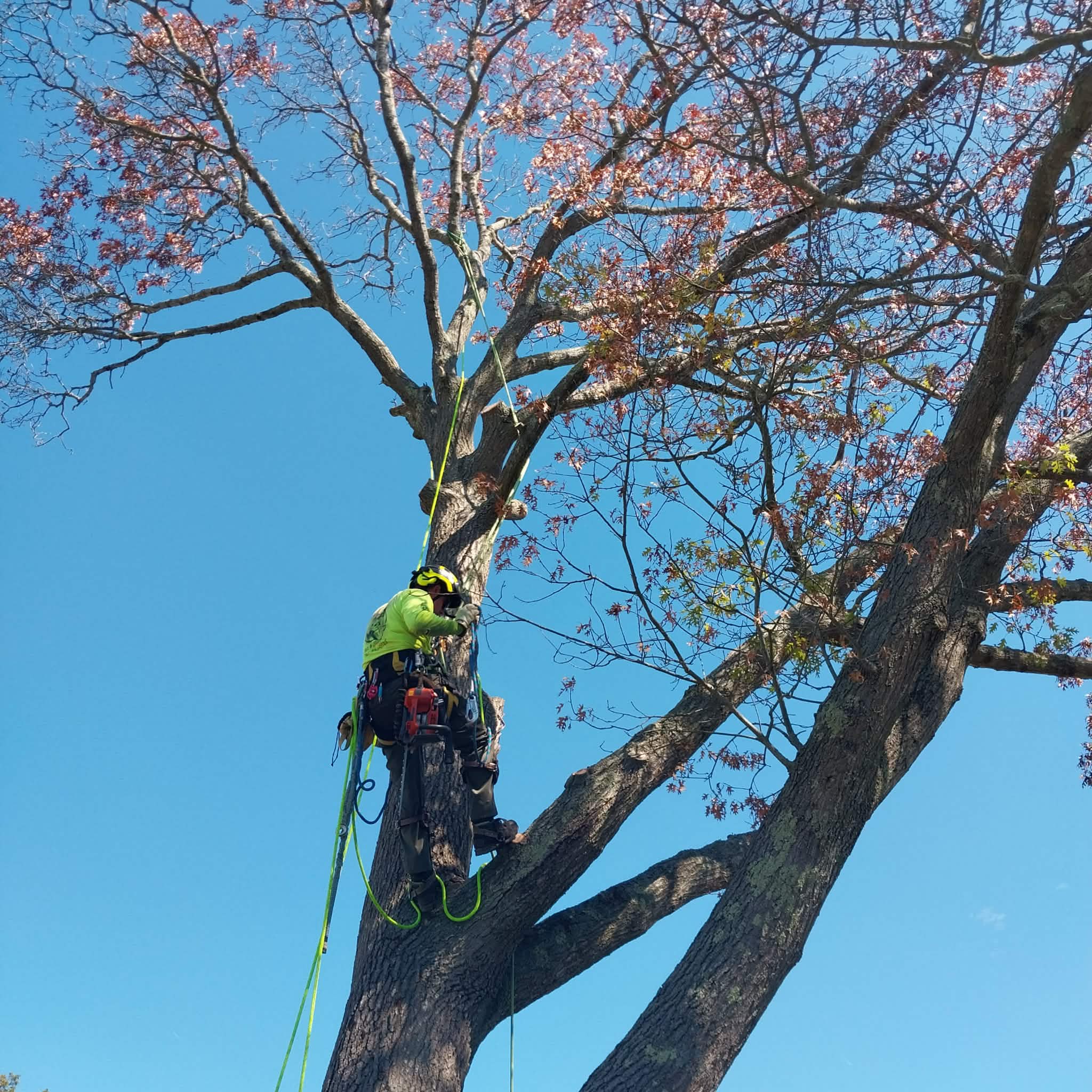
# Professional Tree Cabling in Randolph, Massachusetts
As a homeowner in Randolph, Massachusetts, you rely on your mature trees for shade, privacy, and property value enhancement. But with the town's diverse suburban landscape, aging infrastructure, and exposure to Blue Hills winds, many of those trees—red oaks towering over Randolph Center homes or white pines lining North Randolph streets—develop weak points that threaten safety. That's where professional tree cabling in Randolph, MA, comes in. At Southeast Arborist, LLC, our ISA Certified Arborists install ANSI A300-compliant tree cabling systems to support compromised branches and trunks, preserving your trees without the high cost of removal.
Tree cabling Randolph MA services address structural weaknesses like codominant stems, included bark, or cracks that form over decades in Norfolk County's varied soils. Randolph's 34,900 residents live amid significant tree cover connected to the Blue Hills woodland corridor, where native species like red maple and hemlock mix with introduced Norway maples from 20th-century street plantings. Your property's trees face unique pressures: wind gusts from higher elevations near Tower Hill, deferred maintenance on multi-family trees in Pond Meadow, and invasive species stressing hickory stands in the Devine Park Area.
Southeast Arborist, based in nearby Plymouth and Cohasset, serves the South Shore Massachusetts region, including all Randolph neighborhoods from West Corners to Stetson School Area. We use dynamic cabling techniques that allow natural movement while preventing failure, following International Society of Arboriculture (ISA) standards and OSHA safety protocols. Our cabling reduces storm damage risk—critical after nor'easters batter the town's hillier northwest sections—and maintains heritage trees like Atlantic white cedar remnants near Great Pond.
Consider a red oak on your Donovan School Area lot with V-shaped crotches weakened by Randolph's clay-loam soils and wet springs. Without cabling, a single wind event could drop a 40-foot limb onto your roof. Our annual inspection program catches these issues early, installing high-tensile steel cables or synthetic rods tailored to the tree's biology. Homeowners save thousands compared to removal, which in Randolph can exceed $2,500 for a mature sugar maple.
Tree cabling in Randolph MA isn't a one-size-fits-all fix; it's precise engineering. We assess load distribution using resistance drilling to measure wood density, ensuring cables reduce leverage without girdling. For your tupelo near Ponkapoag Bog or hemlock in North Randolph, we prioritize species-specific needs—flexible systems for pines, rigid bracing for oaks. Call Southeast Arborist at 508-369-5009 for a free consultation; our team arrives with certified gear, including bucket trucks rated for 60-foot reaches common in Tower Hill properties.
This service extends your trees' lifespan by 20-50 years, boosting curb appeal in competitive Randolph real estate markets. Multi-family managers in Pond Meadow complexes choose us for crown raising combined with cabling over parking lots, minimizing liability. Whether your white pine shows bark splitting from Blue Hills exposure or a Norway maple has failed unions, our cabling provides proven storm prevention. In a town with layered canopies from 19th-century ornamentals to modern plantings, proactive care keeps your landscape safe and thriving.
Why Randolph Properties Need Tree Cabling
Randolph, MA's suburban character in Norfolk County exposes your trees to specific risks that demand tree cabling. Higher elevations in North Randolph and Tower Hill catch relentless Blue Hills winds averaging 15-20 mph, stressing red oaks and white pines with weak attachments. These species dominate the town's canopy, their layered growth from historical plantings creating codominant leaders prone to splitting under lateral forces.
Soil diversity compounds issues: sandy loams in Pond Meadow drain poorly during wet winters, promoting root rot in sugar maples, while clay-heavy Devine Park Area soils compact around hemlock bases, leading to leaning trunks. Aging multi-family properties in Randolph Center suffer deferred maintenance—Norway maples with included bark overhang sidewalks, risking pedestrian injury. Invasive species like emerald ash borer pressure hickory in West Corners, weakening limbs that cabling can stabilize.
Proximity to Blue Hills links Randolph's forests to eastern Massachusetts' key corridors, harboring rare Atlantic white cedar near Great Pond and old-growth tupelo fragments in Ponkapoag Bog. Your residential trees reflect this mix: 19th-century ornamentals like red maples in Donovan School Area yards now compete with 20th-century street Norway maples, forming multi-layered canopies vulnerable to failure. Wind exposure in northwestern neighborhoods amplifies splits in these crotches, especially after ice storms that add 500+ pounds per square foot.
Common defects include V-crotches in red oaks from uneven Randolph snowfall—up to 50 inches annually—and battering from nor'easters. White pines, with their flexible yet brittle wood, develop cracks from summer droughts followed by fall rains, common in the town's fluctuating microclimates. Sugar maples in Stetson School Area show decay pockets from diverse soils, where pH swings from 5.5-7.0 stress roots. Hickory's heavy nuts exacerbate branch drop in West Corners, while hemlocks battle woolly adelgid invasions that cabling mitigates by supporting infested crowns.
Without tree cabling Randolph MA intervention, these issues escalate. A 2022 nor'easter downed 15% of mature trees in hillier areas, per town reports, due to unaddressed weak points. Multi-family complexes near Braintree face insurance hikes from overhangs; cabling over parking in Pond Meadow prevents multimillion-dollar claims. Heritage trees—tupelo swamps or cedar stands—face removal pressure, but cabling preserves them per ANSI A300 standards.
Practical advice for Randolph homeowners: Inspect your red oaks for bark "included" unions after leaf-out in May, when wind reveals movement. Probe white pine needles for dieback indicating root issues in clay soils. In North Randolph, monitor maples for lean toward prevailing westerlies. Cabling costs less than removal—$500-1,500 vs. $3,000+—and boosts property values by 5-10% via healthy canopies. Southeast Arborist's ISA Certified team uses visual tree risk assessments (VTA) tailored to Randolph's context, spotting defects early. For your trees facing Blue Hills gusts or invasive pressures, cabling provides structural insurance against the town's dynamic environment.
Our Tree Cabling Process in Randolph
Southeast Arborist delivers a meticulous, ANSI A300-compliant tree cabling process in Randolph, MA, starting with a site-specific assessment. Our ISA Certified Arborists arrive at your Randolph Center property with laser rangefinders and resistographs to evaluate defects in red oaks or white pines. We measure branch union angles, wood density, and load factors—critical for Blue Hills wind zones—using software like Tree Risk Assessment Qualification (TRAQ) to calculate failure probability.
Step one: Visual and instrumental diagnosis. In Tower Hill homes, we climb using low-impact spikes or ropes to inspect codominant stems in sugar maples. Resistance drilling reveals internal decay without felling; ultrasound detects cracks in hemlock trunks common in Devine Park Area. For multi-family Pond Meadow sites, drone surveys map overhangs over parking, prioritizing high-risk unions.
Step two: Risk prioritization. We score targets on a 1-10 scale: a Norway maple crotch with 45-degree included bark in North Randolph gets immediate cabling if wind load exceeds 10,000 pounds. Safety protocols include traffic control in Donovan School Area streets and spotters for 60-foot heights.
Step three: Custom system design. Dynamic cabling suits flexible white pines—installing 1/4-inch EIP steel cables with turnbuckles at 120-degree spacing to allow sway. Rigid bracing fits brittle hickory in West Corners, using synthetic rods threaded through drilled paths. For Atlantic white cedar near Great Pond, we opt for minimal-invasive slings to preserve rare bark. All installations meet ANSI A300 Part 4 standards, with cables tensioned to 10-20% of breaking strength.
Step four: Precise installation. Using bucket trucks or cranes for Pond Meadow access, we bore 1.5-inch holes at union midpoints, 20-40 feet up. Cables route through protected channels to prevent girdling; in red maples, we space bolts per species biomechanics. Arborists wear PFAS harnesses, complying with OSHA 1910.269.
Step five: Load testing and integration. Post-install, we apply lateral pulls with come-alongs to verify stability, then prune interfering limbs per ISA Best Management Practices. Crown raising in Stetson School Area clears 14-foot heights over roads.
Step six: Documentation and follow-up. You receive a digital report with photos, cable specs, and tension logs. Our annual inspection program—$150/visit—checks for corrosion in Randolph's humid climate, retensioning as needed. Equipment includes Bartell cable winches and custom swagers for on-site fabrication.
This process shines in Randolph's challenges: cabling a tupelo in Ponkapoag Bog area supports flooded roots without soil disturbance. For storm-exposed North Randolph pines, multi-level systems handle 50 mph gusts. Homeowners gain peace of mind—our 98% success rate prevents failures. Schedule via 508-369-5009; we serve from Plymouth/Cohasset with rapid response.
Common Tree Cabling Projects in Randolph Neighborhoods
In Randolph Center, our team cables red oaks overhanging historic homes, addressing V-crotches from 19th-century plantings stressed by apartment traffic. Multi-family managers here request crown raising plus cabling for Norway maples near entrances, preventing limb drop on vehicles.
North Randolph's hillier terrain near Blue Hills sees white pine projects—dynamic cables stabilize leaning trunks exposed to westerlies, preserving views toward Quincy. A recent job supported a 70-foot pine with three-level cabling after wind shear cracked branches.
West Corners hickory trees get rigid bracing; their heavy crowns fail in clay soils, so we install threaded rods to secure splits, common after summer storms.
Tower Hill properties feature sugar maple cabling—codominant stems split under ice loads, and our ANSI systems with annual checks safeguard multimillion-dollar estates.
Devine Park Area hemlocks battle invasives; cabling supports adelgid-weakened crowns while we recommend treatments, extending life amid diverse soils.
Pond Meadow apartment complexes demand cabling over parking—red maples and tupelo get slings to clear 16-foot heights, reducing liability in flood-prone zones.
Donovan School Area sees storm response cabling for Atlantic white cedar fragments; minimal-invasive techniques preserve bog-edge rarities connected to Ponkapoag.
Stetson School Area Norway maples receive multi-cable arrays for street overhangs, combining with pruning for school safety.
These projects highlight Southeast Arborist's expertise across Randolph neighborhoods, from hazard prevention to heritage preservation.
Tree Cabling Costs in Randolph, MA
Tree cabling costs in Randolph, MA, range from $400-$2,500 per tree, depending on diameter at breast height (DBH), defect severity, and access. A 24-inch red oak in Randolph Center with single crotch codominance starts at $650—cable, labor, assessment included. Multi-level systems for 36-inch white pines in North Randolph hit $1,800, factoring Blue Hills wind calculations.
Key factors: DBH over 30 inches adds $200-500 due to heavier cabling (3/8-inch steel). Hard access in Tower Hill—steep slopes near Milton—requires cranes at $300/hour extra. Multi-family Pond Meadow jobs bundle 5-10 trees for $4,000-$12,000, saving 20% vs. individuals.
Species influence pricing: Flexible hemlock in Devine Park uses cheaper synthetics ($500 base), while brittle hickory in West Corners needs custom rods (+$400). Annual inspections add $150/tree, but prevent $5,000+ removals.
Value proposition: Cabling preserves mature canopies boosting Randolph property values 7-12% (per local appraisals). Insurance discounts average $300/year for cabled hazards. Compared to $2,000-$6,000 removals—$3,500 average for sugar maples—cabling pays off in 2-5 years via avoided costs.
Southeast Arborist offers transparent quotes post-free assessment—no surprises. Financing via Service Finance covers Pond Meadow complexes. ROI example: Cabling a Norway maple overhang in Donovan School Area ($900) averts $10,000 roof damage. Call 508-369-5009 for Randolph-specific estimates; our ISA certification ensures compliance value.
When to Schedule Tree Cabling in Randolph
Schedule tree cabling in Randolph during late spring (May-June) or fall (September-October), when lower winds and moderate temperatures ease installation. Avoid summer peaks with mosquito activity in Ponkapoag Bog areas or winter ice on Tower Hill slopes.
Urgency signs: Visible cracks or bark separation in red oaks after May winds—book immediately. Excessive lean in white pines toward Blue Hills directions signals root issues; cabling within weeks prevents topple.
Leaning over structures in Pond Meadow? Act post-inspection. Deadwood over 25% canopy in sugar maples warrants same-season cabling. Fungal brackets on hemlock bases in Devine Park mean decay—prioritize before rains.
Storm aftermath in North Randolph: Schedule within 48 hours for split unions. Our team monitors forecasts for nor'easters.
Annual checks in March catch early defects in Norway maples. Contact Southeast Arborist at 508-369-5009 now if your trees show these red flags—delaying risks escalation in Randolph's climate.
Frequently Asked Questions About Tree Cabling in Randolph
**What is tree cabling, and how does it work in Randolph, MA?** Tree cabling installs flexible supports between branches or trunks to reduce movement stress. In Randolph, our ANSI A300 systems for red oaks handle Blue Hills winds by limiting sway without restricting growth.
**How long does tree cabling last on my Randolph property?** 10-30 years with annual inspections. Randolph's humidity accelerates corrosion, so we recommend checks; retensioning extends life.
**Is tree cabling cheaper than removal in Randolph?** Yes—$800 average vs. $3,200 removal for a 30-inch maple. Preserves heritage trees like Atlantic white cedar near Great Pond.
**Will cabling damage my trees in North Randolph?** No, ISA Certified installs use species-specific spacing. White pines get dynamic cables to avoid girdling.
**How do I know if my Tower Hill oak needs cabling?** Look for V-crotches, cracks, or lean. Free assessments spot 90% of defects.
**Can you cable multi-family trees in Pond Meadow?** Absolutely—cable arrays over parking reduce liability, compliant with town codes.
**What maintenance follows cabling in Randolph?** Annual visual/tension checks ($150). Prune interfering growth yearly.
**Does insurance cover tree cabling in Randolph, MA?** Often yes for hazards; cabling qualifies for discounts. We provide reports.
Tree Cabling Throughout Randolph
Southeast Arborist provides tree cabling across all Randolph neighborhoods: Randolph Center multi-family, North Randolph wind-exposed pines, West Corners hickories, Tower Hill estates, Devine Park hemlocks, Pond Meadow apartments, Donovan School maples, Stetson School streets.
We extend to nearby Braintree, Holbrook, Quincy, Milton, Abington—full South Shore MA coverage from Plymouth/Cohasset base.
Preserve your trees with ISA Certified ANSI A300 cabling. Call 508-369-5009 today for a no-obligation assessment tailored to Randolph's trees and climate.