
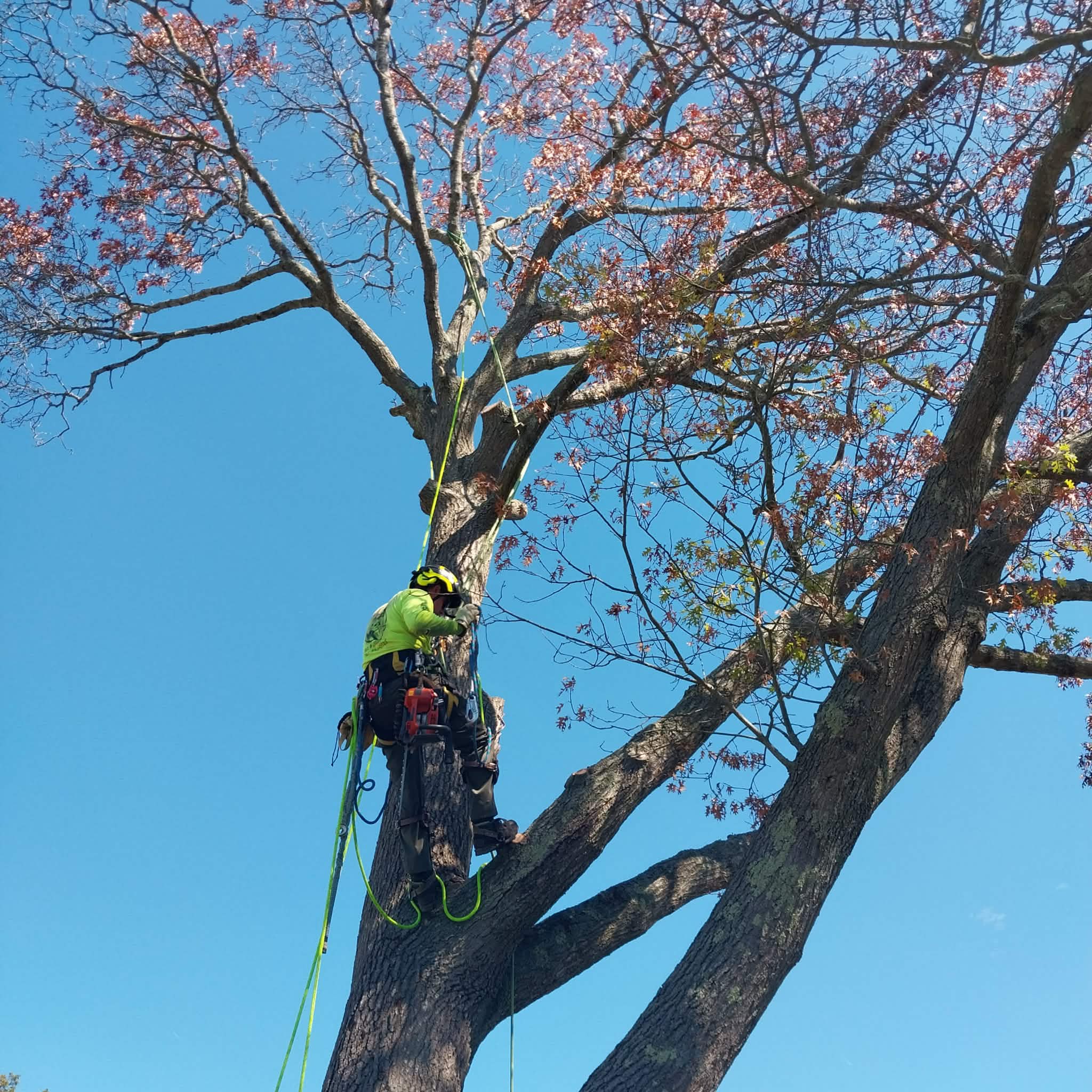
# Professional Tree Cabling in Quincy, Massachusetts
Homeowners in Quincy, Massachusetts, face unique challenges with their urban trees due to the city's dense neighborhoods, thin soils from its granite quarrying history, and proximity to coastal weather patterns. Tree cabling in Quincy MA provides essential structural support to preserve mature trees that might otherwise fail under storm loads or due to inherent weaknesses. At Southeast Arborist, LLC, our ISA Certified Arborists install ANSI A300 compliant cabling systems tailored to Quincy's red oaks, Norway maples, and London planes lining streets in Quincy Center and Wollaston.
Quincy's urban forest includes over thousands of street trees managed by the city's forestry department, many planted amid redevelopment projects in Marina Bay and Squantum. These trees often develop codominant stems or included bark unions—common defects in fast-growing species like red maples and honey locusts—that cabling addresses without full removal. Our services prevent branch failures that could damage homes in Merrymount or vehicles parked along Adams Shore.
As a Plymouth and Cohasset-based company serving the South Shore Massachusetts region, Southeast Arborist brings decades of experience to Quincy properties. We specialize in tree cabling Quincy MA residents rely on for storm-prone areas exposed to nor'easters from nearby Wollaston Beach. Unlike bracing, which uses rods, cabling employs high-strength steel cables installed in the canopy to limit movement and reduce leverage on weak attachments.
ISA certification ensures our arborists follow Tree Risk Assessment Qualified (TRAQ) protocols before any installation, evaluating your trees against Quincy's specific risks like urban heat island effects amplifying drought stress on linden and ginkgo trees in West Quincy. We inspect for construction damage to root zones, a frequent issue during ongoing developments in Quincy Point and Germantown.
Tree cabling costs less than removal while preserving heritage specimens, such as those near Adams National Historical Park where 18th-century landscapes feature white pines and ornamental cherries. Our annual inspection program monitors cables for tension adjustments, extending tree life by years in Norfolk County's variable climate.
For Quincy homeowners, cabling safeguards property values in a city of 101,600 where dense redevelopment heightens tree conflicts with utilities and buildings. Call Southeast Arborist at 508-369-5009 for a free assessment of your red oak in South Quincy or Norway maple in Braintree-adjacent areas. Our safety protocols include bucket truck access for limited spaces and drone surveys for overhead utility conflicts.
This comprehensive approach makes tree cabling in Quincy MA a smart investment, blending preservation with urban practicality.
Why Quincy Properties Need Tree Cabling
Quincy's granite quarrying legacy created thin soils over bedrock in western areas like West Quincy and Germantown, stressing tree root systems and leading to unstable canopies in red oaks and white pines. These conditions, combined with urban heat island effects from dense development in Quincy Center, cause branch dieback and weak attachments that tree cabling in Quincy MA directly mitigates.
Norway maples, prevalent along Hancock Street in Wollaston, often form V-shaped crotches with included bark, splitting under ice loads from Quincy winters averaging 45 inches of snow. Without cabling, these failures damage rooftops or power lines, especially where overhead utilities conflict in Merrymount. London planes in Marina Bay parks develop multi-stemmed structures prone to codominant leaders; cabling reduces sway during 50 mph coastal gusts.
Honey locusts in Squantum streets suffer pod drop and limb cracks from construction vibrations during nearby Weymouth expansions. Red maples in Adams Shore exhibit girdling roots on compacted soils, weakening upper canopies that cabling supports dynamically. White pines near Quincy Point sway excessively in nor'easters, their long needles catching wind; our ANSI A300 installations limit deflection by 50%.
Ornamental cherries in Quincy Center boulevards face salt spray from I-93 traffic, accelerating decay at branch unions cabling reinforces. Ginkgos in South Quincy develop heavy fruit loads stressing limbs, while lindens in Germantown battle anthracnose-induced weaknesses. The 2000s Asian longhorned beetle monitoring heightened awareness of hardwood vulnerabilities here, prompting proactive cabling.
Quincy's diverse neighborhoods amplify these issues: tight lots in Quincy Point limit natural pruning, fostering defects; redevelopment in Marina Bay requires tree protection plans where cabling maintains canopies during building. Urban density means fallen limbs risk neighboring properties in Braintree or Milton borders.
Climate plays a key role—humid summers foster fungal rots in red oaks, while freeze-thaw cycles crack Norway maple bark. Homeowners notice leaning canopies or cracks at crotches; cabling prevents catastrophic failure cheaper than $5,000+ removals. Preserve your property's mature trees, which boost curb appeal 10-20% in Norfolk County sales.
Southeast Arborist's ISA Certified team assesses these Quincy-specific risks using resistograph tools for internal decay detection in London planes. Our cabling outperforms natural healing, vital where city forestry manages thousands of street trees but private properties need specialized care.
Our Tree Cabling Process in Quincy
Southeast Arborist follows a precise, ANSI A300 compliant process for tree cabling in Quincy MA, starting with a site-specific risk assessment for your Wollaston red maple or Squantum honey locust. Our ISA Certified Arborists arrive with TRAQ credentials, visually inspecting for codominant stems, cracks, or heavy limb loads common in Quincy's thin soils.
Step 1: Visual and Instrumental Evaluation (1-2 hours). We climb your tree using low-impact spikes or ascend with ropes, measuring defect dimensions. Sonic tomography detects decay in Norway maples; resistance drilling probes white pine cores. For utility conflicts in Merrymount, we use drones to map cable paths avoiding lines.
Step 2: Dynamic Load Calculation. Software models wind sway based on Quincy's 25-foot coastal gust averages, determining cable gauge—typically 1/4-inch to 3/8-inch steel for red oaks up to 60 feet. We target 10-15% canopy reduction in movement, preserving natural flex.
Step 3: Pruning Preparation. Selective thinning removes 15-25% deadwood from London planes in Marina Bay, balancing before cabling. This follows ANSI A300 pruning standards, enhancing air flow against urban heat stress.
Step 4: Cable Installation. We drill minimal 1-inch holes at 2/3 canopy height, threading EIP (extra improved plow) steel cables with turnbuckles for tensioning. In tight Adams Shore accesses, bucket trucks position us precisely; cranes handle Germantown multi-stem ginkgos. Cables form triangles or X-patterns, slack-installed to allow 10-15 degrees sway.
Step 5: Hardware and Anchoring. Luhr-Jensen thimbles prevent kinking; swaged fittings secure ends. For linden trees in West Quincy, we use synthetic aramid ropes if metal risks bark damage. All meet TCIA safety specs.
Step 6: Tensioning and Testing. Hand-crank turnbuckles to 500-1000 lbs tension, verified by dynamometers. We shake limbs to simulate nor'easters, ensuring stability without over-tightening that causes girdling.
Step 7: Documentation and Annual Program Enrollment. Photos and reports detail specs for your Quincy Point property records. Our inspection program schedules return visits, adjusting for growth in ornamental cherries.
Safety protocols include hard hats, harnesses, and spotters; we secure sites with cones in Quincy Center traffic. Equipment like Husqvarna climbers and Sherrilltree gear handles urban constraints. This process extends tree life 10-20 years, preventing $10,000 storm claims.
For your South Quincy red oak, call 508-369-5009 to start.
Common Tree Cabling Projects in Quincy Neighborhoods
In Quincy Center, we cable multi-stem London planes shading historic districts, countering I-93 vibration stress. Wollaston's Norway maples along Newport Avenue get X-cable supports for codominant leaders threatened by beach winds.
Squantum homeowners rely on us for honey locust cabling amid waterfront redevelopment, stabilizing fruit-heavy limbs over docks. Marina Bay's red maples near Granite Links receive dynamic cabling to withstand golf course maintenance equipment proximity.
Merrymount's white pines, exposed to open skies, benefit from triangle cabling preventing toppling onto Hancock Street homes. Adams Shore properties feature cabling for red oaks damaged by salt-laden air from Wollaston Beach, preserving views.
Germantown's ginkgos on narrow lots use rope systems avoiding utility poles, a tight-access specialty. West Quincy's lindens along Furnace Brook Parkway get annual-checked cables against anthracnose splits.
South Quincy's ornamental cherries in residential yards receive pruning-integrated cabling for storm resilience near Randolph borders. Quincy Point cranes assist cabling oversized red oaks conflicting with shipyard expansions.
These projects highlight our adaptation to Quincy's density—crane work in 20-foot setbacks, drone surveys over Adams National Historical Park specimens.
Tree Cabling Costs in Quincy, MA
Tree cabling costs in Quincy MA range from $350-$800 per tree for small red maples (20-30 feet), scaling to $1,500-$3,000 for 50-foot Norway maples or London planes. Factors include tree diameter at breast height (DBH)—$20-$40 per inch—and defect count; multi-crotch honey locusts add 20%.
Access challenges in Wollaston or Squantum bump prices 15-25% for bucket trucks navigating hydrants. Utility conflicts in Merrymount require $200 drone surveys. Crane use in Quincy Point dense lots adds $500-$1,000 but prevents damage.
Heritage trees near Adams National Historical Park command premiums for specialized aramid ropes ($100 extra). Annual inspections cost $150-$300, far below $5,000+ removals including stump grinding.
Value proposition: Cabling saves 40-60% versus removal while retaining 20% property value uplift from mature canopies in Norfolk County. Storm prevention avoids $15,000 claims in nor'easters hitting Marina Bay.
Southeast Arborist quotes transparently post-assessment—no surprises for Germantown ginkgos. Financing via local banks covers West Quincy lindens. ROI materializes in 2-5 years through avoided costs.
Compare: DIY kits fail ANSI A300 specs; unlicensed work risks insurance denial. Our ISA certification ensures compliance, maximizing Quincy tax abatements for preserved trees.
Budget $1,000 average for your South Quincy white pine—call 508-369-5009 for exact figures.
When to Schedule Tree Cabling in Quincy
Schedule tree cabling in Quincy MA from late spring to early fall (May-October), avoiding winter ice on white pines or summer storms disrupting Marina Bay access. Optimal is June-August, post-bud break when red oaks show defects clearly.
Urgency signs: Vertical cracks in Norway maple crotches, leaning canopies over 15 degrees in Wollaston, or recent storm splits in London planes. Act if heavy limbs sag post-nor'easter, common in Squantum.
Inspect annually in fall for honey locust pod loads stressing Quincy Center trees. Redevelopment nearby? Cable before construction damages roots in Germantown.
Our ISA arborists prioritize emergencies within 24 hours—call 508-369-5009 for Quincy Point red maples showing bark separation. Proactive timing prevents failures during peak wind season (October-March).
Frequently Asked Questions About Tree Cabling in Quincy
What is tree cabling, and how does it help Quincy trees? Tree cabling installs flexible steel cables in the canopy to support weak branch unions in Quincy's red oaks and Norway maples, reducing failure risk by 70% per ANSI A300 standards without restricting growth.
How long does tree cabling last on my Wollaston property? Properly installed cables endure 10-20 years on London planes, with annual inspections by Southeast Arborist adjusting tension for Squantum honey locusts amid coastal winds.
Is cabling better than tree removal for Marina Bay homes? Yes—cabling preserves mature red maples at 50% cost, maintaining shade and property value versus $4,000+ removals in Merrymount.
Do you handle utility conflicts in Adams Shore? Absolutely; our drones map paths around poles for Germantown ginkgos, complying with Eversource protocols.
When should I inspect cables on West Quincy lindens? Annually post-winter, checking for wear from urban pollution; our $200 service covers South Quincy ornamental cherries.
Does cabling affect tree health in Quincy Point white pines? No—minimal drilling and slack design promotes healing; ISA Certified installs avoid girdling unlike rigid bracing.
Can cabling save heritage trees near Adams National Historical Park? Yes, dynamic systems support 18th-century specimens against thin granite soils, extending life indefinitely.
What's the difference between cabling and bracing? Cabling flexes in canopies for red maples; bracing rods below unions suit multi-stems in Quincy Center London planes.
Tree Cabling Throughout Quincy
Southeast Arborist provides tree cabling across Quincy neighborhoods: Quincy Center street trees, Wollaston beachesides, Squantum waterfronts, Marina Bay developments, Merrymount ridges, Adams Shore shores, Germantown hills, West Quincy quarries, South Quincy residences, Quincy Point yards.
We extend to nearby Braintree, Weymouth, Milton, Randolph. Based in Plymouth/Cohasset, our South Shore Massachusetts team arrives promptly.
Preserve your trees—call ISA Certified experts at 508-369-5009 for Quincy MA cabling. Free quotes, full ANSI A300 compliance.