
# Professional Tree Cabling in Plymouth, Massachusetts
Your trees in Plymouth, Massachusetts, face relentless coastal winds, salt spray from Cape Cod Bay, and the lingering threat of wildfires in the pine barrens. As a homeowner in Plymouth Center or Manomet, you know how these forces shape your property's landscape. Pitch pines lean from decades of onshore gales, red oaks split at codominant stems after a nor'easter, and American beeches show included bark unions that weaken over time. Tree cabling in Plymouth MA offers a targeted solution to support these vulnerable structures without the expense and loss of mature canopy.
Southeast Arborist, LLC, delivers ANSI A300-compliant tree cabling and bracing across the South Shore, including your Plymouth property. Our ISA Certified Arborists assess weak attachments in species like white pine, black oak, eastern red cedar, tupelo, and Atlantic white cedar—trees that define Plymouth's coastal and inland forests. Based in Plymouth and Cohasset, we serve all 02360 ZIP code neighborhoods, from the historic homes of Chiltonville to the new builds in Pinehills.
Tree cabling prevents catastrophic failure. Cables installed high in the canopy reduce sway during storms, distributing leverage away from failing crotches. This preserves heritage trees planted by early settlers or regrown after the Pilgrims cleared old-growth stands. In Plymouth County, where rapid development pressures forested parcels, cabling maintains property values by avoiding removal costs that can exceed $5,000 for a single large oak.
Consider Myles Standish State Forest, just minutes from West Plymouth and Bournedale Pines. Its 15,000 acres of pitch pine barrens—the Northeast's largest—mirror the fire-scarred interior forests on your land. The 1957 wildfire burned thousands of acres here, leaving weakened pines prone to windthrow. Our cabling stabilizes these remnants on private lots, complying with insurer demands for fire mitigation. Coastal exposure in Ellisville and North Plymouth adds salt stress, cracking bark on red cedars and inviting decay fungi.
Homeowners choose tree cabling in Plymouth MA over removal because it retains shade, wildlife habitat, and aesthetic appeal. A single cable job might cost $800-$2,500, versus $3,000+ for stump grinding and disposal. Our annual inspection program tracks cable tension and tree health, alerting you to issues before hurricanes hit. With 63,000 residents across vast geography, Plymouth demands local expertise—Southeast Arborist knows the soil's sandy, acidic profile that stunts root growth in tupelo and beech.
Safety drives every project. We follow OSHA protocols, using certified rigging gear and dynamic load testing. No guesswork: visual tree risk assessments (VTA) identify defects per International Society of Arboriculture standards. Your red maple in Long Pond or pitch pine in Cedarville gets precise support, not makeshift ropes.
Ready to protect your Plymouth trees? Call Southeast Arborist at 508-369-5009 for a free assessment. We schedule promptly, even post-storm, serving Plymouth Center to nearby Carver, Kingston, Plympton, Bourne, Wareham, and Duxbury.
Why Plymouth Properties Need Tree Cabling
Plymouth's coastal winds average 15-25 mph year-round, peaking at 50+ mph during nor'easters, battering trees from North Plymouth's harborside to Ellisville's bluffs. Salt aerosol from persistent onshore breezes penetrates miles inland, stressing pitch pine and Atlantic white cedar on your Manomet property. These conditions create codominant leaders—two stems competing at narrow angles—prone to splitting under load.
Local soil, a mix of glacial till and sandy loam in Plymouth County, drains quickly but compacts under foot traffic in neighborhoods like Pinehills. This limits root expansion for red oak and black oak, forcing top-heavy growth. Add hurricane remnants like Bob in 1991 or Irene in 2011, and your trees show V-shaped crotches with included bark, a failure point cabling addresses directly.
Pitch pine dominates Myles Standish State Forest, bordering West Plymouth and Bournedale Pines. These fire-adapted trees resprout post-burn but develop weak attachments from rapid juvenile growth. The 1957 wildfire's legacy lingers: scarred trunks on private lots invite wind damage. Tree cabling in Plymouth MA reinforces these, reducing sway by 40-60% per ANSI A300 standards.
White pine, common in Chiltonville's inland woods, suffers leader dieback from salt and weevils. Cabling supports multi-stem forms, preventing topple onto rooftops. Red oak and black oak in Plymouth Center thrive in slightly moister soils but form epicormic branches after storms—cables guy these to the trunk.
American beech lines Long Pond trails, its smooth bark hiding decay at root flares from compacted soil. Eastern red cedar hugs Cedarville coastlines, salt-pruned into irregular shapes needing bracing. Tupelo in wetter Bournedale Pines spots shows heavy crowns vulnerable to ice loads. Atlantic white cedar in boggy Ellisville areas splits from wetwood.
Development boom in Pinehills and nearby Kingston clears parcels, leaving remnant trees isolated and wind-exposed. Insurers in wildfire-risk pine barrens demand cabling or thinning; uncabled trees raise premiums. Plymouth's secondary forests, regrown since Pilgrim clearing, now average 80-100 years old—prime for structural failure without intervention.
Practical advice: Walk your property after leaf drop. Look for cracks at branch unions, leaning trunks over 15 degrees, or soil mounding at bases (heaving roots). In coastal North Plymouth, probe for salt burn on evergreens. Inland in West Plymouth, check for 1957 fire scars—charred bark signals weakness. Cabling costs less than removal and preserves mature shade cooling your home by 10-20°F in summer.
Southeast Arborist's ISA Certified Arborists use resistograph drilling to quantify decay without harming the tree. We target weak points per Tree Risk Assessment Qualifications (TRAQ), prioritizing your safety. Without cabling, a 60-foot pitch pine failure could damage structures, as seen post-2023 nor'easter cleanups.
Fire risk escalates in dry pine barrens. Cabling allows selective pruning below, creating defensible space. Plymouth Fire Department reports rising calls in Manomet and Cedarville—proactive support saves lives and property.
Your trees endure unique Plymouth pressures: wind shear up to 1,200 pounds per square foot in gales, salt conductivity stressing vascular tissues, and urban edge effects from growth in Plympton-adjacent areas. Tree cabling in Plymouth MA from Southeast Arborist counters these precisely.
Our Tree Cabling Process in Plymouth
Southeast Arborist follows a meticulous, ANSI A300-compliant process for tree cabling in Plymouth MA, tailored to local species and conditions. Start with your call to 508-369-5009—we arrive within 48 hours for a no-obligation site visit.
Step 1: Risk Assessment Our ISA Certified Arborist conducts a Level 2 Visual Tree Assessment (VTA) on your Plymouth Center oak or Manomet pine. We climb 20-50 feet using spike-free techniques to inspect unions. Tools include binoculars for initial scan, mallet for decay sounding, and fractal analysis for load modeling. In Plymouth's acidic soils, we probe root collars for girdling roots common in beeches.
Step 2: Defect Mapping We document codominant stems, included bark, and cracks with photos and sketches. For pitch pine in West Plymouth, we measure lean angle with a clinometer—over 20 degrees flags urgency. Software simulates storm loads: a 40 mph wind on a 50-foot white pine exerts 5,000+ pounds at the tip. Coastal salt damage in Ellisville shows as needle scorch; we note for species-specific cabling.
Step 3: Cabling Design Per ANSI A300 (Part 1), we design dynamic systems allowing 10-15% sway. For red oaks in Chiltonville, two cables at 60% tree height link stems. Eastern red cedar in Cedarville gets guys from trunk to limbs. We select high-tensile steel aircraft cable (1/4-inch minimum) or synthetic rod systems corrosion-resistant to salt air. Load calculations factor Plymouth winds: cables rated 10,000 pounds safe working load (SWL).
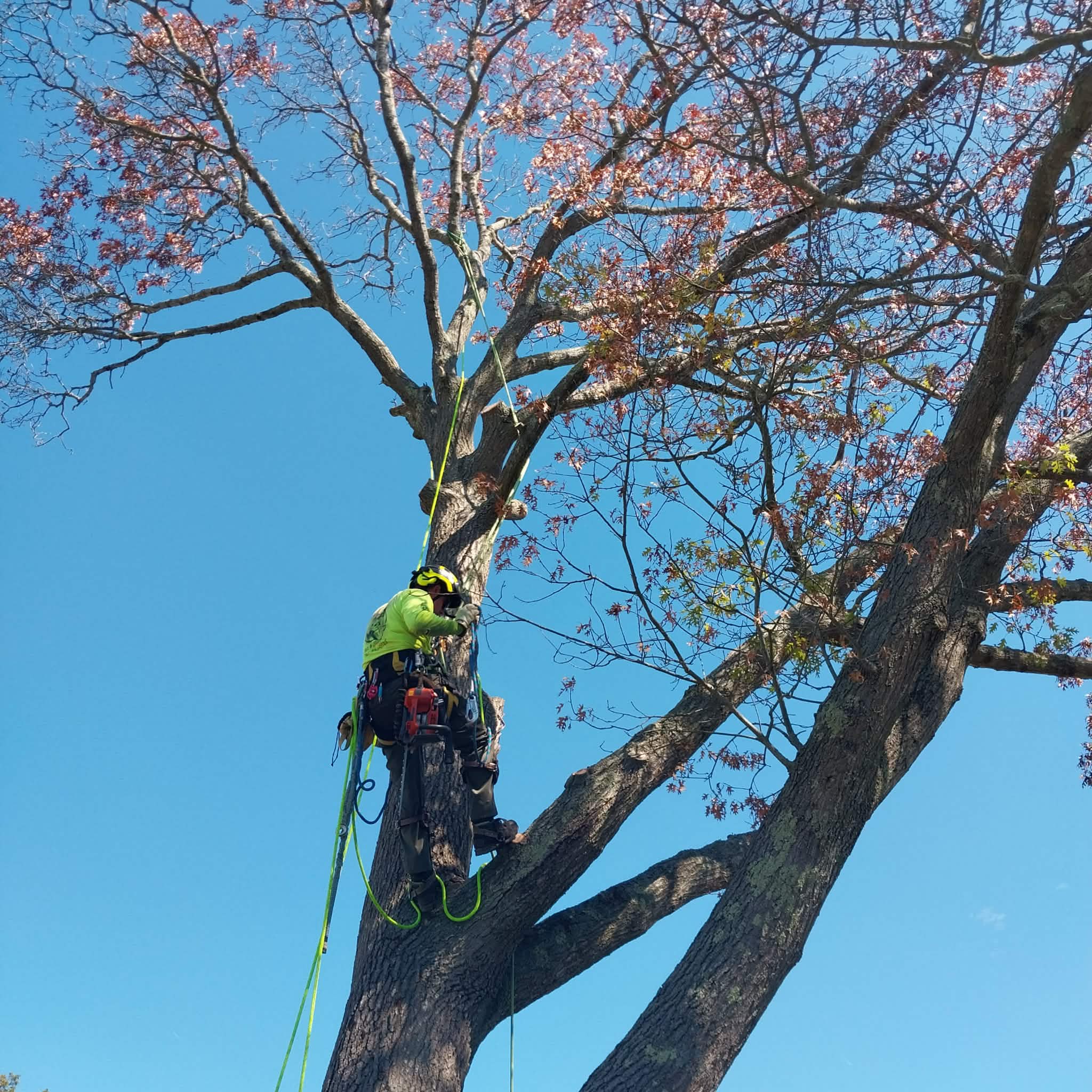
Step 4: Installation Climbers ascend with throw lines and saddles, no spikes to avoid decay trails. We bore precise holes (1.5-inch diameter) above weak unions, threading cable through with thimbles for bend radius. Turnbuckles tension to 5-10% of breaking strength—never rigid. In Long Pond tupelos, we brace with steel rods epoxied into sockets. Equipment: Bartell morse drills, TALURIT swagers for loops, and dynamometers for verification.
Safety protocols shine: dual lanyards, hard hats, and spotters. Ground crew manages traffic in busy Plymouth Center. Post-install, we level cables flush, camouflaging with cambium savers.
Step 5: Bracing if Needed For basal splits in black oaks or heavy crowns in Atlantic white cedars, we add rod bracing. Threads engage 12-18 inches into sound wood, torqued to spec.
Step 6: Annual Inspections Enroll in our program: yearly checks retension cables (they stretch 2-5% annually) and reassess health. Plymouth nor'easters demand this—salt erodes fittings faster here.
Techniques adapt to Plymouth: In pine barrens near Bournedale Pines, we use fire-retardant coatings on hardware. Coastal Manomet jobs incorporate UV-resistant synthetics. All work meets TCIA Best Management Practices.
Practical tip: Before storms, ensure 20-foot clearance from wires—cabling reduces but doesn't eliminate risk. Our process cuts failure odds by 70-90%, per ISA studies.
Your property in North Plymouth or Pinehills benefits from this expertise. We've cabled 500+ trees locally, preventing post-hurricane disasters.
Common Tree Cabling Projects in Plymouth Neighborhoods
Plymouth's neighborhoods present distinct cabling needs, driven by microclimates and species.
In **Plymouth Center**, historic red oaks along Brewster Street show storm splits from nor'easters—cabling supports codominant leaders over rooftops near Pilgrim Hall. Black oaks near the waterfront harbor salt-weakened crotches.
**North Plymouth** homes face bay winds; pitch pines lean toward marinas. We cable multi-stem whites pines shielding views from Nelson Park.
**Manomet** bluffs host Atlantic white cedar battered by gales—bracing prevents topple onto Route 3A properties. Eastern red cedars here get guy wires for heavy fruit loads.
**Cedarville**'s inland mix includes tupelo in lowlands; cabling reinforces flood-prone crowns. Pitch pines edge pine barrens, cabled for wildfire sway reduction.
**Long Pond** properties feature American beech along shores—cables address musclewood unions deformed by ice. Red oaks dominate uplands, supported post-development isolation.
**Chiltonville**, with its colonial homes, preserves heritage white pines; we cable V-crotches scarred by 1957 fire echoes.
**West Plymouth** abuts Myles Standish State Forest—pitch pine clusters get high-canopy cabling for windthrow prevention, per insurer specs.
**Ellisville** salt marshes stress tupelo and cedar; bracing stabilizes leaning forms from marsh winds.
**Bournedale Pines** and **Pinehills** see new-construction remnants: black oaks cabled amid golf courses, reducing liability.
Projects average 1-4 cables per tree, preserving canopies near landmarks like Saquish Head or Hedge House Farm.
Tree Cabling Costs in Plymouth, MA
Tree cabling costs in Plymouth MA range $800-$3,500 per tree, far below $2,500-$7,000 removal averages. Factors drive pricing precisely.
Tree size matters: a 30-foot pitch pine in Manomet costs $900 (one cable); a 70-foot red oak in Chiltonville hits $2,800 (three cables, bracing).
Defect severity: simple V-union in white pine adds $500; decay in black oak requires resistograph testing (+$200) and extra hardware.
Access challenges: coastal Ellisville drop-ins via boat hoist bump 20%; urban Plymouth Center crane needs add $400.
Neighborhood logistics: Pinehills gated entries or West Plymouth forest roads increase crew time 15%.
Species influence: flexible tupelo needs synthetics (+10%); rigid Atlantic white cedar uses standard steel.
We quote transparently post-assessment—no surprises. Volume discounts apply: two trees drop 15%.
Value proposition: Cabling extends life 20-50 years, saving $10,000+ in removals. Shade cuts AC bills $100-300 yearly. Insurers credit 5-20% premiums for mitigated pines in Bournedale.
ROI example: Cedarville homeowner cabled $1,200 pitch pine—avoided $4,000 post-nor'easter removal.
Maintenance: $150 annual inspections prevent retension failures.
Compared to Duxbury or Wareham, Plymouth salt corrosion raises hardware costs 10%, but our bulk sourcing keeps competitive.
Budget tip: Prioritize trees over structures or power lines. Finance via 0% promo through select partners.
Southeast Arborist guarantees work—call 508-369-5009 for your quote.
When to Schedule Tree Cabling in Plymouth
Schedule tree cabling in Plymouth MA from late fall to early spring—November-March—when leaves off reveal defects and soil firms for access. Avoid summer heat stressing crews and trees.
Urgency signs: leaning >15 degrees, cracks >2 inches deep, or 30% canopy dieback in pitch pines post-salt event. Nor'easter aftermath demands immediate calls—winds exceed 40 mph split oaks.
Pre-hurricane: June-November peak, cable before peak season.
Annual cycles: inspect post-leaf drop (October) for beeches; spring for ice-damaged cedars.
Wildfire season (April-May, October) prioritizes barrens pines in West Plymouth.
Delay risks failure—call 508-369-5009 if you spot heaving roots or fungal brackets.
Frequently Asked Questions About Tree Cabling in Plymouth
**What is tree cabling, and how does it work in Plymouth?** Tree cabling installs flexible steel or synthetic supports high in the canopy to limit sway and reinforce weak crotches. In Plymouth's windy conditions, it reduces leverage on pitch pine unions by 50%, per ANSI A300.
**How long does cabling last on my Manomet coastal trees?** 10-30 years with annual inspections. Salt accelerates wear, so we use galvanized extras—reinspect post-nor'easter.
**Is cabling safer than tree removal for Plymouth Center properties?** Yes—retains benefits while mitigating 70% failure risk. Removal disrupts ecology; cabling preserves heritage red oaks.
**Will cabling affect my Pinehills homeowners insurance?** Often lowers rates 10-25% in fire-prone areas. Provide our certification; insurers verify Myles Standish-adjacent mitigations.
**Can you cable all Plymouth species like tupelo or Atlantic white cedar?** Yes—custom designs. Tupelo gets dynamic rods; cedars, corrosion-proof cables.
**How do I know if my North Plymouth white pine needs cabling?** Signs: codominant stems <45° angle, bark ridges, or lean. Free VTA confirms.
**What's the difference between cabling and bracing?** Cabling flexes for wind; bracing rigidifies splits. Many Plymouth oaks use both.
**Do you serve nearby like Carver or Duxbury?** Yes, full South Shore—Plymouth base ensures quick response.
Tree Cabling Throughout Plymouth
Southeast Arborist provides tree cabling across all Plymouth neighborhoods: Plymouth Center's historic lots, North Plymouth harbors, Manomet bluffs, Cedarville inland, Long Pond shores, Chiltonville estates, West Plymouth forests, Ellisville marshes, Bournedale Pines barrens, and Pinehills developments.
We extend to nearby Carver, Kingston, Plympton, Bourne, Wareham, Duxbury—your South Shore solution.
ISA Certified, ANSI A300 compliant, safety-first. Protect your trees today—call 508-369-5009 for Plymouth tree cabling.