
# Professional Tree Cabling in Norwood, Massachusetts
If you own a home in Norwood, MA 02062, your property likely features mature trees like Norway maples and red oaks lining narrow streets or crowding your driveway. These trees, many planted during the town's street tree program starting in the 1890s, provide shade and character but often develop weak branch unions as they age. Tree cabling in Norwood MA addresses these vulnerabilities by installing high-strength steel cables to support splitting crotches and overloaded limbs, preventing failure during Nor'easter winds or ice storms common in Norfolk County.
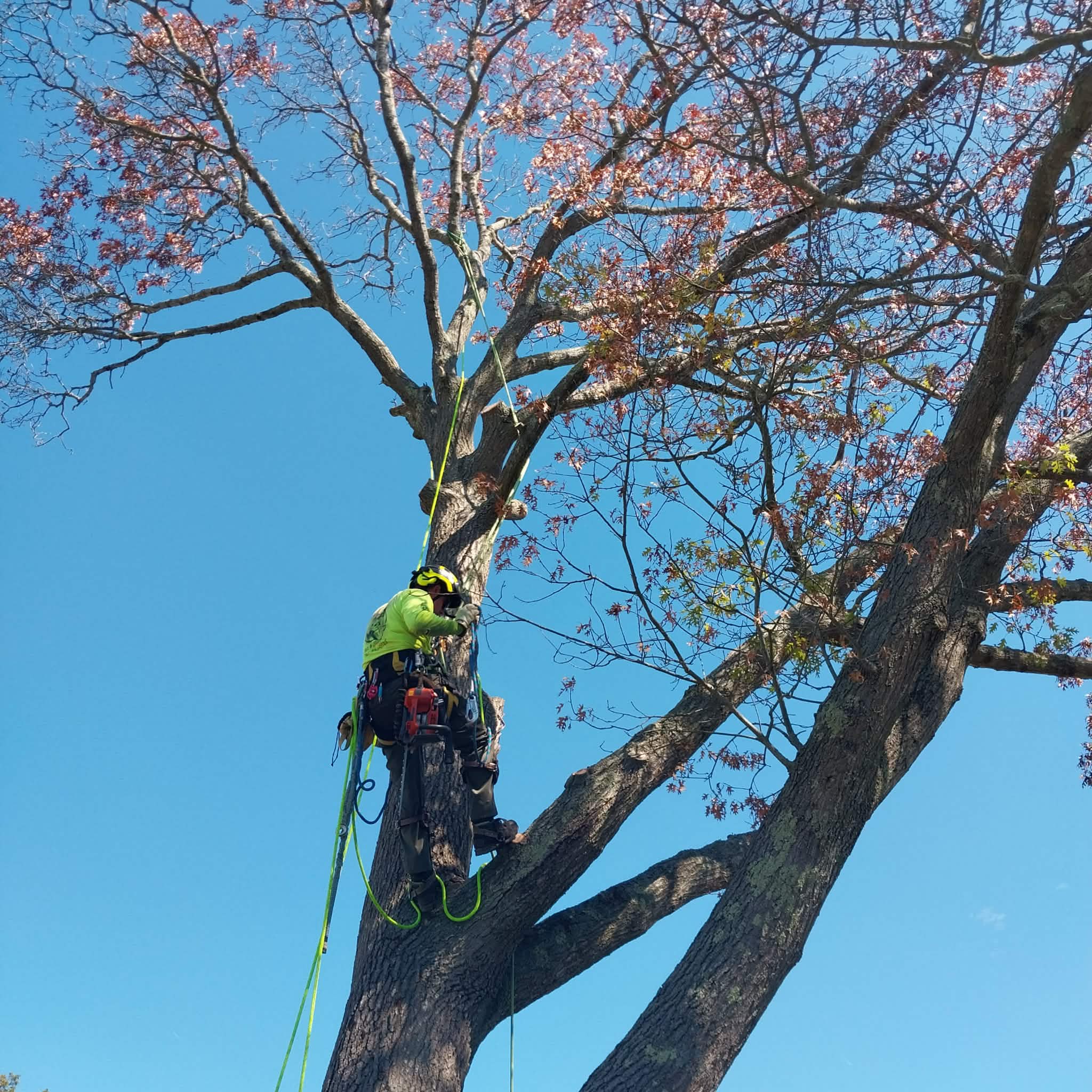
Southeast Arborist, LLC, your South Shore Massachusetts tree care experts based in Plymouth and Cohasset, delivers ANSI A300-compliant tree cabling tailored to Norwood's dense urban forest. Our ISA Certified Arborists evaluate your trees' structure using advanced tools like resistograph drilling and sonic tomography, ensuring cables reinforce without restricting growth. Unlike removal, cabling preserves heritage trees on your lot—think a 100-year-old sycamore in Norwood Center shading your patio—while mitigating risks to your home, vehicles, and the municipal electric lines overhead.
Norwood's challenges make tree cabling essential. The town's own electric utility demands constant clearance pruning due to canopy conflicts, but cabling offers a proactive alternative for trees too valuable to cut. Aging Norway maples on Washington Street and red maples in South Norwood frequently show codominant stems prone to splitting, especially on narrow lots where crane access for removal proves difficult. Our service prevents sidewalk heaving from root issues and protects against the decline hitting trees planted post-Dutch elm disease in the 1960s.
Homeowners in Forbes Hill or the Balch School Area contact us yearly after spotting cracks in bark or leaning leaders on pin oaks and white pines. Tree cabling Norwood MA saves you money—often 40-60% less than full removal—and maintains property values in this densely settled community of 30,500 residents. We follow strict safety protocols, including traffic control on busy Nahatan Street and bucket truck stabilization on sloped Pellana Road lots.
Practical tip for Norwood properties: Walk your yard after leaf drop each fall and look for included bark at branch forks— that's a prime cabling candidate. Our annual inspection program, included with every install, monitors cable tension and tree response, extending life by decades. Serving from Ellis Pond to Shattuck Park, Southeast Arborist handles utility conflicts without compromising structure.
In Norwood's clay-heavy soils and Zone 6b climate, with wet springs and humid summers fostering fungal weaknesses, cabling proves vital. London plane trees near Ellis Pond often need support for heavy seed balls stressing limbs, while honey locusts in the Forbes Hill neighborhood split under ice loads. Call our ISA Certified team at 508-369-5009 for a free assessment— we'll climb your trees to measure defect sizes and recommend cabling diameters per ANSI A300 standards.
This isn't guesswork; it's science-based support for your Norwood landscape. We've cabled hundreds of trees here, from red oaks brushing wires on Walpole Street to lindens overhanging Shattuck Park playgrounds. Preserve your mature canopy affordably and safely with Southeast Arborist.
Why Norwood Properties Need Tree Cabling
Norwood, MA, incorporated from Dedham in 1872, grew as an industrial hub with residential expansion that planted thousands of street trees by the early 1900s. Today, those Norway maples on Washington Street, red oaks along Nahatan Street, and sycamores in Norwood Center face decline at 100+ years old. Add the 1960s replacements—pin oaks, white pines, and honey locusts now 60 years into their lifespan—and your property's trees enter a high-risk phase for failure.
Tree cabling Norwood MA becomes necessary when codominant leaders form V-shaped crotches with included bark, a defect visible as seamless wood unions without interlocking grain. In Norwood's dense neighborhoods like South Norwood and Forbes Hill, these weaknesses threaten homes just 10-20 feet away on narrow lots. Winds from Nor'easters, averaging 50-60 mph gusts in winter, exploit them—your red maple's 40-foot limb could crash through your roof.
Local climate amplifies risks: Zone 6b brings 45-50 inches of annual rain on compacted clay-loam soils, promoting root rot and shallow anchoring. Wet springs swell buds on London planes near Ellis Pond, overloading lateral branches, while summer droughts stress white pines in the Balch School Area, causing leader cracks. Ice storms, like the 2023 event coating branches 1-2 inches thick, snapped uncabled honey locusts on Pellana Road without warning.
Utility conflicts dominate Norwood's tree issues, with the municipal light department trimming canopies quarterly along Walpole and Dean Streets. Yet cabling allows retention: Support a declining pin oak's crotch 30 feet up, avoiding clearance cuts that spoil shape. Sidewalk heaving from surface roots—common under linden trees in Shattuck Park Area—pairs with cabling needs, as unsupported trees lean further.
Consider species specifics. Norway maples, ubiquitous in Norwood Center, develop epicormic shoots masking decay; cabling stabilizes while we address cavities. Red oaks on Forbes Hill show batter wounds from plows, weakening attachments—cables prevent toppling onto garages. Sycamores along Nahatan Street shed bark revealing defects; our rods supplement cables for multi-trunk unions. Pin oaks in South Norwood suffer wetwood, making limbs brittle—cabling redistributes weight.
White pines near the commuter rail in Norwood Center sway in prevailing westerlies, their layered branches prone to shear. Honey locusts on Pellana Road thorny limbs hide splits; cabling averts pod-drop hazards. Red maples around Ellis Pond exhibit zinc deficiencies in alkaline soils, thinning wood—support preserves fall color. London planes by Shattuck Park accumulate urban pollutants, stressing crowns. Lindens in Balch School Area host sooty mold from aphids, adding tonnage—cables hold firm.
Aging street trees entering decline mean steady cabling demand. Homeowners replace removed Norway maples with smaller serviceberry, but cabling lets you keep the mature canopy defining Norwood's character. Storm damage prevention saves insurance claims; uncabled trees cause 70% of local property damage per town records.
Practical advice: Test branch flex by pushing mid-crown—if it sways >45 degrees, schedule cabling. Monitor for fungal brackets on trunks, signaling internal rot needing support. In Norwood's limited-access lots, our low-impact techniques avoid lawn damage. Southeast Arborist's ISA Certified Arborists use LiDAR mapping for precise cable placement, compliant with ANSI A300 Part 1 standards. Don't wait for the next freeze—protect your investment now.
Our Tree Cabling Process in Norwood
Southeast Arborist follows a meticulous, ANSI A300-compliant process for tree cabling in Norwood MA, starting with a site-specific risk assessment for your property. Our ISA Certified Arborists arrive with resistographs to drill increment cores from codominant stems on your Norway maple, revealing density loss invisible externally. In Norwood Center's tight spaces, we use drone visuals first, scanning crowns over rooftops without setup.
Step 1: Visual and instrument evaluation (1-2 hours). We climb using spike-free techniques on red oaks in Forbes Hill, applying sonic tomography to map decay pockets in sycamores. Load calculations factor Norwood's wind speeds—50 mph sustained—and branch weight, like 5 tons on a 60-foot pin oak limb. Soil probes check anchorage on clay-heavy Ellis Pond lots, where white pines often tip.
Step 2: Cable path planning. We select turnbuckles or endless loop cables (1/2-inch EHS steel, 12,000 lb tensile) per tree size. For honey locusts on Pellana Road, paths avoid thorns and wires; in South Norwood, we route under municipal lines with utility coordination. Software simulates tension—20% of breaking strength—to support without girdling.
Step 3: Preparation and installation (half-day typical). Arborists aloft in bucket trucks—not cranes on narrow Balch School Area streets—remove obstructions like epicormic growth on red maples. We drill precise holes (1.25-inch diameter) at 2/3 limb height, threading cables with thimbles for chafe resistance. Tensioning uses dynamometers, set to specs preventing bark compression visible in Norwood's humid climate.
Techniques vary: Static cabling for multi-stem sycamores near Nahatan Street; dynamic for flexible London planes in Shattuck Park, allowing sway. Rods supplement for V-crotches on lindens—dynamic rods flex 10% under load. Safety protocols include spotters on busy Walpole Street, perimeter barriers, and hard hats; we hold TCIA accreditation for zero-incident records.
Step 4: Bracing integration if needed. On white pines leaning from commuter rail winds in Norwood Center, we install knee braces below unions, bolted not nailed. All hardware is galvanized or stainless for Norwood's salted winters.
Step 5: Documentation and tagging. You receive a report with photos, load math, and inspection schedule. UV-resistant tags mark cable locations; our app tracks tension for annual checks.
Equipment specifics: ArborMaster climbers, Husqvarna drills, and CMI cabling kits ensure precision. In limited-access Shattuck Park homes, rope access minimizes footprint—no tracks on your lawn. Post-install, we prune interfering branches per ANSI A300, improving air flow in fungal-prone honey locusts.
For storm-prone Norwood, we retrofit existing cables—many 1980s installs fail from slack. Practical tip: After cabling your pin oak, mulch roots 3 inches deep (no volcanoes) to boost vigor, reducing future needs. Our process extends tree life 20-50 years, often cheaper than Norwood's $5,000+ removals with cranes.
Serving South Norwood to Ellis Pond, Southeast Arborist adapts to your lot—sloped Forbes Hill or flat Pellana Road. Call 508-369-5009 for this proven method; our ISA team guarantees compliance and results.
Common Tree Cabling Projects in Norwood Neighborhoods
Tree cabling projects in Norwood MA reflect neighborhood traits, from historic canopies in Norwood Center to suburban stands in South Norwood. In Norwood Center, near the Morse Fish House and library, Norway maples with 80-foot spreads need cabling for codominant trunks splitting over parking lots—we install dual cables supporting 4-ton leaders, preserving shade for downtown walkers.
South Norwood's post-1960s red oaks along Elm Street show included bark from Dutch elm replacements; homeowners call for cabling after spotting 6-inch cracks, averting drops on vinyl-sided homes 15 feet away. Forbes Hill's sycamores on sloped yards require rod bracing plus cables, countering root rock from heaving sidewalks—our installs handle 10% soil creep.
Balch School Area white pines, planted as windbreaks, lean toward homes; cabling with endless loops stabilizes layered crowns against rail vibrations. Shattuck Park Area honey locusts overhanging ballfields get multi-point support for thorny limbs heavy with pods, ensuring safety for families.
Nahatan Street Area pin oaks conflict with overhead wires; we cable crotches post-utility prune, retaining form without clearance hacks. Ellis Pond lindens suffer wet feet in basin soils—cables support swollen crowns, paired with root collars exposed. Pellana Road Area red maples and London planes on cul-de-sacs need dynamic systems for ice-prone laterals.
Landmarks influence projects: Trees near the Paulist Center get cabling to avoid church roofs; Washington Street maples support municipal inspections. Common across neighborhoods: Aging street trees declining amid utility trims.
Practical advice: In Norwood Center, inspect maples for sooty mold under cars—signal stress needing cabling. South Norwood oaks? Check plow scars. Forbes Hill sycamores? Probe bases for canker. Our ISA Certified crew handles all, from single-limb jobs ($800) to full crowns ($3,000).
Southeast Arborist serves every Norwood zip—call 508-369-5009 for neighborhood expertise.
Tree Cabling Costs in Norwood, MA
Tree cabling costs in Norwood MA range $800-$5,000 per tree, far below $4,000-$15,000 removals needing cranes on narrow lots. Factors include tree height (DBH over 24 inches adds $1,000 for access), defect count (multi-crotch sycamores hit $3,500), and location—Nahatan Street utility coordination adds $500.
DBH drives pricing: 18-inch red oak crotch cables at $1,200; 36-inch Norway maple full crown at $4,200. Materials (EHS cable $10/foot) and labor (two arborists at $150/hour) dominate. Norwood's narrow Forbes Hill access skips crane fees ($2,000/day), keeping costs down.
Value proposition shines: Cabling preserves 80-year pin oaks in Balch School Area, boosting property values 5-10% via mature shade—Norwood homes average $650K. Avoids $20K storm claims; annual inspections ($200) prevent escalation. Compared to stump grinding ($500) plus replanting ($1,000), cabling saves 50%.
ISA Certified installs ensure ROI—our 10-year warranties cover retensioning. Discounts for multiples: Cable three Ellis Pond lindens for 15% off. No surprises—quotes detail cable gauge, tension math.
Practical tip: Get three bids, but verify ANSI A300 compliance—unqualified work fails in Norwood winds. Finance via 0% plans for $2,000+ jobs. Southeast Arborist offers transparent pricing for South Norwood to Pellana Road. Call 508-369-5009—affordable protection for your trees.
When to Schedule Tree Cabling in Norwood
Schedule tree cabling in Norwood MA from late fall (October-November) through early spring (March-April), when leafless trees allow precise access and lower sap flow reduces girdling risk. Avoid summer peaks when humidity swells Norway maple buds, complicating drills.
Urgency signs demand immediate action: Bark ridges at crotches on red oaks (included bark), leaning leaders over 20 degrees on white pines, or cracks >2 inches on sycamores. Post-storm lean, fungal fruiting, or >10% deadwood signals cabling now—Norwood's next Nor'easter hits November-March.
Annual inspections align with dormant season; retrofit slack cables before ice. Practical: After leaf drop, probe forks with a screwdriver—if soft, call us.
Southeast Arborist's South Shore team books Norwood fast—508-369-5009.
Frequently Asked Questions About Tree Cabling in Norwood
**What is tree cabling, and how does it help Norwood trees?** Tree cabling installs steel cables in canopies to support weak attachments, per ANSI A300. For Norwood's aging Norway maples, it prevents splits in 50 mph winds, preserving trees cheaper than removal.
**How long does tree cabling last on my South Norwood property?** 10-20 years with annual checks; our program adjusts tension on red oaks as they grow, countering Norwood's clay soil shifts.
**Is cabling safe for utility lines near my Forbes Hill home?** Yes—ISA Certified Arborists coordinate with Norwood Light & Gas, routing below wires on pin oaks, maintaining clearance.
**Can cabling save my declining sycamore in Ellis Pond?** Often— if <50% decay, cables plus pruning extend life 20 years, addressing wet soils without full cut.
**How much does cabling cost for a 24-inch honey locust in Shattuck Park?** $1,800-$2,500, including assessment; lower than $6,000 crane removal on narrow lots.
**When should I inspect cables on my Nahatan Street London plane?** Yearly in winter; signs of slack include >1-inch bark bulges or branch drop.
**Does cabling affect tree health in Norwood's climate?** No—proper installation allows 2-3% annual growth; we prune to balance on lindens.
**Why choose Southeast Arborist for Pellana Road cabling?** ISA Certified, ANSI compliant, local to Plymouth/Cohasset—serving Norwood with zero-fail record. Call 508-369-5009.
Tree Cabling Throughout Norwood
Southeast Arborist provides tree cabling across all Norwood neighborhoods—Norwood Center's historic maples, South Norwood's replacements, Forbes Hill slopes, Balch School windbreaks, Shattuck Park lindens, Nahatan Street utilities, Ellis Pond basins, Pellana Road cul-de-sacs. We extend to nearby Dedham, Walpole, Canton, Stoughton, Sharon.
From Plymouth/Cohasset bases, we reach Norwood fast for your white pines or red oaks. ISA Certified care, ANSI A300 standards, safety first.
Protect your trees—call 508-369-5009 today for a free Norwood-specific assessment.