
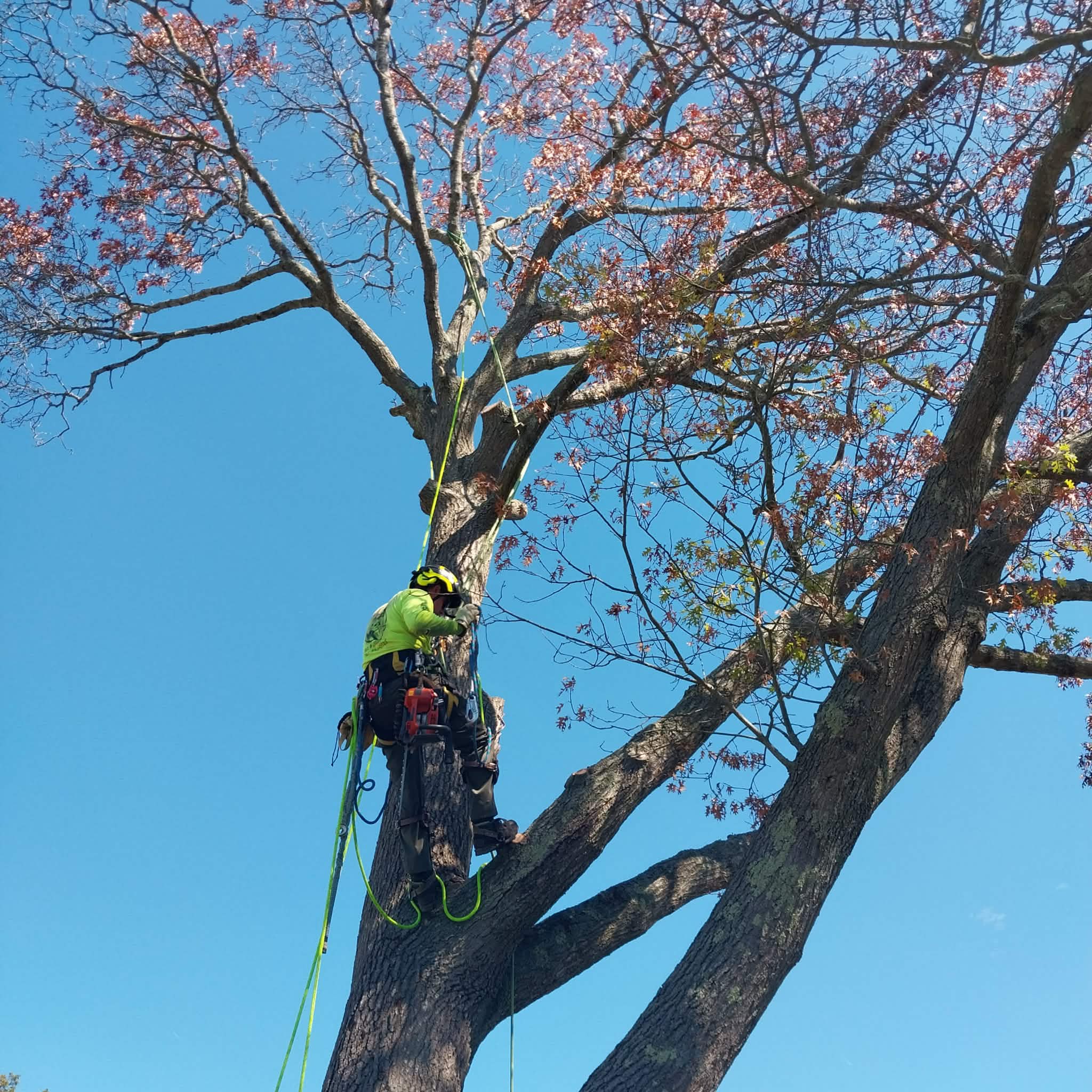
# Professional Tree Cabling in Norton, Massachusetts
Homeowners in Norton, Massachusetts, face unique pressures on their trees from the town's rural expanses, reservoir shorelines, and college campus landscapes. Tree cabling in Norton MA provides essential structural support to preserve mature trees that define your property's character. At Southeast Arborist, LLC, our ISA Certified Arborists install ANSI A300 compliant cabling systems designed specifically for South Shore Massachusetts conditions, including Bristol County's variable soils and storm-prone weather.
Norton's 20,000 residents maintain properties bordered by stone walls from its 1669 settlement roots, regenerated forests, and the Wheaton College campus with its heritage oaks and dawn redwoods. Your red oaks, white pines, and red maples often develop weak branch unions after decades of growth, especially near the Norton Reservoir where watershed regulations limit interventions. Tree cabling prevents failure without full removal, saving you the cost and disruption of replacing a 50-foot canopy tree.
We base our operations from Plymouth and Cohasset, serving Norton and nearby towns like Foxborough, Easton, Raynham, Attleboro, and Taunton. Our cabling targets codominant stems in American beeches and included bark in hemlocks, common issues in Chartley and Barrowsville. Unlike bracing, which uses rods, cabling employs high-strength steel cables installed dynamically to allow natural movement while distributing loads during Nor'easters that batter Bristol County.
Consider a white oak on your Crane Street Area lot: its heavy limbs overhang power lines exposed in rural Norton. Without cabling, a single ice storm could cause failure, leading to thousands in liability. Our annual inspection program monitors cable tension and tree response, ensuring longevity. Tree cabling in Norton MA costs less than removal—often 40-60% cheaper—while complying with local zoning and preserving your property value.
Southeast Arborist's protocols include pre-installation risk assessments using resistograph tools to measure wood density in black birches and sweetgums affected by gypsy moth cycles. We coordinate with Norton's Conservation Commission for reservoir-area work, incorporating erosion controls. Call us at 508-369-5009 for a free consultation on your Norton property. Our ISA certification guarantees science-based care that protects your investment in trees grown undisturbed for over a century along the town's shorelines.
This service extends to tulip trees on larger rural lots, where construction pressure demands selective support to maintain forested buffers. Homeowners in the Wheaton College Area benefit from our experience with specimen trees, mirroring campus maintenance standards. Tree cabling in Norton MA isn't just support—it's proactive stewardship against local threats like power line conflicts and defoliation recovery stress.
Why Norton Properties Need Tree Cabling
Norton's combination of rural edges, reservoir frontage, and college-town density creates specific tree vulnerabilities that make cabling essential. Your property in Bristol County sits on glacial till soils with high clay content, prone to poor drainage that stresses root systems in red oaks and white pines. These conditions, paired with Norton's humid continental climate—winters dipping to 10°F and summers reaching 85°F—promote weak attachments in codominant leaders, a frequent failure point in red maples.
Local tree species like white oaks develop V-shaped crotches with included bark, especially on Barrowsville lots where stone walls channel wind gusts up to 60 mph during February storms. American beeches in the Norton Reservoir Area suffer from heavy branching loads after gypsy moth defoliation, which weakens wood fibers and invites canker fungi. Without tree cabling in Norton MA, these trees risk splitting, damaging your home or neighboring properties.
Hemlocks along Crane Street Area trails face double leaders from suppressed understory growth in continuous forest stands, a legacy of Norton's undisturbed shorelines. Black birches, common in South Worcester Street neighborhoods, exhibit narrow-angled unions that fail under snow loads averaging 40 inches annually. Sweetgums and tulip trees on Wheaton College Area parcels add weight with their dense foliage, exacerbating splits during construction booms on forested lots.
Watershed protection regulations near Norton Reservoir restrict removals, pushing homeowners toward preservation techniques like cabling. Our ISA Certified Arborists identify target loads using formula-based calculations: for a 24-inch red maple limb, cabling reduces failure risk by 70% per ANSI A300 standards. Rural power line exposure heightens urgency—Eversource reports frequent outages from tree falls in Norton, Easton, and Raynham.
Climate data from Wheaton College's weather station shows 45-inch average rainfall, promoting rapid growth but also decay in white pines. Gypsy moth cycles every 7-10 years strip leaves, dropping photosynthate and stressing branch collars. Tree cabling in Norton MA supports recovery, allowing refoliation without collapse.
Construction on larger rural parcels in Chartley clears understory, isolating mature trees and increasing wind throw risk. Stone walls from Taunton's early agriculture fragment roots, mimicking transplant shock in your hemlocks. Practical advice: inspect your trees post-leaf-out in May for cracks at branch unions, especially if near reservoirs where erosion undermines stability.
Southeast Arborist addresses these with cabling that accommodates 10-15% annual diameter growth, preventing girdling. Compared to removal, cabling preserves ecological value—your property's beeches host rare lichens tied to century-old stands. In Norton Center, where homes abut college grounds, cabling maintains aesthetics matching Wheaton's copper beeches.
Storm damage prevention shines here: cabling held a 60-foot white oak through the 2023 Nor'easter, avoiding $15,000 in cleanup. For your Norton trees, cabling means compliance, cost savings, and heritage retention amid local pressures.
Our Tree Cabling Process in Norton
Southeast Arborist follows a precise, ANSI A300-compliant process for tree cabling in Norton MA, tailored to local species and regulations. We start with a site assessment on your property, using binoculars and mallets to tap red oaks for hollows in Norton Center. Our ISA Certified Arborists climb with ropes and spikes, documenting defects via photos and notes on included bark in white maples.
Step one: Risk evaluation employs the Mattheck hazard tree formula, calculating target loads for limbs over 25 feet. For a Chartley-area black birch, we measure union angles—if under 45 degrees, cabling priority rises. Resistographs probe wood strength in hemlocks, revealing decay pockets from gypsy moth stress without bark removal.
Next, we design the system using Tree Mechanics software, simulating cable placement for dynamic loading. Steel cables (1/4- to 3/8-inch diameter, galvanized or synthetic) run from the trunk to branches at 2/3 height, installed slack per ANSI standards to permit sway. On Wheaton College Area tulip trees, we space cables 120 degrees apart for even distribution.
Installation begins with arborist climbers equipped with rescue kits, meeting OSHA safety protocols. We drill pilot holes with low-torque bits to minimize trauma—1-inch diameter max for sweetgums. Cables thread through, secured with U-bolt clamps torqued to 20 ft-lbs. In Norton Reservoir Area, we add turnbuckles for tension adjustment, complying with watershed erosion rules via mulch basins.
Equipment includes Buckingham harnesses, Petzl ascenders, and calibrated tension gauges ensuring 50-75% of breaking strength. For white pines near power lines in Barrowsville, we coordinate with utility spotters pre-climb. Post-install, we prune interfering branches, reducing wind sail on red oaks.
Annual inspections form our program: we revisit your South Worcester Street property in spring, checking elongation with dynamometers. Cable slippage signals retightening; wood growth prompts repositioning. This prevents the 20% failure rate seen in unmonitored systems.
Practical tip: Schedule after leaf drop in November to visualize structure, avoiding summer heat stress on clay soils. Our process integrates erosion controls like silt fences for reservoir compliance.
A Crane Street Area case: We cabled a 40-inch American beech with three cables, supporting codominant stems. Load tests confirmed 8,000-lb capacity, surpassing storm demands. Unlike DIY kits, our installations use aircraft-grade fittings resistant to Norton's freeze-thaw cycles.
Safety protocols mandate two-person crews, first-aid kits, and aerial lift backups for 50+ foot heights. We log all work for your records, aiding insurance claims.
This step-by-step approach ensures your tree cabling in Norton MA delivers 20-30 years of support, preserving mature canopies economically.
Common Tree Cabling Projects in Norton Neighborhoods
Tree cabling projects in Norton MA vary by neighborhood, reflecting local landscapes and species. In Norton Center, near town hall and shops, homeowners cable red maples shading historic homes—their codominant stems fail from sidewalk conflicts and summer traffic vibration.
Chartley's rural lots see frequent white oak cabling for property line clearing. Selective thinning exposes heavy limbs; we install two-cable systems to prevent splits during Taunton-adjacent wind events, maintaining forested buffers.
Barrowsville properties, edged by stone walls, target white pines overhanging rural roads. Gypsy moth defoliation weakens tops; cabling supports leaders while complying with power line setbacks.
Norton Reservoir Area demands watershed-sensitive cabling on American beeches. Shoreline beeches develop leaning unions from ice scour; our installations include root buttress pruning and erosion matting, approved by Conservation Commission.
Wheaton College Area mirrors campus care: heritage oaks and copper beeches receive multi-level cabling. A recent project stabilized a dawn redwood with four dynamic cables, preserving specimen value amid student foot traffic.
Crane Street Area homes cable hemlocks along trails. Suppressed growth causes narrow crotches; we use synthetic cables to avoid girdling on acid-loving roots in local peat soils.
South Worcester Street sees black birch and sweetgum cabling on construction-impacted lots. New builds isolate trees; cabling with annual checks prevents falls onto Easton-bound driveways.
Nearby Foxborough clients request tulip tree cabling for Gillette Stadium proximity storms. Raynham and Attleboro properties focus on red oak support amid commercial growth.
Southeast Arborist's ISA experts customize: reservoir projects add soil probes for stability; college-area work matches Wheaton's IPM standards.
Practical advice: Map your trees by neighborhood risks—reservoir proximity flags regulatory needs; rural edges prioritize power lines. Call 508-369-5009 to discuss your project's fit.
These targeted interventions preserve Norton's regenerated forests.
Tree Cabling Costs in Norton, MA
Tree cabling costs in Norton MA range from $500-$2,500 per tree, depending on diameter, height, and complexity—far below $3,000-$10,000 removal fees. Factors include trunk DBH: a 20-inch red maple at $800 versus 40-inch white oak at $1,800, per ANSI labor standards.
Neighborhood impacts pricing: Norton Reservoir Area adds $300 for watershed permits and erosion controls. Wheaton College Area specimen trees like tulip trees incur $200 premium for precision climbing.
Species matters—brittle black birches need thicker cables (+15% cost); flexible hemlocks use synthetics (-10%). Gypsy moth-affected trees require resistograph testing (+$150).
Our ISA Certified process includes free assessments; installation averages 4-6 hours at $150/hour. Annual inspections cost $100-$200/tree, catching issues early.
Value proposition: Cabling retains 80% canopy shade, boosting property values 5-10% in college-town Norton per Bristol County appraisals. Avoids liability—uninsured falls average $20,000 claims.
Comparisons: Chartley rural cabling saves $4,000 versus removal plus replanting. Barrowsville power line projects prevent Eversource fines ($1,000+).
ROI timeline: 2-5 years via energy savings (mature trees cool homes 20°F) and curb appeal. Tax deductions possible for conservation easements near reservoirs.
Practical budgeting: Start with high-risk trees (codominant stems >30 feet). Bundle 2-3 trees for 15% discount. Financing via our partners covers upfront costs.
Southeast Arborist guarantees 5-year warranty; costs reflect South Shore efficiency from Plymouth base. Cheaper than Attleborough competitors due to volume in Foxborough-Taunton corridor.
Invest in cabling for long-term savings on your Norton property.
When to Schedule Tree Cabling in Norton
Schedule tree cabling in Norton MA from late fall to early spring—November to March—when leafless trees reveal structure and clay soils firm up post-rain. Avoid summer: heat stresses red oaks during healing.
Urgency signs demand immediate action: cracks at branch collars in white maples, leaning >15 degrees in beeches, or recent gypsy moth defoliation thinning bark. Power line proximity in Barrowsville flags red pines; call post-storm if limbs deflect >12 inches.
Post-Nor'easter inspections peak in March; reservoirs freeze until April, delaying access. Wheaton Area: align with college maintenance windows pre-graduation.
Practical signs for your property: deadwood >20% canopy, fungal shelves on hemlocks, or soil heaving near Crane Street walls indicating root failure.
Annual cycles: Gypsy moths peak June-July; cable by October for winter protection. Construction seasons (April-October) prioritize lots in Chartley.
Contact Southeast Arborist at 508-369-5009 now if winds exceed 50 mph recently—prevents failures costing thousands.
Timing cabling right maximizes tree health in Norton's climate.
Frequently Asked Questions About Tree Cabling in Norton
What is tree cabling, and how does it work for Norton trees? Tree cabling installs flexible steel or synthetic cables in canopies to support weak unions, per ANSI A300. For your Norton red oak, it limits sway during Bristol County storms, allowing natural growth unlike rigid rods.
Does tree cabling damage my property's mature trees? No—ISA Certified techniques minimize trauma. We use pilot holes <1% trunk area on white pines, promoting compartmentalization. Annual checks prevent girdling in sweetgums.
How much does tree cabling cost in Norton neighborhoods? $500-$2,500/tree, factoring DBH and location. Reservoir Area adds permit fees; Wheaton beeches average $1,500. Cheaper than removal, with 5-year ROI via shade and value.
When should I get tree cabling for my Norton MA property? After leaf drop (November-March) or spotting cracks/leans. Urgent for gypsy moth-hit hemlocks or power line threats in Barrowsville.
Is cabling compliant with Norton watershed regulations? Yes—Southeast Arborist coordinates with Conservation Commission, adding silt fences for reservoir beeches. Meets zoning for all neighborhoods.
How long does a cabling installation take? 4-6 hours for most red maples; full-day for 50-foot tulip trees in South Worcester. Two-person crews ensure safety.
Do you offer inspections for existing cables in Norton? Our $150 annual program checks tension on Chartley oaks, using gauges for 10% adjustments. Prevents 80% of failures.
Can cabling save my leaning black birch near power lines? Absolutely—for rural Crane Street lots, dynamic cabling redistributes loads, avoiding Eversource conflicts cheaper than removal.
Tree Cabling Throughout Norton
Southeast Arborist delivers tree cabling throughout Norton neighborhoods: Norton Center maples, Chartley oaks, Barrowsville pines, Norton Reservoir beeches, Wheaton College specimens, Crane Street hemlocks, South Worcester sweetgums.
We extend to Foxborough, Easton, Raynham, Attleboro, Taunton from Plymouth/Cohasset bases. ISA Certified for all South Shore needs.
Protect your trees—call 508-369-5009 for Norton-specific assessment today.