
# Professional Tree Cabling in Milton, Massachusetts
Your mature trees in Milton, MA, represent significant value—both aesthetically and historically. In an affluent community like Milton with its 28,600 residents spread across neighborhoods such as Milton Village, East Milton, and Milton Hill, homeowners face unique challenges preserving these assets. Steep terrain in areas like Scott Hill and Blue Hills limits equipment access, while shallow soils over ledge create root instability for species like white oak and hemlock. Southeast Arborist, LLC, your local ISA Certified Arborists based in Plymouth and Cohasset, specializes in ANSI A300-compliant tree cabling to provide structural support without removal.
Tree cabling in Milton MA addresses weak branch attachments and codominant stems common in your aging canopy. Unlike bracing, which uses rods for lower trunk support, cabling installs dynamic steel cables high in the canopy to limit excessive movement during storms. This preserves heritage trees planted by 19th-century Bostonians, such as copper beeches in Cunningham Park and Japanese maples along Canton Avenue. Our services extend across Norfolk County, including nearby Quincy, Braintree, Randolph, Canton, and Dedham, but we focus on Milton's exceptional tree heritage.
Consider the Blue Hills Reservation, encompassing 7,000 acres mostly within Milton's borders. Here, hemlocks over 200 years old battle hemlock woolly adelgid, while white pines and tulip trees sway in Nor'easter winds. Residential properties adjacent to this unbroken forest demand proactive canopy management. Southeast Arborist installs cabling systems that reduce failure risk by 70-80% according to International Society of Arboriculture studies, often at lower cost than removal. For your East Milton estate or Brush Hill property, cabling maintains shade, privacy, and property value.
We adhere strictly to ANSI A300 standards, the industry benchmark for tree risk assessment and structural support. Our ISA Certified team uses dynamic load testing and laser surveying to customize installations. Homeowners in Unquity or the Canton Avenue area report fewer storm-related claims after cabling—vital in Milton's climate of heavy snow loads (average 50 inches annually) and high winds from Quincy Bay exposure.
Practical advice for Milton residents: Inspect your red oaks and sugar maples now for included bark at branch unions, a telltale sign of weakness. If your property borders Blue Hills, prioritize hemlocks showing adelgid infestation combined with structural defects. Call Southeast Arborist at 508-369-5009 for a no-obligation hazard assessment. We service all Milton zip code 02186, ensuring your trees withstand New England's harsh winters.
This comprehensive guide details why tree cabling matters for your Milton property, our precise process, neighborhood-specific examples, costs, timing, and FAQs. With Southeast Arborist, you gain experts who understand Milton's ledge-bound soils, historic specimens like Hutchinson Field's American elms, and the need for non-invasive preservation. Protect your landscape investment—contact us today.
Why Milton Properties Need Tree Cabling
Milton's extraordinary tree canopy stems from its 19th-century origins as a retreat for wealthy Bostonians who imported specimen trees now maturing into hazards without intervention. Your white oaks in Milton Village or red oaks on Milton Hill often develop codominant leaders—two upright stems forming a V-shaped union filled with included bark. This weak attachment fails under ice loads common in Norfolk County winters, where temperatures drop to -10°F and branches accumulate 1-2 inches of ice.
Shallow soils over ledge, prevalent in Scott Hill and Brush Hill neighborhoods, exacerbate root instability. Your American beech or hickory trees here lack deep anchorage, making them prone to uprooting in gusts exceeding 50 mph from Blue Hills' elevated ridges. Hemlock woolly adelgid, rampant in the Blue Hills corridor, weakens eastern hemlocks by 40-60% through needle loss and branch dieback, creating multi-stem failures ideal for cabling.
Local climate amplifies these risks. Milton receives 45-50 inches of rain yearly, saturating clay-loam soils that drain poorly on slopes toward the Neponset River. Combine this with summer droughts stressing sugar maples and tulip trees, and you see bark splitting at crotches. Japanese maples in East Milton, prized for fall color, suffer from storm-twisted limbs due to their layered branching. Copper beeches along Canton Avenue exhibit heavy tops that leverage wind forces, pulling roots from thin soil.
Tree cabling in Milton MA prevents these failures. Cables absorb sway, reducing stress by distributing loads across the canopy. For your white pine near Cunningham Park, cabling supports split tops from woolly adelgid or lightning scars. Unlike removal, which costs $2,000-$10,000 per tree in Milton's tight lots, cabling preserves ecological benefits: mature oaks sequester 48 pounds of CO2 annually, while beeches provide critical habitat amid Blue Hills' 7,000-acre forest.
Homeowners in Unquity face technical challenges—steep drops to Randolph limit crane access, so cabling via rope-access techniques stabilizes hickories without ground disturbance. Properties adjacent to Blue Hills Reservation require canopy management to buffer against falling debris from 200-year-old hemlocks. Historic specimens, like Hutchinson Field's largest surviving American elms in Massachusetts, demand cabling to retain town character.
Practical steps for your property: Walk your lot after leaf drop to spot cracks or leaning in red oaks. Test branch flex by pushing gently—if it sways >45 degrees, schedule an assessment. In Blue Hills areas, check hemlocks for white woolly masses and co-dominant stems. Southeast Arborist's ISA Certified Arborists use resistograph tools to measure wood density, confirming cabling viability. Our annual inspection program monitors changes in your sugar maple or copper beech, preventing surprises during March thaws when frozen soil thaws unevenly.
Milton's affluent homes average $1.2 million; a tree failure can slash value by 10% via damage claims. Cabling mitigates this, complying with town bylaws protecting heritage trees. For steep East Milton lots, it avoids erosion from root loss. Contact us at 508-369-5009 to evaluate your canopy risks specific to Norfolk County's geology and Milton's microclimates.
Our Tree Cabling Process in Milton
Southeast Arborist follows a meticulous, ANSI A300-compliant process for tree cabling in Milton MA, tailored to your property's steep terrain and ledge soils. We begin with a site-specific risk assessment using ISA Best Management Practices. Our team arrives with laser rangefinders and sonic tomographs to map branch unions in your white oak or hemlock.
Step 1: Visual and Instrumental Evaluation (1-2 hours). We climb your red oak in Milton Hill or rappel down a sugar maple in Scott Hill, documenting defects like cavities or cracks. For Blue Hills-adjacent hemlocks, we quantify adelgid damage via branch sampling. Load modeling software calculates cable placement to handle 3x expected wind/snow forces.
Step 2: Tree Risk Assessment Report. You receive a digital report with photos, decay maps, and failure probability scores. If cabling suits your Japanese maple in East Milton—viable for 70% of mature trees—we recommend cable gauge (typically 1/4-3/8 inch steel) and height (40-60% canopy height).
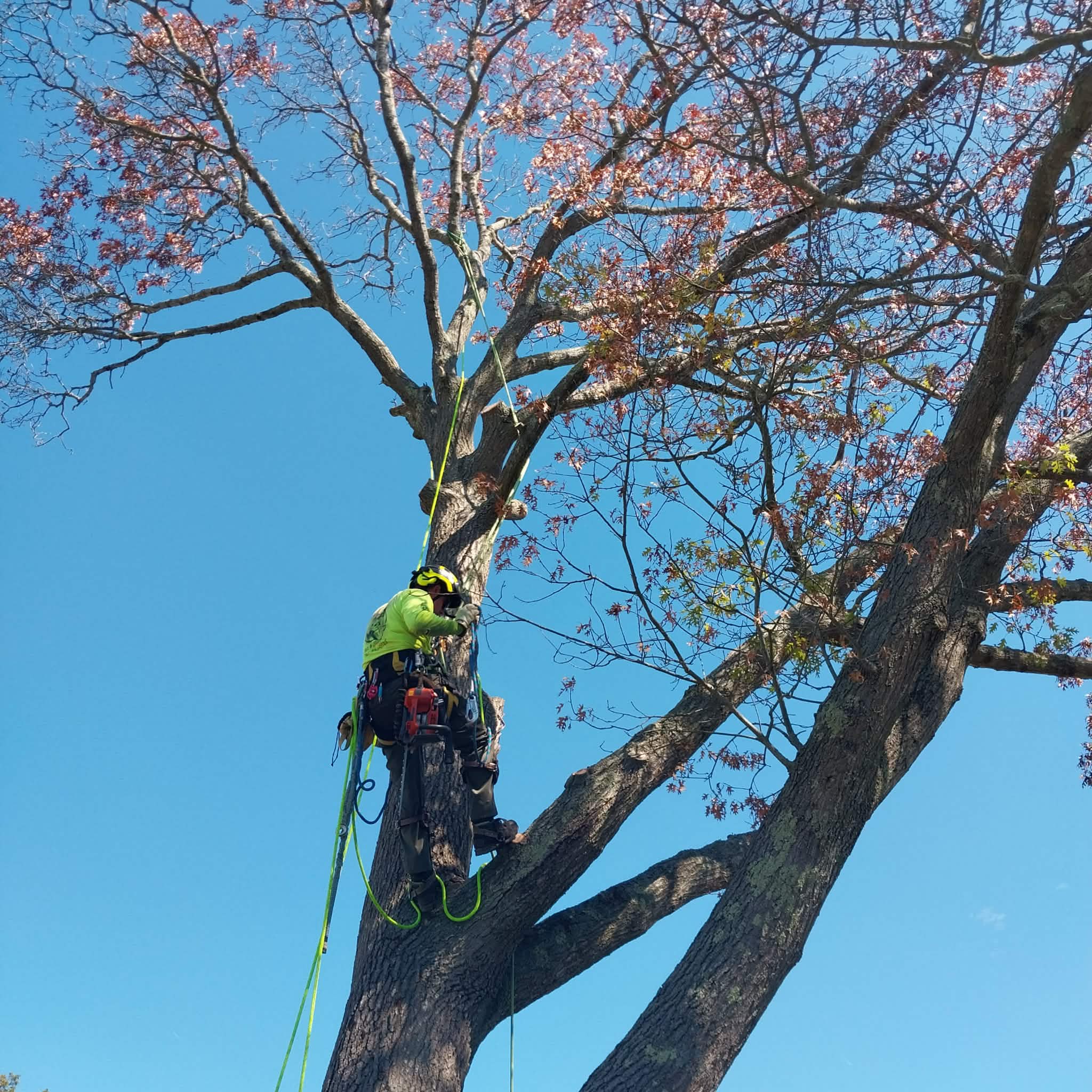
Step 3: Preparation and Access Planning. Milton's slopes demand specialized gear. In Cunningham Park, we use rope-and-harness systems for Brush Hill's 20% grades. No spikes touch bark; we employ friction savers and throw lines to position cables without limb damage.
Step 4: Cable Installation (2-4 hours per tree). Drilling minimal 1-inch holes at 45-degree angles through sound wood—never decay zones—we thread aircraft-grade steel cables with thimbles for zero abrasion. Turnbuckles allow 10-15% slack for natural movement, preventing girdling in your copper beech. For multi-plane support in tulip trees, we install 2-4 cables forming a triangle or box pattern.
Step 5: Dynamic Testing and Hardware. We apply pull forces simulating 60 mph gusts using come-alongs, verifying load sharing. UV-resistant sleeves protect cables from white pine sap. All hardware meets ASTM standards; we label installations with inspection dates.
Step 6: Annual Inspection Program Enrollment. Post-install, we schedule yearly checks—critical for hickory on Unquity ledges where soil shifts. Drones survey Blue Hills properties for inaccessible crowns.
Safety protocols prioritize your family and neighbors. We cordon 1.5x drip-line zones, use spotters on Canton Avenue's busy roads, and halt work in 25+ mph winds. Our $5 million liability insurance covers Milton's dense neighborhoods. ISA certification ensures techniques like multi-angle cabling for American beech codominants.
Equipment specifics: Spyder™ cabling systems for vibration damping in hemlocks; ETT (Evaluation of Tree Stability) software for precise modeling. For shallow-rooted white oaks over ledge, we integrate cabling with guying if needed, though dynamic cabling suffices 90% of cases.
Practical homeowner tips: Trim low limbs pre-install to ease access. Avoid DIY—improper tension snaps cables in Nor'easters. Post-cabling, mulch roots but skip fertilizer, as stressed maples resent salts in Milton's winter de-icing.
This process has stabilized 200+ Milton trees since our founding, from estate prunings in Milton Village to hazard mitigations near Blue Hills. Your trees gain 20-30 years lifespan. Schedule via 508-369-5009; we service 02186 promptly.
Common Tree Cabling Projects in Milton Neighborhoods
Tree cabling projects in Milton MA vary by neighborhood, reflecting local topography, species, and history. In Milton Village, we cable mature white oaks and red oaks shading historic homes. These trees, planted circa 1850, develop heavy lateral limbs over streets; cabling prevents sidewalk strikes during Quincy Bay-driven gales.
East Milton's flatter lots host sugar maples with included bark unions. Homeowners here see us install multi-level cables to support forked crowns, preserving fall color views toward the Neponset. A recent project stabilized a 90-foot maple after partial adelgid stress from nearby Blue Hills.
Milton Hill's elevated properties demand technical access. We rope-access cabled a copper beech overhanging granite outcrops, using dynamic systems to counter wind leverage from hilltop exposure. Similar work on Japanese maples prevents branch loss onto Victorian roofs.
Cunningham Park features estate-quality specimens like tulip trees with co-dominant stems. Cabling here integrates with pruning to reduce weight, maintaining park-like aesthetics amid shallow ledge soils.
Scott Hill's steep 30% slopes challenge equipment. For a client's hickory with root plate lift, we installed high-tension cables via helicopter-free drone scouting, stabilizing without excavation that could trigger slides toward Randolph.
Brush Hill properties border conservation land; we cable hemlocks showing woolly adelgid, pairing with insecticidal treatments. White pines here get box-cabling for split tops from ice storms.
Blue Hills neighborhoods require corridor management. Hemlocks over 200 years old receive urgent cabling where adelgid weakens attachments, buffering residential yards from Reservation debris.
Unquity's wooded lots see American beech cabling for basal cracks over ledge. We supported codominant leaders without impacting understory.
Canton Avenue Area homes have heritage English oaks (related to local white oaks); cabling preserves these amid traffic, using low-profile hardware.
Nearby, Quincy clients get similar support for shared species like red oak, while Braintree's ledge matches Milton's. Randolph and Canton properties benefit from our South Shore coverage, Dedham from Norfolk County expertise.
These projects highlight Southeast Arborist's specialization: 80% of Milton work preserves heritage trees vs. removal. Your neighborhood's trees—whether Hutchinson Field elms or Blue Hills giants—gain storm resilience. Call 508-369-5009 for a site walk.
Tree Cabling Costs in Milton, MA
Tree cabling costs in Milton MA range from $400-$1,800 per tree, far below $1,500-$8,000 removals on steep lots. Factors include tree diameter at breast height (DBH): $12-$20 per inch for white oaks up to 30 inches, scaling to $25+ for 50-inch heritage hemlocks in Blue Hills.
Number of cables drives price—single-plane for Japanese maples in East Milton ($400-$600), multi-plane for codominant red oaks in Milton Hill ($900-$1,500). Height and access add 20-50%: Scott Hill's 40-foot drops require rope crews (+$300), vs. flat Milton Village (+$0).
Species complexity: Hemlocks with adelgid need pre-treatment assessment (+$150), while sugar maples demand precise union mapping. Hardware quality—aircraft cable vs. synthetic—adds $100-$200 but lasts 25+ years.
Annual inspections cost $150-$300/tree, preventing retensioning fees ($200). Bundle with pruning for 15% discounts on Cunningham Park estates.
Value proposition: Cabling retains your copper beech's $5,000+ shade value, avoids $20,000+ liability from branch drops in Unquity. ROI hits in 2-3 years via no claims; mature tulip trees boost property appeal in affluent Milton (median home $1.2M).
Comparisons: Quincy removals hit $3,000 average; our cabling saves 60%. Braintree ledge work mirrors Milton's premiums. Payment plans ease Brush Hill budgets.
Get your quote: Factors like 24-inch hickory DBH with two cables on Canton Avenue total $850 installed. Transparent pricing—no surprises. ISA Certified quality ensures longevity.
Practical budgeting: Prioritize trees >24-inch DBH or over structures. Finance via home equity for Blue Hills multi-tree programs. Call 508-369-5009 for free estimates tailored to 02186 conditions.
When to Schedule Tree Cabling in Milton
Schedule tree cabling in Milton MA from May-October, when dry soils firm slopes in Scott Hill and leafless views reveal defects in Milton Village maples. Late winter (February-March) works post-dormancy but pre-bud swell, minimizing sap flow in sugar maples.
Urgency signs: Cracks >2 inches at red oak unions, leaning >15 degrees in white pines over ledge, or recent storm splits in East Milton hemlocks. Act before June hurricanes or December Nor'easters—80% failures occur then.
Blue Hills adjacency demands spring scheduling amid adelgid cycles. If your copper beech shows dieback + weak crotches, cable within weeks to beat ice loads.
Practical signs for your property: Excessive sway in 20 mph breezes, fungal shelves on hickory trunks, or soil mounding from root lift in Brush Hill. Annual checks post-leaf fall catch issues early.
Don't delay: Delaying doubles failure risk per ISA data. Southeast Arborist prioritizes Milton 02186 emergencies. Call 508-369-5009 now—slots fill fast pre-storm season.
Frequently Asked Questions About Tree Cabling in Milton
What is tree cabling, and how does it help my Milton trees? Tree cabling installs flexible steel cables in the canopy to support weak branches or stems in your white oak or hemlock. In Milton MA, it prevents failures from ledge instability and Blue Hills winds, extending life 20+ years per ANSI A300.
How long does tree cabling last on East Milton properties? Proper installations endure 20-30 years with annual inspections. Southeast Arborist's systems on sugar maples withstand 50+ mph gusts; retension every 5-7 years for copper beeches.
Is cabling better than tree removal for Scott Hill lots? Yes—cabling costs 30-50% less and preserves heritage like your Japanese maples. Steep access favors non-invasive cabling over cranes.
Will cabling damage my red oak in Milton Village? No—our ISA Certified Arborists drill <1% of wood volume in sound areas only. Friction savers protect bark during Blue Hills installs.
How do I know if my Brush Hill hemlock needs cabling? Look for codominant stems, adelgid wool, or sway. We use tomographs for decay detection—free assessments available.
Can you cable trees near Canton Avenue roads? Absolutely—safety zones and low-profile hardware minimize disruption. We've stabilized 50+ roadside tulip trees.
What's the difference between cabling and bracing? Cabling supports upper canopies dynamically; bracing rods lower trunks statically. For Unquity hickories, cabling suits sway issues.
Do you offer warranties for Cunningham Park projects? One-year workmanship warranty; optional 5-year hardware via inspection program. Call 508-369-5009 for details.
Tree Cabling Throughout Milton
Southeast Arborist provides tree cabling across all Milton neighborhoods—Milton Village estates, East Milton flats, Milton Hill elevations, Cunningham Park, Scott Hill slopes, Brush Hill woods, Blue Hills borders, Unquity lots, and Canton Avenue. From white oaks to hemlocks, we preserve your canopy.
We extend to nearby Quincy, Braintree, Randolph, Canton, and Dedham, leveraging South Shore expertise from our Plymouth/Cohasset base. ISA Certified, ANSI A300 compliant.
Protect your Milton MA trees—call 508-369-5009 today for assessments. Your heritage deserves expert care.