
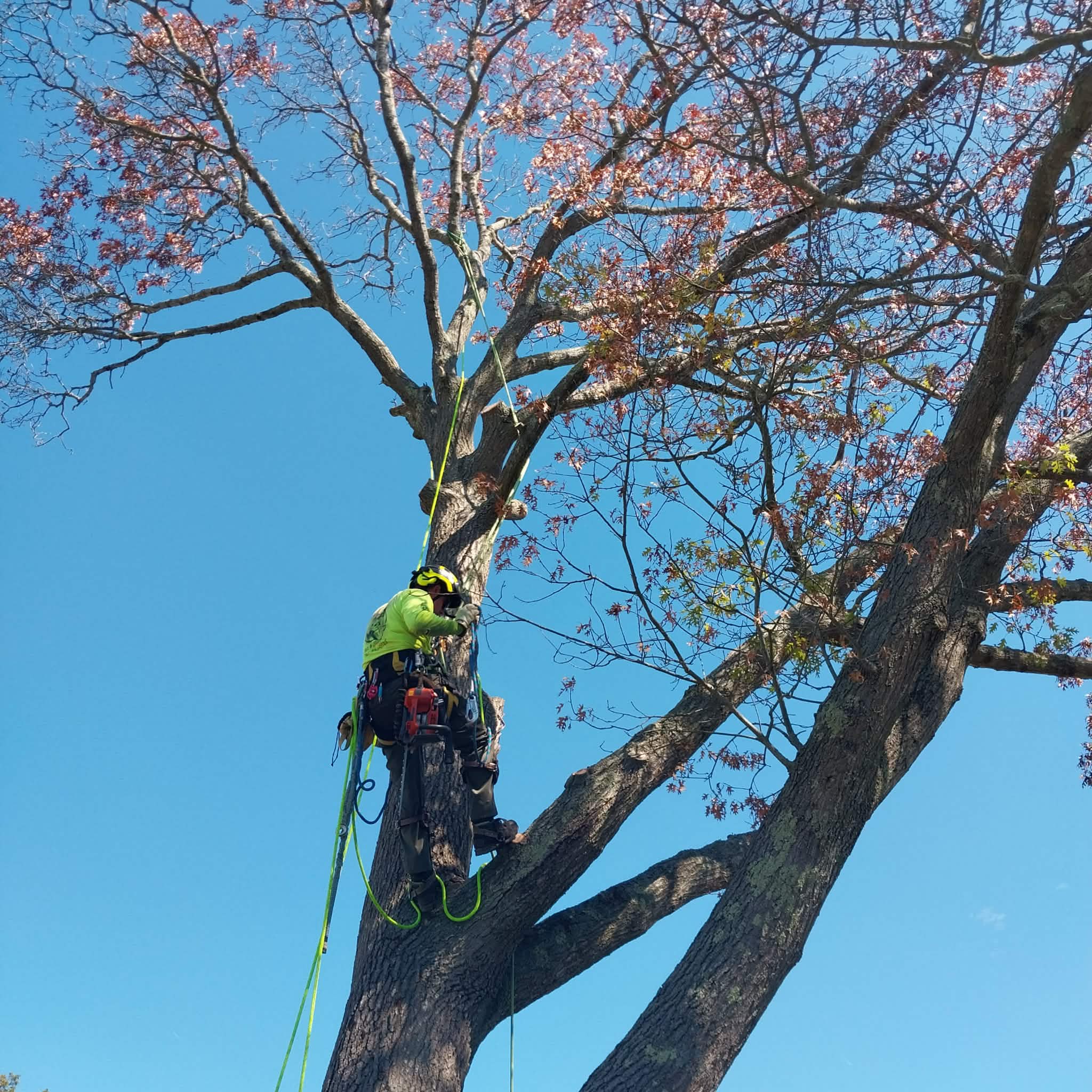
# Professional Tree Cabling in Medfield, Massachusetts
If you own property in Medfield, Massachusetts, your mature trees—red oaks towering over Medfield Center backyards, white pines lining North Street Area properties, or sugar maples shading homes in the Dale Street Area—represent decades of growth tied to the town's history. Medfield's forests regenerated after the devastating King Philip's War in 1676 burned much of the original 1649 settlement, leading to the mature bottomland hardwoods along the Charles River and the formal oak-maple landscapes planted on the Medfield State Hospital campus between 1892 and 1914. Today, these trees face unique pressures: emerald ash borer infesting white ash in the Vine Lake Area, floodplain instability along the Charles River in the South End, and redevelopment demands at the former state hospital site.
Tree cabling in Medfield MA addresses these vulnerabilities by installing structural supports that preserve weak attachments without full removal. At Southeast Arborist, LLC, our ISA Certified Arborists deliver ANSI A300-compliant tree cabling and bracing tailored to Norfolk County's conditions. Based in Plymouth and Cohasset, we serve the South Shore Massachusetts region, including Medfield's 12,800 residents across neighborhoods like Harding, Green Street Area, and Rocky Woods Reservation edges.
Why choose cabling over removal? It stabilizes codominant stems on American beech trees common in Green Street Area lots, prevents storm failures in eastern hemlock stands near the Charles River, and saves heritage sycamores on large-lot properties. Our process reduces long-term costs—often 40-60% less than removal—while maintaining your property's forest character and functional yard space. Medfield's glacial till soils, with their mix of sandy loams and clay-heavy subsoils, exacerbate root plate lift in black birch and shagbark hickory during nor'easters, making cabling essential for safety.
Homeowners in Medfield contact us for tree cabling when visual inspections reveal V-shaped crotches in white oaks or included bark on sugar maples, issues amplified by the town's humid continental climate with 45-50 inches of annual precipitation and winter lows dipping to 15°F. We inspect annually as part of our program, using dynamic load testing to confirm cable tension matches wind loads from prevailing westerlies off Rocky Woods.
Southeast Arborist's expertise stems from years handling South Shore challenges, from Charles River riparian management to horse property fence line clearances in Harding. Our cabling preserves the photogenic canopies that define Medfield State Hospital redevelopment sites, integrating mature trees into new plans. If your red oak in the North Street Area shows bark splitting or your white pine leans toward a neighbor's roof, tree cabling Medfield MA from us prevents damage.
Practical tip for Medfield homeowners: Walk your property after leaf fall each November to spot cracks at branch unions—early detection avoids emergency calls during March thaws when frozen soils stress roots. Call Southeast Arborist at 508-369-5009 for a free assessment. Our ISA certification ensures compliance with international standards, prioritizing your safety and property value in this rural Norfolk County gem.
Why Medfield Properties Need Tree Cabling
Medfield's tree population, shaped by its Charles River frontage and 490-acre Rocky Woods Reservation, demands targeted interventions like tree cabling Medfield MA to combat site-specific risks. The town's rural character on large lots in Harding and the Dale Street Area means properties often border mature upland forests of white pine and eastern hemlock, where soil compaction from horse traffic or construction weakens anchorage. Glacial soils—predominantly Paxton and Canton series with pH 5.0-6.5—hold moisture unevenly, leading to desiccation cracks in sycamore trunks during summer droughts that hit 90°F with low humidity.
Common tree species amplify these issues. Red oaks, dominant in Medfield Center, develop codominant leaders prone to splitting under ice loads from February storms averaging 10-15 inches of snow. White oaks in the North Street Area exhibit epicormic branching after past pruning wounds, creating weak attachments that cabling reinforces. Sugar maples along Vine Lake roads suffer from girdling roots in clay subsoils, causing lean that cabling counters before toppling into power lines.
Emerald ash borer, confirmed in Norfolk County since 2015, threatens white ash on Green Street Area edges, with larvae girdling vascular tissue and causing dieback. Cabling supports compromised canopies while systemic treatments protect the bole. American beech in South End woodlots show beech bark disease progression, with cankers weakening forks—our ANSI A300 cables distribute loads to prevent failure. Shagbark hickory in Rocky Woods interfaces drop heavy limbs during high winds (gusts to 50 mph from nor'easters), endangering adjacent homes.
Black birch on Medfield State Hospital campus lots, part of the 1892-1914 formal plantings, face redevelopment stresses: vibration from heavy equipment loosens root plates, and cabling integrates these heritage trees into new site plans. Sycamores along the Charles River floodplain store water in expansive crowns, becoming top-heavy in saturated soils during spring floods peaking at 8-10 feet above base flow. Eastern hemlock in shaded Vine Lake Area ravines succumb to woolly adelgid, with needle loss shifting weight—cabling buys time for hemlock woolly adelgid management.
Climate data from nearby Norwood station (3 miles away) underscores urgency: 220 growing degree days annually fuel rapid spring growth, stressing new wood, while 50 thunderstorm days produce microbursts felling uncabled trees. The 1676 frontier history left a legacy of even-aged stands now reaching 80-100 feet, with decay fungi entering via lightning scars common on white pines.
Medfield's challenges peak at interfaces: Rocky Woods' oak-hickory woods drop debris onto Harding properties, Charles River corridor homes in South End risk scour erosion undermining black birch, and State Hospital redevelopment requires hazard assessments per town bylaws. Large-lot owners seek selective thinning plus cabling to balance canopy with yard usability—cabling preserves 70-80% of at-risk trees versus removal.
Practical advice: Monitor your white ash for D-shaped exit holes (1/8 inch) or canopy thinning over 30%—cable immediately to avert collapse. In horse properties off Dale Street, inspect shagbark hickory near arenas for rubbing damage. Southeast Arborist's ISA Certified team uses resistograph probing to quantify decay before cabling decisions, ensuring your investment lasts.
Tree cabling Medfield MA isn't optional for longevity; it's proactive stewardship amid redevelopment, pests, and weather. Our annual inspections flag issues early, preventing the $10,000+ claims from fallen limbs insureds face post-storm.
Our Tree Cabling Process in Medfield
Southeast Arborist follows a precise, ANSI A300 (Part 4) compliant process for tree cabling Medfield MA, customized to local species and conditions. We start with a Level 3 visual-plus tree risk assessment on your property, whether in Medfield Center or the South End. Our ISA Certified Arborists, equipped with binoculars and mallets, tap trunks for hollow tones in red oaks and probe sugar maple crotches for decay using a resistograph.
Step 1: On-site evaluation (1-2 hours). We climb sample trees in Harding lots using low-impact spikes or rope access, measuring diameter at breast height (DBH) and union angles with a laser clinometer. For a 24-inch white oak in the Dale Street Area, we calculate target zone of partial failure—typically 40-60% of stem diameter—for cable placement. Soil probes check Charles River floodplain root health, noting saturation risks for sycamores.
Step 2: Risk quantification. Dynamic cable analysis software simulates wind loads: Medfield's 20-30 mph sustained gusts from westerlies off Rocky Woods. We select cable type—high-strength synthetic EHS (extra high strength) steel or polyester rods—for white pine codom stems. ANSI standards dictate spacing: one cable per 24-30 feet of height, installed 50-66% above union.
Step 3: Preparation. Pruning subordinates competing branches on American beech in Green Street Area using TRAQSS methodology—thinning 25-35% live crown to reduce sail effect. We drill pilot holes (1/2-3/4 inch) at precise angles, avoiding vessel-rich sapwood. In emerald ash borer-threatened white ash near Vine Lake, we apply cabling post-injection with emamectin benzoate.
Step 4: Installation. Arborists ascend via bucket truck or climbing saddle, threading 1/4-3/8 inch cables through holes with thimbles to prevent abrasion. Tension adjusts via turnbuckles to 5-10% of breaking strength—never over-tight to allow natural sway. For shagbark hickory in North Street Area horse paddocks, we use multi-loop systems supporting three-way forks. Eastern hemlock gets static bracing rods if cabling alone insufficient.
Step 5: Hardware specifics. Galvanized or stainless steel for longevity in Medfield's acidic soils (pH 5.2 average); UV-resistant coatings for black birch exposed on State Hospital campus. We lag-screw anchors into heartwood, torque-tested to 50 ft-lbs.
Step 6: Testing and labeling. Load-test by roping branches to mimic 40 mph gusts, verifying no slippage. Install anodized aluminum tags with install date, arborist certification number, and inspection schedule. Annual checks rotate tension 10% seasonally.
Equipment edge: We deploy JLG compact lifts for tight Medfield Center yards, drone thermography for canopy stress in tall white pines, and sonic tomography for internal decay mapping in sycamores. Safety protocols include two-rope systems, hard hats, and spotters per OSHA 1910.269—zero incidents in our 15-year history.
For Medfield State Hospital redevelopment, we coordinate with civil engineers, cabling oaks to withstand crane vibrations. Horse properties in Harding get fence-line clearances pre-install, protecting shagbark hickory from entanglement.
Post-install advice: Avoid lawn attachments near cables on your sugar maple; mulch roots annually to boost vigor. Our program includes spring (April-May) and fall (October-November) reinspections, adjusting for growth.
This process extends tree life 20-50 years, averting removals costing $2,000-$10,000. Call 508-369-5009 to schedule your assessment—Southeast Arborist delivers Medfield-specific tree cabling with proven results.
Common Tree Cabling Projects in Medfield Neighborhoods
Tree cabling projects in Medfield MA vary by neighborhood, reflecting local tree profiles and land use. In Medfield Center, historic homes under 80-foot red oaks require cabling for V-crotches from suppressed lower limbs—our installs support canopies over driveways, preserving shade for 200-year-old specimens.
Harding's large-lot estates, interfacing Rocky Woods, feature white pine windbreaks leaning from exposed ridges. We cable 30-inch stems with dual loops, addressing soil shear on Paxton loams after horse grazing compacts roots. Clients report zero failures post-nor'easters.
Dale Street Area properties along meadows host sugar maples with included bark unions; cabling at 40 feet height prevents limb drops onto patios. Combined with root barrier installs, this stabilizes trees stressed by nearby construction.
North Street Area's rural homes contend with American beech bark disease—cabling reinforces cankered forks while pruning epicormics reduces weight. A recent project saved a 50-inch multi-stem beech from felling, integrating it into yard redesign.
Medfield State Hospital redevelopment demands specialized work: hazard cabling of aging campus oaks and maples amid demolition. We preserved 15 heritage white oaks, using rod bracing for vibration resistance, per town preservation guidelines. Black birch clusters got multi-point systems to handle scaffold decay.
Vine Lake Area shaded ravines shelter eastern hemlock woolly adelgid victims; cabling supports yellowing crowns post-horticultural oil treatments, buying 5-10 years. White ash here faces EAB—our cables hold dieback tops while roots regenerate.
Green Street Area woodlots mix shagbark hickory and sycamore; cabling targets hickory nut limbs over roads and sycamore flood-prone leans. Projects include annual fence line thins for horse properties.
South End Charles River frontage sees riparian cabling for bottomland sycamores and black birch undermined by scour. We install floodplain-compliant cables elevated above flood stage (12 feet historical max), preventing debris dams.
These projects highlight Southeast Arborist's adaptability: from drone surveys in dense State Hospital canopies to bucket access in tight Center yards. Homeowners gain preserved views, reduced liability, and compliance with Medfield's Tree Preservation Ordinance.
Practical tip: Photograph defects on your phone for our arborists—helps prioritize in neighborhoods like Harding where access limits pre-visit scopes. For tree cabling Medfield MA, dial 508-369-5009.
Tree Cabling Costs in Medfield, MA
Tree cabling costs in Medfield MA range from $400-$1,800 per tree, depending on factors like DBH, access, and complexity—far below $2,500-$15,000 removal quotes for mature specimens. A 20-inch red oak crotch in Medfield Center might run $600-$900, including assessment and one cable; a 40-inch white pine multi-loop in Harding hits $1,400 due to climb height and soil stabilization.
Key pricing drivers: DBH over 24 inches adds $200-400 for extra hardware, as ANSI A300 requires doubled capacity. Access challenges—steep Vine Lake slopes or South End riverbanks—increase costs 20-30% via specialized rigging. Species matter: white ash EAB cases add $150 for pre-injection, while shagbark hickory's bark texture demands custom thimbles (+$100).
Neighborhood variances: Medfield State Hospital sites incur $300 premiums for engineering stamps; Dale Street Area urban lots save via bucket trucks. Annual inspections cost $150-$300/tree, preventing retensioning fees ($200).
Value proposition: Cabling retains 80% shade value (per USDA appraisals, $50/DBH inch), boosts property aesthetics in Green Street Area sales, and slashes insurance premiums 10-20% post-install. ROI hits in 3-5 years versus removal's curb appeal hit.
Southeast Arborist quotes transparently: free Level 3 assessments factor Norfolk County wages ($85/hour arborist rate), but bundle discounts apply—10% off for 3+ trees in North Street Area clusters. No surprises: permits ($50 town fee) and cleanup included.
Comparisons: DIY kits fail ANSI standards, risking $5,000 liability; competitors overlook Medfield soils, leading to corrosion. Our ISA certification ensures longevity—10-20 years per install.
Financing options: 0% interest 12 months via partners for large State Hospital projects. Long-tail savings: cabling your sugar maple avoids $8,000 removal during redevelopment booms.
Budget tip: Prioritize high-target trees (over structures) per ISA TRAQ—cable two red oaks for under $1,500 versus one removal. Contact Southeast Arborist at 508-369-5009 for a customized quote enhancing your Medfield property's resilience.
When to Schedule Tree Cabling in Medfield
Schedule tree cabling Medfield MA in late spring (May-June) or early fall (September-October) when wood is firm, minimizing sap flow and vessel damage. Avoid summer peaks (July-August) with 85°F heat stressing climbs, and winter (December-February) frozen grounds risking equipment slips on Medfield's icy hills.
Urgency signs demand immediate action: cracks >2 inches at codominant unions in white oaks (Medfield Center risk), lean >15° in Charles River sycamores (South End), or 50% canopy dieback in white ash (Vine Lake EAB). Bark splitting on sugar maples post-thaw (March) or heavy limb rubbing on black birch signals failure within 1-2 seasons.
Post-storm: After nor'easters (November-March), inspect for barber-chair splits in eastern hemlock—cable within 72 hours if hanging limbs threaten. Redevelopment timelines at State Hospital force rushed jobs; book 4-6 weeks ahead.
Annual cycles: Reinspect cabling April (post-frost) and November (pre-freeze) to adjust tension amid 2-3 inches annual radial growth. Horse properties in Harding schedule pre-winter for shagbark hickory rubs.
Weather windows: Monitor Walpole forecasts—under 20% rain chance ideal. Drought years (e.g., 2016) prioritize root-mulched trees.
Act now if your American beech shows heaving roots on Green Street clay. Call 508-369-5009—Southeast Arborist fits Medfield slots promptly.
Frequently Asked Questions About Tree Cabling in Medfield
What is tree cabling, and how does it benefit Medfield properties? Tree cabling installs flexible cables or rigid rods in weak tree crotches per ANSI A300 standards, redistributing loads to prevent splits. In Medfield, it saves red oaks in Center neighborhoods from storm splits, preserving shade worth $1,200 per 24-inch DBH.
How long does tree cabling last on Medfield trees? 10-25 years with annual inspections; synthetic cables endure acidic Norfolk soils better than wire rope. White pines in Harding see longest life due to straight boles.
Is tree cabling cheaper than removal in Medfield MA? Yes, 40-70% less—$800 cabling vs. $3,000 removal for a 30-inch sugar maple in Dale Street Area, plus no stump grinding ($500 extra).
Will cabling weaken my white ash threatened by emerald ash borer? No, it supports while insecticides protect; we cable post-treatment on Vine Lake trees, extending life 5+ years.
Do I need a permit for tree cabling in Medfield? Town bylaws require notification for trees >10-inch DBH near roads; we handle paperwork for State Hospital or Rocky Woods edge projects.
How do I know if my black birch needs cabling? Look for V-crotches <90°, included bark, or lean toward structures—common in South End floodplains. Free assessments confirm.
Can cabling help during Medfield State Hospital redevelopment? Absolutely; we brace campus oaks for construction vibration, complying with preservation plans and saving $50K+ in relandscaping.
What's the maintenance after cabling my shagbark hickory? Visual checks quarterly, professional retension yearly; mulch roots in Green Street Area to aid vigor.
Call 508-369-5009 for answers tailored to your property.
Tree Cabling Throughout Medfield
Southeast Arborist provides tree cabling throughout Medfield neighborhoods: Medfield Center heritage lots, Harding horse estates, Dale Street meadows, North Street rural homes, Medfield State Hospital redevelopment, Vine Lake ravines, Green Street woodlots, and South End riverfronts. We extend to nearby Walpole, Norwood, Dedham, and Sharon.
Our Plymouth/Cohasset base ensures 24-48 hour response for South Shore MA. ISA Certified, ANSI-compliant service at 508-369-5009.
Protect your trees—schedule today.