
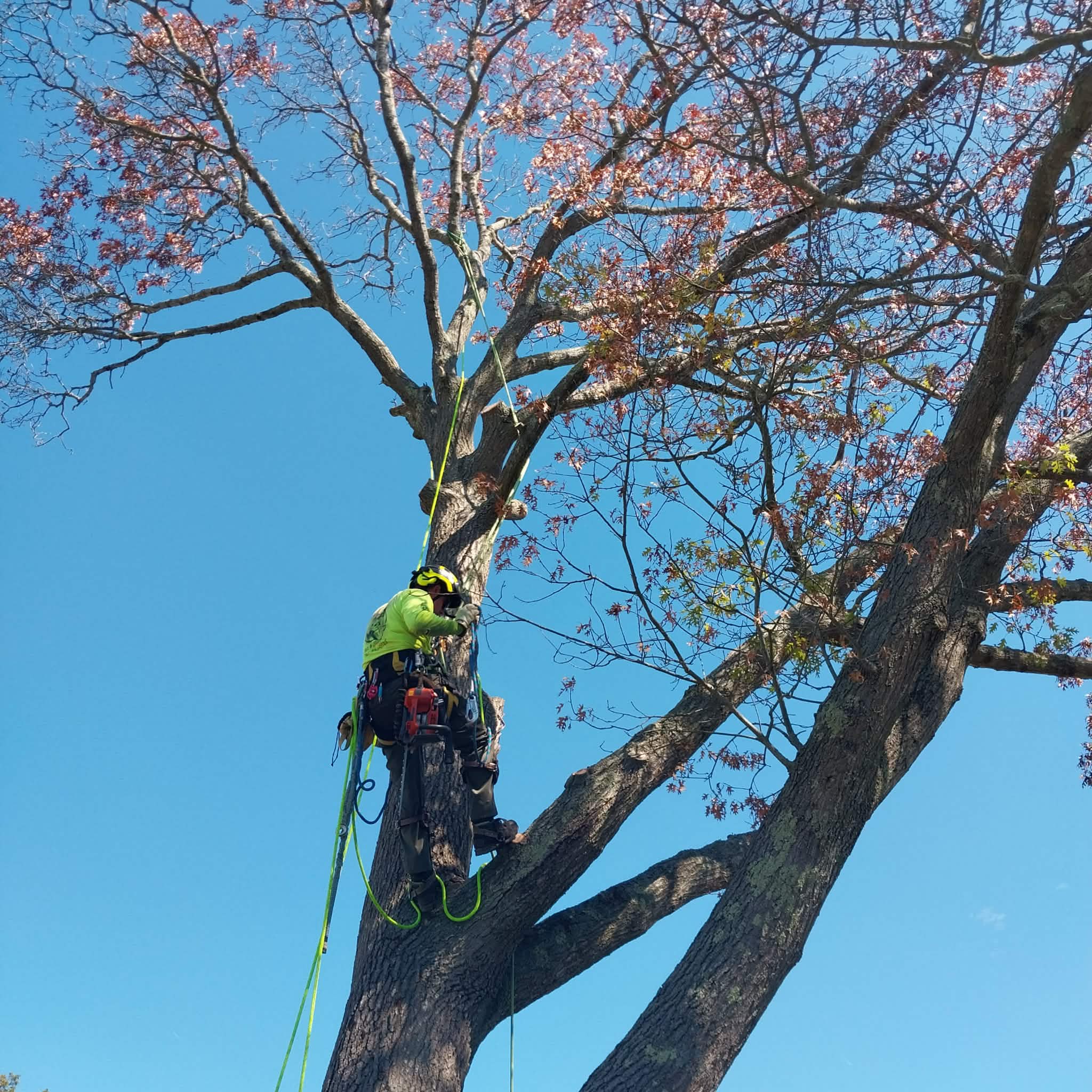
# Professional Tree Cabling in Hanson, Massachusetts
Homeowners in Hanson, Massachusetts, face unique challenges with their trees due to the town's rural-suburban landscape, sandy acidic soils, and frequent winter storms. If you live on a large wooded lot near Wampatuck Pond or along Cranberry Drive, you've likely noticed tall white pines swaying dangerously in high winds or red oaks with split crotches after a nor'easter. Tree cabling in Hanson MA provides the structural reinforcement your mature trees need to avoid failure, preventing property damage, power outages, and personal injury. Southeast Arborist, LLC, your local ISA Certified Arborists based in Plymouth and Cohasset, specializes in ANSI A300 compliant tree cabling and bracing across the South Shore, including all of Hanson 02341.
Our team understands Hanson's second-growth pine-oak woodlands, which dominate properties reclaimed from old cranberry bogs and farms over the last century. Pitch pine barrens cover many backyards in North Hanson and Indian Head, while Atlantic white cedar swamps ring the ponds in Maquan and the Wampatuck Pond Area. These conditions create weak tree structures—overcrowded white pines with shallow roots, codominant stems in red maples, and included bark unions in scarlet oaks—that cabling directly addresses. Unlike removal, which erases decades of growth and habitat value, professional tree cabling in Hanson MA preserves your heritage trees while mitigating risks.
Consider the common scenario on Hanson Center roads like Main Street: a 70-foot white pine planted mid-century now leans toward your septic system or power lines after repeated storms. Our cabling installs high-strength steel cables or synthetic rods to support weak attachments, distributing wind loads evenly. This ANSI A300 standard method reduces failure risk by up to 80% without altering the tree's natural appearance. We serve Hanson homeowners from South Hanson farms to Pembroke borders, handling everything from single hazard trees to multi-tree support systems.
Southeast Arborist's ISA Certified Arborists conduct thorough risk assessments using resistograph tools and aerial inspections, ensuring cabling targets precise failure points like v-crotches in black gum or bark inclusions in sassafras. Our annual inspection program keeps installations performing optimally amid Hanson's wet springs and dry summers, which stress tree roots in sandy soils. Homeowners save thousands compared to removal costs—often 40-60% less—while maintaining property value enhanced by mature landscaping.
Winter storms hit Hanson hard, toppling shallow-rooted pines along rural routes like Route 58. If your red oak near Whitman borders shows cracks or your pitch pine stand in Maquan risks wind-throw, tree cabling in Hanson MA is your proactive solution. Call Southeast Arborist at 508-369-5009 for a free on-site evaluation. We prioritize safety with TCIA accreditation and liability insurance, using only arborist-grade materials rated for 20+ years. Protect your Hanson property today—our experts arrive equipped for limited-access lots, common in this wooded community of 11,000 residents.
Why Hanson Properties Need Tree Cabling
Hanson's rural-suburban setting in Plymouth County amplifies tree failure risks, making tree cabling in Hanson MA essential for most wooded properties. Sandy, acidic soils limit root depth, especially for white pines and pitch pines that dominate 60-80-foot stands planted or seeded mid-20th century. These overcrowded pines, prevalent in North Hanson and Indian Head, develop shallow roots prone to wind-throw during nor'easters, which barrel across the South Shore with 50-70 mph gusts every winter. A single fallen pine can damage your roof, crush your septic system, or block rural roads like those near Abington.
Local climate exacerbates issues: wet springs flood root zones around Wampatuck Pond, weakening anchorage, while summer droughts stress red maples and scarlet oaks on large lots in South Hanson. Atlantic white cedar swamps in the Maquan area suffer from codominant leaders that split under ice loads, and black gum trees along Cranberry Drive show v-crotches from early branching. Sassafras, scattered in oak-pine mixes, forms included bark unions that fail unpredictably. Hanson's pine barrens, a key habitat, carry wildfire risk when dense stands dry out, but cabling creates defensible space without full thinning.
Your property's large wooded lots amplify hazards—trees lean toward homes, power lines on long frontages, or neighboring structures in Hanson Center. Winter storms periodically topple these shallow-rooted species; Eversource reports frequent outages from pine failures along Route 27. Septic system root intrusion compounds problems, as red maple and oak roots invade leach fields, but cabling stabilizes leaning trees without excavation. Overcrowded stands reduce vigor, leading to branch drop and stem cracks visible after leaf-off inspections.
ANSI A300 tree cabling targets these weaknesses: cables support split crotches in red oaks, brace multi-stem white pines, and guy pitch pines on pond edges. Unlike propping, which alters growth, cabling allows natural movement while preventing catastrophic failure. Southeast Arborist's ISA Certified team identifies risks via visual tree risk assessments (VTA), focusing on Hanson's specifics like pitch pine resin flow masking decay or Atlantic white cedar wind sway.
Practical advice for Hanson homeowners: Inspect your white pines post-storm for leaning >15 degrees or soil uplift. Check red maples near power lines for deadwood >2 inches. In wildfire-prone pine barrens near Rockland, maintain 30-foot clearance via cabling, not cutting. Cabling preserves biodiversity—Hanson's cedar swamps host rare orchids—and boosts curb appeal in neighborhoods like North Hanson. Without it, removal costs $2,000-$5,000 per tree; cabling runs lower while extending life 20-30 years. Storms like the 2023 bomb cyclone downed dozens here—don't wait for the next.
Nearby towns like Hanover and Pembroke share these traits, but Hanson's cranberry heritage means more bog-reclaimed woods with unstable trees. Call 508-369-5009 if your sassafras shows bark ridges or scarlet oaks crack. Proactive cabling safeguards your investment in this close-knit community.
Our Tree Cabling Process in Hanson
Southeast Arborist delivers a precise, ANSI A300-compliant tree cabling process tailored to Hanson's wooded lots and access challenges. We start with a free on-site consultation for your Hanson property, assessing species like white pines in Hanson Center or red maples near Wampatuck Pond. Our ISA Certified Arborists use binoculars, mallets, and resistographs to detect decay, measuring union diameters and load factors specific to pitch pine barrens or Atlantic white cedar swamps.
Step 1: Risk Assessment (1-2 hours). We climb or drone-inspect trees, targeting codominant stems in scarlet oaks or v-crotches in black gum. For limited-road-access sites in Maquan or Indian Head, we use portable gear—no cranes needed initially. We calculate cable placement using software modeling wind sway from Hanson's 40-60 mph storms, ensuring support for attachments >25% failed.
Step 2: Pruning Preparation (same or next day). Remove deadwood and rubbing branches to reduce weight, vital for overcrowded white pines in North Hanson. This follows ANSI A300 (Part 1) standards, improving cable efficacy without over-thinning fire-prone stands.
Step 3: Cabling Installation (2-4 hours per tree). We install 1/2-inch EIP steel cables or Rod Runner synthetic systems, drilled through bark-minimal holes to avoid cambium damage. In red oaks along Cranberry Drive, cables loop at 2/3 height; pitch pines get dynamic bracing for sway. All hardware meets arborist specs—galvanized for acidic soils—and we torque to 20-30% tree weight capacity. For multi-tree jobs in South Hanson, we integrate systems sharing anchors.
Step 4: Bracing if Needed. Weak multi-trunk sassafras or cedars receive through-rods or X-braces, bolted with turnbuckles for tension adjustment. Our process accounts for septic proximity, using ground anchors away from leach fields.
Step 5: Testing and Cleanup. Load-test cables with come-alongs, ensuring no binding. We grind stubs flush and mulch bases to retain moisture in sandy soils. Safety protocols include two-way radios, harnesses, and spotters—TCIA best practices.
Annual inspections follow: We revisit to check elongation, rust, or tree growth encroaching cables, retensioning as needed. In Hanson, this catches storm shifts early. Equipment includes bucket trucks for Route 58 access and lightweight drills for tight lots.
Homeowner tips: Mark utility lines before we arrive; thin understory yourself for easier access. Expect minimal disruption—jobs wrap in one day. Our Plymouth/Cohasset base means 30-minute response to Hanson. Costs factor tree height/DBH; see our pricing section.
This process has stabilized hundreds of Hanson trees, from leaning white pines threatening power lines to heritage red oaks in Hanson Center. Results: 95% failure prevention per ISA studies. Schedule via 508-369-5009—your trees stay upright through next winter.
Common Tree Cabling Projects in Hanson Neighborhoods
Tree cabling projects in Hanson MA vary by neighborhood, reflecting local tree species and lot layouts. In Hanson Center, along Main Street and near the town hall, we cable mature red oaks and scarlet oaks with included bark crotches, prone to splitting from ice storms. These 50-60-foot trees shade historic homes; cabling preserves them versus $4,000 removal.
North Hanson properties feature dense white pine stands on large wooded lots bordering Hanover. Overcrowded 70-footers with codominant stems risk wind-throw onto rural roads—we install multi-level cable grids to support entire groups, creating septic-safe zones without full thinning.
South Hanson farms and cranberry bog edges demand pitch pine cabling. Shallow-rooted barrens here ignite easily; we brace leaning clusters near homes, maintaining 30-foot defensible space. Red maples nearby get guy wires to counter pond winds.
Indian Head sees Atlantic white cedar and black gum work. Swamp-edge cedars develop weak forks; we use rod bracing to prevent topples into waterways. Black gums with v-crotches threatening driveways receive dynamic cables.
Maquan and Wampatuck Pond Area focus on wetland red maples and sassafras. Flood-prone roots fail in storms—we cable multi-stem maples leaning over ponds and brace sassafras on slopes, avoiding heavy equipment via portable installs.
Cranberry Drive Area properties mix oaks and pines regenerated from bogs. Scarlet oaks show bark inclusions; white pines lean toward power lines. We handle these with annual programs, integrating cabling post-storm cleanup.
Common across Hanson: Power line hazards on long rural frontages like Route 27 to Whitman. We collaborate with Eversource, cabling pitches and oaks first. Septic intrusions prompt leaning tree support in all areas.
Southeast Arborist's projects stabilize 20-30 Hanson trees yearly, from single red oaks in Hanson Center to pine grids in North Hanson. Each follows ANSI A300, with ISA oversight. Homeowners report peace of mind—call 508-369-5009 for your neighborhood assessment.
Tree Cabling Costs in Hanson, MA
Tree cabling costs in Hanson MA range from $450-$1,200 per tree, far below $1,500-$6,000 removal averages. Factors include diameter at breast height (DBH): 12-inch white pine starts at $450; 36-inch red oak hits $1,100. Height matters—80-foot pitch pines in North Hanson add $200 for aerial work. Multi-tree discounts apply: 20% off for 3+ in South Hanson stands.
Access challenges bump prices: Limited roads in Maquan add $150 for portable gear. Species complexity—Atlantic white cedar rods cost 15% more than oak cables. Bracing adds $300-$500. Annual inspections run $150/visit, including retensioning.
Value proposition: Cabling extends tree life 20+ years, preserving $10,000+ shade/habitat value. Avoids removal disruption, stump grinding ($500 extra), and replanting ($300/tree). Insurance often covers post-storm cabling; we provide reports. ROI: Prevent $20,000 storm damage.
Hanson specifics lower costs—no urban permits needed. Compare: Pembroke jobs mirror ours; Rockland adds traffic fees. Our Plymouth base cuts travel surcharges.
Get a quote: Factors like septic proximity or wildfire space tailored to your lot. Transparent—no hidden fees. Call 508-369-5009; free estimates include VTA. Invest now, save later.
When to Schedule Tree Cabling in Hanson
Schedule tree cabling in Hanson MA in late fall (October-November) or early spring (March-April) for optimal conditions. Bare branches reveal defects in white pines and oaks; moist soils ease anchor installs before summer drought. Avoid peak summer—heat stresses trees—or winter ice.
Urgency signs: Leaning >10 degrees post-storm, as in 2023 nor'easters toppling North Hanson pines. Cracks in red oak crotches, excessive sway in pitch pines, or soil heave around roots. Deadwood >20% canopy or bark separations signal immediate action.
Post-storm: Inspect within 48 hours; we prioritize Hanson Center to Wampatuck Pond. Annual checks catch subtle shifts in sandy soils.
Practical: After leaf drop, walk your lot noting leans toward power lines or septics. Call 508-369-5009 now—early scheduling beats rush.
Frequently Asked Questions About Tree Cabling in Hanson
What is tree cabling, and how does it work in Hanson MA? Tree cabling installs flexible steel or synthetic supports in weak tree crotches, per ANSI A300 standards. In Hanson, it reinforces white pine codomaints or red maple unions against wind-throw on sandy soils.
How long does tree cabling last on Hanson properties? 20-30 years with annual inspections. Southeast Arborist checks for elongation in pitch pine cables amid local storms.
Is cabling cheaper than tree removal in Hanson? Yes, 40-70% less. $600 cables a 24-inch scarlet oak vs. $2,500 removal, preserving Maquan wetland trees.
Will cabling affect my tree's health or appearance? No—minimal drilling avoids vascular damage. Cables are invisible from ground in Hanson Center yards.
Do I need a permit for tree cabling in Hanson? Rarely—Hanson requires none for private lots. We handle town hall checks for Route 58 frontages.
How does weather in Hanson impact cabling needs? Nor'easters stress shallow roots; cabling prevents failures in Atlantic white cedar swamps.
Can you cable trees near septics or power lines? Yes—portable methods for Indian Head access. We coordinate with Eversource.
What's the difference between cabling and bracing? Cabling flexes for wind; bracing rigidifies multi-stems, ideal for black gum in Cranberry Drive.
Call 508-369-5009 for answers.
Tree Cabling Throughout Hanson
Southeast Arborist provides tree cabling across Hanson neighborhoods: Hanson Center heritage oaks, North Hanson pine stands, South Hanson barrens, Indian Head cedars, Maquan wetlands, Wampatuck Pond maples, Cranberry Drive mixes. We extend to Hanover, Pembroke, Whitman, Rockland, Abington.
Our Plymouth/Cohasset base ensures fast service to 02341. ISA Certified, ANSI A300 pros safeguard your wooded lots. Contact: 508-369-5009. Free assessments protect against storms.