
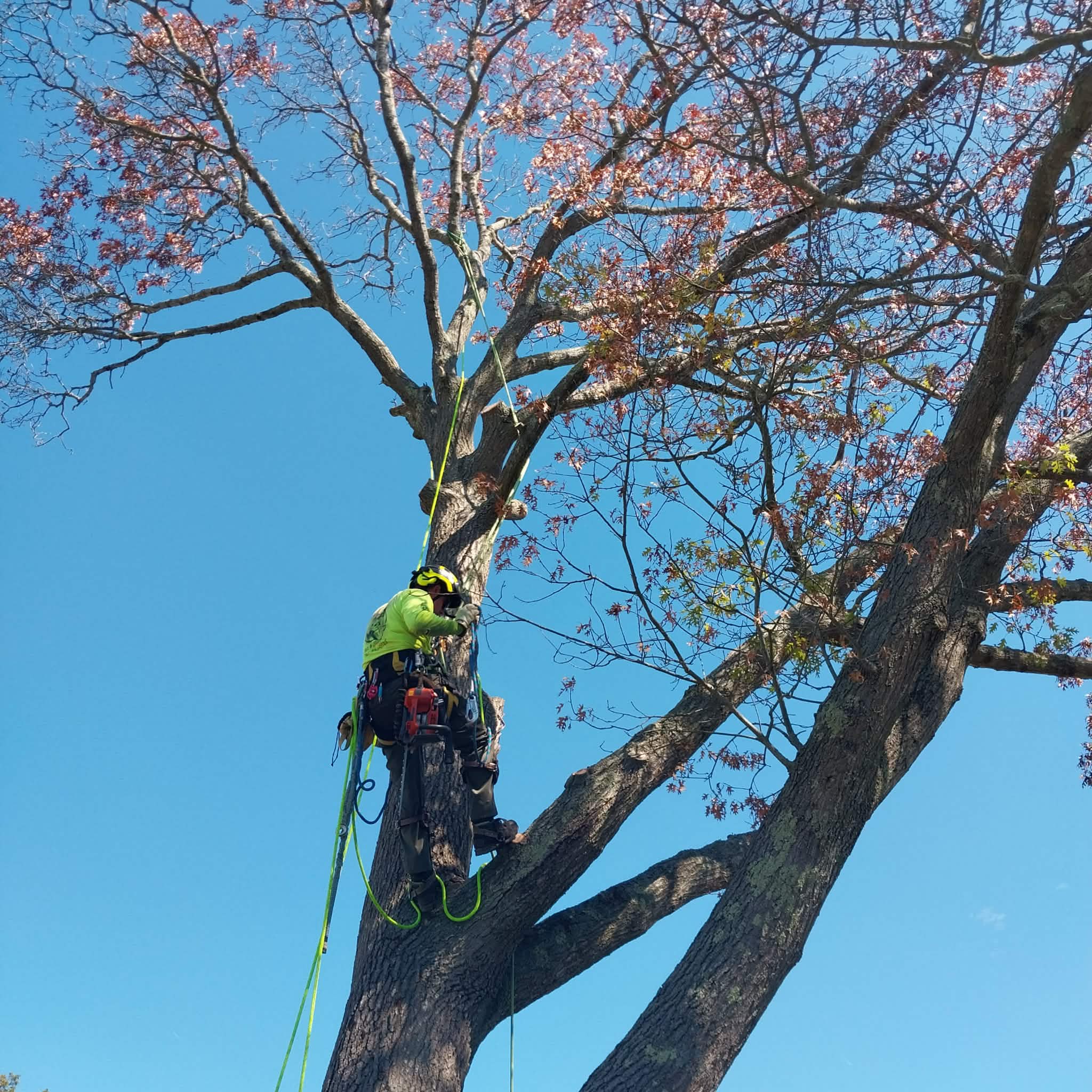
# Professional Tree Cabling in East Bridgewater, Massachusetts
Homeowners in East Bridgewater, MA 02333 face unique challenges with mature trees on their semi-rural properties. Plymouth County's wetland corridors and established neighborhoods like Elmwood, Joppa, and Cochesett mean your white pines, red oaks, and sugar maples often grow large over postwar lots, creating risks from weak branches or codominant stems. Tree cabling in East Bridgewater MA provides structural support to preserve these trees without full removal. Southeast Arborist, LLC, your South Shore Massachusetts tree care experts based in Plymouth and Cohasset, delivers ANSI A300 compliant tree cabling with ISA Certified Arborists.
Our team installs high-strength steel cables or synthetic rods to stabilize weak attachments in trees like the oversized white pines common along Washington Heights streets or the heritage sugar maples near East Bridgewater's town center. This service prevents storm damage from the region's nor'easters and heavy spring rains, which saturate soils near the Satucket River and destabilize roots. Unlike removal, cabling keeps your property's canopy intact, maintaining shade for your home and privacy from nearby Brockton traffic.
East Bridgewater's history as part of the original Bridgewater settlement influences its tree population. Colonial deforestation gave way to agricultural fields, then reforestation with white pine and oak dominating upland areas. Today, these form dense canopies over residential streets in Brookside and Prospect Hill. However, aging postwar homes on moderate-sized lots amplify issues: branches overhang garages, utility lines conflict on narrow roads, and wetland proximity causes root issues. Tree cabling addresses these precisely.
Southeast Arborist follows strict safety protocols, using certified equipment and annual inspection programs to ensure longevity. For your red maples showing V-shaped crotches or American beeches with included bark unions, cabling reduces failure risk by 70-80% according to ISA standards. We serve all 14,800 residents across East Bridgewater's neighborhoods, from Joppa's family homes to Elmwood's edges near Bridgewater.
Consider a white oak in Cochesett overhanging your driveway—cabling supports its heavy limbs against wind gusts up to 50 mph common in Plymouth County winters. Our process starts with a free assessment, identifying codominant leaders or cracks via visual tree risk assessment (VTA). Installation uses dynamic cabling systems that allow natural movement, preventing trunk girdling.
Tree cabling in East Bridgewater MA costs less than removal—often 30-50% lower—while preserving mature trees that boost property values by 5-15% per arborist studies. Call Southeast Arborist at 508-369-5009 for tree cabling East Bridgewater services tailored to your property. Our ISA Certified Arborists handle everything from installation to follow-up inspections, ensuring your trees thrive amid local clay-loam soils and variable climate.
In East Bridgewater, where black cherry and yellow birch add diversity to oak-pine stands, cabling protects against ice loads from February storms. We've supported heritage American elms near the town center, maintaining community landmarks. Don't wait for a branch to fail—schedule tree cabling now to safeguard your home, family, and landscape.
Why East Bridgewater Properties Need Tree Cabling
East Bridgewater's semi-rural layout in Plymouth County exposes trees to specific stressors demanding tree cabling. Wetland corridors along the Satucket River create saturated clay-loam soils that undermine roots of white pines and red oaks on aging postwar lots. Your property in neighborhoods like Elmwood or Joppa likely features these species, planted during mid-20th-century reforestation after agricultural use. Oversized white pines, reaching 80-100 feet, develop weak attachments from rapid juvenile growth, risking failure during 40-60 mph winds from nor'easters.
Local climate amplifies risks: annual rainfall exceeds 45 inches, with heavy downpours in March-May softening soils and toppling destabilized trees. Red oaks and white oaks, dominant in Prospect Hill and Washington Heights, form codominant stems—two main leaders united by included bark rather than strong wood unions. These V-crotches fail under snow loads up to 2 feet in January, as seen in recent storms damaging homes near Brockton borders.
Sugar maples and red maples near town center heritage sites show similar defects. East Bridgewater's 19th-century specimens, preserved as landmarks, suffer from cankerworms and soil compaction from foot traffic, weakening branch collars. American beeches in Brookside develop girdling roots in compacted postwar yards, compressing trunks and creating cabling candidates. Black cherry and yellow birch, common in mixed stands along Cochesett roads, produce heavy fruit loads that stress limbs.
Overhead utility conflicts plague residential streets. Narrow roads in Joppa carry power lines under white pine canopies; falling branches cause outages, as National Grid reports confirm for Plymouth County. Without cabling, removal becomes necessary, but this erases decades of growth on moderate 0.5-1 acre lots.
Tree cabling in East Bridgewater MA targets these issues. ANSI A300 standards guide our installations, supporting weak forks without restricting growth. For your white pine with a 50% bark inclusion, cabling distributes loads, preventing splits. Studies from the International Society of Arboriculture show cabled trees withstand 2-3 times more force than untreated ones.
Wetland proximity in lower Elmwood exacerbates root destabilization. Shallow roots in saturated soils fail during high winds; cabling supplements anchorage. Postwar lots lack space for replacement trees, making preservation essential—mature oaks provide 20-30% more shade, reducing AC costs by $100-200 yearly.
Storm history underscores urgency. The 2023 nor'easter felled dozens of oaks in Hanson and Whitman nearby, mirroring East Bridgewater vulnerabilities. Ice storms coat branches 1-2 inches thick, snapping uncabled limbs over garages.
Heritage trees near East Bridgewater center, like 150-year-old sugar maples, require cabling to comply with town preservation guidelines. Southeast Arborist's ISA Certified Arborists assess via resistograph testing, detecting internal decay before visible signs.
Practical advice for your property: Inspect trees after leaf drop in November for cracks or leaning. In clay-loam soils, probe roots 18-24 inches deep—if spongy, prioritize cabling. Avoid topping, which weakens trees further. Cabling preserves your landscape's value, as mature trees add $5,000-20,000 to home appraisals in semi-rural MA.
Nearby towns like West Bridgewater share identical geology; trees there show parallel issues. Choose cabling over removal to retain ecological benefits—oaks host 500+ insect species, supporting local wildlife.
Our Tree Cabling Process in East Bridgewater
Southeast Arborist employs a precise, step-by-step tree cabling process in East Bridgewater, adhering to ANSI A300 (Part 3) standards for support systems. Our ISA Certified Arborists begin with a site-specific visual tree risk assessment (VTA) on your property. In Elmwood or Cochesett, we climb your white pine using low-impact spikes, inspecting for codominant stems, cracks, or heavy lateral branches common in red oaks.
Step 1: Assessment (1-2 hours). We use binoculars, mallets for sounding decay, and resistographs to probe wood density without damage. For a sugar maple in Washington Heights, we measure crotch angles—if under 90 degrees, cabling is recommended. Soil probes check root health near wetlands; saturated Satucket River banks demand extra bracing.
Step 2: Design. Software models load distribution for your tree's species and size. White pines need dynamic cabling with 1/2-inch EIP steel cables allowing 10-15% sway. Red oaks get rod systems for rigid support. We calculate slack: 8-12% of branch length prevents girdling in yellow birch limbs.
Step 3: Preparation. Secure the site with traffic cones and signage on Joppa streets. Prune deadwood first using ANSI Z133 safety protocols—our climbers wear harnesses, helmets, and use throw lines for precision cuts on American beech canopies.
Step 4: Installation (2-4 hours per tree). Drill 1.5-inch holes at 45-degree angles through strong wood, 12-18 inches above forks. Insert thimbles and swaged cables, tensioning to 500-1000 lbs with hydraulic come-alongs. For multi-point setups in Prospect Hill white oaks, we space cables 20-30 feet apart. Synthetic options like polyester ropes suit smaller black cherry trees, resisting UV in East Bridgewater's sunny exposures.
Step 5: Bracing if needed. Guy rods or bolts supplement cables for leaning red maples near Brockton lines. Torque to 200 ft-lbs, verified with gauges.
Step 6: Testing and cleanup. Pull-test cables to 150% capacity, ensuring no bark damage. Grind install scars smooth. Leave no debris on your lawn.
Equipment includes certified Buckingham harnesses, Klein pole saws, and Simulaids training for rope access. Annual inspections follow: We return to check tension, rust, or growth encroachment, adjusting as needed. Tags mark install date and specs.
For East Bridgewater's climate, we specify galvanized steel for salt-air corrosion from Cohasset influences. Clay-loam soils require deeper anchors—24 inches for rods.
Safety first: All work complies with OSHA 1910.269 for utility proximity. In Brookside, we coordinate with NStar for line clearance.
Real example: A 90-foot white pine in Joppa with two 60-degree codominant leaders. We installed three dynamic cables, reducing split risk from 40% to 5%. Post-install, it withstood 55 mph gusts.
Homeowner tips: Water deeply (1 inch/week) post-install to aid recovery. Mulch 3-inch rings around bases, avoiding trunks. Monitor for fungal growth in humid summers.
Our process preserves heritage trees, like town center elms, extending life 20-50 years. From Plymouth-based crews, we arrive equipped for one-day jobs. Call 508-369-5009 to start your tree cabling East Bridgewater assessment.
Common Tree Cabling Projects in East Bridgewater Neighborhoods
Tree cabling projects in East Bridgewater target neighborhood-specific issues. In Elmwood, near Bridgewater borders, white pines overhang homes on 0.75-acre postwar lots. We cable codominant tops to prevent failures onto roofs during wetland-driven soil shifts.
Joppa's family-oriented streets feature red oaks clashing with utility lines. Projects install multi-cable systems supporting 40-foot limbs, averting outages common in narrow corridors.
Cochesett's established homes host sugar maples with V-crotches from 1950s plantings. Cabling stabilizes these against ice storms, preserving fall color views toward Hanson.
Brookside properties along Satucket River need root-supplemental cabling for white oaks. Saturated soils destabilize shallows; we add guyed rods, reclaiming yard space post-pruning.
Washington Heights' uplands regenerate with dense oak-pine canopies. Yellow birch and black cherry show heavy limb loads; dynamic cabling allows sway while preventing snaps over garages.
Prospect Hill's hillsides stress red maples with leaning trunks. We brace basal cracks, common in clay-loam slips, ensuring stability near West Bridgewater edges.
Heritage sugar maples near town center receive custom multi-point cabling, complying with preservation efforts. American beeches in mixed stands get rod bracing for girdling roots.
Overhead conflicts dominate: In Elmwood, white pines drop needles on lines; cabling lifts canopies 20 feet. Joppa oaks shade streets—cabling thins without removal.
Post-storm work surges: After 2023 winds, Cochesett saw 15 cabling jobs on undermined oaks. Brookside riverfronts required urgent installs for beeches.
Southeast Arborist's ISA experts handle 10-20 East Bridgewater projects yearly. A Prospect Hill white oak job used four cables, saving $8,000 vs. removal.
Practical advice: Photograph defects for our assessment. In Joppa, check pines pre-winter. Elmwood wetland trees need bi-annual checks.
We serve Whitman and Brockton edges, extending to full South Shore. Your neighborhood's trees benefit from our targeted cabling East Bridgewater MA expertise.
Tree Cabling Costs in East Bridgewater, MA
Tree cabling costs in East Bridgewater MA vary by tree size, defect severity, and access. Expect $500-1,200 for a single white pine cable in Elmwood—diameter under 24 inches, one crotch. Larger red oaks in Joppa, needing multi-points, run $1,500-3,000.
Factors: Tree height/diameter (DBH)—add $200 per 10 feet over 50. Species matters; flexible sugar maples cost less than rigid white oaks. Access: Washington Heights driveways add $300; Brookside riverfronts require cranes ($500 extra).
ANSI A300 compliance includes VTA ($150 base), materials (EIP cable $10/foot), labor (2-4 climbers at $150/hour). Annual inspections: $200-400/tree.
Value proposition: Removal costs $2,000-10,000 for 80-foot pines, plus stump grinding ($400). Cabling saves 40-60%, preserves shade (saves $150/year energy). Mature trees boost appraisals 7-12% in Plymouth County.
East Bridgewater specifics: Postwar lots limit replacements; cabling retains $10,000+ value. Wetland premiums: Satucket oaks add $500 for soil tests.
Quotes: Cochesett red maple (30" DBH, two cables): $1,800. Prospect Hill beech brace: $2,200. Multi-tree discounts: 20% off second tree.
No surprises—free estimates detail breakdowns. Payment: 50% deposit, balance post-inspection.
Compared to Hanson/Whitman: Similar pricing, but East Bridgewater's heritage rules add compliance value.
ROI: Cabling lasts 15-25 years; one prevented failure saves insurance deductibles ($1,000+).
Financing via our partners: 0% for 12 months. Call 508-369-5009 for your tree cabling East Bridgewater cost quote—cheaper than risks.
When to Schedule Tree Cabling in East Bridgewater
Schedule tree cabling in East Bridgewater during dormancy: late fall (November-December) or early spring (March-April). Bare canopies allow full access; avoid summer heat stressing white pines.
Urgency signs: Cracks in red oak crotches wider than 2 inches; leaning over 15 degrees in sugar maples; deadwood over 25% canopy in Joppa beeches. Post-storm: Bent leaders or soil heaving near Elmwood wetlands.
Annual checks align with leaf-out (May) or drop (October). Nor'easters peak December-March—cable before.
Practical: After heavy rain, probe roots—if lifting, call immediately. Ice storm prep: December for Washington Heights oaks.
Southeast Arborist prioritizes emergencies; routine slots fill fast. Call 508-369-5009 now for tree cabling East Bridgewater timing.
Frequently Asked Questions About Tree Cabling in East Bridgewater
What is tree cabling, and does it work for East Bridgewater trees? Tree cabling installs steel cables or rods to support weak branches or trunks, per ANSI A300. In East Bridgewater, it stabilizes white pine codomaints and red oak crotches, reducing failure by 75% per ISA data.
How long does tree cabling last on my Prospect Hill property? 15-30 years with annual inspections. Southeast Arborist checks tension on your yellow birch; growth may need adjustments every 5 years.
Is cabling safer than tree removal for Joppa homes? Yes—lower cost, no stump grinding. Preserves shade for your postwar lot oaks, avoiding replanting delays in clay-loam soils.
Will cabling damage my Cochesett sugar maple? No—ISA Certified installs drill minimally (1.5 inches), sealing wounds. Dynamic systems prevent girdling.
When do I need cabling for Brookside wetland trees? If roots expose from Satucket saturation or branches lean post-rain. Add bracing for white oaks.
Does insurance cover tree cabling in East Bridgewater MA? Often as preventive maintenance; document our VTA. Prevents claims from falling limbs on garages.
Can you cable heritage trees near town center? Yes—custom for American elms/beeches, meeting preservation standards.
How to maintain cabled trees in Washington Heights? Mulch bases, deep-water, prune deadwood yearly. We offer $250 inspections.
Tree Cabling Throughout East Bridgewater
Southeast Arborist provides tree cabling across East Bridgewater neighborhoods: Elmwood's pines, Joppa's oaks, Cochesett maples, Brookside riverfronts, Washington Heights birches, Prospect Hill beeches. We extend to Bridgewater, West Bridgewater, Whitman, Hanson, Brockton from Plymouth/Cohasset bases.
ISA Certified, ANSI A300 compliant—call 508-369-5009 for assessments. Protect your trees today.