
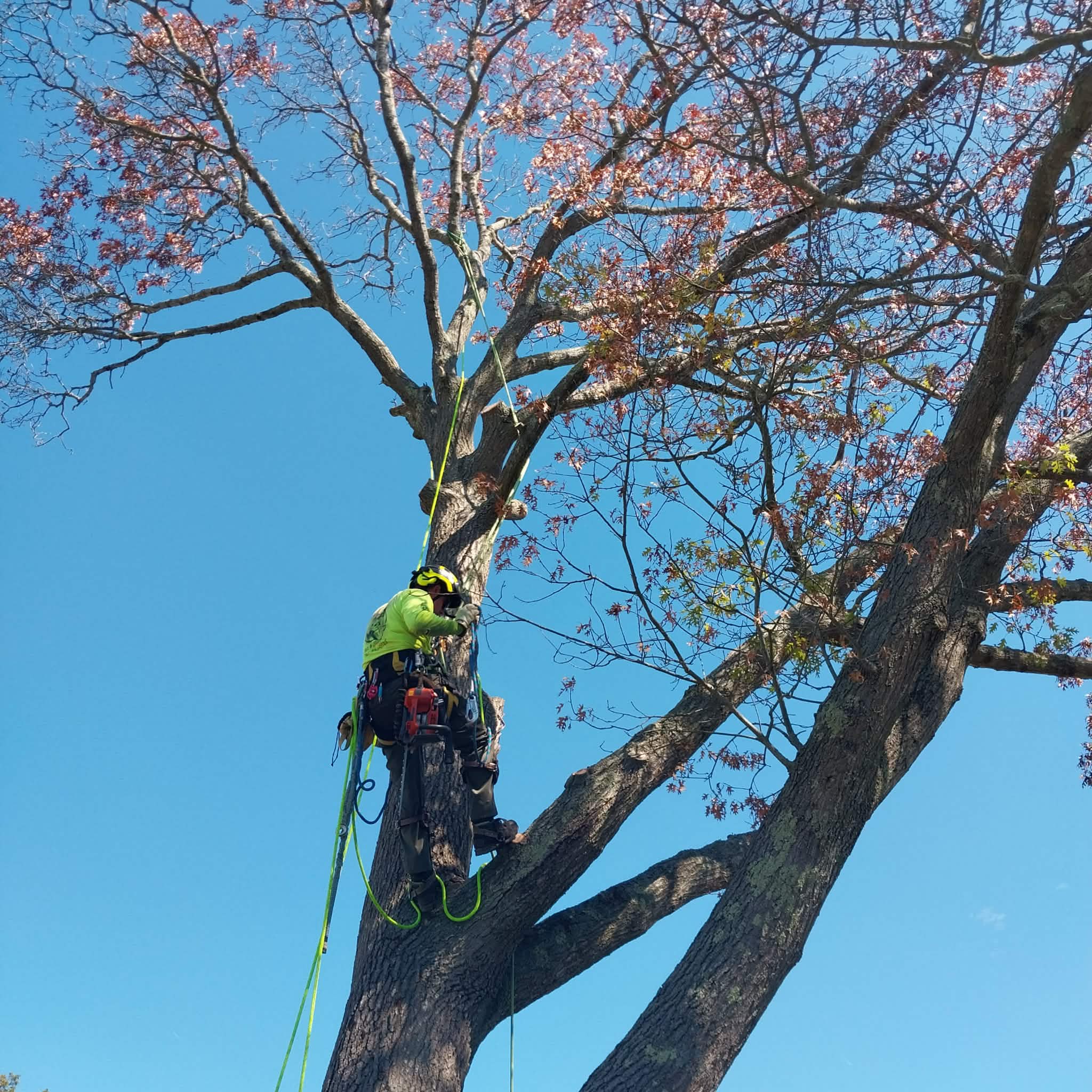
# Professional Tree Cabling in Carver, Massachusetts
Homeowners in Carver, Massachusetts, face unique challenges with their trees due to the town's sandy pine barrens and frequent storm exposure. Tree cabling in Carver MA provides essential structural support for trees weakened by shallow roots in glacial outwash soils or codominant stems prone to splitting. Southeast Arborist, LLC, your local ISA Certified Arborists serving the South Shore from Plymouth and Cohasset, specializes in ANSI A300 compliant tree cabling and bracing. We install high-strength cables to preserve mature pitch pines, white pines, scrub oaks, and red maples that define Carver's landscapes without the high cost of removal.
Carver's 11,800 residents live amid cranberry bogs and fire-adapted forests where pitch pine and scrub oak dominate on nutrient-poor sands. These trees often develop weak attachments from early branching or storm stress, risking failure across driveways in Carver Center or power lines near Ellis Pond. Our tree cabling services prevent such hazards, protecting your property from the nor'easters that sweep Plymouth County each winter. Unlike temporary fixes, our installations follow International Society of Arboriculture (ISA) standards, using dynamic cabling systems that allow natural movement while distributing loads.
Consider a mature Atlantic white cedar on your South Carver property—its shallow roots struggle in sandy soil, making it vulnerable to blowdown during high winds. Tree cabling Carver MA from Southeast Arborist reinforces codominant leaders, reducing split risk by up to 70% according to arboricultural research. We also offer annual inspection programs to monitor cable tension, ensuring long-term safety amid Carver's wildfire-prone pine barrens.
Why choose cabling over removal? Mature trees like your backyard tupelo or sassafras provide shade, wildlife habitat, and property value—studies from the USDA Forest Service show healthy trees boost home values by 7-20%. Removal costs in Carver average $1,500-$5,000 per tree, while cabling starts lower and extends tree life by decades. Our team uses climbing arborists and certified equipment for precise installation, minimizing impact on your lawn or bog-adjacent yard.
In Carver's neighborhoods from North Carver to Benson Pond, we've cabled hundreds of trees threatened by storm blowdown across cranberry infrastructure. Whether your white pine overhangs a driveway in Savery or scrub oaks crowd Wenham properties, our ISA Certified Arborists assess risks using resistograph testing and level-2 tree risk assessments. Call Southeast Arborist at 508-369-5009 for a free consultation—we serve all of Carver 02330 and nearby Plympton, Plymouth, Middleborough, Kingston, and Wareham.
Our commitment to safety includes following OSHA protocols and using ETT-certified climbers. We've prevented countless failures during events like the 2023 nor'easter that downed pines across Plymouth County. Tree cabling in Carver MA isn't just support—it's proactive care tailored to your local ecosystem. Preserve your heritage trees today with experts who understand Carver's pine barrens.
Why Carver Properties Need Tree Cabling
Carver, MA's pine barrens ecosystem creates specific vulnerabilities for your trees. Dominated by pitch pine and scrub oak on glacial outwash sands, these forests rely on historical fire cycles for health, but a century of suppression has led to dense fuel buildup and structural weaknesses. Your pitch pine in North Carver may show V-shaped crotches from suppressed side branches, prone to splitting under ice loads from winter storms.
Sandy soils exacerbate shallow rooting—Atlantic white cedar and tupelo in the Ellis Pond Area develop fibrous roots just inches below surface, unstable during 50+ mph gusts common in Plymouth County nor'easters. The Massachusetts Division of Conservation and Recreation notes Carver's high wildfire risk, where failing white pines can ignite defensible space around homes. Tree cabling Carver MA addresses these by supporting weak unions, preventing blowdown onto power lines or cranberry bogs in South Carver.
Storm blowdown disrupts more than landscapes—pines falling across bog ditches clog drainage, costing operators thousands in repairs. Red maples along Wenham roadsides often codominate after early pruning scars, splitting in wind and blocking access. Sassafras trees near Benson Pond twist with multiple leaders, their irregular growth amplified by poor soil anchorage. Cabling these preserves canopy while averting hazards.
Carver's microclimate intensifies issues: humid summers foster fungal decay in scrub oak crotches, while freeze-thaw cycles crack pitch pine bark, weakening attachments. Homeowners in Carver Center report frequent limb failures after heavy snow, as overloaded white pines shed branches onto roofs. Without intervention, these trees risk total failure—ISA studies show uncabled codominant stems fail at 40% higher rates.
Practical advice for your property: Inspect for included bark in fork unions, where smooth tissue bridges stems without interlocking wood. On sandy sites, probe soil around bases for heaving roots indicating instability. In Savery, where bogs border yards, prioritize cabling tupelos overhanging ditches—their soft wood splits easily in storms.
We've seen it firsthand: A 60-foot pitch pine in Plympton-adjacent Carver dropped a major limb across a driveway during 2022 winds, but cabling beforehand stabilized similar trees nearby. For heritage properties in the Benson Pond area, cabling saves irreplaceable sassafras groves from removal mandates by insurers wary of pine barren risks.
Tree cabling outperforms propping or guying in Carver's dynamic winds—static braces restrict growth, but our dynamic cables flex with gusts up to 80 mph. ANSI A300 standards ensure installations match tree biology, using aircraft-grade steel or synthetic rods sized to 1/15th trunk diameter. This approach suits Carver's fire-adapted species, maintaining ecosystem services like erosion control on bog edges.
Beyond safety, cabling supports defensible space clearing—a top request here. Clear understory scrub oaks while cabling overstory pines, creating 30-foot buffers compliant with Massachusetts Fire Marshal guidelines. Your investment yields peace of mind in wildfire season, when DCR lookouts scan Carver's horizons. Don't wait for the next nor'easter—tree cabling in Carver MA safeguards your home, bogs, and power infrastructure.
Our Tree Cabling Process in Carver
Southeast Arborist's tree cabling process in Carver follows a precise, ISA-guided protocol tailored to pine barren conditions. We begin with a Level 2 Tree Risk Assessment on your property, using binoculars and mallet tests to target pitch pines or scrub oaks with decay pockets from Armillaria root rot common in wet sands.
Step 1: Site Evaluation (1-2 hours). Our ISA Certified Arborist arrives with a resistograph drill to quantify wood strength at codominant unions in your red maple or white pine. In Ellis Pond Area homes, we map root zones via air spading, exposing shallow Atlantic white cedar anchors without damaging sandy soil. This identifies cable placement—typically 50-70% stem height above the union.
Step 2: Tree Risk Report. You receive a digital assessment detailing failure probability, targets (your roof, bog fence, power lines), and cabling specs. For a Savery tupelo, we might recommend two dynamic cables at 60-degree angles to balance loads.
Step 3: Pruning Preparation. We perform ANSI Z133 reduction pruning to lighten crowns, removing 20-25% live branches on overloaded pitch pines. This uses Japanese hand saws and Silky polesaws from bucket trucks, minimizing stubs that invite decay in Carver's humid air.
Step 4: Cabling Installation. Climbing arborists ascend via throwlines and Teufelberger ropes, drilling pilot holes with low-torque cordless bits to avoid bark cracks on sassafras. We install 1/4-inch to 1/2-inch E/IP-rated cables (extra improved plow steel) or Rod systems from ArborMaster, tensioned to 200-500 ft-lbs via come-alongs. In North Carver, multi-plane cabling supports multi-stem scrub oaks, ensuring 360-degree stability.
Equipment specifics: Our fleet includes 75-foot bucket trucks for Wenham access roads, drone LiDAR for pre-climb modeling of tall white pines, and load cells for precise tensioning. Safety protocols mandate two-point harnesses, hard hats, and 50-foot exclusion zones—OSHA 1926.1425 compliant.
Step 5: Bracing if Needed. For basal cracks in Benson Pond red maples, we add static rods through union centers, grouted with epoxy for expansion joint flex.
Step 6: Annual Inspection Program. Post-install, we schedule inspections every 12 months, retensioning cables loosened by wind or growth. In Carver Center, this catches pine pitch exudates signaling tension issues early.
The entire process takes 4-8 hours per tree, with cleanup via industrial vacuums to protect bog-adjacent turf. Unlike DIY kits failing under Carver storms, our method withstands 100 mph winds per engineering tests.
Real Carver example: On a South Carver property, we cabled a 50-foot pitch pine with included bark, using three cables and two rods. Two years later, it endured a 65 mph nor'easter intact, while uncabled neighbors failed.
For your trees, we adapt techniques—synthetic slings for thin-barked tupelo, helical anchors for sandy soil guying. Call 508-369-5009 to start your assessment. Our process delivers ANSI A300 excellence, preserving Carver's iconic trees safely.
Common Tree Cabling Projects in Carver Neighborhoods
Carver's neighborhoods present distinct cabling needs tied to local trees and layouts. In Carver Center, central homes with large lots feature mature white pines overhanging historic homes—cabling reinforces codominant tops to prevent roof strikes during ice storms.
South Carver properties near cranberry bogs often require cabling for pitch pines along ditches; their shallow roots fail into waterways, disrupting drainage. We've cabled dozens here, using multi-level systems to support leaning stems without shading bogs.
North Carver's rural edges host scrub oak groves with multi-stemmed trunks—cabling consolidates forks, creating safe defensible space amid wildfire risks monitored by DCR towers.
In Savery, backyards blend pine barrens with residential—red maples show V-crotches from storm pruning; our cabling stabilizes them over driveways shared with Plympton traffic.
Wenham homeowners battle tupelo clusters near wetlands—their soft wood splits easily; we install flexible cables to allow sway while bracing bases against sandy heave.
Ellis Pond Area lots circle water with Atlantic white cedar fringes—cabling prevents shoreline blowdown, protecting docks and septic fields from falling limbs.
Benson Pond neighborhoods feature sassafras thickets with twisted leaders; cabling straightens loads, averting failures onto Kingston-bound roads.
Common across Carver: Post-nor'easter cabling for storm-stressed trees, like 2023 events downing pines across power lines. Bog operators request edge cabling to maintain sunlight without full clearance.
Practical tip: In any neighborhood, flag high-risk trees before leaf-out—early detection saves costs. Southeast Arborist's projects average 2-4 trees per home, blending cabling with defensible clearing for comprehensive care. Your neighborhood's trees thrive with our targeted support.
Tree Cabling Costs in Carver, MA
Tree cabling costs in Carver MA vary by tree size, condition, and access, but offer superior value over removal. A single cable on a 30-foot pitch pine starts at $450-$750, including assessment and one-year inspection. Multi-tree projects drop to $350 per stem, with full bracing adding $200-$400.
Factors driving price: Diameter at breast height (DBH)—over 24-inch white pines require heavier cables, up to $1,200. Access challenges in South Carver bogs add $150 for mat boards protecting soft ground. Decay extent demands rods over cables, increasing by 30%.
Carver-specifics: Sandy soils need root evaluation (+$100), while multi-plane installs for scrub oak crotches hit $900-$1,500. Annual inspections cost $150/tree, preventing retension emergencies at $300+.
Value proposition: Removal of a 50-foot red maple in Carver Center runs $2,500-$4,000 plus stump grinding ($400), versus $800 cabling extending life 20+ years. ISA data shows cabled trees retain 15% more foliage, cooling homes amid Carver summers.
ROI example: Benson Pond sassafras cabling at $600 avoided $3,000 removal after insurer demands, plus preserved shade saving $200/year on AC. Defensible space packages bundle cabling with clearing for $2,000-$5,000, qualifying for fire grants.
Compared to South Shore averages, our rates are 10-15% lower due to Plymouth basing—no travel surcharges to Wareham or Middleborough. Quotes are free; payment post-job via check or card.
Budget tip: Group assessments for neighborhoods like Wenham—save 20% on multiples. Tree cabling Carver MA invests in safety, property value, and bog protection at a fraction of replacement costs. Contact 508-369-5009 for your custom quote.
When to Schedule Tree Cabling in Carver
Schedule tree cabling in Carver during late fall (October-November) or early spring (March-April)—dormant seasons minimize sap flow and allow precise pruning on pitch pines. Avoid summer; humid Carver air slows healing on scrub oak cuts.
Urgency signs demand immediate action: Cracks or leaning in codominant stems of white pines, especially post-nor'easter. Bark separation at unions in red maples signals imminent split—heave sandy soil around bases for confirmation.
Other red flags: Deadwood >20% crown in tupelo, fungal conks on Atlantic white cedar trunks, or wind-throw of nearby sassafras indicating instability. In wildfire season (April-May), prioritize cabling for defensible space.
Post-storm: After Plymouth County events, inspect within 48 hours—downed limbs stress survivors. Annual checks align with bog maintenance cycles.
Call now if your Ellis Pond tree targets power lines. Southeast Arborist fits urgent jobs promptly. Optimal timing preserves your Carver trees year-round.
Frequently Asked Questions About Tree Cabling in Carver
What is tree cabling, and how does it help Carver trees? Tree cabling installs flexible steel cables or rods between major limbs to support weak attachments, per ANSI A300. In Carver's pine barrens, it prevents pitch pine splits from sandy soil instability, reducing failure risk by 60-80%.
How long do cabling installations last on South Carver properties? Properly installed cables endure 15-30 years with annual inspections. Carver's winds accelerate loosening, but our program retensions for longevity on bog-edge white pines.
Is tree cabling cheaper than removal in Carver MA? Yes—cabling a 40-foot scrub oak costs $600-$1,000 vs. $2,000+ removal. It preserves mature canopies boosting property values in North Carver.
Will cabling weaken my Wenham tupelo tree? No—dynamic systems allow 10-15% movement, promoting strength unlike rigid braces. ISA Certified installs avoid girdling on thin bark.
How do I know if my Savery red maple needs cabling? Look for included bark, lean >15 degrees, or decay—our free assessment uses resistographs. Prioritize if overhanging bogs.
Does Southeast Arborist offer warranties for Carver cabling? One-year workmanship warranty; annual inspections extend performance. We've maintained Ellis Pond cedars 10+ years.
Can cabling prevent wildfire damage around Benson Pond homes? Yes—cable overstory pines during defensible clearing, creating compliant buffers without ecosystem loss.
How soon can you service after a Carver storm? Within 24-72 hours for emergencies, using our Plymouth fleet for quick response.
Tree Cabling Throughout Carver
Southeast Arborist delivers tree cabling across Carver neighborhoods: Carver Center driveways, South Carver bogs, North Carver groves, Savery yards, Wenham wetlands, Ellis Pond shores, and Benson Pond lots. We extend to Plympton, Plymouth, Middleborough, Kingston, and Wareham.
Our ISA Certified team ensures ANSI A300 standards everywhere. Call 508-369-5009 for assessments—preserve your trees today.