
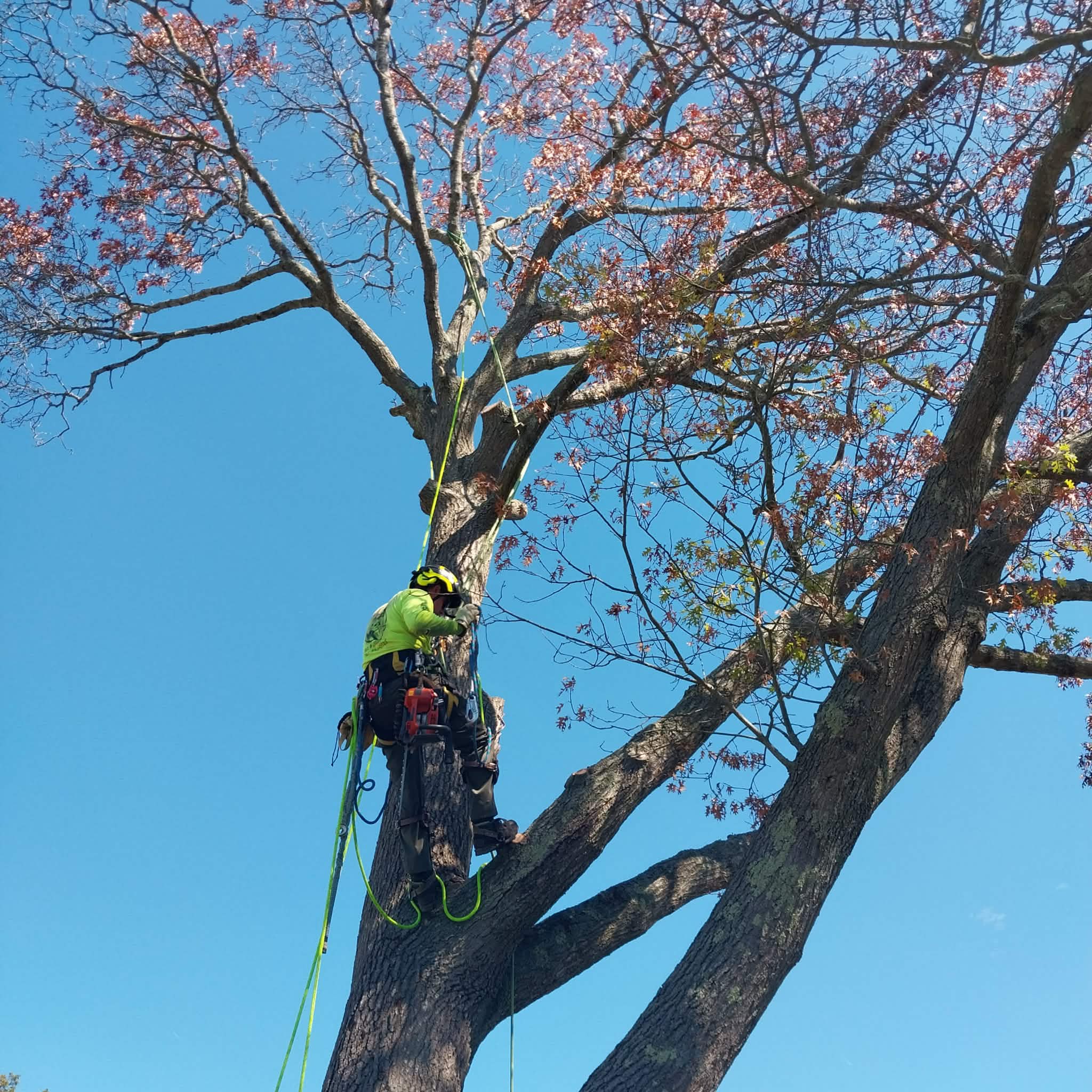
# Professional Tree Cabling in Canton, Massachusetts
Your mature oaks and hickories lining Washington Street in Canton Center provide essential shade and property value, but weak branch unions from decades of growth expose them to storm failure. Tree cabling in Canton, MA, delivers targeted structural support to preserve these assets without full removal. Southeast Arborist, LLC, your South Shore Massachusetts tree care experts based in Plymouth and Cohasset, installs ANSI A300-compliant cabling systems using ISA Certified Arborists. We serve Canton homeowners facing the unique pressures of Blue Hills Reservation adjacency and hilly terrain.
Canton, in Norfolk County with a population of 24,000, features suburban neighborhoods like Ponkapoag and Knollwood backed by the Blue Hills' protected forests since 1893. These old-growth chestnut oaks and shagbark hickories influence your residential canopy, planted mostly from early 20th-century farmland conversions. Ice storms hit hilltops hard, while hemlock woolly adelgid threatens reservation-edge hemlocks. Our tree cabling services address these risks directly, supporting codominant stems in red oaks and split forks in sugar maples common along Pleasant Street.
Unlike removal, which erases heritage trees and costs thousands, cabling reinforces weak attachments at a fraction of the price while maintaining your landscape's character. We use dynamic cabling with high-strength synthetic cables that flex in wind, reducing sway without girdling. Annual inspections, included in our program, catch shifts early in Canton's variable soils—sandy loams in Reservoir Pond Area prone to drought stress, heavier clays in Canton Junction holding ice loads.
Homeowners in Pecunit and Springdale call us after spotting leaning white pines or cracked beech trunks, knowing cabling prevents roof damage during nor'easters. Our process starts with a Level 2 Tree Risk Assessment, mapping defects in your specific species like tulip trees with V-notches. Safety protocols include bucket truck access for elevated installs and ground barriers around drop zones.
Serving the South Shore from Stoughton to Milton borders, Southeast Arborist brings 20+ years stabilizing Canton's aging canopy. Call 508-369-5009 for a free on-site evaluation—our arborists arrive equipped with resistograph tools to measure wood strength before recommending cabling. Preserve your property's trees against local wind events averaging 15-20 mph gusts, backed by our insurance and certification. Tree cabling Canton MA protects your investment in this Blue Hills gateway community.
Why Canton Properties Need Tree Cabling
Canton's landscape, shaped by Blue Hills Reservation's continuous forest since 1893, presents distinct tree stability challenges for your property. Red oaks and white oaks dominate Canton Center streets, their codominant leaders forming included bark unions vulnerable to splitting under ice loads from winter storms. Chestnut oaks on Ponkapoag hilltops, among eastern Massachusetts' oldest stands, develop heavy lateral branches that fail in high winds due to decay at attachments.
Shagbark hickory in Knollwood shows V-crotches from early branching, exacerbated by Canton's clay-loam soils that retain moisture, promoting fungal rots like Armillaria. American beech near Canton Junction suffer from beech bark disease, weakening stems and requiring cabling to support leaning crowns over driveways. Eastern hemlock along reservation borders in Reservoir Pond Area face hemlock woolly adelgid infestation, causing top dieback and unbalanced loads that cabling redirects.
White pines in Springdale tower with multiple leaders, their flexibility turning hazardous in 50+ mph gusts common during nor'easters. Sugar maples along Washington Street exhibit frost cracks from Canton's microclimate—colder hilltop nights followed by sunny exposures—leading to compartmentalization failures. Tulip poplars in Pecunit grow fast with brittle wood, prone to storm breakage at fork unions.
The forest-residential interface amplifies risks: trees leaning from Blue Hills stands toward Canton Corner homes need assessment for guyed cabling. Aging canopies over historic streets like Pleasant endure 80-100 years of growth, now declining without intervention. Ice storms, hitting Canton's elevation changes hardest, coat branches 1-2 inches thick, overloading weak points—cabling distributes forces, preventing cascading failures.
Soil conditions vary: sandy, well-drained types in Blue Hills frontage stress roots during summer droughts, causing top-heaviness in mature hickories. Heavier Norfolk County clays in Canton Junction compact under equipment, limiting root expansion and increasing topple risk. Local climate data shows 45-50 inches annual precipitation, with 10-15 storm events yearly, making proactive cabling essential.
Without support, hazard trees at edges drop limbs on power lines or roofs, as seen post-2018 nor'easter. Cabling preserves these species' ecological roles—oaks host 500+ insects vital for Canton's wildlife—while cutting removal costs by 50-70%. ISA Certified evaluations identify priorities: prioritize codominant red oaks over 24 inches DBH, cable beeches with 30% hollowing.
In neighborhoods like Knollwood, structural pruning pairs with cabling for hickories, reducing wind sail. Homeowners gain peace of mind knowing ANSI A300 methods extend tree life 10-20 years, matching Canton's development timeline. Southeast Arborist tailors to these specifics, avoiding one-size-fits-all approaches.
Our Tree Cabling Process in Canton
Southeast Arborist follows a precise, ANSI A300-compliant process for tree cabling Canton MA, starting with your free consultation at 508-369-5009. Our ISA Certified Arborists arrive with sonic tomography and resistograph drills to assess wood density in your red oak or hemlock—no guesswork.
Step 1: Risk Assessment. We conduct a visual and instrumented Level 2 TRA, targeting defects like included bark in white oaks or decay pockets in shagbark hickories. For Blue Hills-adjacent properties in Ponkapoag, we map lean angles using clinometers, noting wind exposure from 200-foot hilltops.
Step 2: Tree Mapping. Laser rangefinders plot branch unions above critical zones—your roof, patio in Canton Center. We prioritize attachments 30-50 feet up, common in 60-80 foot sugar maples, using drones for canopy access without spikes.
Step 3: Cable Design. Dynamic cabling uses 1/4-3/8 inch synthetic polyester ropes (5,000-10,000 lb breaking strength), flexed to 10-15% of branch diameter. For chestnut oaks in Knollwood, we install multi-level systems: primary cables at forks, secondary loops mid-crown. Static steel cables apply only to rigid failures, per ANSI specs.
Step 4: Installation Prep. Ground crew sets up 50-foot exclusion zones with signage, verifies utility locates. Bucket trucks with 85-foot reach position for Pecunit tulip trees; climbing arborists use low-impact friction savers on bark.
Step 5: Drilling and Routing. Arborists drill 1-1.5 inch holes at 120-degree angles through collars, 12-18 inches from unions to preserve reaction wood. Cables route through thimbles, tensioned to 500-1,000 lbs with come-alongs, allowing 8-12 inches sway under load.
Step 6: Bracing Integration. Rods or bolts supplement cables in American beech splits, torqued to specs. Hemlock woolly adelgid cases get treatment ports during installs.
Step 7: Testing and Labeling. Load-test cables with 1,000 lb pulls simulating ice. Install tamper-proof tags with install date, specs, and inspection schedule. Provide digital report with photos for your Canton records.
Annual inspections use torque wrenches on bolts, visual slack checks on ropes—critical in Canton's freeze-thaw cycles stressing synthetics. Equipment includes certified rigging gear meeting OSHA standards; all arborists wear PFAS harnesses.
For storm-damaged white pines in Springdale, we emergency-cable within 24 hours. This process extends heritage tree life, complies with Norfolk County regs, and outperforms DIY kits prone to improper tension.
Practical tip: Walk your property post-rain; note cracks >2 inches in oak bark—call us immediately. Our South Shore base ensures 1-hour response to Canton.
Common Tree Cabling Projects in Canton Neighborhoods
In Canton Center, cabling supports codominant red oaks over 100 years old along Washington Street, where V-unions threaten historic homes. Properties here often pair cabling with pruning to lighten 40-foot limbs.
Canton Junction sees white pine leaders cabled after wind sway, protecting rail-adjacent roofs. Multi-trunk sugar maples get looped systems to unify stems separated by soil heaving in local clays.
Ponkapoag hilltop chestnut oaks bordering Blue Hills require guy wires from trunks to anchors, countering lean toward houses from reservation shading. Shagbark hickory forks here demand dual cables due to heavy nut crops adding weight.
Knollwood's American beech groves need bracing for bark disease-weakened crotches overhanging lawns—our installs preserve understory shade. Eastern hemlocks get adelgid-treated cabling to stabilize dieback tops.
Canton Corner properties cable tulip trees with brittle wood near roads, preventing traffic hazards during leaf-off gusts. Reservoir Pond Area's mature white oaks over water features use submerged anchors for lateral support.
Pecunit homes fronting farmland remnants cable aging hickories with decay, extending life amid suburban expansion. Springdale's dense canopies feature oak-hickory mixes cabled at 50 feet to avert chain-reaction falls.
Blue Hills interface projects dominate: hazard assessments identify 20% leaning trees needing removal, 40% cabling. Storm cleanup follows with immediate cabling on survivors, as in 2023 ice event downing 100+ limbs.
Southeast Arborist documents each via before-after photos, aiding insurance claims. These neighborhood-specific interventions match Canton's growth patterns, preserving 1930s plantings.
Tree Cabling Costs in Canton, MA
Tree cabling costs in Canton MA range $500-$2,500 per tree, far below $3,000-$10,000 removals for 50-80 foot specimens. Factors include tree size: 24-inch DBH red oak at $800 base; 48-inch chestnut oak $1,800+ for multi-level.
Number of cables drives price—single fork $600, full crown 4-6 cables $2,000. Species matters: hemlock woolly adelgid treatment adds $200; beech bark disease rods $300.
Access impacts: bucket truck in Canton Center yards $400 extra vs. climbing in tight Knollwood. Height over 50 feet in Ponkapoag adds $500 for rigging.
Soil/terrain: Reservoir Pond wet areas need mat boards ($150); hilltop anchors in Pecunit $250 drilled concrete.
Annual inspections $150/tree, bundled for 3+ trees at $100. Our packages save 15%: $1,200 average for Washington Street oaks.
Value proposition: Cabling retains 20-30% property value from mature trees, per Appraisal Institute data. Avoids $5,000+ roof repairs, cuts liability insurance 10%.
ROI timeline: 2-5 years via energy savings—oaks shade AC 20-30%. Heritage preservation boosts resale in family-oriented Canton.
Compare bids: We quote transparently post-assessment, no hidden fees. Financing via 0% promo for South Shore clients.
Call 508-369-5009 for precise estimate—your Canton specifics ensure fair pricing.
When to Schedule Tree Cabling in Canton
Schedule tree cabling Canton MA in late spring (May-June) post-budbreak, when leaves reveal imbalances but before summer storms. Avoid winter—frozen soils hinder drilling, hidden defects.
Urgency signs: leaning >15 degrees in white pines; cracks >3 inches in oak crotches; >25% dieback in hemlocks. Post-storm sway or bark sloughing demands 24-48 hour response.
Fall (September-October) suits inspections ahead of leaf drop exposing forks. Ice-vulnerable hilltops in Ponkapoag prioritize pre-January.
Annual checks: April for frost damage, October for summer wear. Bundle with pruning during dormant season.
Monitor via app tips: photograph unions monthly; note changes in Canton's 40-inch rain patterns stressing roots.
Proactive timing prevents 80% failures, per ISA studies. Contact Southeast Arborist at 508-369-5009 now—spring slots fill fast.
Frequently Asked Questions About Tree Cabling in Canton
**What is tree cabling, and how does it work in Canton trees?** Tree cabling installs flexible cables or rigid rods to support weak branch attachments, per ANSI A300. In Canton's red oaks, it limits split travel to 12 inches under load, preserving structure.
**How long does tree cabling last on my Canton property?** 10-20 years with annual inspections; synthetics endure freeze-thaw, steel needs rust checks. Blue Hills oaks often hit 15 years.
**Is cabling better than tree removal for Canton hazards?** Yes for 70% cases—costs 40-60% less, keeps shade/ecology. Remove only >50% failure risk trees near homes.
**Will cabling damage my sugar maple or hickory?** No, ISA Certified installs drill minimally through live collars, promoting healing. No girdling like old wire methods.
**How much does tree cabling cost in Canton neighborhoods?** $500-$2,500/tree; factors size, access. Ponkapoag hilltops higher due to terrain.
**When should I call for cabling in ice-prone Canton?** At codominant stems >20 feet up, leaning, or post-storm cracks. Pre-nor'easter ideal.
**Do you offer warranties on Canton cabling?** Yes, 2-year install warranty; annual program includes retensioning.
**Can cabling help hemlocks with woolly adelgid here?** Absolutely—supports unbalanced crowns during treatment, common near Blue Hills.
Tree Cabling Throughout Canton
Southeast Arborist provides tree cabling across Canton neighborhoods: Canton Center, Canton Junction, Ponkapoag, Knollwood, Canton Corner, Pecunit, Springdale, Reservoir Pond Area. Extend to nearby Stoughton, Sharon, Randolph, Milton, Norwood, Dedham.
Our Plymouth/Cohasset base ensures rapid South Shore response. ISA Certified, ANSI A300 experts ready for your trees.
Call 508-369-5009 today for Canton tree cabling—free assessment protects your property.