
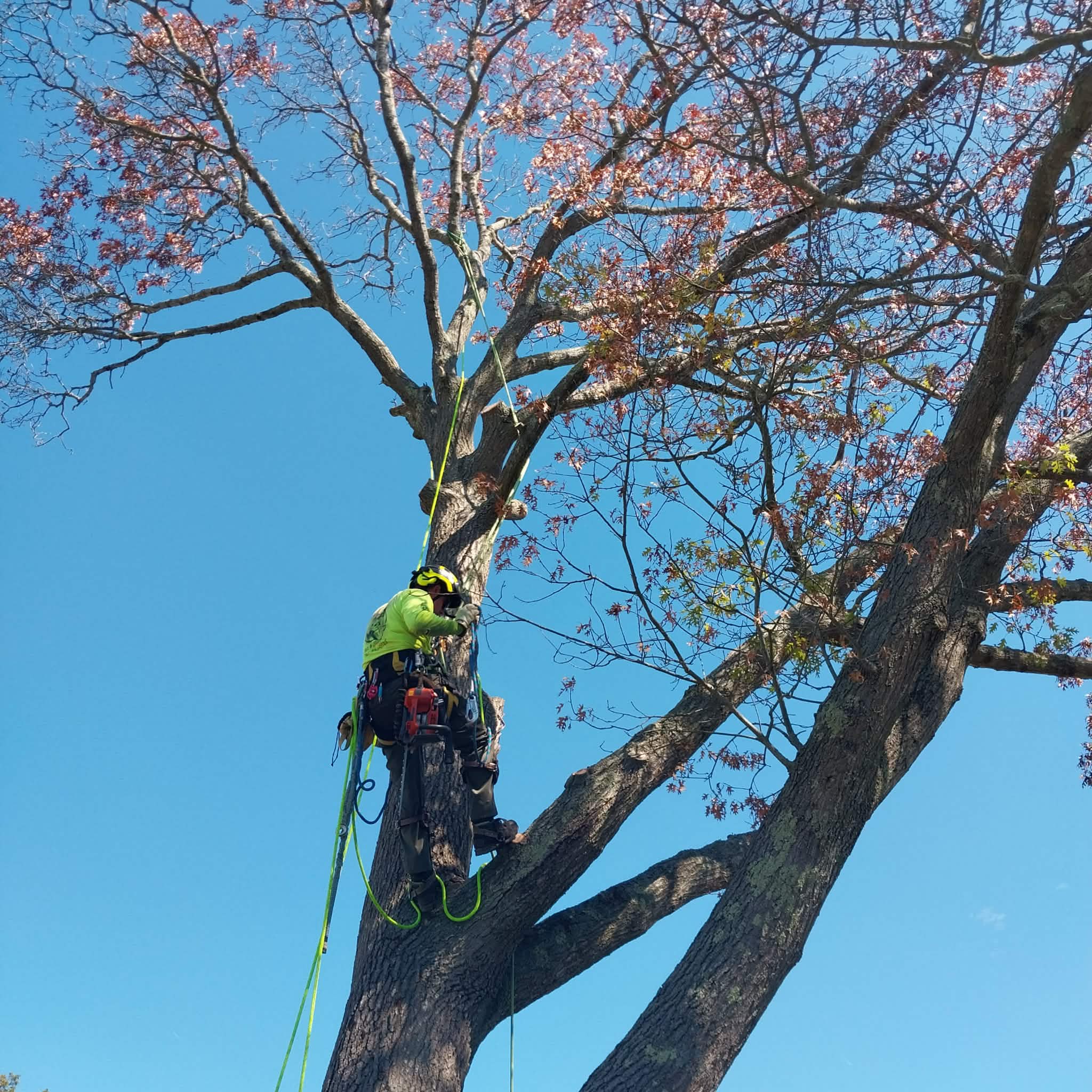
# Professional Tree Cabling in Bridgewater, Massachusetts
If you own property in Bridgewater, Massachusetts, your trees face unique pressures from saturated soils around the Hockomock Swamp, aggressive wetland species, and decades-old shade trees lining historic streets. Tree cabling in Bridgewater MA provides essential structural support to prevent failures in these vulnerable trees, preserving your landscape without the expense of full removal. As ISA Certified Arborists at Southeast Arborist, LLC, we specialize in ANSI A300 compliant tree cabling and bracing across the South Shore, including your Bridgewater home in Plymouth County.
Bridgewater's 28,000 residents live amid wetland-bordered neighborhoods like Bridgewater Center, Scotland, and Lake Nippenicket, where red maples and swamp white oaks dominate. These trees often develop weak attachments from co-dominant stems or decay pockets, exacerbated by the town's iron-smelting history that cleared original hardwoods in 1656. Today, the Town Common boasts some of Plymouth County's oldest American elms, survivors of Dutch elm disease, but they require cabling to withstand ice storms and saturated root zones near river corridors.
Tree cabling Bridgewater MA services from Southeast Arborist target these issues head-on. We install high-strength steel cables or rods to stabilize split forks, leaning trunks, or overloaded branches in species like sugar maple, white pine, pin oak, river birch, and willow. This approach aligns with ANSI A300 standards, ensuring your cabling supports tree health while reducing liability on your Stanley Heights or Titicut property.
Homeowners in Bridgewater frequently call us after noticing cracks in bark or included bark unions—early signs of failure in aging street trees. Our cabling prevents branch drops that could damage roofs in the South Street Area or block drainage in Pratt Town. Unlike removal, cabling lets you retain mature canopy for shade and property value, often at half the cost.
We base operations in Plymouth and Cohasset, serving all of South Shore Massachusetts with a phone call to 508-369-5009. Our annual inspection program monitors cables for tension adjustments, vital in Bridgewater's wet climate where roots struggle in clay-heavy soils. Expect safer trees that endure nor'easters, preserving the character of your college town surrounded by wetlands.
Consider a large river birch on your Lake Nippenicket lot: its multiple leaders form a V-shaped crotch prone to splitting under wind loads. Our cabling distributes stress evenly, extending its life by decades. For red maples encroaching from Hockomock Swamp edges, we combine cabling with selective pruning to maintain clearance from your home.
Safety drives every project—our team uses certified climbing gear, ground anchors, and load calculations per International Society of Arboriculture guidelines. We've cabled hundreds of trees in Bridgewater, from Town Common elms to backyard willows, earning trust through proven results.
Ready to assess your trees? Contact Southeast Arborist at 508-369-5009 for a free consultation on tree cabling Bridgewater MA. Protect your investment in this historic Plymouth County town today.
Why Bridgewater Properties Need Tree Cabling
Your Bridgewater property sits in a landscape shaped by settlement in 1656, when farming and iron smelting stripped hardwood forests, leaving today's mix of planted shade trees and wetland regrowth. Saturated soils from Hockomock Swamp to the north cause root instability, especially in red maple swamps—one of southeastern Massachusetts' largest. Add aggressive wetland species encroachment and aging street trees with structural decay, and tree cabling Bridgewater MA becomes essential for your safety.
Common tree species like red maple and swamp white oak thrive in Bridgewater's wet, acidic soils but develop co-dominant stems that split under ice storm loads. American elms on the Town Common, among Plymouth County's oldest, survive Dutch elm disease yet show decay pockets from decades of stress. Sugar maples in Scotland and Titicut neighborhoods lean from shallow roots in clay-loam, while white pines in Pratt Town sway dangerously in winds channeling through the Taunton River valley.
Pin oaks along South Street Area streets form included bark unions, weak attachments where bark grows between stems, prone to failure during nor'easters. River birches near Lake Nippenicket drop heavy branches from layered growth, and willows along wetland edges topple easily due to root rot in standing water. Bridgewater's microclimate—humid summers, freeze-thaw cycles, and 50+ inches of annual precipitation—amplifies these risks.
Saturated soils near river corridors destabilize roots, a frequent issue post-storms in East Bridgewater-adjacent areas. Ice storms coat branches with 1-2 inches of ice, multiplying weight by 20 times and snapping uncabled forks. Encroaching red maples from Hockomock Swamp shade homes in Stanley Heights, clog drains, and compete with heritage oaks.
Without cabling, your trees risk catastrophic failure: a 40-foot white pine limb crashing onto your Bridgewater Center driveway, or a pin oak fork splitting onto power lines in Raynham-bordering zones. Cabling provides dynamic support, allowing natural movement while preventing splits—key for preserving mature trees that boost property values by 10-20% in wetland-fringed neighborhoods.
Practical advice for Bridgewater homeowners: Inspect your trees annually for vertical cracks, leaning trunks over 15 degrees, or deadwood exceeding 25% of canopy. In red maples, watch for fungal conks signaling internal decay; in willows, soft roots heaving from soil. Near Middleborough's swamp influences, test soil drainage—if water pools after rain, prioritize cabling for root-weakened species.
Southeast Arborist's ISA Certified Arborists evaluate these using resistograph probes and sonic tomography, confirming cabling needs before installation. Our work complies with ANSI A300 standards, targeting weak points without girdling trunks. This preserves Bridgewater's historic tree canopy, from Town Common elms to backyard sugar maples.
In nearby West Bridgewater, similar soils demand cabling for storm-prone river birches. Bridgewater's college town vibe means busy streets in Bridgewater Center—cabling prevents disruptions from falling limbs during Bridgewater State University events. Save costs long-term: cabling a mature swamp white oak costs less than emergency removal after failure.
Your property's trees contribute to Bridgewater's charm—protect them with professional tree cabling Bridgewater MA from Southeast Arborist. Dial 508-369-5009 to discuss your specific risks.
Our Tree Cabling Process in Bridgewater
Southeast Arborist delivers a precise, ANSI A300 compliant tree cabling process tailored to Bridgewater's wetland soils and species like red maple and American elm. As ISA Certified Arborists serving South Shore Massachusetts from Plymouth and Cohasset, we start with a site assessment on your property.
Step 1: Visual and Instrumented Evaluation (1-2 hours). Our team arrives with binoculars, mallets, and fracture-detecting tools to scan your trees. In Bridgewater Center, we check sugar maples for codominant leaders; near Lake Nippenicket, river birches get root plate analysis via inclinometer for lean angles. Resistographs drill micro-cores to map decay in swamp white oaks, while sonic tomography visualizes internal voids in white pines—critical for Hockomock Swamp-edge properties.
Step 2: Risk Assessment and Design (30 minutes on-site). Using ISA Best Management Practices, we calculate loads: a 50-foot pin oak fork might withstand 5,000 pounds uncabled but needs support for ice loads up to 10,000 pounds. Software models cable placement to avoid bark compression, spacing bolts 1/3 up the union height. For your Titicut willow, we design dynamic cabling allowing 10-15% sway.
Step 3: Preparation and Pruning (1-3 hours). We subordinate weak branches via reduction cuts, removing no more than 25% canopy per ANSI A300. In Pratt Town's saturated soils, ground crews stabilize with air spades to expose roots without damage. Safety protocols include traffic control for South Street Area jobs and spotters for overhead power lines common near Raynham.
Step 4: Cabling Installation (2-4 hours). Climbing arborists use rope access to drill 1-inch holes at precise angles, threading 1/4- to 1/2-inch galvanized steel cables or synthetic rods. Turnbuckles adjust tension to 5-10% of breaking strength, measured with dynamometers. In Stanley Heights American elms, we install loop systems around decay pockets; for Scotland red maples, multi-level cables brace V-crotches.
Equipment specifics: Petersen tree jacks lift heavy limbs during install; E-Z Lines provide temporary support. All hardware meets ASTM standards, with thimbles preventing cable wear. We avoid static bracing unless decay exceeds 50%—preferring flexible systems for Bridgewater's windy conditions.
Step 5: Bracing if Needed (add 1 hour). For severe leans in white pine, we install steel rods or nylon slings anchored to ground screws buried 4 feet in your clay soils. Load cells monitor distribution, ensuring even stress.
Step 6: Final Inspection and Documentation (30 minutes). We torque cables to spec, label installations with install date and inspection schedule, and provide a report with photos. Your annual program includes free re-tensions every 12-18 months, vital as trees grow 1-2 inches yearly.
Throughout, our team wears PFAS-rated harnesses, hard hats, and uses two-way radios. In Bridgewater's neighborhoods, we minimize disruption—no chainsaws before 8 AM, chipper debris recycled on-site.
This process saved a 60-year-old pin oak in Lake Nippenicket from removal, stabilizing its split trunk for under $1,500. Homeowner tip: Water deeply but infrequently post-install to encourage deep roots in saturated zones; mulch 3 inches around bases, keeping it 6 inches from trunks.
For tree cabling Bridgewater MA, trust Southeast Arborist's proven steps. Call 508-369-5009 to schedule your evaluation.
Common Tree Cabling Projects in Bridgewater Neighborhoods
Bridgewater neighborhoods present distinct cabling needs due to their proximity to wetlands, historic plantings, and soil types. In Bridgewater Center, we cable large American elms and sugar maples along Central Street, addressing co-dominant stems from 1800s plantings. These trees shade the Town Common but risk pedestrians during college events—our ANSI A300 cables support forks at 30 feet up.
Scotland's rural lots feature white pines destabilized by shallow roots in glacial till; we've installed multi-strand systems to prevent wind throw toward homes. Titicut properties near the Taunton River need cabling for river birches with layered branches, prone to ice storm snaps—we brace codominant trunks to maintain river views without hazards.
Pratt Town's older homes back onto swamp edges, where red maples encroach aggressively. Selective cabling stabilizes mature specimens while pruning subordinates invaders, preserving drainage. Stanley Heights sees pin oaks with decay pockets from road salt; our loop cabling encircles unions without drilling into rot.
South Street Area street trees—swamp white oaks and willows—demand cabling for overhead utility conflicts. We reduce sail effect via cabling and thinning, coordinating with National Grid. Lake Nippenicket waterfront homes require cabling for willows and river birches toppled by wave action and saturated banks; ground anchors supplement cables here.
Common projects include emergency cabling post-ice storms, like the 2023 event that split dozens of red maples. Heritage tree preservation on Town Common involves annual inspections for elms, using synthetic cables to mimic flexibility.
Southeast Arborist's ISA experts handle these with neighborhood-specific adaptations: lighter tensions in windy Lake Nippenicket, heavier bracing in clay-heavy Pratt Town. Call 508-369-5009 for your area's common fixes.
Tree Cabling Costs in Bridgewater, MA
Tree cabling costs in Bridgewater MA vary by tree size, defect severity, and access, but offer strong value over removal. Expect $500-$2,500 for a single mature tree—far below $3,000-$10,000 for takedowns of 50+ foot species like white pine or swamp white oak.
Key pricing factors: Diameter at breast height (DBH) drives costs—a 24-inch red maple in Bridgewater Center needs more cable than a 12-inch willow in Titicut, adding $200 per 6 inches DBH. Defect complexity: simple V-crotch cabling runs $600-$1,000; multi-level with decay bracing hits $1,500-$2,500.
Access matters—Stanley Heights sloped yards add $300 for rigging; Lake Nippenicket waterfronts require cranes at $500 extra. Species influence: softwood white pines drill easily ($800 average), while hard sugar maples demand specialized bits (+$200).
Our ANSI A300 installations include evaluation, pruning, and one-year warranty— no hidden fees. Annual inspections cost $150-$300/tree, preventing retension failures.
Value proposition: Cabling preserves 20-50 years of growth, maintaining shade that cools your home 10-15 degrees in Bridgewater summers, slashing AC bills. It boosts curb appeal in college-town neighborhoods, increasing resale by 5-10%. Insurance discounts of 5-15% apply for mitigated risks.
Compare: Removing a 40-foot pin oak in South Street Area exceeds $4,000 with stump grinding; cabling at $1,200 extends life indefinitely. For Hockomock-adjacent red maples, cabling plus clearing saves $2,000 vs. full clear-cut.
Homeowner savings tip: Bundle 2-3 trees for 20% discount; schedule off-peak (fall) to cut 10-15%. Southeast Arborist quotes transparently after free assessment.
Invest in tree cabling Bridgewater MA with us—call 508-369-5009 for your custom quote.
When to Schedule Tree Cabling in Bridgewater
Schedule tree cabling in Bridgewater MA during spring (April-May) or fall (September-October) to avoid peak growth when sap flow complicates drilling. These seasons precede storm risks—nor'easters peak November-March, ice storms January-February.
Urgency signs demand immediate action: cracks wider than 1/4 inch in bark, especially V-crotches on red maples; leans over 20 degrees in white pines; fungal shelves on swamp white oaks; or 30%+ deadwood in American elms. Post-storm leaning or soil heaving near river birches signals root failure from saturated soils—call within 48 hours.
Annual checks align with leaf-off winter for full visibility, but summer inspections spot heat-stressed willows. In Lake Nippenicket, schedule before boating season to clear hazards.
Don't delay: A split pin oak can drop 10 tons of wood. Contact Southeast Arborist at 508-369-5009 now for timely protection.
Frequently Asked Questions About Tree Cabling in Bridgewater
What is tree cabling, and how does it help my Bridgewater trees? Tree cabling installs steel cables or rods in weak tree attachments, per ANSI A300 standards, to prevent splits in species like red maple or sugar maple. It supports without restricting growth, ideal for Bridgewater's aging elms.
How long does tree cabling last on my property? Properly installed cables endure 20-50 years with annual inspections. Southeast Arborist adjusts tensions as your white pine or willow grows, ensuring longevity in wet soils.
Is tree cabling cheaper than removal in Bridgewater MA? Yes—$800-$2,000 vs. $3,000+ for removal. Cabling preserves heritage trees on Town Common, saving costs and maintaining shade in Scotland neighborhoods.
Will cabling damage my red maple or swamp white oak? No, ISA Certified techniques use precise drilling and padding to avoid girdling. We target only 1-inch holes, less invasive than decay progression.
How do I know if my tree needs cabling in Titicut or Pratt Town? Look for codominant stems, included bark, or decay. Our free evaluation uses tools like resistographs for accurate diagnosis.
Can cabling prevent storm damage near Hockomock Swamp? Absolutely—it redistributes loads during ice storms, stabilizing roots in saturated areas. We've protected hundreds post-2023 events.
Do you offer maintenance for cabling in Bridgewater neighborhoods? Yes, our $200 annual program includes retensioning and reporting, essential for pin oaks in South Street Area.
Is tree cabling safe for properties near Lake Nippenicket? Yes, with ground anchors and certified gear. We minimize disruption, recycling debris on-site.
For more, call 508-369-5009.
Tree Cabling Throughout Bridgewater
Southeast Arborist provides tree cabling across all Bridgewater neighborhoods: Bridgewater Center's historic elms, Scotland's pines, Titicut's birches, Pratt Town's maples, Stanley Heights' oaks, South Street Area's streetside trees, and Lake Nippenicket waterfronts. We extend to nearby East Bridgewater, West Bridgewater, Raynham, and Middleborough.
As Plymouth/Cohasset-based ISA Certified Arborists, we're minutes away for fast response. Protect your trees—call 508-369-5009 today.