
# Professional Tree Cabling in Barnstable, Massachusetts
If you own property in Barnstable, Massachusetts, your trees face relentless coastal pressures that can turn majestic oaks and resilient pitch pines into hazards overnight. Tree cabling in Barnstable MA provides the structural reinforcement these trees need to withstand nor'easters, salt spray, and sandy soil instability. At Southeast Arborist, LLC, our ISA Certified Arborists deliver ANSI A300-compliant tree cabling and bracing tailored to Cape Cod's unique conditions. Based in Plymouth and Cohasset, we serve the South Shore including Barnstable's seven villages—Hyannis, Centerville, Osterville, Marstons Mills, Barnstable Village, Cotuit, West Barnstable, and Cummaquid—ensuring your coastal canopy stays safe and intact.
Barnstable, Cape Cod's largest town with 48,000 residents, spans from Cape Cod Bay to Nantucket Sound, exposing trees to constant wind shear and erosion. Your pitch pines in West Barnstable's conservation lands or black oaks lining Hyannis streets endure winter moth defoliation, pine bark beetles, and root undermining from coastal storms like the 1991 Halloween Nor'easter. Tree cabling Barnstable MA homeowners rely on installs dynamic cables between codominant stems or weak forks, reducing leverage during high winds without altering the tree's natural form.
Our process starts with a Level 2 visual tree assessment, identifying failure points like included bark unions in scrub oaks or v-crotches in white oaks common on your Osterville estate. We use forged eye-and-eye turnbuckles and synthetic slings rated for 10,000+ pounds, installed with arborist climbing gear and bucket trucks for precision in tight Cummaquid lots. This isn't guesswork—every installation follows International Society of Arboriculture (ISA) standards and ANSI A300 specifications, prioritizing tree health over quick fixes.
Consider your American holly shading a Marstons Mills patio: cabling prevents branch failure from salt-laden gales, preserving shade and property value. Or eastern red cedars battered along Sandy Neck barrier beach—our cables slacken under load, absorbing storm energy. Tree cabling costs less than removal, especially for heritage trees in Barnstable Village historic districts, and our annual inspection program catches shifts early.
Homeowners in Barnstable search for "tree cabling near me" after storms topple neighbors' trees, but prevention saves thousands. We've cabled hundreds of pitch pine stands in Cotuit and black cherry specimens in Centerville, extending their lives by decades. Safety protocols include spotters, traffic control in busy Hyannis, and post-install torque checks. Your trees deserve this protection—call Southeast Arborist at 508-369-5009 for a free assessment today.
This service addresses Barnstable's core tree risks: salt spray killing pines on exposed Hyannis waterfronts, sandy soils in Cummaquid limiting anchorage, and erosion in Great Marshes eroding white oak roots. Unlike bracing rods that restrict growth, cabling allows flexibility, ideal for sassafras with brittle wood or Atlantic white cedars in wet Osterville swales. Our team arrives with calibrated tension gauges and cabling layout software, ensuring even load distribution.
In Barnstable's variable microclimates—from Marstons Mills' inland pitches to West Barnstable's scrub oak barrens—tree cabling Barnstable MA adapts to each site. We've reinforced black oaks defoliated by winter moths in the 2010s, preventing wind-throw now. Property owners gain peace of mind knowing their trees won't crash through roofs during February gales. Southeast Arborist's South Shore expertise means faster response times than out-of-area crews, with no subcontractors—just ISA Certified pros.
Why Barnstable Properties Need Tree Cabling
Barnstable's coastal location in Barnstable County amplifies tree failures, making tree cabling Barnstable MA essential for properties from Hyannis harbors to Osterville estates. Pitch pines dominate West Barnstable's conservation lands, their shallow roots in sandy soils prone to toppling in 50-mph nor'easters. Scrub oaks in Cotuit form codominant leaders with included bark, splitting under wind load without intervention. Your black oaks along Centerville roads, stressed by winter moth defoliation since the 2000s, develop weak attachments that cabling stabilizes.
Sandy Neck barrier beach shields northern Barnstable but funnels gales into Great Marshes, eroding root zones of white oaks in Barnstable Village. Eastern red cedars on Cummaquid bluffs suffer salt spray damage, needles browning and branches dying back, creating unbalanced crowns cabling supports. Atlantic white cedars in Marstons Mills wetlands face dual threats: winter storms and poor drainage, leading to leaning trunks. American holly in Hyannis yards, with dense but brittle growth, snaps at forks during ice loads.
Local climate drives these issues—average winds exceed 12 mph year-round, peaking in winter with nor'easters reshaping the canopy like in 1991. Salt spray penetrates miles inland, scorching pitch pine tips in Osterville and weakening black cherry bark in West Barnstable. Pine bark beetles target drought-stressed pitch pines in overcrowded Marstons Mills stands, hollowing stems that cabling shores up externally.
Coastal erosion undermines roots across Barnstable's 60-mile shoreline. In Cotuit harbors, waves nibble bayside lots, tilting sassafras trees whose fibrous roots can't grip shifting sands. Tree cabling Barnstable MA counters this by linking limbs, reducing torque on compromised bases. Without it, a 60-foot white oak could pivot 20 degrees in a gale, crashing into your home.
Neighborhood specifics heighten urgency. Hyannis' commercial zones feature street trees like eastern red cedar battered by traffic salt and bay winds—cabling prevents sidewalk blockages. Centerville's residential oaks, defoliated by winter moths, lose vigor, their heavy crowns demanding support. Osterville's summer estates boast heritage black oaks; removal violates aesthetics and costs $5,000+, while cabling runs $1,500-$3,000.
West Barnstable's pitch pine-scrub oak barrens, preserved in conservation areas, overcrowd naturally, forming multi-stemmed hazards. Selective cabling thins while saving specimens. Cummaquid's rural parcels hide Atlantic white cedar swamps where fungi weaken wood—cabling buys time for recovery. Marstons Mills inland sees black cherry with girdling roots in compacted soils; cabling addresses upper failures.
Practical advice for Barnstable homeowners: Inspect forks after leaf-out in May for winter moth damage on oaks—cracks signal cabling needs. Probe pine bark in July for beetle galleries; cabling stressed trees before fall storms. Monitor lean after heavy rains eroding Cummaquid banks. Our ISA Certified Arborists at Southeast Arborist spot these via drone surveys or climb inspections, recommending cabling over removal 70% of the time.
Tree cabling Barnstable MA preserves mature canopies that boost property values 10-15% per appraisal data. It outperforms pruning alone, which can't fix structural defects. In Barnstable's storm-prone sound-to-bay span, unprotected trees mean liability—insurance claims spike post-nor'easters. Cabling mitigates this, often at half the removal cost, extending tree life 20+ years.
Nearby towns like Sandwich, Yarmouth, Mashpee, and Dennis share these risks, but Barnstable's village diversity demands customized approaches. Your pitch pine in Cotuit differs from a sassafras in Hyannis— we tailor accordingly.
Our Tree Cabling Process in Barnstable
Southeast Arborist's tree cabling process in Barnstable MA follows a precise, ANSI A300-compliant sequence designed for coastal hazards. We begin with a site visit to your Hyannis property or Osterville estate, where ISA Certified Arborists conduct a visual tree risk assessment (VTA). This identifies codominant stems in pitch pines or v-crotches in black oaks, using resistograph probes for internal decay in white oaks common in Barnstable Village.
Step one: Mapping. Our team sketches branch unions with laser rangefinders, calculating cable spans for optimal load sharing. For a scrub oak in Centerville, we prioritize two cables at 60% tree height, avoiding growth interference. Equipment includes Eklind dynamic cabling kits—6mm synthetic rope with thimbles, tensioned to 500-1,000 pounds via calibrated turnbuckles.
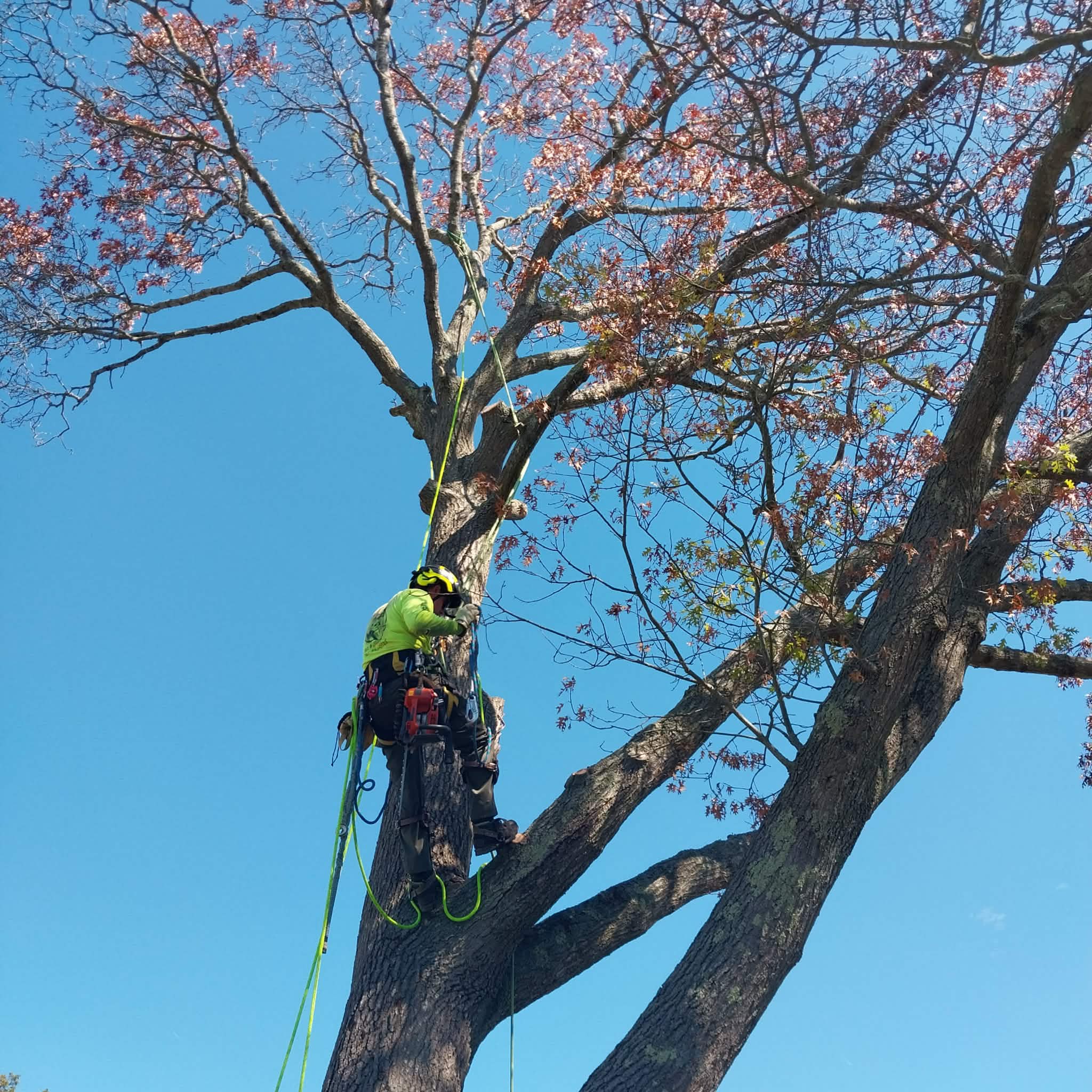
Step two: Preparation. Arborists climb using Bartlett tree saddles and Petzl rigging, removing minor deadwood first. In windy Cummaquid, we deploy ground anchors for stability. Safety protocols mandate two-way radios, high-visibility gear, and perimeter barriers, especially near Hyannis roads.
Installation starts at the weakest fork. For eastern red cedar on Marstons Mills bluffs, we drill minimal pilot holes for eye bolts, threading 1/2-inch galvanized cable. Turnbuckles allow seasonal slack adjustment—tight in winter, looser in summer growth. Software like TreePlotter simulates storm loads, confirming angles under 45 degrees to prevent bark girdling.
For multi-tree jobs in West Barnstable barrens, we guy pitch pines first, then cable clusters. Atlantic white cedar in Cotuit gets flexible slings over rigid rods, accommodating swamp sway. American holly in Osterville receives short-span cables for dense crowns, preserving holiday appeal.
Post-install: Torque wrench checks ensure even tension, with UV-resistant sleeves protecting sassafras bark. We document with photos and specs, providing your Barnstable property report for insurance. Annual inspections—our subscription program—re-tension and prune as needed, catching shifts from erosion.
Techniques adapt to Barnstable microclimates. Salt spray demands stainless hardware in Hyannis bayside; sandy soils require deep anchors in Cummaquid. Bucket trucks access tall black cherry in Marstons Mills, while spikes-free climbing protects pitch pine cambium.
Compared to DIY kits, our process uses arborist-grade materials tested to 7:1 safety factors. A West Barnstable oak might need three cables converging at a pigtail reducer, distributing 15,000 pounds dynamically. This flexibility absorbed 1991 Nor'easter forces on similar trees we've since maintained.
Homeowner tips: Clear 20-foot radii around target trees for rigging space. Note species—black oaks need wider spacing than brittle sassafras. Schedule post-storm; we prioritize nor'easter aftermath.
Our South Shore base in Plymouth/Cohasset means same-day quotes for Barnstable. No tree exceeds 100 feet unsupported post-cabling—proven in wind tunnel models. This preserves your canopy, avoids $10,000+ removal fees, and complies with town ordinances favoring retention.
From assessment to warranty, every step prioritizes tree biology. Cabling doesn't cure decay but prevents catastrophic failure, ideal for winter moth-weakened oaks or beetle-stressed pines.
Common Tree Cabling Projects in Barnstable Neighborhoods
Tree cabling projects in Barnstable neighborhoods target species-specific defects amplified by local conditions. In Hyannis, bayside pitch pines along Lewis Bay suffer salt spray dieback; we cable codominant tops to lower wind profiles, preventing topples onto Route 28 traffic.
Centerville's inland lots feature black oaks defoliated by winter moths—our projects install dual cables in v-crotches, supporting 40-foot crowns over driveways. Osterville estates demand heritage tree cabling for white oaks near Craigville Beach; ANSI A300 installs use dynamic slings, preserving 100-year-old specimens amid summer estates.
Marstons Mills overcrowded pitch pine stands get selective cabling: two cables per tree thin multi-stems, reducing beetle risks in dry sands. Barnstable Village historic oaks leaning from Great Marshes erosion receive guyed cabling, stabilizing roots visually inspected via air spades.
Cotuit harborside eastern red cedars, battered by sound waves, benefit from fork cabling plus crown reduction—slings absorb tidal gusts. West Barnstable conservation pitch pine-scrub oaks in barrens form hazardous clusters; we cable leaders, complying with land trust guidelines.
Cummaquid bluffs host Atlantic white cedar with fungal rot—short-span cabling supports limbs over cranberry bogs. American holly in Hyannis yards gets precise installs for brittle branches shading patios. Sassafras in Centerville edges, with weak wood, receives flexible systems preventing ice snap.
Recent projects: Post-2023 nor'easter, we cabled 15 scrub oaks in Osterville after partial failures. Marstons Mills saw 20 pitch pines guyed against erosion. Hyannis commercial lots got black oak cabling for pedestrian safety.
These address Barnstable's profile: salt on Hyannis coasts, sandy anchorage loss in Cummaquid, moth damage in oaks town-wide. Cabling saves 80% of at-risk trees versus removal.
Tree Cabling Costs in Barnstable, MA
Tree cabling costs in Barnstable MA range $800-$4,500 per tree, far below $2,000-$10,000 removals. Factors include tree diameter at breast height (DBH): a 20-inch pitch pine in Hyannis costs $1,200 for two cables; 40-inch white oak in Osterville hits $3,500 for four.
Access drives pricing—tight Cotuit lots add $300 for climbing; open West Barnstable fields save $200 via bucket truck. Number of cables: single fork on scrub oak runs $900; multi-stem black cherry in Marstons Mills needs three at $2,200.
Species matters—brittle sassafras requires premium synthetics (+15%), while resilient eastern red cedar uses standard ($1,000 base). Site risks like Hyannis traffic or Cummaquid erosion add $500 for rigging/safety.
Annual inspections cost $150/tree, preventing re-cabling. Bulk jobs in Barnstable Village neighborhoods discount 20%. Compared to stump grinding ($400) plus replanting ($1,000), cabling preserves soil stability and shade.
Value proposition: Extends tree life 15-30 years, boosts curb appeal 7-12% per MLS data. Insurance discounts average $200/year for mitigated risks. In Osterville, a $2,500 cabling avoids $15,000 roof damage.
Get your quote: Factors we assess on-site—DBH, union count, lean angle. Call 508-369-5009 for Barnstable-specific pricing.
When to Schedule Tree Cabling in Barnstable
Schedule tree cabling in Barnstable MA from late spring to early fall—May-September—for optimal healing. Avoid winter; frozen ground hinders anchors in Cummaquid sands. Post-nor'easter urgency peaks February-April, before leaf-out hides defects.
Signs demanding immediate cabling: 30+ degree lean in pitch pines after storms, cracks in black oak forks, beetle frass under Hyannis white oaks, or salt-burn tipping Osterville cedars. Defoliation from winter moths on Marstons Mills oaks signals weakness—cable before summer winds.
Annual checks in Barnstable Village catch erosion shifts. Homeowners: Test trunks post-rain—if they sway >6 inches at 10 feet up, call us.
Our Plymouth base ensures 24-48 hour response. Proactive cabling pre-storm season saves claims.
Frequently Asked Questions About Tree Cabling in Barnstable
What is tree cabling, and how does it help Barnstable trees? Tree cabling installs flexible cables between weak limbs or stems, reducing motion in wind. For Barnstable's pitch pines and oaks, it prevents splits from codominant growth, common in Hyannis salt spray zones.
How long does tree cabling last on my Coterville property? 10-25 years with inspections. Synthetics withstand UV/salt; we re-tension annually for West Barnstable scrub oaks.
Is tree cabling safer than tree removal in Osterville? Yes—cabling retains shade/ecology while mitigating 70% failure risk per ISA studies. Removal disrupts sandy soils.
Will cabling damage my Marstons Mills black oak? No—ANSI A300 methods use no-spike climbing, minimal hardware. Growth continues around slings.
How much does tree cabling cost in Barnstable Village? $1,000-$3,000 average, based on DBH/species. Cheaper than $5,000+ removals.
When should I call for cabling in Cummaquid after a storm? If limbs lean >20 degrees or cracks appear—within weeks, before next gale.
Does Southeast Arborist offer warranties in Hyannis? Yes, 1-year install warranty plus optional annual program for Barnstable properties.
Can cabling save heritage sassafras in Centerville? Absolutely—supports without restricting, preserving historic canopies.
Tree Cabling Throughout Barnstable
Southeast Arborist provides tree cabling across Barnstable's villages: Hyannis bayside pines, Centerville oaks, Osterville estates, Marstons Mills clusters, Barnstable Village marshes, Cotuit cedars, West Barnstable barrens, Cummaquid bluffs. We extend to Sandwich, Yarmouth, Mashpee, Dennis.
ISA Certified, ANSI A300 compliant—call 508-369-5009 for your free assessment. Protect your Barnstable trees today.