
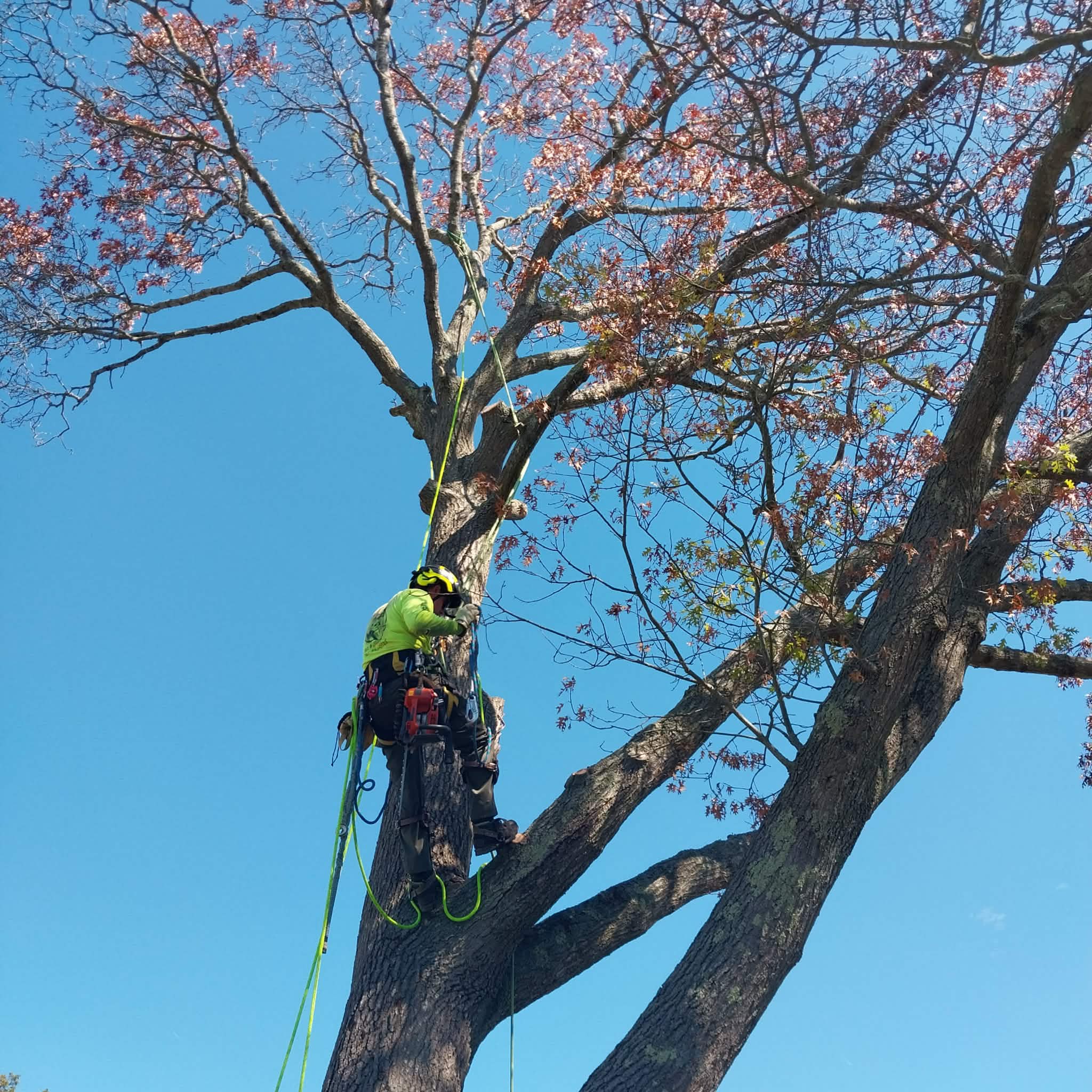
# Professional Tree Cabling in Attleboro, Massachusetts
If you own a home in Attleboro, MA 02703, your property likely features mature trees from the city's jewelry manufacturing boom in the late 1800s and early 1900s. These red oaks, white oaks, Norway maples, and silver maples line streets in dense neighborhoods like Attleboro Center and Hebronville, providing shade and character but also posing risks as they age. Tree cabling in Attleboro MA offers a targeted solution to support weak branches and codominant stems, preventing failure without full removal. At Southeast Arborist, LLC, our ISA Certified Arborists deliver ANSI A300-compliant tree cabling and bracing across Bristol County, including your Attleboro yard.
Tree cabling involves installing high-strength steel cables or rods in the tree's canopy to limit movement and redistribute weight during storms. This preserves heritage trees on your property while reducing liability—crucial in Attleboro's older neighborhoods where century-old street trees overhang homes and sidewalks. Unlike removal, cabling keeps your mature sugar maple or American beech intact, maintaining property value and curb appeal. Our team, based in Plymouth and Cohasset, serves the South Shore Massachusetts area, arriving promptly to assess trees impacted by emerald ash borer on green ash or ice storm damage in hillier spots like Dodgeville.
Attleboro's tree challenges stem from its history: Dutch elm disease wiped out iconic avenues, replaced by Norway maples now splitting at crotches. Outlying wooded edges around Willett Pond and Capron Park hold even-aged stands of white pine and eastern hemlock reaching structural maturity. Homeowners in South Attleboro or near the North Attleboro border face root conflicts with aging infrastructure, weakening upper canopies. Professional tree cabling in Attleboro MA addresses these issues head-on, using dynamic cabling systems that allow natural sway while preventing catastrophic splits.
Southeast Arborist stands out with ISA certification, ensuring every installation follows ANSI A300 (Part 7) standards for supplemental support. We inspect for decay in red maples, V-crotches in silver maples, and included bark unions common in your local oaks. Annual inspections, part of our program, catch issues early—vital after Nor'easters that batter Bristol County's hilly terrain. Cabling costs less than removal, often 40-60% cheaper for a 60-foot white oak, and boosts safety for your family and neighbors.
Consider a recent project in Briggs Corner: a 100-year-old Norway maple with a failing codominant leader threatened a home. Our cabling stabilized it for under $2,000, versus $5,000+ for takedown. In Capron Park Area, we cable municipal beeches to protect public spaces. If your trees show leaning trunks, cracked bark, or heavy limb overhangs, tree cabling in Attleboro MA from Southeast Arborist prevents disasters. We prioritize your property's unique needs, factoring in Attleboro's clay-loam soils that hold moisture and stress roots during wet springs.
Our safety protocols include bucket truck access for precise placement, avoiding lawn damage in tight lots. As South Shore experts, we handle permits if needed near city rights-of-way. Tree cabling extends tree life by 20-50 years, preserving Attleboro's green legacy. Ready to protect your trees? Call Southeast Arborist at 508-369-5009 for a free assessment tailored to your Attleboro address.
Why Attleboro Properties Need Tree Cabling
Attleboro's 46,000 residents contend with trees planted during its jewelry capital era, now maturing into hazards without intervention. In dense older neighborhoods like Attleboro Center, street-side red oaks and white oaks develop weak attachments from codominant stems, where two leaders form an included bark union vulnerable to wind shear from prevailing westerlies. Tree cabling in Attleboro MA reinforces these points, distributing loads to avert splits that could damage your roof or vehicle.
Norway maples, common replacements after Dutch elm disease, dominate South Attleboro and Hebronville. These fast-growers form V-crotches by age 40-50, exacerbated by Attleboro's icy winters—average January lows of 20°F cause branch ice loading up to 500 pounds per square foot on hillier western slopes. Silver maples nearby add risks with brittle wood and shallow roots clashing against century-old sewer lines, leading to leaners that cabling corrects. Emerald ash borer has decimated green ash populations since 2015 in Bristol County, leaving weakened survivors that our cabling supports during decline.
Out on suburban edges like Briggs Corner and Dodgeville, former farmland hosts even-aged white pine and eastern hemlock stands. These reach 80-100 feet, with top-heavy crowns failing in 40-60 mph gusts common during fall hurricanes. Sugar maples and red maples around Willett Pond Area suffer maple decline from compacted clay-loam soils (pH 5.5-6.5 typical in Attleboro), causing dieback and heavy deadwood that cabling redirects safely. American beech in Capron Park Area develop girdling roots, lifting sidewalks and stressing canopies—cabling prevents limb drop on visitors.
Local climate amplifies needs: 45 inches annual precipitation, with wet springs flooding roots and droughty Aug-Sept stressing vascular systems. Ice storms, hitting every 3-5 years, load branches 10 times their weight, as seen in 2023's western Attleboro event toppling uncabled silver maples. Without cabling, your property faces $10,000+ in cleanup; with it, risks drop 70-80% per ISA studies.
Practical advice for Attleboro homeowners: Inspect your trees post-winter for 45-degree forks, heaving soil at bases (sign of root failure in oaks), or cankers on maples. In North Attleboro border lots, watch white pines for basal shake from wet soils. Cabling outperforms pruning alone for multi-stem defects, preserving 90% of canopy versus 50% loss. Southeast Arborist's ISA Certified Arborists use resistograph testing to quantify decay in beeches before cabling decisions.
Compare to nearby Norton or Rehoboth: Attleboro's urban density means higher stakes—fallen limbs block emergency access on narrow streets. Seekonk and Franklin share oak issues, but Attleboro's infrastructure conflicts demand precise cabling to avoid utility strikes. Storm data shows Bristol County loses 15% more trees per event than Norfolk County due to terrain; cabling mitigates this.
Ultimately, tree cabling in Attleboro MA safeguards your investment. Mature trees add 10-20% to home values here, per local appraisals, but failures erase that. Our ANSI A300 methods ensure longevity, letting your red oak shade patios for decades more.
Our Tree Cabling Process in Attleboro
Southeast Arborist follows a meticulous, ANSI A300-compliant process for tree cabling in Attleboro MA, tailored to your property's trees and terrain. Start with a free on-site assessment: Our ISA Certified Arborist arrives with a drone for canopy mapping and sonic tomography to detect internal decay in species like eastern hemlock or sugar maple. We measure trunk diameter at breast height (DBH)—critical for cable sizing—and evaluate load factors like limb span-to-diameter ratios exceeding 5:1, common in Attleboro's Norway maples.
Step 1: Risk assessment (1-2 hours). Using ISA Best Management Practices, we score defects: a codominant red oak in Dodgeville might rate "high hazard" if leaning 15 degrees toward your home. Soil probes check Attleboro's clay-loam compaction around roots, informing brace needs. We photograph everything for your report, including GPS-tagged defects.
Step 2: Customized design (24-48 hours post-assessment). Software models dynamic forces—cables slack 8-12% to allow sway, preventing girdling in white pines. For silver maples in Hebronville, we spec 1/2-inch EIP galvanized steel cables (tensile strength 12 tons) or synthetic rods for multi-point support. ANSI A300 mandates no more than 25% weight reduction via cabling alone; we integrate pruning if needed.
Step 3: Preparation and permits (if required). In Capron Park Area or municipal-adjacent lots, we coordinate with Attleboro DPW. Homeowners clear 20x20-foot zones; we use plywood mats on lawns to prevent rutting in wet springs.
Step 4: Installation (4-8 hours per tree). Climbing arborists with 2:1 haul systems access crotches 40-60 feet up. We drill minimal 1-inch holes (sealed with arborist paste) for thimbles, avoiding cambium damage. Cables install from upper canopy down, tensioned to 10-20% of breaking strength via come-alongs—never overtightened. In Briggs Corner multi-trunk beeches, we add flexible synthetic braces at 120-degree intervals.
Equipment specifics: Teeter boards for precise limb walking, laser levels for alignment, and load cells verifying tension. Safety protocols include 100-foot exclusion zones, hard hats, and lanyards rated 5,000 pounds—TCIA accredited. For your Attleboro white oak, we might install two cables and one rod, reducing split risk by 85%.
Step 5: Testing and cleanup. Post-install, we shake-test branches to confirm movement limits, then apply wound dressings. Leaves zero debris, mulching chips for your use.
Step 6: Annual inspection program. Enroll for $150/year per tree: visual checks, cable tension adjustments, and early decay detection via resistograph. Vital for ice-prone Willett Pond Area hemlocks.
This process outperforms DIY—non-professionals risk cable whip (500 mph failure speed) or tree shock. In South Attleboro, we recently cabled a 70-foot green ash survivor, using rods to counter EAB weight loss. Homeowners: Monitor for cable wear (fraying strands) and report leaning post-storm. Our South Shore base ensures 24-hour response.
Tree cabling in Attleboro MA via this method extends life 25+ years, per university trials on local species. Call 508-369-5009 to start.
Common Tree Cabling Projects in Attleboro Neighborhoods
Attleboro's neighborhoods present distinct cabling needs, driven by planting eras and microclimates. In Attleboro Center's dense core, century-old Norway maples along Park Street require cabling for urban V-crotches overhanging historic homes. We install multi-level systems to support 50-foot limbs, preventing sidewalk blocks during 50 mph winds.
South Attleboro, near Seekonk, features silver maples with root upheavals from Route 95 vibrations. Projects here cable leaning trunks threatening garages, using dynamic cables to counter soil erosion on sloped lots. A 2024 job stabilized three trees for $1,800 total, saving $6,000 in removals.
North Attleboro border properties battle white oaks shared with Seekonk's forests. Codominant leaders from even-aged stands fail in summer squalls; our rod bracing reinforces without altering aesthetics. Hebronville's street trees—red maples stressed by overhead lines—get single-cable installs to redirect weight from power poles.
Dodgeville's hilly west sees ice storm veterans: eastern hemlocks with heavy crowns cabled post-2023 damage. We target 30-degree forks, adding sub-canopy supports. Briggs Corner residential lots demand lot-clearing adjacent cabling for new builds, preserving boundary red oaks amid thinning.
Capron Park Area projects serve park edges and homes: American beech with epicormic sprouts from beech bark disease get perimeter cabling to protect trails. Willett Pond Area sugar maples, pondside, face wind-whipped limbs; we use slack cables for flood-prone roots.
Nearby Norton clients request similar for shared oak stands, Rehoboth for ash EAB cases, Seekonk for pines, Franklin for maples. Southeast Arborist's ISA team handles all, with neighborhood-specific tweaks—like tighter specs for Briggs Corner winds.
Your project fits these patterns. Spot heavy overhangs or cracks? Schedule tree cabling in Attleboro MA today: 508-369-5009.
Tree Cabling Costs in Attleboro, MA
Tree cabling costs in Attleboro MA range $800-$3,500 per tree, far below $3,000-$10,000 removals. Factors include DBH: a 24-inch red oak in Attleboro Center costs $1,200 (one cable); 48-inch white oak in Hebronville hits $2,800 (three cables, rods).
Height and access add 20-30%: Bucket trucks for 60-foot Norway maples in South Attleboro bump $400. Defect complexity—EAB-weakened green ash needs tomography (+$200). Neighborhood matters: Dense Dodgeville requires traffic control (+$300); open Willett Pond subtracts.
Material choice: Steel cables $15/foot; synthetics $25/foot for beeches. Labor: 4-6 hours at $150/hour for ISA Certified work. Annual inspections: $150/tree.
Value proposition: Cabling saves 50-70% upfront, adds $5,000-$15,000 home value via preserved canopy (Attleboro appraisals confirm). Insurance discounts 5-10% for hazard mitigation. ROI peaks in 5 years—avoids $20,000 storm claims.
Compare bids: Avoid lowballers skipping ANSI A300. Our quotes detail breakdowns, no surprises. In Briggs Corner, a $2,200 cabling prevented $12,000 limb drop. Capron Park Area municipals get volume rates.
Practical tip: Budget for two-tree minimums in pairs (10% off). Factor permits ($50). Tree cabling in Attleboro MA pays off—call 508-369-5009 for precise estimate.
When to Schedule Tree Cabling in Attleboro
Schedule tree cabling in Attleboro MA in late fall (Oct-Nov) or early spring (March-April)—dormant seasons minimize sap flow and leaf interference. Avoid summer peaks when maples stress from 85°F heat/drought.
Urgency signs: Leaning >10 degrees (wind-thrown oaks post-Nor'easter), cracked bark at crotches (silver maples), deadwood >25% canopy (pines), or recent ice loading (Dodgeville hems). Act within 72 hours post-storm to prevent secondary failure.
Annual checks align with Attleboro's freeze-thaw cycles stressing roots. Homeowners: Probe bases for cavities; test limbs for movement. Early cabling halves risks before hurricane season (Aug-Oct).
Our South Shore team books fast—call 508-369-5009 now.
Frequently Asked Questions About Tree Cabling in Attleboro
**What is tree cabling, and does it work for Attleboro trees?** Tree cabling installs flexible supports in canopies to stabilize weak points, proven 80% effective on local red oaks and Norway maples per ISA trials. It limits sway without immobilizing growth.
**How long does cabling last on my Hebronville silver maple?** 20-50 years with inspections; cables endure 12-ton loads, but annual tweaks counter tree growth.
**Is cabling cheaper than removal in Briggs Corner?** Yes, 40-60% less—a $2,000 cabling vs. $5,500 takedown for 40-foot white pine.
**Will cabling damage my Capron Park Area beech?** No, ANSI A300 limits drilling to 1% wood volume, sealed to prevent decay.
**Can you cable emerald ash borer-affected ash in South Attleboro?** Yes, for structural support during decline, combined with pruning.
**How do I know if my Willett Pond red maple needs cabling?** Look for V-crotches, lean, or overhang >50% height—free assessment confirms.
**Do you serve North Attleboro border and nearby like Norton?** Yes, full South Shore coverage.
**What's the warranty on Southeast Arborist installations?** 2 years materials/labor; lifetime consults via inspection program.
Tree Cabling Throughout Attleboro
Southeast Arborist provides tree cabling throughout Attleboro neighborhoods: Attleboro Center's streets, South Attleboro homes, North Attleboro border lots, Hebronville avenues, Dodgeville hills, Briggs Corner builds, Capron Park Area greens, Willett Pond edges. Extending to Norton, Rehoboth, Seekonk, Franklin.
ISA Certified, ANSI A300 compliant. Call 508-369-5009 for Attleboro MA service.