
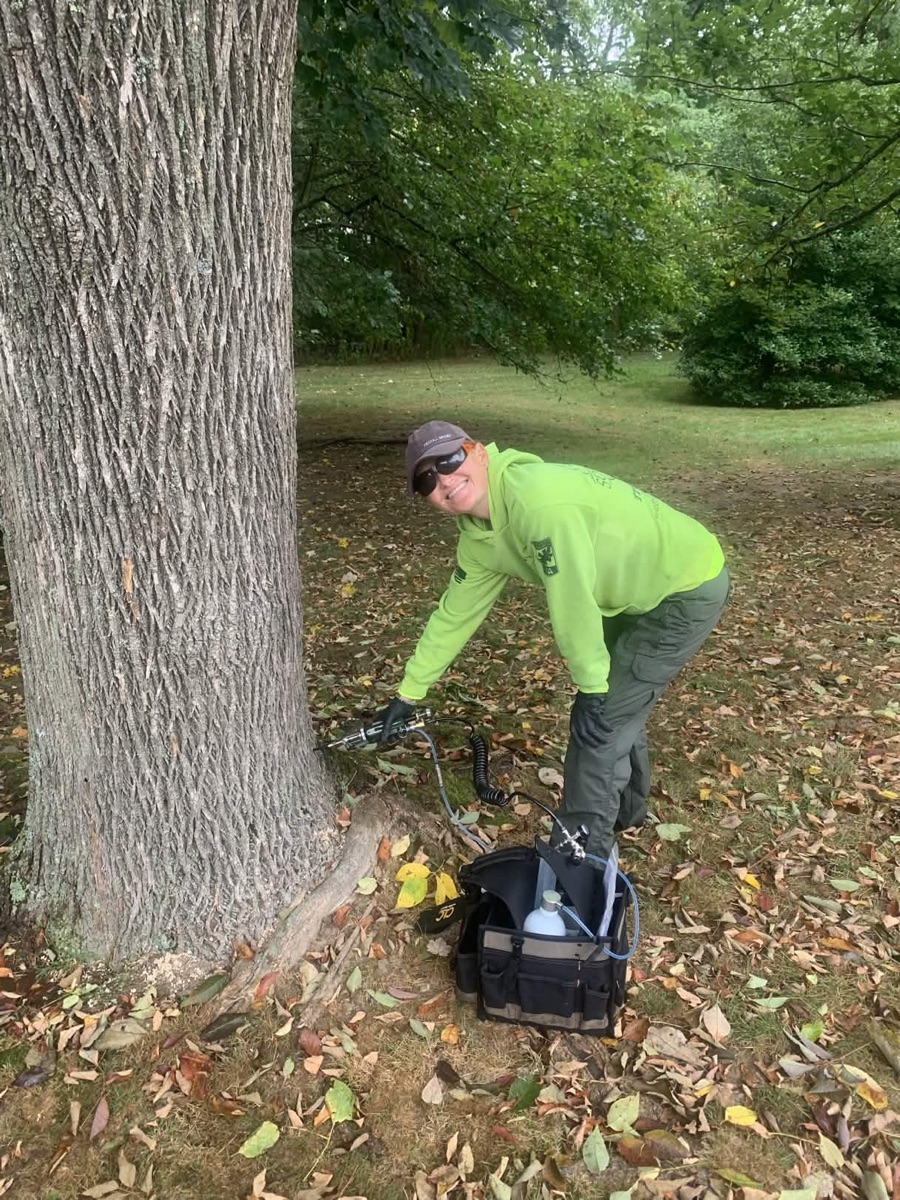
# Professional Arborist Consultation in Sharon, Massachusetts
As a homeowner in Sharon, Massachusetts, your property likely features mature trees like red oaks and white pines that define the town's upscale wooded character. These trees enhance curb appeal, provide shade, and support local wildlife, but they also present unique risks in a suburb surrounded by conservation land like the Moose Hill Wildlife Sanctuary. An arborist consultation in Sharon, MA, from Southeast Arborist delivers ISA Certified expertise to assess tree health, identify hazards, and provide written reports tailored to your needs.
Southeast Arborist, LLC, based in Plymouth and Cohasset, serves the South Shore Massachusetts region, including Sharon in Norfolk County. Our ISA Certified Arborists follow ANSI A300 standards for tree care recommendations, ensuring assessments meet legal, insurance, and municipal requirements. Whether you live near Lake Massapoag or in the Moose Hill area, our consultations address local challenges such as hemlock decline from woolly adelgid and managing oak-hickory canopies around homes.
Sharon's 18,600 residents enjoy a landscape shaped by its oak-hickory forests, which extend from the 2,000-acre Moose Hill Wildlife Sanctuary into residential neighborhoods. Trees here, some over 200 years old, face pressures from shoreline erosion at Lake Massapoag, dense canopies overhanging structures, and the need to maintain wildlife corridors. An arborist consultation in Sharon, MA, evaluates these issues with precision, using tools like resistographs and aerial inspections to detect internal decay in shagbark hickories or structural weaknesses in sugar maples.
Homeowners request our services for pre-purchase inspections on properties in Sharon Heights, risk assessments near East Sharon power lines, or construction impact plans in Upland Road developments. We prioritize safety with protocols that include ground-based visual assessments, drone surveys for tall white pines, and soil probe testing for root health in Norfolk County's clay-loam soils. Our written reports include prioritized maintenance plans, cost estimates, and compliance notes for Sharon's active tree warden program.
In Sharon Center, 19th-century elms and maples line streets, requiring evaluations for disease resistance. Lakefront properties in the Massapoag area need shoreline tree preservation to prevent erosion while opening vistas. Southeast Arborist's arborist consultation in Sharon, MA, empowers you to protect these assets, potentially saving thousands in emergency removals. Call 508-369-5009 today to schedule your consultation and receive a detailed report customized to your Sharon property.
This service goes beyond basic inspections. We integrate local context, such as Sharon's Zone 6b climate with wet springs and dry summers, which stresses American beeches and eastern hemlocks. Our experts identify early signs of black birch decline or pignut hickory codling moth damage, offering proactive solutions. With rising insurance claims from falling limbs in wooded suburbs, a professional arborist consultation in Sharon, MA, provides documentation that lowers premiums and strengthens claims.
Southeast Arborist commits to Sharon's ecological health, aligning recommendations with the town's urban forestry inventory. Your consultation includes digital mapping of tree risks, species-specific care advice, and follow-up support. Don't wait for a storm to expose vulnerabilities—secure your investment with ISA Certified arborist consultation in Sharon, MA, from Southeast Arborist.
Why Sharon Properties Need Arborist Consultation
Sharon, MA 02067, stands out in Norfolk County for its mature forest canopy, blending upscale residential areas with conservation lands like Moose Hill Wildlife Sanctuary. Your trees—red oaks dominating Sharon Center lots, white pines screening Sharon Heights homes—thrive in the town's acidic, well-drained soils but face specific stressors. An arborist consultation in Sharon, MA, identifies these before they escalate into costly hazards.
Local climate plays a key role. Sharon's humid continental conditions, with average January lows of 18°F and July highs of 83°F, promote fungal pathogens in sugar maples during wet springs. Eastern hemlocks along Lake Massapoag suffer woolly adelgid infestations, exacerbated by mild winters that allow two generations per year. Without an arborist consultation, you miss early hemlock decline, leading to branch drop on shoreline paths.
Common tree species amplify these risks. Red oaks, prevalent in Moose Hill neighborhoods, develop oak wilt from native sap beetles, spreading via root grafts in dense stands. White oaks in East Sharon show armillaria root rot in compacted soils near roads. Shagbark hickories in Ames Street areas crack under ice loads, their bark sloughing reveals decay. Pignut hickories near Upland Road host codling moths, weakening leaders. Sugar maples in town center plantings exhibit verticillium wilt, while American beeches in conservation edges battle beech bark disease. White pines drop needles from white pine weevil, and black birches split in windstorms due to included bark.
Managing mature forest canopy around residential structures demands arborist consultation in Sharon, MA. In Sharon's wooded suburbs, oaks and hickories overhang roofs, with canopies interconnecting across property lines. This creates shared risks, especially during nor'easters that hit the South Shore. Properties near Moose Hill require hazard tree assessments for 100-foot oaks leaning toward homes, their root plates destabilized by wildlife trails.
Shoreline tree preservation at Lake Massapoag presents another challenge. Lakefront homes in the Massapoag neighborhood lose soil to wave action, exposing roots of black birches and white pines. An arborist consultation evaluates stability, recommending cabling or selective thinning to maintain views without compromising shoreline integrity. This preserves erosion control while complying with Massapoag Lake Association guidelines.
Hemlock decline from woolly adelgid ravages eastern hemlocks in East Sharon and Moose Hill, turning once-vibrant stands gray. Infestations spread via deer and wind, killing trees within 5-10 years. Arborist consultation detects sooty mold and needle loss early, advising imidacloprid treatments or removals to protect adjacent white pines.
Maintaining wildlife corridor connectivity requires balance. Sharon's forests link Moose Hill Sanctuary to town properties, supporting species like eastern chipmunks and barred owls. Over-pruning disrupts this, so consultations prioritize selective thinning that retains habitat value.
Soil conditions in Norfolk County—sandy loams in uplands, heavy clays near the lake—lead to girdling roots on young maples in newer developments. Drought stress in Upland Road areas causes beech decline, with leaves browning by August. An arborist consultation in Sharon, MA, tests soil pH (ideally 5.5-6.5 for oaks) and moisture, recommending mulch rings to boost resilience.
Sharon's tree warden program tracks inventory, flagging high-risk trees. Homeowners benefit from consultations that align with this, providing reports for permits. Pre-purchase inspections in Foxborough-adjacent East Sharon reveal hidden defects in century-old hickories. Construction near Canton borders needs impact assessments to protect beeches during grading.
Insurance data shows tree-related claims spike 30% post-storm in wooded suburbs like Sharon. A Southeast Arborist consultation documents risks, prioritizing removals to cut premiums. Practical advice: Inspect co-dominant stems on young red oaks annually; if forks exceed 45 degrees, prune early. For Lake Massapoag properties, stake white pines loosely to prevent wind rock without girdling.
In summary, Sharon's unique blend of old-growth forests, lakefront exposures, and suburban density makes arborist consultation essential for protecting your property's value and safety.
Our Arborist Consultation Process in Sharon
Southeast Arborist delivers a structured arborist consultation process in Sharon, MA, using ISA Certified Arborists trained to ANSI A300 standards. We start with a site visit tailored to your property's layout, whether in compact Sharon Center or expansive Moose Hill acres.
Step 1: Initial Contact and Scheduling. Call 508-369-5009 to describe your concerns—overhanging shagbark hickory limbs or declining eastern hemlocks. We ask about property size, tree species, and urgency, scheduling within 48 hours for Sharon clients. Our service area covers South Shore Massachusetts, with quick response from Plymouth/Cohasset bases.
Step 2: On-Site Visual Assessment. Our arborist arrives with safety gear, including hard hats and high-visibility vests, per OSHA protocols. We walk your property, mapping trees via GPS apps. In Sharon Heights, we note red oak codominant leaders; near Lake Massapoag, we probe white pine roots for wetwood. Tools include binoculars for crown evaluation and mallets to tap trunks for hollow sounds in pignut hickories.
Step 3: Advanced Diagnostics. We deploy resistographs to core sample sugar maples without scarring, measuring decay in 0.5mm increments. Soil probes assess compaction around American beeches in East Sharon clays. Drones survey tall white pines in Upland Road, capturing 4K images of hemlock adelgid. Increment borers reveal growth rings on black birches, dating trees to 1800s Moose Hill extensions.
Step 4: Risk Evaluation. Using ISA Tree Risk Assessment Qualified Arborist (TRAQ) methods, we score trees on target value (your home), failure potential, and size of part. A red oak overhanging your Ames Street garage scores high if decay exceeds 40% in the buttress root. We factor Sharon's wind speeds—gusts to 60mph in nor'easters—and soil moisture from recent rains.
Step 5: Health Analysis. We diagnose species-specific issues: woolly adelgid on hemlocks via magnification; oak wilt vascular streaking in red oaks. Fungal mats under bark signal armillaria in white oaks. Nutrient tests check for maple decline in sugar maples, common in Norfolk loams deficient in magnesium.
Step 6: Written Report Preparation. Back at our office, we compile a 10-20 page PDF report with photos, diagrams, and ANSI-compliant recommendations. Sections cover risk ratings (low/medium/high), prioritized actions (e.g., prune included bark on young hickories first), and 5-year maintenance plans. Legal templates suit insurance or Sharon tree warden submissions.
Step 7: Review and Recommendations. We email the report within 72 hours, followed by a 30-minute call. For Massapoag lakefronts, we suggest vista pruning: remove 20% canopy selectively. Construction assessments include protection zones—12x trunk diameter for mature oaks.
Equipment enhances accuracy. Sonic tomographs map internal voids in Moose Hill beeches; air spades expose roots non-invasively for East Sharon properties. Safety protocols mandate two-person teams for heights over 20 feet, with first-aid kits and spill containment for probes.
Techniques follow best practices: No climbing without ropes during consultation; ground-based only unless specified. We integrate local data—Sharon's urban forest inventory—for context-aware advice.
Practical tips during consultation: Note your trees' ages; plant sugar maples with staking removed after year one to avoid codominant stems. For hemlocks, apply horticultural oil in April before egg hatch.
Southeast Arborist's process ensures your arborist consultation in Sharon, MA, yields actionable insights. Pre-purchase buyers in Sharon Center get defect disclosures; developers in Upland Road receive impact mitigation. Our ISA certification guarantees objectivity, with reports accepted by insurers like MAPFRE.
This thorough approach minimizes surprises, extending tree lifespans in Sharon's challenging environment. Schedule via 508-369-5009 for results you can trust.
Common Arborist Consultation Projects in Sharon Neighborhoods
Sharon neighborhoods each present distinct tree care needs, making targeted arborist consultation projects essential. Southeast Arborist customizes services for these areas, drawing on local species and conditions.
In Sharon Center, 19th-century street trees like sugar maples and elms require health checks for Dutch elm disease and verticillium. Consultations here focus on structural pruning to lift canopies over sidewalks, preventing branch failures on historic homes. A recent project assessed a 60-foot red oak with co-dominant stems, recommending cabling to avert split during winds.
Sharon Heights properties, with dense white pine stands, see consultations for weevil damage and white pine blister rust. We evaluate needle retention and leader dieback, advising ferruginous sprays timed to Sharon's May bud break. Hazard assessments target pines leaning toward pools, scoring risks per TRAQ.
East Sharon, near Stoughton, features pignut hickory groves stressed by road salt. Projects include decay mapping in trunks, revealing codling moth galleries. We provide reports for power line clearances, pruning lower limbs to utility specs while preserving wildlife value.
Massapoag neighborhood lakefronts demand shoreline tree preservation. Arborist consultations for Lake Massapoag homes assess black birch and eastern hemlock stability against erosion. Selective thinning opens water views—removing 15-25% understory—while anchoring roots with mulch berms. One consultation identified hemlock adelgid, prescribing soil drenches to save a 40-tree screen.
Ames Street Area homes border wetlands, where American beeches show bark disease scaling. Consultations diagnose neonectria infections, recommending sanitation prunes and phosphite injections. Pre-purchase inspections flag root flaws in saturated soils.
Moose Hill areas extend the sanctuary's oak-hickory forest. Hazard tree assessments dominate, targeting 200-year-old shagbark hickories overhanging decks. Drones reveal crown dieback from gypsy moth defoliation; reports prioritize removals based on lean angle and soil exposure.
Upland Road Area's newer developments need structural pruning on young red oaks and white oaks. Consultations correct v-crotches formed by poor nursery stock, using ANSI A300 Part 1 standards. Construction impact assessments protect mature maples during additions, specifying fencing and no-grade zones.
Lake Massapoag-specific projects blend vista pruning with stability. White pines here suffer windthrow; we cable anchors and thin competitors. Homeowners gain written plans for town permits.
Across neighborhoods, common threads include wildlife corridor maintenance—retaining mast trees like oaks for acorns—and insurance reports. Southeast Arborist's ISA Certified team handles 20+ Sharon projects yearly, from Foxborough-border lots to Walpole-adjacent edges.
Practical advice: In Moose Hill, monitor hickory bark for sloughing post-rain; indicates heart rot. Massapoag owners, test soil annually for pH shifts from lake water.
These projects safeguard Sharon's tree canopy, boosting property values by 10-15% per appraisal data. Contact 508-369-5009 for neighborhood-specific arborist consultation in Sharon, MA.
Arborist Consultation Costs in Sharon, MA
Arborist consultation costs in Sharon, MA, range from $350 to $1,200, depending on property scope and diagnostics. Southeast Arborist provides transparent pricing for South Shore homeowners, emphasizing value over volume.
Base fees start at $350 for a 1-acre lot visual assessment in Sharon Center—covering up to 15 trees with a basic report. Add $150 for advanced tools like resistographs on red oaks. Larger Moose Hill properties (2+ acres) run $600-$900, including drone surveys of white pines.
Factors influencing costs:
- **Property Size and Tree Count**: Sharon Heights half-acre lots with 20 trees cost $450; expansive East Sharon estates with 50+ hit $1,000. We charge per acre bands: $300/acre up to 2 acres.
- **Diagnostics Depth**: Visual-only suits pre-purchase in Ames Street ($350). Resistograph coring for sugar maple decline adds $200/tree. Sonic tomography for shagbark hickory voids: $400.
- **Travel and Access**: From Plymouth base, Sharon visits incur no fee; Norwood or Walpole edges add $100. Difficult access in Upland Road (steep slopes) requires $150 rigging.
- **Report Complexity**: Standard PDF for insurance: included. Legal exhibits for disputes or tree warden appeals: +$250. Construction plans with tree protection specs: $500.
- **Urgency**: Same-day for storm damage near Lake Massapoag: +50%. Off-season (Nov-Mar) discounts 10%.
Value proposition outweighs costs. A $500 consultation prevents $10,000 emergency red oak removal in Massapoag. Reports reduce insurance by 5-15% via documented mitigations—our clients report $300 annual savings. Pre-purchase insights avoid 7-figure liabilities from undetected hemlock failures.
ROI examples: Moose Hill hazard assessment ($750) led to cabling three hickories, averting roof damage worth $20,000. Lakefront vista pruning plan ($600) complied with permits, enabling $50,000 dock addition.
Compared to South Shore averages ($400-$1,000), Southeast Arborist undercuts by focusing on ISA efficiency—no upselling removals. Payment: 50% deposit, balance post-report.
Financing tips: Deduct as home maintenance on Schedule A taxes. Bundle with pruning for 15% discount.
Practical budgeting: Small lots—budget $400. Lakefronts with drones—$800. Track via our quote form online.
Investing in arborist consultation costs in Sharon, MA, protects your assets long-term. Call 508-369-5009 for a customized quote.
When to Schedule Arborist Consultation in Sharon
Timing your arborist consultation in Sharon, MA, maximizes effectiveness against local tree cycles. Schedule in late winter (Feb-Mar) for baseline health checks, when deciduous trees like red oaks reveal structure without leaves. Sharon's Zone 6b thaws allow soil probes for root health in white oaks.
Spring (April-May) suits pest detection: Inspect eastern hemlocks for woolly adelgid crawlers before June flights. Sugar maples show tar spot early; book post-bud break to catch weevils in white pines.
Summer (June-Aug) targets drought stress. Dry spells parch American beeches in Upland Road; consult mid-July for irrigation plans. Monitor black birches for birch leafminer—yellowing flags need.
Fall (Sep-Oct) ideal for hazard hunts: Falling acorns under shagbark hickories expose defects. Pre-nor'easter assessments in Massapoag prevent claims.
Urgency signs demand immediate scheduling:
- Cracks or leaning in pignut hickories post-storm.
- Mushroom conks on Moose Hill oaks.
- 30%+ canopy dieback in East Sharon hemlocks.
- Soil heaving near Ames Street beeches.
- Recent construction vibrations shaking Sharon Center maples.
Call 508-369-5009 for 24-hour emergencies. Avoid peak foliage (Oct) when demand surges.
Seasonal advice: Winter prune young trees; summer mulch roots. Align with Sharon tree warden inventories for free referrals.
Prompt scheduling preserves your Sharon trees' health.
Frequently Asked Questions About Arborist Consultation in Sharon
What is included in an arborist consultation in Sharon, MA? Southeast Arborist's ISA Certified consultation covers site mapping, visual and diagnostic assessments, risk scoring, health diagnoses, and a written ANSI A300 report with photos and action plans. Tailored for Sharon species like red oaks and hemlocks, it includes local factors such as Lake Massapoag erosion.
How long does an arborist consultation take in Sharon? Initial site visit lasts 1-3 hours based on acreage—1 hour for Sharon Center lots, 3 for Moose Hill spreads. Full report delivers in 72 hours. Drones extend East Sharon tall pine checks by 30 minutes.
Do you provide written reports for insurance in Sharon, MA? Yes, our reports detail risks, photos, and mitigations, accepted by carriers for premium reductions or claims. Sharon Heights clients use them for overhanging hickory documentation.
When should I get a pre-purchase arborist consultation in Sharon? Before closing on Massapoag lakefronts or Upland Road new builds. We flag hemlock decline or oak root issues, potentially saving $50,000+ in surprises.
Can arborist consultations address construction near trees in Sharon? Absolutely. For Ames Street additions, we specify protection radii (1 foot per trunk inch DBH), air spade roots, and pruning plans to save beeches during grading.
How do I identify if my Sharon trees need consultation? Look for leaning red oaks in Moose Hill, adelgid fuzz on East Sharon hemlocks, or girdling roots on young Sharon Center maples. Annual checks prevent failures.
Are your arborists certified for Sharon, MA services? All are ISA Certified, TRAQ-qualified, following ANSI standards. We serve South Shore from Plymouth/Cohasset, with Sharon-specific knowledge of Moose Hill forests.
What if my neighbor's tree threatens my Sharon property? We assess cross-boundary risks, providing reports for tree warden mediation or legal use. Common in interconnected canopies near Lake Massapoag.
Arborist Consultation Throughout Sharon
Southeast Arborist provides arborist consultation across Sharon neighborhoods: Sharon Center's historic maples, Sharon Heights pines, East Sharon hickories, Massapoag lakefronts, Ames Street beeches, Moose Hill oaks, Upland Road young trees, and Lake Massapoag shorelines. We extend to nearby Stoughton, Foxborough, Canton, Easton, Norwood, Walpole.
From our Plymouth/Cohasset base, we reach Sharon in under 45 minutes. Call 508-369-5009 for prompt service anywhere in 02067.
Protect your trees with ISA Certified expertise—schedule today.