
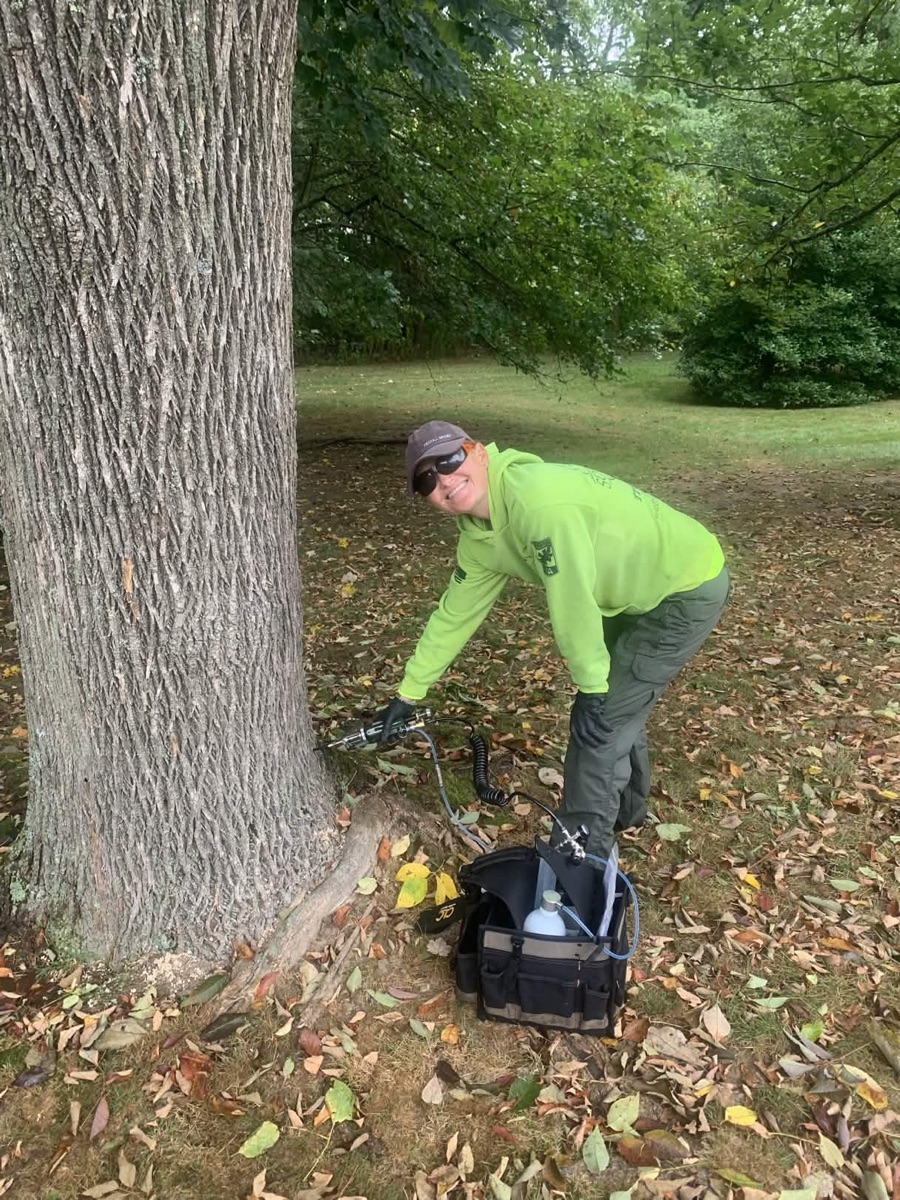
# Professional Arborist Consultation in Plymouth, Massachusetts
Your trees in Plymouth, Massachusetts, face unique pressures from coastal winds, salt spray, pine barrens wildfires, and rapid suburban expansion. As a homeowner in Plymouth Center, Manomet, or Pinehills, you rely on these trees—pitch pines shading your yard, red oaks framing your driveway, or Atlantic white cedars along your property line—for curb appeal, privacy, and property value. But without expert eyes, hidden risks like structural weaknesses or disease can turn them into liabilities, especially after a nor'easter rips through Plymouth Harbor or development crews encroach on your forested lot.
Southeast Arborist, LLC, based in Plymouth and Cohasset, delivers ISA Certified Arborist consultations tailored to South Shore Massachusetts properties. Our team provides detailed tree health assessments, risk evaluations, and written reports compliant with ANSI A300 standards. Whether you're in North Plymouth eyeing a pre-purchase inspection or West Plymouth preparing for construction, we identify issues like wind-damaged white pines or salt-stressed eastern red cedars before they escalate.
Plymouth's 63,000 residents span coastal enclaves and inland pine barrens, including Myles Standish State Forest's 15,000 acres of pitch pine ecosystem—the Northeast's largest. This geography breeds specific tree challenges: onshore gales shear branches from black oaks in Chiltonville, the 1957 wildfire's legacy lingers in scarred tupelo stands near Long Pond, and new builds in Bournedale Pines demand lot clearing assessments. An arborist consultation in Plymouth MA uncovers these threats, offering prioritized maintenance plans that protect your investment.
Our ISA Certified Arborists use visual tree risk assessments (VTA) and tools like resistographs for precise diagnostics, ensuring reports meet insurance requirements or municipal codes. For coastal Manomet properties, we evaluate salt exposure on American beech; in Ellisville, we flag fire hazards around homes amid pitch pine barrens. Homeowners scheduling arborist consultation Plymouth MA gain actionable insights—prune now or remove later?—saving thousands in emergency work.
Practical tip: Walk your Plymouth property after heavy rain. Look for leaning red oaks, cracked trunks on pitch pines, or fungal growth on Atlantic white cedars. These signal the need for professional arborist consultation Plymouth MA. Southeast Arborist follows strict safety protocols, including PPE and traffic control, to assess your trees without disruption.
In Plymouth County, where hurricanes and nor'easters strike regularly, proactive arborist consultation Plymouth MA prevents disasters. Our written reports support claims after storms batter Cedarville's coastal forests or insurers demand fire mitigation in Pinehills. With service across Plymouth's neighborhoods—from Plymouth Center's historic lots to Kingston and Duxbury borders—Southeast Arborist equips you with data-driven recommendations.
Don't wait for a branch to crash through your roof. Call Southeast Arborist at 508-369-5009 for arborist consultation Plymouth MA. Our experts turn tree risks into managed assets, preserving Plymouth's secondary canopy regrowth from Pilgrim-era clearings.
Why Plymouth Properties Need Arborist Consultation
Plymouth, MA 02360, blends 17th-century history with modern growth across Plymouth County's diverse landscapes. Your coastal property in Manomet endures relentless salt-laden winds from Plymouth Harbor, weakening pitch pines and eastern red cedars. Inland in West Plymouth or Bournedale Pines, pitch pine barrens mirror Myles Standish State Forest's fire-prone ecosystem, where the 1957 blaze scorched thousands of acres, leaving resilient but vulnerable regrowth.
Common tree species define these challenges. Pitch pine dominates pine barrens neighborhoods like Ellisville, its thick bark resisting fire but branches snapping in 50-mph nor'easters. White pines in North Plymouth tower over sandy soils but suffer needle scorch from salt spray. Red oaks and black oaks in Chiltonville provide majestic shade on clay-loam soils yet develop cankers from wet springs. American beech near Long Pond shows muscle rot in compacted soils, while tupelo in wetter Cedarville bottoms risks uprooting in hurricanes. Eastern red cedar and Atlantic white cedar hug rocky coastal bluffs in Plymouth Center, battered by onshore gales.
Climate amplifies issues. Plymouth's average 45-inch annual rainfall, combined with USDA Zone 7a winters dipping to 0°F, stresses roots. Sandy, acidic soils (pH 4.5-6.0) in pine barrens leach nutrients, starving white pines. Coastal fog deposits salt, browning pitch pine needles—your Manomet yard likely shows this. Rapid development in Pinehills and Bourne borders clears forested parcels, compacting soils and inviting emerald ash borer or beech bark disease, though ash is less common here.
Wildfire risk peaks in pitch pine stands. Insurers in West Plymouth now require 30-foot defensible space around homes, per Massachusetts Forest Fire Control guidelines. Without arborist consultation Plymouth MA, you miss deadwood buildup signaling fire ladders. Hurricane damage, like from 2023's Lee remnants, splits red oak leaders; nor'easters topple tupelo in saturated soils.
Development pressure hits hard. In growing Long Pond or Plympton-adjacent lots, construction vibrates roots, cracking black oak trunks. Pre-purchase arborist consultation Plymouth MA reveals these on Kingston-border properties. Salt exposure kills understory Atlantic white cedar, opening canopies to storm wind.
Practical advice for Plymouth homeowners: Inspect for codominant stems on young red oaks— they split in wind. Test soil pH near pitch pines; amend with lime if below 5.5 to boost vigor. Monitor beech for tar spots, early rot signs. In Ellisville, thin ladder fuels annually to cut wildfire spread.
Southeast Arborist's ISA Certified Arborists quantify risks using TRAQ scoring. A score over 75% on your Chiltonville beech warrants removal; under 40% means cabling. Our reports cite ANSI A300 pruning specs, helping you navigate Plymouth Conservation Commission permits for protected trees near historic sites.
Neglect costs: A falling white pine in Plymouth Center could total your garage ($20K+). Proactive arborist consultation Plymouth MA from Southeast Arborist prevents this, boosting property values 5-15% via healthy canopies. In coastal Cedarville, we assess salt pruning needs; inland, firewise plans for Wareham neighbors. Your trees deserve this expertise.
Our Arborist Consultation Process in Plymouth
Southeast Arborist streamlines arborist consultation Plymouth MA into a six-step process, customized for South Shore properties. We start with your call to 508-369-5009, gathering site details like Plymouth Center's harbor views or Manomet's bluff exposure.
Step 1: Site Arrival and Walkthrough (30-60 minutes). Our ISA Certified Arborist arrives in a marked truck with safety gear—hard hats, high-vis vests, traffic cones per ANSI Z133.1. You walk the property, pointing out concerns: leaning pitch pine in West Plymouth or dying tupelo near Long Pond. We note Plymouth's topography—coastal dunes in Ellisville or inland kettles in Bournedale Pines—affecting drainage.
Step 2: Visual Tree Risk Assessment (VTA). Using International Society of Arboriculture (ISA) TRAQ methods, we score targets (your home, driveway). For a North Plymouth red oak, we check trunk taper, check for root plate lift from nor'easter winds. Tools include binoculars for crown evaluation, mallet for decay sounding on black oaks. Pitch pines get bark scrape tests for pitch mass borer.
Step 3: Advanced Diagnostics. Resistographs probe wood density without damage—essential for American beech in Chiltonville suspecting Nectria canker. Soil probes measure compaction around eastern red cedar roots in Cedarville (over 300 psi signals trouble). Drones survey tall white pines in Pinehills, spotting deadwood unseen from ground. Salt stress on Atlantic white cedar? We use chloride test kits.
Step 4: Species-Specific Evaluation. Plymouth's trees demand tailored checks. Pitch pine barrens in Bournedale Pines: fire scar analysis per USDA Forest Service protocols. Coastal Manomet white pines: needle chloride levels. Tupelo in wet Long Pond: buttress root exposure from erosion. We reference local data, like Plymouth's 1957 fire maps for regrowth vigor.
Step 5: Report Compilation. Back at our Plymouth/Cohasset base, we draft your written report within 48 hours. It includes photos, TRAQ scores, ANSI A300-compliant recommendations—e.g., "Crown thin 25% on red oak to reduce wind sail." Legal sections cover insurance (post-hurricane claims) or construction impacts (vibration limits for Duxbury builds). Prioritized actions: Level 1 (immediate removal) to Level 5 (monitor).
Step 6: Consultation Debrief and Follow-Up. We email the PDF report, then call to explain: "Your Ellisville pitch pine needs 10-foot clearing for fire defensible space." You get a maintenance calendar—prune black oaks pre-winter. Safety protocols ensure zero incidents; we're licensed, insured, with TCIA accreditation.
Equipment edge: Sonic tomographs detect internal decay in tupelo trunks; increment borers age white pines for decline trends. For Plymouth's sandy soils, we advise mulch rings (3-4 inches deep, 4-foot radius) to retain moisture.
This process shines in pre-purchase checks for Kingston buyers—flagging unstable eastern red cedar—or construction assessments in growing Pinehills, where we model root protection zones (1 foot radius per inch DBH). Homeowners save 20-30% on future work via our plans.
Call 508-369-5009 to start your arborist consultation Plymouth MA. Southeast Arborist's precision protects your Plymouth property.
Common Arborist Consultation Projects in Plymouth Neighborhoods
Plymouth neighborhoods showcase tailored arborist consultation Plymouth MA needs. In Plymouth Center, historic lots near Burial Hill demand risk assessments for mature red oaks threatening colonial homes—pruning clears harbor views while preserving canopy.
North Plymouth's working-class yards feature white pines battered by Cape Cod Bay winds. Consultations reveal codominant leaders needing cabling; our ISA reports guide selective thinning to prevent nor'easter failures.
Manomet's coastal bluffs host salt-stressed pitch pines and Atlantic white cedar. Homeowners request view-clearing evaluations—remove deadwood without destabilizing dunes—complying with Plymouth Beach Commission rules.
Cedarville's mix of forest and marsh sees tupelo and eastern red cedar rot checks. Post-hurricane consultations prioritize buttress root inspections, recommending guy wires for leaning specimens.
Long Pond's kettle ponds edge American beech groves. Developments trigger construction impact assessments, protecting roots during Carver-border builds with orange fence barriers.
Chiltonville's upscale estates line red oak avenues. Pre-insurance fire mitigation clears understory around black oaks, creating 30-foot zones amid oak decline from armored scale.
West Plymouth abuts Myles Standish State Forest's pine barrens. Pitch pine consultations focus on wildfire scars—thin ladder branches to drop fire intensity by 50%, per MassWildlife specs.
Ellisville's harborside parcels need salt pruning for white pines overlooking saltmarshes. Consultations flag erosion-exposed roots, advising riprap or mulch berms.
Bournedale Pines' dense pitch pine lots face development pressure. Lot clearing evaluations balance tree preservation with safe removal, citing Chapter 133 permits.
Pinehills' golf community consults for aesthetic pruning—crown raise black oaks over fairways—while assessing storm damage from Bourne gales.
Across these, Southeast Arborist delivers. In Manomet, we pruned wind-damaged cedars post-2022 nor'easter; in West Plymouth, firewise plans satisfied insurers. Practical tip: In pitch pine areas, maintain 10-foot vertical clearance to roofs. For coastal, hose salt off trunks quarterly.
Arborist Consultation Costs in Plymouth, MA
Arborist consultation Plymouth MA pricing from Southeast Arborist starts at $250 for a single-tree assessment, scaling to $750+ for full-property evaluations in expansive Bournedale Pines or Pinehills lots. Factors drive costs: property size (under 1 acre: $300-450; 2+ acres near Myles Standish: $500+), tree count (1-5: base rate; 20+: $15/tree), and diagnostics (resistograph adds $100).
Plymouth-specifics influence: Coastal Manomet adds $50 for drone surveys over bluffs; inland West Plymouth wildfire mapping bumps $75. Travel within South Shore (Kingston to Wareham) is free; Duxbury edges $50. Reports—essential for insurance or permits—include base fee; rush 24-hour delivery +$100.
Value proposition: Our $400 consultation on a Chiltonville red oak prevented $5,000 emergency removal. Written ISA reports, with TRAQ scores and ANSI A300 plans, cut long-term costs 30-50% via prioritized fixes—like cabling your North Plymouth white pine for $800 vs. $3,000 crane work.
Comparisons: Uncertified "tree guys" charge $150 but skip diagnostics, risking inaccurate advice on pitch pine fire risk. Southeast Arborist's ISA certification ensures credibility for Plymouth Conservation approvals or FEMA claims post-nor'easter.
Breakdown example: Ellisville 1-acre coastal lot, 8 trees (pitch pine, cedar): Walkthrough $250 + VTA $100 + soil/salt tests $150 + report $100 = $600. Pre-purchase in Long Pond: $450 flat, including construction zones.
ROI shines. Healthy trees add $10K+ to Plymouth home values (per Appraisal Institute). Fire mitigation in Bournedale Pines avoids $2K insurer hikes. Practical budgeting: Bundle with pruning for 15% discount.
No surprises—quotes via 508-369-5009 detail inclusions. Pay via check/credit post-report. Invest in arborist consultation Plymouth MA; save on disasters.
When to Schedule Arborist Consultation in Plymouth
Schedule arborist consultation Plymouth MA in early spring (March-April) before leaf-out hides defects in red oaks, or fall (September-October) post-growing season for accurate decline reads on pitch pines. Avoid summer peaks when coastal humidity swells Manomet consultations.
Urgency signs demand immediate calls to 508-369-5009: Leaning trunks after nor'easters (common in Cedarville tupelo), split bark on black oaks from 1957 fire heirs in West Plymouth, or heavy deadwood in white pines signaling salt stress in North Plymouth.
Post-storm: Within 72 hours of hurricanes—check Ellisville cedars for root exposure. Pre-construction: 4-6 weeks before Bourne builds vibrate Long Pond beech roots. Insurance-driven: Before renewals in fire-prone Pinehills, prove 30-foot clearances.
Seasonal cues: Winter (December-February) for bare-stem VTA on Chiltonville oaks, spotting cankers. Plymouth's wet springs reveal saturated soils stressing Atlantic white cedar—inspect May.
Practical: After 40+ mph winds (Plymouth averages 10/year), scan for cracks. Fungal shelves on pitch pines? Schedule now. Call Southeast Arborist—we prioritize Plymouth properties.
Frequently Asked Questions About Arborist Consultation in Plymouth
What is an arborist consultation in Plymouth MA? An ISA Certified Arborist consultation in Plymouth MA involves on-site tree health and risk assessments for species like pitch pine and red oak. Southeast Arborist provides written reports with TRAQ scores, ANSI A300 recommendations, and photos, tailored to coastal salt or inland fire risks.
How long does arborist consultation Plymouth MA take? Expect 1-3 hours on-site for most Plymouth Center or Manomet properties. Diagnostics like resistographs add 30 minutes. Reports deliver in 48 hours.
Do I need an arborist consultation before buying property in Plymouth? Yes, for pre-purchase in growing Pinehills or Long Pond. We flag unstable white pines or development-impacted beech, saving 10x costs vs. surprises.
What does an arborist report include for Plymouth trees? Photos, risk ratings, species notes (e.g., pitch pine fire scars), maintenance plans, and legal sections for insurance or Plymouth permits.
How much does arborist consultation cost in Plymouth neighborhoods? $250-$750 based on scope. Coastal Ellisville drone use adds fees; value prevents $10K+ damages.
Are Southeast Arborist arborists certified for Plymouth MA? Yes, fully ISA Certified, following ANSI Z133.1 safety and A300 standards, serving South Shore from Plymouth/Cohasset base.
When is the best time for arborist consultation in Plymouth after storms? Immediately post-nor'easter or hurricane—call 508-369-5009 for priority in Cedarville or West Plymouth.
Can arborist consultation help with insurance in fire-prone Plymouth areas? Absolutely. Reports prove defensible space around Bournedale Pines pitch pines, satisfying insurers.
Arborist Consultation Throughout Plymouth
Southeast Arborist provides arborist consultation Plymouth MA across all neighborhoods: Plymouth Center's historic trees, North Plymouth's bayside pines, Manomet's bluffs, Cedarville's marshes, Long Pond's pondsides, Chiltonville's estates, West Plymouth's forests, Ellisville's dunes, Bournedale Pines' barrens, and Pinehills' courses.
We extend to nearby towns—Carver, Kingston, Plympton, Bourne, Wareham, Duxbury—in Plymouth County and beyond. From Myles Standish edges to harbor views, our ISA Certified team covers South Shore.
Protect your property: Call 508-369-5009 today for expert arborist consultation Plymouth MA.