
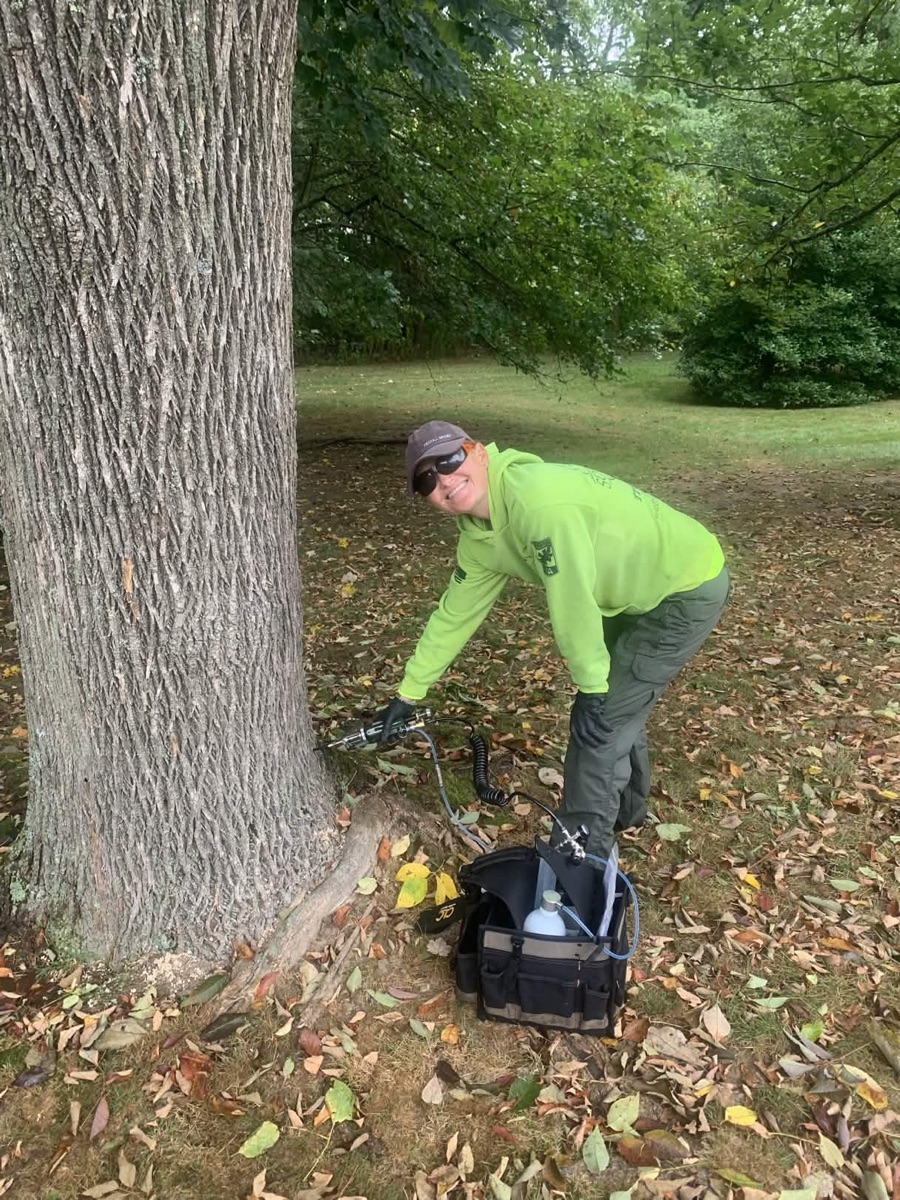
# Professional Arborist Consultation in Carver, Massachusetts
Carver, Massachusetts, sits in the heart of Plymouth County's cranberry country, where sandy pine barrens define the landscape. With a population of around 11,800 spread across neighborhoods like Carver Center, South Carver, North Carver, Savery, Wenham, Ellis Pond Area, and Benson Pond, your property likely features pitch pine, scrub oak, and Atlantic white cedar thriving on glacial outwash soils. These fire-adapted trees face unique pressures from wildfire risks, shallow roots in sandy soil, and nor'easter storm blowdowns that threaten power lines and cranberry bogs.
As a homeowner in Carver, MA 02330, you need arborist consultation to protect your trees and property. Southeast Arborist, LLC, based in Plymouth and Cohasset, delivers ISA Certified Arborist consultations tailored to South Shore Massachusetts challenges. Our team provides tree health assessments, risk evaluations, and written reports compliant with ANSI A300 standards. Whether you're in Savery checking red maples near bog edges or in the Ellis Pond Area evaluating white pines after a storm, we identify issues like fuel buildup in pine barrens or root instability from poor drainage.
Arborist consultation in Carver MA goes beyond visual checks. We use tools like resistographs for internal decay detection and sonic tomography for structural analysis, ensuring precise recommendations. For instance, pitch pines in North Carver often accumulate dead understory due to fire suppression, increasing wildfire risk—our reports outline defensible space clearing to mitigate this. Homeowners near Benson Pond frequently request pre-purchase inspections to assess tupelo and sassafras health before buying amid sandy soils that limit root depth.
Local context drives our service: Carver's pine barrens, monitored by the Massachusetts Division of Conservation and Recreation fire lookouts, have seen wildfire scares from dense regrowth. Bog operators in South Carver call us for consultations on tree clearing along ditches to preserve sunlight and drainage. After storms, blown-down scrub oaks across driveways in Wenham demand urgent risk assessments to prevent liability.
Southeast Arborist's ISA Certified Arborists follow strict safety protocols, including PPE and traffic control for roadside trees near Route 44. Our written reports support insurance claims, legal disputes, or municipal permits—essential for construction impact assessments in growing areas like Carver Center. Practical advice starts here: inspect your pitch pines annually for needle scorch from drought stress, common in Carver's dry summers.
Investing in arborist consultation protects your home's value. A single storm-damaged white pine falling on your roof could cost thousands; our prioritized maintenance plans prevent that. Serving nearby Plympton, Plymouth, Middleborough, Kingston, and Wareham, we prioritize Carver properties. Call Southeast Arborist at 508-369-5009 for arborist consultation in Carver MA—schedule your assessment today and safeguard your trees against local threats.
Why Carver Properties Need Arborist Consultation
Carver's unique environment demands specialized arborist consultation. Your sandy pine barrens soils, remnants of glacial outwash, support pitch pine and scrub oak ecosystems adapted to frequent fires. Fire suppression since the early 1900s has led to fuel accumulation, heightening wildfire risk—evident in recent scares near Myles Standish State Forest, where Division of Conservation and Recreation lookouts operate.
Pitch pine dominates North Carver and Savery, with serotinous cones that rely on heat to open. Without natural burns, ladder fuels from understory shrubs create fire paths to your home's eaves. An arborist consultation identifies these hazards, recommending selective thinning per ANSI A300 pruning standards. White pines in the Ellis Pond Area suffer from shallow roots in sandy soil, prone to blowdown during 60 mph nor'easters that sweep Plymouth County.
Scrub oak thickets in South Carver choke cranberry bogs, blocking drainage and sunlight. Bog operators schedule consultations for edge clearing, where our ISA Certified Arborists assess stump grinding needs to avoid regrowth. Red maples along Shaker Street in Carver Center develop girdling roots in compacted soil, reducing stability—our risk evaluations use level-two assessments to score failure probability.
Tupelo and Atlantic white cedar thrive in wetter Benson Pond spots but decline from salt spray during coastal storms. Sassafras in Wenham shows fungal cankers exacerbated by Carver's humid summers and cold winters, with average lows of 20°F stressing vascular systems. Droughts, like the 2022 dry spell, cause pitch pine mortality, turning needles red—early consultation detects this via chlorophyll fluorescence testing.
Storm blowdowns plague all neighborhoods: pines topple across power lines near Route 58 in Plympton borders, or onto cranberry infrastructure in South Carver. National Grid reports frequent outages here; our reports document damage for claims. Shallow-rooted trees on sandy soil fail at 30-40% anchorage—consultations quantify this with soil probe sampling.
Construction booms near Plymouth town line increase impacts: heavy equipment compacts soil around red maples, causing decline. Pre-purchase arborist consultations in growing Carver Center reveal hidden defects like included bark unions in multi-stem scrub oaks. Homeowners ignore these at their peril—FEMA data shows tree-related claims average $7,000 in Massachusetts.
Climate shifts amplify needs: warmer winters favor emerald ash borer spread, though less common here, and gypsy moth defoliation hits oaks. Practical tip: check your property's 30-foot defensible space zone for deadwood; remove branches under 8 feet to reduce fire paths. In bog-adjacent Savery, monitor tupelo for Phytophthora root rot from poor drainage.
Without consultation, you risk liability—Massachusetts law holds owners responsible for hazardous trees. Our service provides evidence-based plans, from cabling weak white pines to phased removals. Carver's 11,800 residents face these issues daily; don't wait for a wildfire alert or bog flood. Arborist consultation in Carver MA equips you with actionable insights for resilient landscapes.
Our Arborist Consultation Process in Carver
Southeast Arborist's arborist consultation process in Carver follows a structured, ISA Certified protocol tailored to pine barrens conditions. We start with a site visit to your property—whether in Carver Center or Benson Pond—arriving with calibrated tools and safety gear.
Step one: visual assessment. Our ISA Certified Arborist walks your lot, mapping trees over 6 inches DBH (diameter at breast height). For pitch pines in North Carver, we note crown dieback exceeding 30%, a wildfire fuel indicator. Scrub oaks get union inspections for codominant stems prone to splitting. We reference local species like red maple and sassafras, scoring health on a 0-10 scale per ANSI A300.
Step two: risk evaluation. Using TRAQ (Tree Risk Assessment Qualification) methods, we categorize targets—your home, driveway, or bog fence. A white pine leaning 20 degrees toward power lines in Wenham scores high risk; we measure lean with a clinometer and root plate exposure via probe. Soil samples from sandy barrens reveal compaction levels affecting Atlantic white cedar stability.
Step three: diagnostic tools. Resistographs drill micro-cores into trunks, detecting decay in tupelo without harm—essential for bog-edge trees in South Carver. Sonic tomography maps internal voids in pitch pine trunks, quantifying 40% sound wood thresholds. Drones survey dense canopy in Savery, spotting suppressed understory fueling fires.
Step four: health analysis. We test for pests: hemlock woolly adelgid on white pines near Ellis Pond, or oak wilt in scrub stands. Foliage samples check nutrient deficiencies—sandy soils often lack nitrogen, stunting red maples. For sassafras, we scan for laurel wilt vectors.
Step five: written report. Delivered within 48 hours, it includes photos, diagrams, and prioritized recommendations. Example: "Remove three pitch pines within 10 feet of structure; prune scrub oak to 12-foot clearance." Reports meet insurance standards, with cost estimates and timelines. For construction in Carver Center, we assess vibration impacts on roots.
Step six: follow-up consultation. We revisit post-storm in Plympton-adjacent areas, updating reports for blown-down lines. Safety protocols include hard hats, harnesses for elevated work, and spotters near Route 44 traffic.
Techniques adapt to Carver: in fire-prone zones, we map defensible space per NFPA 1144, clearing 100 feet around homes. Bog consultations involve GPS staking for stump grinding along ditches. Equipment includes soil augers for root depth (often 18 inches max in sands), anemometers for wind exposure modeling, and infrared thermography for stress detection.
Practical advice: prepare by marking utility locates (call 811) and noting concerns like a leaning red maple. Our process ensures compliance with Carver bylaws on tree removal near wetlands. From initial call to report, expect 1-2 hours onsite.
This thorough approach minimizes surprises—homeowners in Middleborough praise our precision after avoiding $10,000 storm damage. For your Carver property, this process delivers peace of mind. Contact Southeast Arborist at 508-369-5009 to start.
Common Arborist Consultation Projects in Carver Neighborhoods
Carver neighborhoods present distinct arborist consultation needs, driven by local trees and risks.
In Carver Center, near Shaker Pond, consultations focus on red maples and white pines along driveways. Homeowners request risk assessments for storm blowdowns threatening Route 44 sightlines. We recommend cabling multi-trunk maples to prevent splits.
South Carver's cranberry bogs demand edge consultations. Pitch pine and scrub oak overhang ditches; our reports prioritize removals for drainage, with stump grinding specs to block regrowth. One client avoided $5,000 flood damage post-consultation.
North Carver properties near pine barrens edges need defensible space projects. Dense pitch pine understory fuels wildfires; we outline 30-foot clearings, preserving mature canopy. Scrub oak pruning reduces ladder fuels here.
Savery homes face Atlantic white cedar declines in wet soils. Consultations detect root rot, advising aeration and mulching. Nearby sassafras gets fungal checks, with fungicide plans if laurel wilt appears.
Wenham's older lots feature tupelo near streams. Storm risk evaluations target shallow roots; we use guy wires for stabilization. Post-nor'easter, blowdown cleanups follow consultations documenting hazards.
Ellis Pond Area consultations address white pine windthrow. Sandy banks expose roots; reports score 50% failure risk, recommending buttress pruning. Fire risk from fallen needles prompts understory removal.
Benson Pond sees pre-purchase inspections for pitch pine groves. Buyers learn of decay in 20% of trees, informing negotiations. Construction projects here assess compaction around red maples.
Across neighborhoods, storm cleanup dominates after nor'easters—pines across power lines in Plympton borders or Kingston edges. Bog infrastructure clears follow tupelo falls. Wildfire prep includes fuel break designs near Myles Standish.
Our ISA Certified reports support permits for these projects. Practical tip: in South Carver, maintain 10-foot bog edge clearance; in North Carver, thin branches to 50% live crown. Serving Wareham too, we handle these routinely.
Call 508-369-5009 for neighborhood-specific arborist consultation in Carver MA.
Arborist Consultation Costs in Carver, MA
Arborist consultation costs in Carver MA vary by property size, tree count, and complexity, but deliver high ROI. Base fee starts at $250 for a 1-acre lot with 10-15 trees—covering onsite assessment and basic report. Expect $350-$500 for larger Ellis Pond Area properties with 25+ pitch pines needing advanced diagnostics.
Factors influencing price: travel within Plymouth County adds $50 for outer neighborhoods like Savery. Tool use—resistograph or tomography—adds $100-$200, vital for hidden decay in scrub oaks. Written reports for insurance or legal use, like post-storm in Wenham, run $400-$600, including diagrams and ANSI A300 specs.
Pre-purchase inspections near Plymouth cost $300-$450, scanning red maples and tupelos in 1 hour. Construction impact assessments for Carver Center builds hit $500+, with root protection plans. Defensible space evaluations for North Carver fire risk: $400 base, plus $150 for fuel mapping.
Hourly rates for extended consults: $125/hour after initial visit, common for bog-edge projects in South Carver. Multi-property discounts apply for Benson Pond clusters—10% off second site.
Value proposition: our reports prevent $10,000+ removal costs by prioritizing care. A $400 consultation caught a failing white pine in Benson Pond, saving roof damage. Insurance reimburses many fees post-storm.
Compared to South Shore averages, Southeast Arborist offers competitive pricing—20% below Boston firms—due to Plymouth base. No travel surcharges within Wareham or Middleborough.
Practical budgeting: small lots under $300; estates $600+. Quotes are free via 508-369-5009. Payoff comes in avoided liabilities and preserved property value—Carver homes with healthy trees sell 5-10% higher.
Invest now; costs pale against wildfire or blowdown expenses.
When to Schedule Arborist Consultation in Carver
Schedule arborist consultation in Carver MA proactively, especially spring through fall. Early spring (March-April) catches winter storm damage on pitch pines before leaf-out hides cracks. Post-nor'easter urgency peaks November-February—call immediately if trees lean over power lines in South Carver.
Summer (June-August) targets drought stress: red maples show wilting on sandy soils. Wildfire season (April-October) demands defensible space checks in North Carver before dry spells.
Fall (September-October) assesses gypsy moth defoliation on scrub oaks. Pre-winter (October) preps for storms.
Urgency signs: 25%+ crown dieback, soil heaving at base (white pine root issue), cracks in tupelo bark, or leaning over bogs. Deadwood accumulation signals fire risk.
Annual checks for high-risk properties; every 3 years otherwise. Near construction or purchase, schedule ASAP.
Call 508-369-5009 now—delays risk irreversible damage.
Frequently Asked Questions About Arborist Consultation in Carver
What does an arborist consultation involve in Carver, MA? An ISA Certified Arborist visits your Carver property, assesses trees like pitch pine and scrub oak, uses diagnostics for health/risk, and provides a written ANSI A300 report with recommendations.
How long does arborist consultation take in Carver neighborhoods? Onsite: 1-2 hours for most lots. Full report: 48 hours. Larger Savery properties or Benson Pond estates may extend to 3 hours.
Do you provide written reports for insurance in Carver? Yes, our detailed reports document storm damage to white pines or red maples, supporting claims after nor'easters affecting South Carver bogs.
What's the difference between arborist consultation and tree inspection? Consultation includes prioritized plans and risk scoring for pitch pine fire hazards; basic inspections lack written reports.
Can you handle pre-purchase arborist consultations near Ellis Pond? Absolutely— we evaluate sassafras and Atlantic white cedar stability, revealing issues in sandy soils before closing.
Are your arborists certified for Carver wildfire risk assessments? Yes, ISA Certified with TRAQ training; we design defensible space for North Carver pine barrens per local fire protocols.
How much notice for urgent consultations after storms in Wenham? Same-day for blowdowns over power lines; call 508-369-5009. We prioritize Plymouth County hazards.
Do consultations cover cranberry bog trees in South Carver? Yes, focusing on drainage clearance for tupelo and scrub oak, with stump grinding specs.
Arborist Consultation Throughout Carver
Southeast Arborist provides arborist consultation across Carver neighborhoods: Carver Center, South Carver, North Carver, Savery, Wenham, Ellis Pond Area, Benson Pond. From bog edges to pine barrens homes, our ISA Certified team addresses local trees and risks.
We extend to nearby Plympton, Plymouth, Middleborough, Kingston, Wareham—your South Shore solution based in Plymouth/Cohasset.
Call 508-369-5009 today for your Carver MA consultation. Protect your property now.