
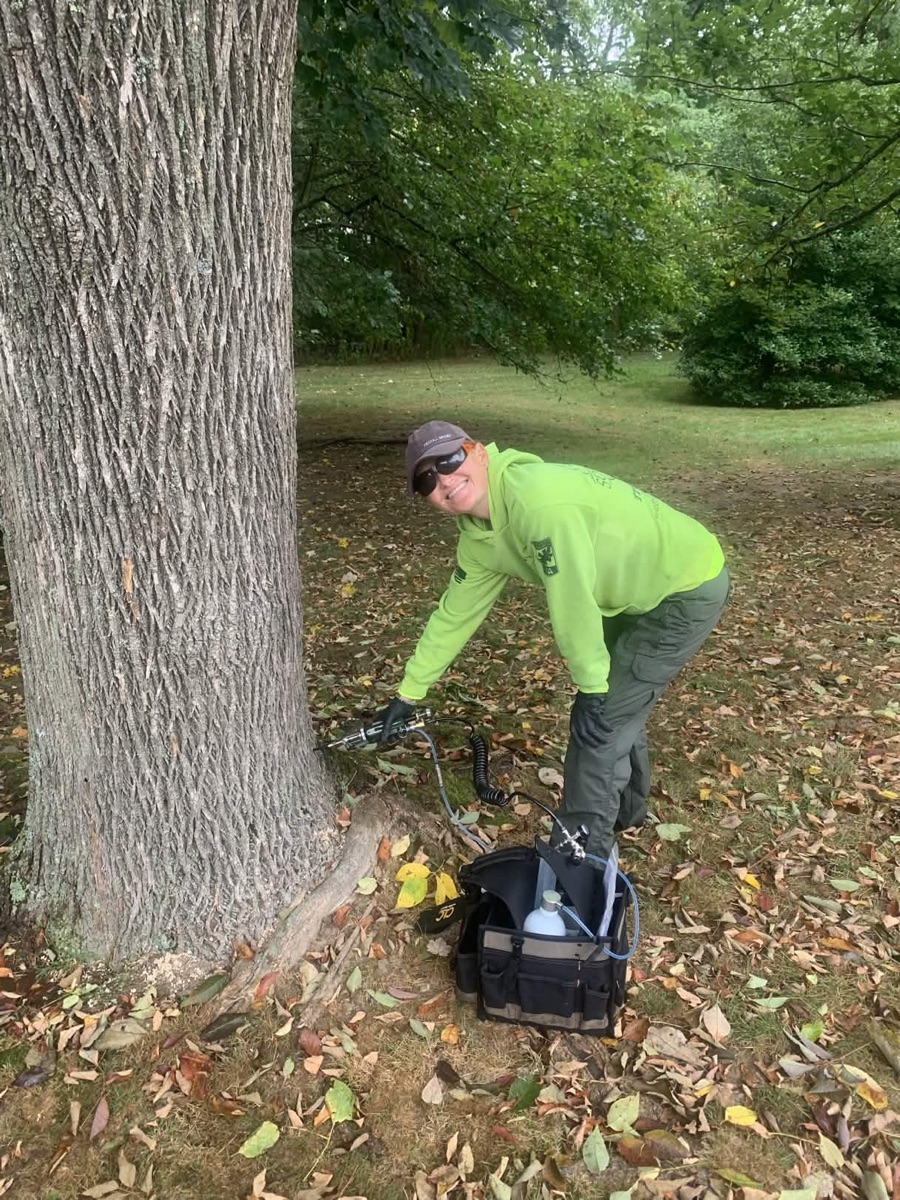
# Professional Arborist Consultation in Bridgewater, Massachusetts
As a homeowner in Bridgewater, MA 02324, you rely on the mature trees shading your property in neighborhoods like Bridgewater Center or Lake Nippenicket to enhance curb appeal, provide summer cooling, and support local wildlife. These trees—often red maples, swamp white oaks, or historic American elms—face unique pressures from Plymouth County's saturated soils, Hockomock Swamp influences, and frequent ice storms. That's where arborist consultation in Bridgewater MA becomes essential. Southeast Arborist, LLC, your South Shore Massachusetts tree care experts based in Plymouth and Cohasset, delivers ISA Certified Arborist assessments tailored to these conditions.
Our arborist consultation services include comprehensive tree health evaluations, risk assessments, and detailed written reports compliant with ANSI A300 standards. Whether you're in Titicut dealing with river birch root instability near the Taunton River or in Stanley Heights managing aging sugar maples with co-dominant stems, we identify issues before they escalate. Call 508-369-5009 for an arborist consultation in Bridgewater MA that protects your investment.
Bridgewater's landscape, shaped since its 1656 settlement, features wetland-bordered residential areas where original hardwood forests gave way to farming and iron smelting. Today, the Town Common boasts some of Plymouth County's oldest planted shade trees, including Dutch elm disease-resistant American elms. Properties near Hockomock Swamp contend with expansive red maple swamp forests encroaching on yards, while saturated soils along river corridors destabilize roots during storms. An arborist consultation in Bridgewater MA from Southeast Arborist uncovers these risks, offering prioritized maintenance plans like pruning or cabling.
We specialize in pre-purchase property inspections for buyers eyeing homes in Scotland or Pratt Town, construction impact assessments to safeguard trees during additions, and insurance-ready reports for storm-damaged white pines in South Street Area. Our ISA Certified Arborists use resistograph drilling, sonic tomography, and aerial inspections to diagnose decay in pin oaks or willows without unnecessary removal. This precision ensures your trees thrive amid Bridgewater's clay-heavy soils and humid coastal climate.
Homeowners often overlook subtle signs like leaning swamp white oaks after heavy rains or fungal growth on river birches near Lake Nippenicket. Our consultations provide actionable advice, such as mulching to combat soil compaction or cabling to reinforce structural weaknesses. In a college town with 28,000 residents, where Bridgewater State University influences growth, preserving canopy cover maintains property values—studies show mature trees add 10-20% to home resale prices.
Southeast Arborist follows strict safety protocols, including TCIA accreditation guidelines and PPE for all site visits. For your arborist consultation in Bridgewater MA, we arrive with calibrated tools like clinometers for lean measurements and soil probes for moisture analysis. Expect a customized report detailing health scores, risk ratings (low, moderate, high), and timelines for intervention. Don't wait for the next nor'easter—schedule with us at 508-369-5009 to safeguard your Bridgewater property.
Why Bridgewater Properties Need Arborist Consultation
Bridgewater's position in Plymouth County exposes trees to saturated soils from Hockomock Swamp and the Taunton River, causing root instability in species like red maple and river birch. Your property in Bridgewater Center might feature a mature swamp white oak with shallow roots uplifted by poor drainage, a common issue after spring thaws. An arborist consultation in Bridgewater MA evaluates these conditions, using soil auger samples to measure compaction levels exceeding 300 psi, which starve roots of oxygen.
Aggressive wetland species encroachment plagues edges of neighborhoods like Titicut and Lake Nippenicket, where fast-growing red maples and willows invade lawns, blocking sunlight and clogging drainage ditches. Without professional assessment, these invaders compete with desirable sugar maples or white pines, leading to decline. Our ISA Certified Arborists map encroachment patterns, recommending selective thinning to restore balance while complying with Bridgewater's wetland bylaws.
Aging street trees along Central Street in Bridgewater Center show structural decay from decades of growth, including co-dominant stems in American elms and pin oaks. Ice storms, frequent in this coastal zone with average January lows of 20°F, exacerbate splits—last winter's event toppled several in Pratt Town. Arborist consultation identifies decay pockets via increment core sampling, revealing rot depths over 50% of trunk diameter, which signals imminent failure.
Saturated soils near river corridors in South Street Area destabilize root plates, especially in willows and river birches with fibrous systems prone to heaving. Bridgewater's clay-loam soils retain water, creating anaerobic zones where pathogens like Phytophthora thrive, infecting red maples. A consultation includes resistograph probes to quantify wood density loss, providing data for insurance claims post-storm.
The Town Common's historic elms, survivors of Dutch elm disease, require vigilant monitoring for cankerworm defoliation and verticillium wilt, issues our assessments detect via leaf sampling. In Scotland, properties bordered by Hockomock Swamp face red maple swamps expanding due to beaver activity, shading homes and promoting mosquito breeding. We assess canopy density with hemispherical photography, advising on removals that enhance drainage without wetland violations.
White pines in Stanley Heights suffer from white pine weevil attacks, boring into leaders during humid summers averaging 75% relative humidity. Pin oaks develop iron chlorosis from high pH soils (6.5-7.2), yellowing leaves that an arborist consultation diagnoses through tissue analysis, recommending chelated iron treatments. Sugar maples in elevated Pratt Town yards crack from freeze-thaw cycles, with included bark unions weakening over time.
Local climate data from Bridgewater State University's weather station shows 45 inches annual precipitation, mostly fall-winter, overloading root zones. Without arborist consultation, homeowners risk liability—fallen trees cause 30% of property claims in Plymouth County. Southeast Arborist delivers written reports with risk matrices, prioritizing actions like cabling for moderate-risk trees. Practical tip: Inspect your trees post-rain for soil mounding at bases; if present, call for consultation to prevent blowdowns.
Nearby towns like East Bridgewater share similar issues, but Bridgewater's unique swamp proximity demands specialized knowledge. Our services ensure your trees withstand these challenges, preserving Bridgewater's character.
Our Arborist Consultation Process in Bridgewater
Southeast Arborist's arborist consultation in Bridgewater MA follows a structured, ANSI A300-compliant process starting with your call to 508-369-5009. We schedule within 48 hours, dispatching an ISA Certified Arborist equipped with a truck-mounted soil probe, resistograph, and laser rangefinder.
**Step 1: On-Site Visual Assessment (30-45 minutes per tree).** Your arborist arrives in Bridgewater Center or Titicut, scanning for defects like codominant stems in American elms on the Town Common. Using binoculars and a clinometer, we measure lean angles—over 15 degrees flags high risk. For red maples near Hockomock Swamp, we note epicormic sprouting indicating root stress from saturated soils.
**Step 2: Soil and Root Zone Evaluation.** In wetland-bordered areas like Lake Nippenicket, we extract cores with a 4-inch auger to depths of 24 inches, testing for moisture (above 30% volumetric signals issues) and compaction. For river birches in South Street Area, we map root plates, identifying heaving from Taunton River flooding. Practical advice: Maintain a 3-foot mulch ring around bases to improve aeration without volcano mulching.
**Step 3: Advanced Diagnostic Tools.** Employing sonic tomography on swamp white oaks in Stanley Heights, we generate decay maps showing sound wave velocities under 800 m/s, pinpointing pockets. Resistograph drilling on pin oaks reveals density gradients, with losses over 40% prompting cabling recommendations. For white pines in Scotland, we use the Mattcheck for weevil galleries.
**Step 4: Canopy and Structural Analysis.** Climbing with a rope-and-harness system (per OSHA standards), or using drones for tall sugar maples in Pratt Town, we inspect branch unions for included bark. Cabling feasibility assesses with pull-testing cables at 50% of breaking strength. Safety protocols include spotters and traffic control for street trees.
**Step 5: Risk Rating and Health Scoring.** We assign Tree Risk Assessment Qualification (TRAQ) ratings: low (inspect yearly), moderate (act within 2 years), high (immediate). Health scores factor species vigor—e.g., willows score low near wetlands due to dieback from Phytophthora. Data integrates into a digital report with photos and diagrams.
**Step 6: Written Report Delivery (24-48 hours).** You receive a PDF report for insurance, legal, or pre-purchase needs, including prioritized recommendations like ANSI pruning for codominant leaders or soil injections for chlorotic pin oaks. For construction near Bridgewater State University, we detail protected root zones (1 foot per inch DBH).
**Step 7: Follow-Up Consultation.** We review findings via phone, suggesting DIY monitoring like annual photos of woundwood closure. All work adheres to TCIA Best Management Practices, with liability insurance coverage.
This process adapts to Bridgewater's clay soils and ice storm history—for instance, post-storm in East Bridgewater-adjacent areas, we prioritize fracture mapping. Homeowners in Middleborough or Raynham benefit similarly. Our equipment calibration ensures accuracy, like anemometers for wind load calculations on exposed white pines.
Practical takeaway: During consultation, note any recent changes like new downspouts directing water to roots—these accelerate decline in red maples. Southeast Arborist's thorough approach minimizes surprises, empowering you to maintain healthy trees.
Common Arborist Consultation Projects in Bridgewater Neighborhoods
In Bridgewater Center, consultations focus on pruning and cabling large shade trees along historic streets, where American elms and sugar maples develop decay from urban soil compaction. A recent project involved a 60-foot elm with codominant stems; our assessment revealed 30% decay, leading to rod bracing that preserved the canopy.
Scotland properties near Hockomock Swamp require selective clearing of encroaching red maples shading homes—consultations map overgrowth, recommending removals spaced 20 feet to improve drainage and light penetration. One client avoided $5,000 in foundation repairs by addressing root competition early.
Titicut's riverfront lots see frequent risk evaluations for river birches and willows destabilized by Taunton River saturation. Post-ice storm, we consulted on a leaning birch, using tomography to confirm root plate lift, resulting in phased removal and replanting with pin oaks.
Pratt Town's elevated yards feature swamp white oaks prone to storm damage; consultations include pre-purchase inspections revealing hidden girdling roots, advising corrective excavation for buyers. A homeowner prevented a $10,000 claim by acting on our moderate-risk rating.
Stanley Heights street trees, including white pines, undergo structural assessments for weevil damage and leader cracks. We cabled a pin oak cluster, enhancing safety near playgrounds while meeting town ordinances.
South Street Area wetland edges need encroachment control for swamp oaks and red maples clogging swales—our reports guide permitted thinning, restoring property lines without fines.
Lake Nippenicket shoreline properties face willow dieback from poor drainage; consultations prescribe aeration and fungicide plans, with one project saving a mature stand via cabling.
These projects highlight Southeast Arborist's expertise in Bridgewater's neighborhoods, delivering reports for insurance after West Bridgewater storms or construction near Raynham.
Arborist Consultation Costs in Bridgewater, MA
Arborist consultation costs in Bridgewater MA range from $250-$600 per property, depending on tree count, size, and diagnostics. A single mature red maple in Bridgewater Center might cost $300 for visual and soil assessment, while a Lake Nippenicket lot with 10 wetland willows reaches $550 including tomography.
Factors driving costs include travel within Plymouth County (minimal from our Plymouth base), tree diameter (DBH over 24 inches adds $50 for climbing), and tools—resistograph adds $100, drones $150. Pre-purchase inspections for Titicut homes average $400, covering 5-7 trees with written reports.
Value proposition: Our $350 consultation on a Stanley Heights sugar maple prevented $8,000 removal, identifying cabling at $1,200 as sufficient. Insurance reports save claims denials—post-ice storm in South Street Area, a $450 assessment secured $15,000 payout.
Compared to general tree services, ISA Certified consultations command 20-30% premiums for ANSI compliance and legal weight. Multi-tree discounts apply—$800 for Pratt Town lots with 15+ trees. Construction assessments near Bridgewater State start at $500, detailing TRZ protections.
ROI is clear: Healthy trees boost values 15% per Plymouth County appraisals. Budget tip: Combine with pruning for bundled savings. No hidden fees—quotes via 508-369-5009 detail inclusions.
Nearby Raynham or Middleborough consultations match pricing, with volume discounts for neighborhoods. Investing in our process yields long-term savings over reactive removals.
When to Schedule Arborist Consultation in Bridgewater
Schedule arborist consultation in Bridgewater MA in early spring (March-April) before leaf-out hides defects in red maples, or fall (September-October) post-dormancy for root checks. Avoid summer peaks when humidity stresses white pines.
Urgency signs: Leaning over 10 degrees in swamp white oaks after rains, soil mounding at river birch bases in Titicut, or fungal shelves on American elms in Bridgewater Center—call 508-369-5009 immediately.
Post-storm (November-March ice events), inspect within 72 hours for splits. Pre-purchase before May closings in Scotland. Construction starts demand assessments 30 days prior.
Wetland edges in Lake Nippenicket need annual checks during dry July for encroachment. Aging street trees in Stanley Heights warrant biennial visits.
Act now on early dieback in pin oaks or willow wilt to halt spread.
Frequently Asked Questions About Arborist Consultation in Bridgewater
**What does an arborist consultation in Bridgewater MA involve?** ISA Certified evaluation of tree health, risks, and maintenance using visual, soil, and diagnostic tools, ending in a written ANSI A300 report.
**How much does arborist consultation cost in Bridgewater?** $250-$600 based on trees and tools; e.g., $350 for a red maple assessment in Pratt Town.
**Do you provide reports for insurance in Bridgewater neighborhoods?** Yes, detailed reports with risk ratings for claims after Hockomock Swamp storms or Taunton River flooding.
**When should I get an arborist consultation for my Lake Nippenicket property?** Post-storm, pre-purchase, or if willows show root heaving from saturated soils—spring ideal.
**Can you assess construction impacts near Bridgewater State University?** Absolutely, we define protected root zones for sugar maples and white pines during builds.
**What if my American elm in Town Common shows decay?** Consultation uses resistograph to measure; cabling often preserves these historic trees.
**Do you serve nearby towns like East Bridgewater or Raynham?** Yes, full South Shore coverage from our Plymouth/Cohasset base.
**How long does a Bridgewater consultation take?** 1-3 hours on-site, report in 48 hours.
Arborist Consultation Throughout Bridgewater
Southeast Arborist provides arborist consultation across Bridgewater neighborhoods: Bridgewater Center's historic elms, Scotland's swamp edges, Titicut riverfronts, Pratt Town elevations, Stanley Heights streets, South Street wetlands, and Lake Nippenicket shores. We extend to East Bridgewater, West Bridgewater, Raynham, and Middleborough.
From Plymouth/Cohasset, response times average 24 hours. Contact our ISA Certified team at 508-369-5009 or online for your assessment. Protect your Bridgewater trees today.