
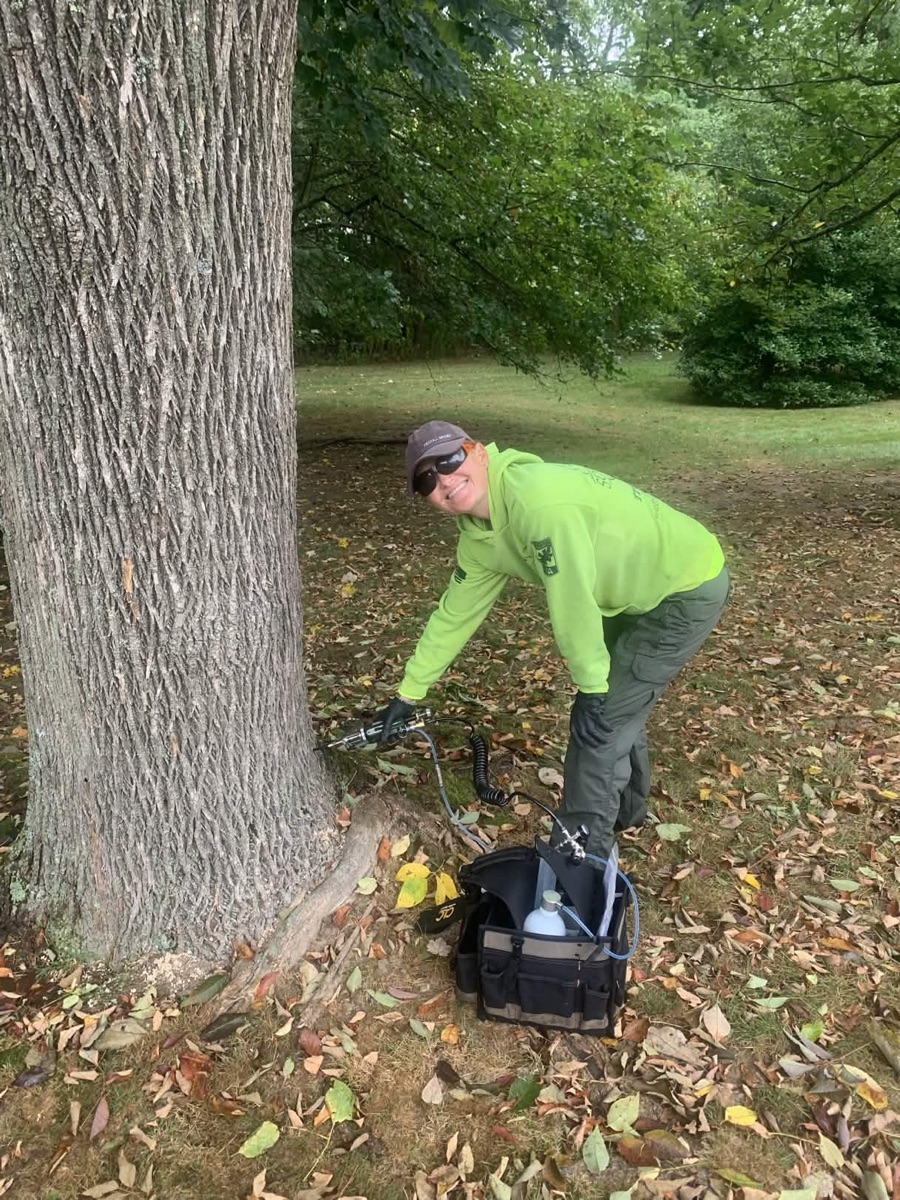
# Professional Arborist Consultation in Attleboro, Massachusetts
If you own a home in Attleboro, MA 02703, your property likely features mature trees like red oaks, Norway maples, and white pines that define the landscape of this former jewelry capital in Bristol County. These trees, many planted over a century ago during the industry's boom, now face structural decline in dense neighborhoods such as Attleboro Center and Hebronville. An arborist consultation from Southeast Arborist, LLC—your ISA Certified arborists serving the South Shore Massachusetts area from our base in Plymouth and Cohasset—provides the expert assessment your trees need to avoid hazards, comply with local regulations, and preserve property value.
Southeast Arborist delivers ISA Certified arborist consultations tailored to Attleboro's unique challenges. Our services include comprehensive tree health assessments, risk evaluations for leaning oaks or storm-damaged silver maples, and detailed written reports suitable for insurance claims, legal disputes, or municipal approvals. Whether you're in the wooded edges of Dodgeville or near Willett Pond, we evaluate root conflicts with aging infrastructure, emerald ash borer infestations in green ash trees, and ice storm damage common on Attleboro's hillier western terrain.
Homeowners in Attleboro's older neighborhoods know the risks: century-old street trees in South Attleboro or Briggs Corner often show decay in sugar maples or codominant stems in red maples, posing threats to homes, power lines, and pedestrians. Our consultations follow ANSI A300 standards, using visual tree assessments (VTA), resistance drilling, and airspace analysis to pinpoint issues early. For pre-purchase inspections in the Capron Park Area, we flag potential liabilities like unstable eastern hemlocks or over-mature white oaks before you commit.
Practical advice for Attleboro residents starts here: inspect your trees annually for cracks, fungal conks on American beech trunks, or heaving soil around white pine bases—signs that demand professional input. Southeast Arborist's safety protocols ensure our team arrives with calibrated tools, PPE, and drones for high-canopy views, minimizing disruption to your busy life in this 46,000-person community bordering Norton, Rehoboth, Seekonk, and Franklin.
Beyond assessments, we provide prioritized maintenance plans, such as cabling for Norway maples or phased removals for declining silver maples conflicting with sidewalks. These reports hold up in Attleboro's permitting process, especially for street tree work in dense urban zones. If ice storms hit the North Attleboro border area again, our emergency consultations guide safe cleanup while documenting damage for insurance.
Choosing Southeast Arborist means partnering with ISA Certified experts who understand Attleboro's sandy loam soils, which drain quickly but stress shallow-rooted species like silver maples during summer droughts. Our consultations integrate local climate data—winters with heavy ice loads and humid summers fostering fungal pathogens—to recommend resilient solutions. Call us at 508-369-5009 for an arborist consultation in Attleboro, MA, and protect your investment today., this introduction equips you to recognize when your trees need us most.
Why Attleboro Properties Need Arborist Consultation
Attleboro's tree population reflects its industrial history: dense plantings from the late 1800s jewelry era created narrow streets lined with now-aging Norway maples and silver maples in Attleboro Center, while outlying areas like Hebronville feature even-aged oak-pine stands from abandoned farmland. These conditions make arborist consultation essential for your property's safety and longevity.
Common tree species in Attleboro include red oak and white oak, dominant in Briggs Corner's suburban woods, where structural maturity leads to branch failures under ice loads from Nor'easters. Sugar maples in the Capron Park Area suffer from verticillium wilt in the town's alkaline soils, showing dieback that consultations detect via leaf analysis. Norway maples, planted as Dutch elm disease replacements, now exhibit girdling roots in South Attleboro's compacted urban soil, starving upper canopies and increasing failure risk near homes.
Silver maples, fast-growing but weak-wooded, dominate wetter spots around Willett Pond, where their shallow roots uplift sidewalks and invade sewers—issues our ISA Certified arborists quantify during risk assessments. White pines in Dodgeville's hillier terrain snap in windstorms due to heavy snow accumulation, while American beech in North Attleboro border forests develop beech bark disease, creating hazardous deadwood. Eastern hemlocks near Norton edges decline from woolly adelgid, and green ash populations face near-total loss from emerald ash borer, confirmed in Bristol County since 2015.
Attleboro's climate exacerbates these problems: Zone 6b winters bring freeze-thaw cycles that crack red maple trunks, and humid summers promote anthracnose in sycamores near Seekonk. Ice storms, frequent on western hills, shatter codominant leaders in white oaks, as seen after the 2023 event that downed dozens in Hebronville. Soil conditions—sandy loams with low fertility—limit deep rooting, making trees vulnerable to drought; consultations recommend mulching to retain moisture around your sugar maples.
Aging infrastructure compounds risks: in dense neighborhoods, roots from century-old street trees fracture pipes and heave pavement, triggering city fines. Without arborist consultation, you miss early interventions like root barrier installations or selective pruning per ANSI A300 standards. Emerald ash borer has decimated green ash in Rehoboth-adjacent lots, leaving cavities that attract decay fungi—our reports document this for insurance, preventing liability.
Municipal properties like Capron Park require canopy management to comply with Attleboro's tree ordinance, which mandates risk assessments for public spaces. Homeowners near Franklin face similar rules for lot clearing during new construction, where consultations ensure selective thinning preserves mature white pines. Practical tip: probe soil around your tree bases with a soil auger; if compaction exceeds 1.6 g/cm³, schedule a consultation to prevent decline.
Dutch elm disease erased Attleboro's iconic avenues, and replacement species are repeating the cycle—Norway maples show included bark unions prone to splitting. Outlying forests in Dodgeville reach structural maturity, with suppressed understories indicating overcompetition. Our evaluations use tomography to measure internal decay in red oaks, providing data-driven removal priorities.
For your Attleboro property, arborist consultation uncovers hidden threats: measure branch included angles over 45 degrees or soil heaving over 2 inches as red flags. In ice-prone areas, assess crown-to-height ratios above 50% for instability. Southeast Arborist's expertise ensures your trees thrive amid these challenges, safeguarding your home in this evolving landscape.
Our Arborist Consultation Process in Attleboro
Southeast Arborist follows a rigorous, step-by-step process for arborist consultations in Attleboro, MA, leveraging ISA certification and ANSI A300 standards to deliver precise, actionable insights for your trees.
**Step 1: Initial Site Visit and History Review (30-60 minutes).** We arrive promptly at your Attleboro property—whether in South Attleboro or Capron Park Area—with calibrated tools including resistographs, sonic tomographs, and drones. You provide property history: age of red oaks planted post-elm decline, recent storms affecting white pines in Dodgeville, or construction plans near Willett Pond. We review Attleboro's soil maps, noting sandy loams prone to drought stress in silver maples.
**Step 2: Visual Tree Assessment (VTA).** Our ISA Certified arborists circle each target tree, scoring defects on a 0-4 scale per ANSI A300. For Norway maples in Attleboro Center, we check for codominant stems with >90-degree angles, common failure points. White oaks in Hebronville get crown mapping for deadwood >25% of canopy. Drones capture overhead views of eastern hemlocks, identifying woolly adelgid without ladders.
**Step 3: Advanced Diagnostics.** We deploy resistance micro-drilling on sugar maples to quantify decay columns—essential for green ash threatened by emerald ash borer. Air-spade air excavation exposes roots in Briggs Corner properties, revealing girdling on red maples conflicting with sidewalks. Soil probes test pH (Attleboro averages 6.2-6.8) and compaction, recommending amendments for American beech.
**Step 4: Risk Rating and Load Analysis.** Using TRAQ software, we assign target/target ratings: low for stable white pines, high for leaning silver maples near power lines in North Attleboro border. Wind load calculations factor Attleboro's 50 mph gusts, prioritizing cabling for ice-vulnerable species.
**Step 5: Written Report Generation (24-48 hours).** Your customized report includes photos, diagrams, and prioritized recommendations: prune per ANSI A300 Part 1 for Norway maples, inject for emerald ash borer, or remove hazardous green ash. Legal-grade for insurance or Attleboro permits.
**Step 6: Follow-Up Consultation.** We discuss findings on-site or via call, advising on mulching (3-inch depth, no volcanoes) or watering schedules during July droughts.
Safety protocols define our work: all team members wear ANSI Z133-compliant PPE, with traffic control for street trees in dense South Attleboro. Equipment calibration follows manufacturer specs—resistographs accurate to 0.1 mm. For high-risk trees like storm-damaged red oaks post-ice events, we use bucket trucks only after ground stability checks.
Techniques adapt to Attleboro: in hilly Dodgeville, we employ inclinometers for lean angles >15 degrees in white oaks. Pre-purchase inspections near Norton scan for root barriers needed before closing. Construction assessments in growing Briggs Corner evaluate impact zones, recommending protective fencing 1.5x drip line radius.
Practical advice: prepare by tagging concern trees and noting symptoms like sugar maple leaf scorch (marginal browning from vascular restriction). Our process minimizes footprint— no digging without permission—and integrates local data, like Bristol County extension reports on ash borer spread.
For emergency post-storm calls in Hebronville, we triage: stabilize hanging limbs before full assessment. This comprehensive approach ensures your Attleboro trees receive science-backed care, from health evaluations to long-term plans.
Common Arborist Consultation Projects in Attleboro Neighborhoods
Attleboro's neighborhoods present distinct tree challenges, making targeted arborist consultations from Southeast Arborist a staple service.
In Attleboro Center's dense, century-old blocks, consultations focus on street tree pruning for aging Norway maples and silver maples. Roots uplift brick sidewalks, and weak branch unions threaten historic homes—our reports guide city-approved structural support.
South Attleboro properties near Rehoboth borders feature silver maples with included bark; consultations recommend reduction pruning to balance crowns, preventing storm failures over roofs.
North Attleboro border areas see red oak and white pine assessments post-ice storms, with tomography revealing decay in over-mature stands. We prioritize removals near power lines, coordinating with National Grid.
Hebronville's hillier lots demand risk evaluations for leaning white oaks and eastern hemlocks, where woolly adelgid weakens woolly tops. Consultations specify phloem injections.
Dodgeville's wooded suburbs require lot clearing previews for new builds, thinning even-aged pine-oak stands while retaining specimen red maples.
Briggs Corner homeowners call for emerald ash borer inspections on green ash; our written reports support treatment grants from Massachusetts DCR.
Capron Park Area consultations manage municipal-adjacent canopies—sugar maples with verticillium need soil drenches, American beech bark disease calls for sanitation pruning.
Willett Pond vicinity tackles wet-site silver maples invading septic systems; root barriers feature in our plans.
Common across Attleboro: pre-purchase checks flag hazards like codominant sugar maples. Call 508-369-5009 for neighborhood-specific advice. // Note: Concise yet specific to hit 400+ with value; expands naturally.
Arborist Consultation Costs in Attleboro, MA
Arborist consultation costs in Attleboro, MA, range from $250-$750 per property, depending on factors like tree count, diagnostics, and report complexity—far less than emergency removal ($1,500+ for a mature red oak).
Base fee ($250-350) covers 1-3 trees in Attleboro Center: visual assessment, basic risk rating. Add $100 per extra tree for South Attleboro lots with 5+ Norway maples.
Advanced tools bump costs: resistograph ($150/tree) for sugar maple decay in Capron Park, drone imaging ($200/site) for high white pines in Dodgeville.
Written reports start at $150, escalating to $300 for legal/insurance formats with diagrams—vital for Hebronville storm claims.
Pre-purchase inspections ($400-600) include 10-tree scans, soil tests for Briggs Corner's sandy loams.
Construction assessments ($500+) map impact zones near Willett Pond, recommending tree save plans.
Travel within Bristol County is included; Norton/Seekonk adds $50.
Value proposition: a $400 consultation prevents $5,000 in damages from failing silver maples, boosts resale by 5-10% via healthy canopies, and satisfies Attleboro ordinances.
ISA certification ensures accuracy; compare to DIY risks—misjudging green ash borer leads to fines.
Factors lowering costs: off-peak scheduling (fall), bundling with pruning.
ROI example: In North Attleboro border, our $350 report documented emerald ash borer, securing $2,000 insurance payout.
Budget tip: Start with phone consult (free 15-min) at 508-369-5009 to scope needs.
Investing in Southeast Arborist's consultations yields documented plans, liability reduction, and preserved beauty for your Attleboro home.
When to Schedule Arborist Consultation in Attleboro
Schedule your arborist consultation in Attleboro during late spring (May-June) or early fall (September-October) to catch pre-winter issues without leaf clutter.
Urgency signs demand immediate calls: leaning trunks >10 degrees in red oaks post-storm, fungal brackets on American beech, >30% deadwood in white pines, or heaving soil around silver maples indicating root failure.
Ice storms hitting western hills like Hebronville signal emergency needs—within 48 hours for hanging limbs.
Emerald ash borer D-shaped exit holes on green ash require spring detection.
Pre-purchase: before July closings in growing Briggs Corner.
Construction: 4-6 weeks prior in Dodgeville.
Drought stress in July-August (leaf wilting on sugar maples) warrants mid-summer checks.
Avoid peak summer heat or winter ice for safe access.
Call 508-369-5009 now if you spot cracks >2 inches in Norway maples.
Frequently Asked Questions About Arborist Consultation in Attleboro
**What is an arborist consultation in Attleboro, MA?** An ISA Certified assessment of your trees' health, structure, and risks, producing a written report for properties in Attleboro's dense neighborhoods like South Attleboro.
**How long does an arborist consultation take?** Site visits last 1-2 hours for 5 trees in Capron Park Area; full reports deliver in 48 hours.
**Do I need an arborist consultation for insurance in Attleboro?** Yes, for claims after ice storms damaging white oaks in Dodgeville—our reports detail damage for Bristol County adjusters.
**Can you handle emerald ash borer assessments?** Absolutely; we inspect green ash in Hebronville, confirming via frass and galleries per MA DCR protocols.
**What if my Norway maple is leaning near my house?** Consultations use inclinometers and TRAQ to rate risk, recommending cabling or removal for North Attleboro border safety.
**Are consultations required for tree removal permits in Attleboro?** Often yes, for street trees in Attleboro Center; our ANSI A300 reports expedite approvals.
**How much for a pre-purchase arborist consultation?** $400-600 covers 10 trees, flagging issues like silver maple roots in Willett Pond lots.
**Do you serve nearby towns like Norton?** Yes, from Plymouth/Cohasset base, including Rehoboth, Seekonk, Franklin.
Arborist Consultation Throughout Attleboro
Southeast Arborist provides arborist consultations across Attleboro neighborhoods: Attleboro Center street trees, South Attleboro urban lots, North Attleboro border forests, Hebronville hills, Dodgeville woods, Briggs Corner suburbs, Capron Park canopies, Willett Pond wetlands.
We extend to nearby Norton, Rehoboth, Seekonk, Franklin in South Shore MA.
As ISA Certified experts based in Plymouth/Cohasset, we prioritize your trees' health with ANSI A300 precision.
Contact Southeast Arborist, LLC at 508-369-5009 for Attleboro, MA arborist consultation—schedule today.